- Product Description Description
- Table of Contents TOC
- List of Table & Figure LOT
- Get Free Sample PDF Sample PDF
Market Size, 2025
$5.84 BnMarket Estimate, 2026
$6.32 BnMarket Forecast, 2034
$11.95 BnCAGR, 2026–2034
8.3%Executive Summary: Global Failure Analysis Market
- Market Scope: Comprehensive global failure analysis market analysis covering equipment types, application verticals, regional leadership frameworks, material science applications, and root-cause diagnostic metrics.
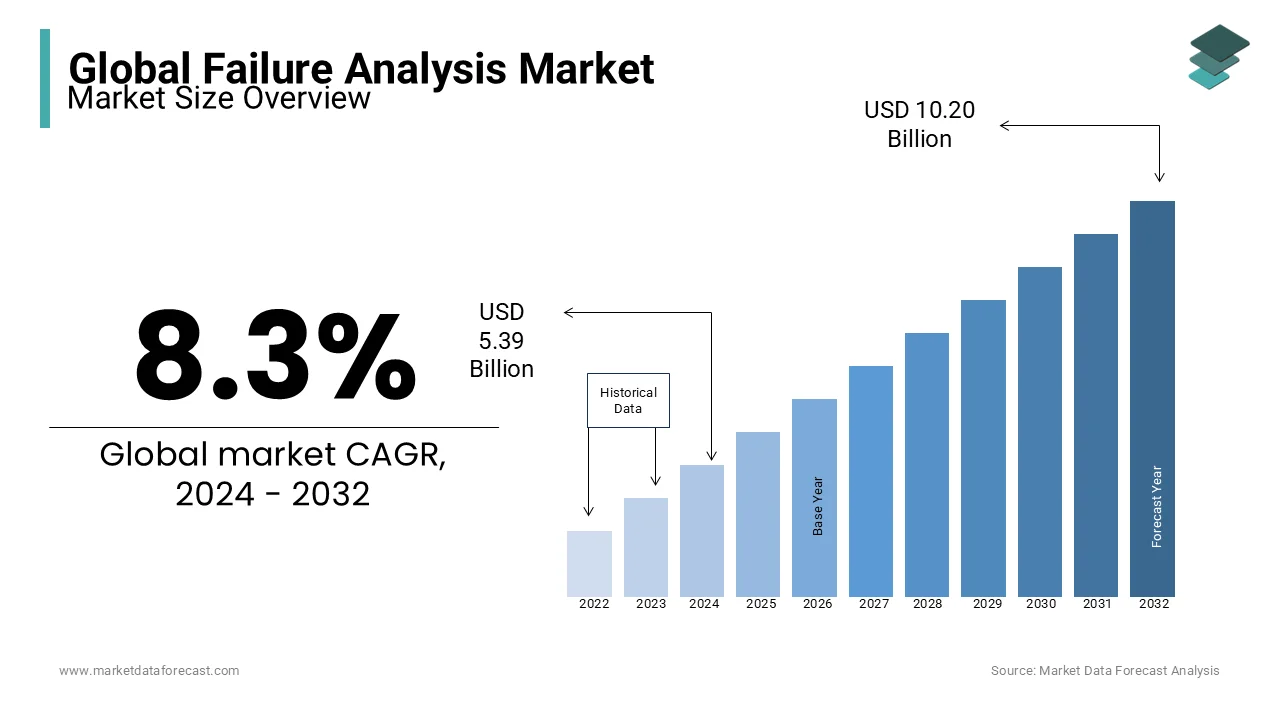
- Market Valuation: Valued at USD 5.84 billion (2025), estimated at USD 6.32 billion (2026), and projected to reach USD 11.95 billion by 2034, registering a robust CAGR of 8.3% (2026–2034).
- Primary Growth Drivers: Rapid global industrialization in emerging economies, increasing adoption of failure analysis for material science, and soaring demand from wireless communication, semiconductor, and electronics manufacturing industries driven by complex IC designs. Key operational hurdles include high costs of sophisticated equipment (such as TEM, SEM, and FIB systems) and a shortage of skilled operators in developing regions.
Key Market Segment Metrics (2026–2034)
| Category | Leading Segment (2025 Position) | Fastest-Growing Segment |
|---|---|---|
| By Equipment | Focused Particle Beam System (FIB) (dominated market applications in materials science and microstructural investigation) | Focused Particle Beam System (FIB) segment (projected to experience fastest growth through nano-machining and TEM sample preparation) |
| By Application | Electronics & Semiconductor (anticipated to account for the largest market share due to miniaturized transistor chips and nanoelectronics) | Electronics & Semiconductor (estimated to register the highest CAGR driven by automated manufacturing and advanced robotics) |
| By Region / Country | North America (held the major global share, anchored by early technology adoption, automotive manufacturing, and critical infrastructure analysis) | Asia-Pacific (growing rapidly, driven by booming semiconductor fabrication, electronics production, and automotive manufacturing in China, Japan, and South Korea) |
Major Market Players & Market Structure
Market Structure: Highly competitive global failure analysis equipment landscape featuring major international technology pioneers competing on ultra-high spatial resolution, advanced electron/ion microscopy precision, automated defect inspection metrology, and multi-layer semiconductor fault localization.
Key Companies: Thermo Fisher Scientific, Inc., Hitachi High-Technologies Corporation, Carl Zeiss, JEOL Ltd., TESCAN ORSAY HOLDING, Bruker, Semilab, A&D Company Ltd., HORIBA Ltd., and Leica Microsystems GmbH.
Global Failure Analysis Market Size
The global failure analysis market size was valued at USD 5.84 billion in 2025 and is anticipated to reach a valuation of USD 6.32 billion in 2026 to reach USD 11.95 billion by 2034, growing at a CAGR of 8.3% from 2026 to 2034.
Failure analysis is a procedure to determine the root cause of a failure and helps in making product improvements. Failure analysis primarily covers component, structure, and assembly errors, and this process is conducted by professionals in those fields who can identify the matter and make appropriate product adjustments. Failure detection is a multi-step procedure that features a physical examination of the product or service.
MARKET DRIVERS
The rising industrialization worldwide, particularly in emerging economies, is one of the major factors propelling the global failure analysis market growth.
The growing acceptance of failure analysis for material science applications is further fuelling the growth rate of the global market. For the mineralogical and structural examination of materials such as metals, polymers, alloys, biomaterials, and ceramics, optical and scanning electron microscopes are utilized to perform failure analysis. An increase in the demand for failure analysis equipment from the wireless communication and electronics manufacturing industries is favoring the market’s growth rate. The ever-increasing size and complexity of semiconductor and embedded system circuit design requirements have led to the widespread use of failure analysis equipment during the computer circuit development process (ICs).
The rising usage of failure analysis equipment in industries such as oil & gas and mining is a supportive factor for the global market growth. The failure analysis market is seeing new growth opportunities due to the advent of the latest and advanced technologies, such as correlative light and microscopy (CLEM) and super-resolution microscopy.
MARKET RESTRAINTS
High costs associated with the equipment used to perform failure analysis are one of the key factors hampering the global market growth. Transmission electron microscopes (TEM), scanning electron microscopes (SEM), and focused ionic beam systems are all pricey failure analysis tools, which act as the major restraint for the global failure analysis market. Optical microscopes, on the other hand, are more cost-effective than electron microscopes, despite the latter's greater features and uses. End users in the Asia Pacific have a limited amount of such equipment, which is projected to slow the expansion of the worldwide failure analysis market throughout the forecast period. The scarcity of skilled workers who can perform accurate failure analysis is another notable factor impeding global market growth. Skilled workers are required to work and manage failure analysis equipment. Individuals in this position must have proper training and knowledge of the equipment. Although competent experts are plentiful in affluent countries, rising regions like geographic areas, the Middle East, Asia Pacific, and Africa are in short supply. As a result, these factors are projected to limit the worldwide failure analysis market's growth over the forecast period.
REPORT COVERAGE
| REPORT METRIC | DETAILS |
| Market Size Available | 2024 to 2033 |
| Base Year | 2024 |
| Forecast Period | 2025 to 2033 |
| CAGR | 8.3% |
| Segments Covered | By Equipment, Application, and Region |
| Various Analyses Covered | Global, Regional & Country Level Analysis, Segment-Level Analysis, DROC, PESTLE Analysis, Porter’s Five Forces Analysis, Competitive Landscape, Analyst Overview on Investment Opportunities |
| Regions Covered | North America, Europe, APAC, Latin America, Middle East & Africa |
| Market Leaders Profiled | Thermo Fisher Scientific, Inc., Hitachi High-Technologies Corporation, Carl Zeiss, JOEL Ltd, TESCAN OSRAY HOLDING, Bruker, Semilab, A&D Company Ltd, HORIBA Ltd, Leica Microsystems GmbH, and Others. |
SEGMENTAL ANALYSIS
By Equipment Insights
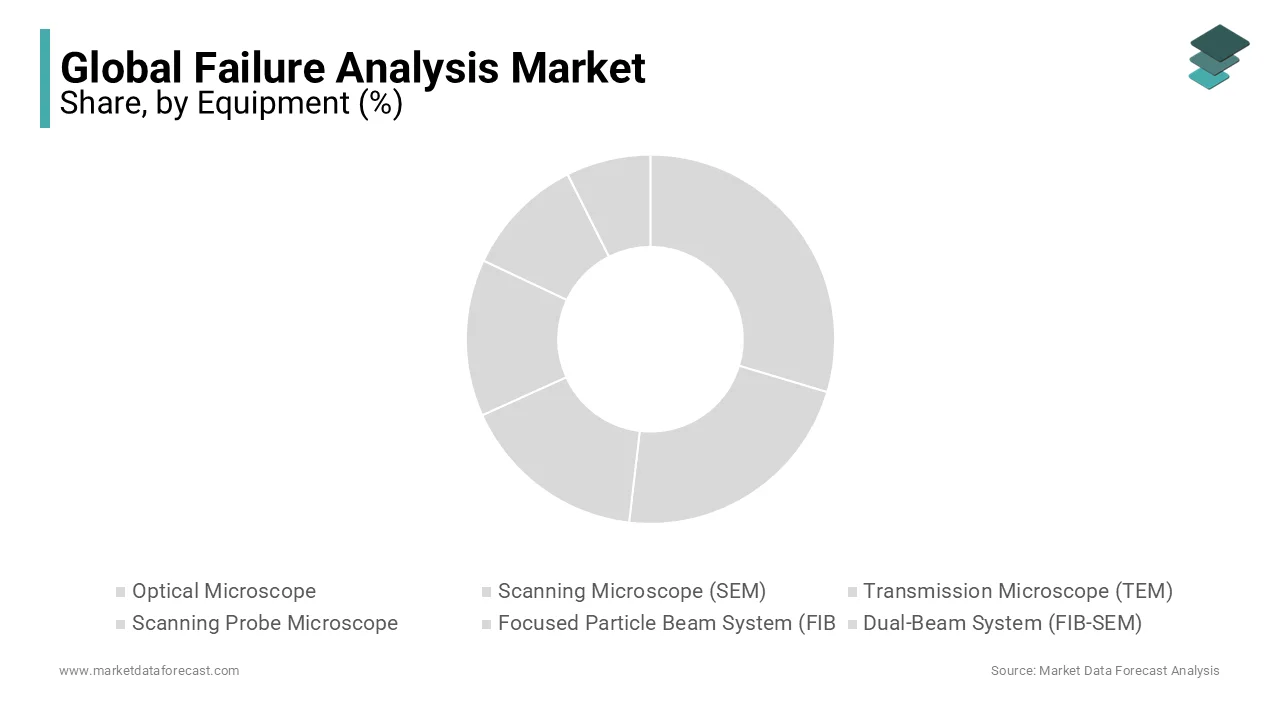
Based on equipment, the focused particle beam system (FIB) segment dominated the market in 2023 and is also predicted to be the fastest-growing segment in the global market during the forecast period. FIB systems are increasingly employed in material science and bioscience applications, which is one of the major factors propelling segmental growth. The usage of FIB systems in the field of fabric sciences has increased considerably, and this trend is expected to continue in the coming years and boosting the growth rate of the FIB system segment in the global market. FIBs can now be utilized for microstructural investigation and prototyping nano machining, in addition to circuit editing and sample preparation for Transmission microscopy (TEM).
By Application Insights
Based on application, the electronics and semiconductor segment is anticipated to account for the largest share of the global market during the forecast period. The growth of the electronics and semiconductor segment in the global failure analysis market is majorly driven by the increased need for small transistor chips, nanoelectronics, quantum dots, and optoelectronics. Due to the growing use of robotics and automation to make electronics products, the electronics and semiconductor segment is also estimated to register the highest CAGR among all segments in the global market. High-density, integrated, and tiny devices are required in the electronics and semiconductor industries.
REGIONAL ANALYSIS
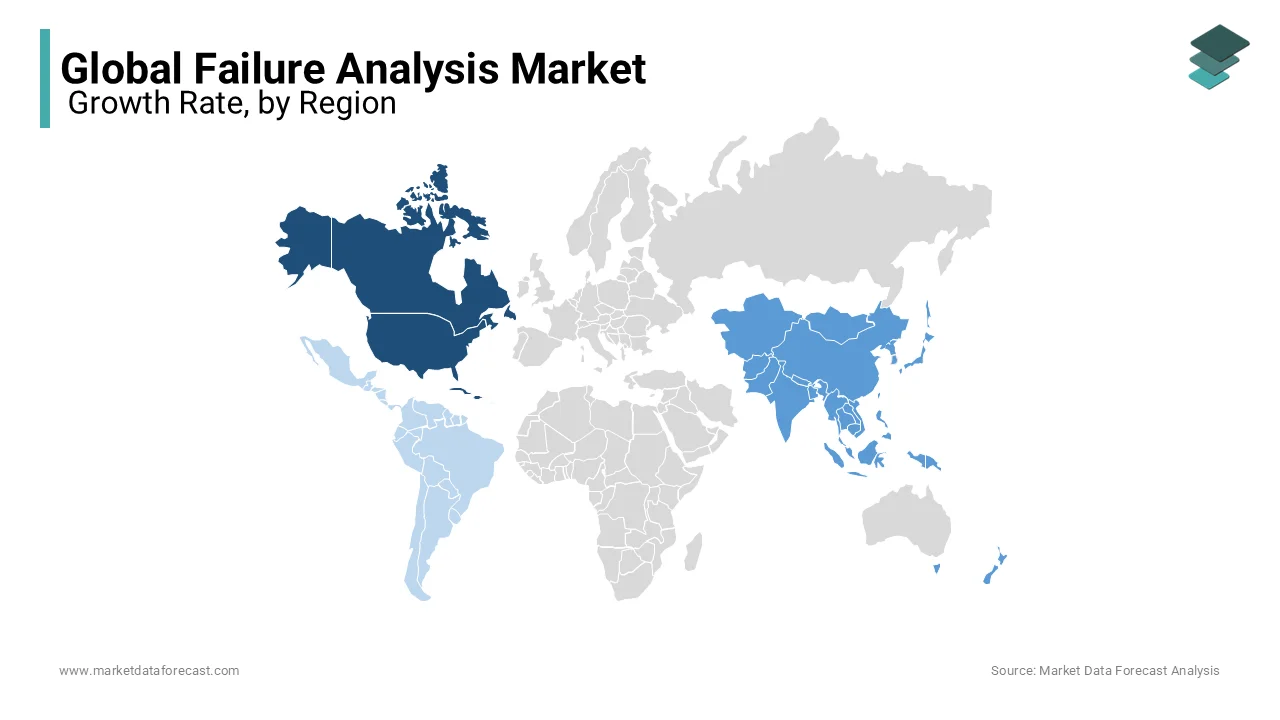
North America held the major share of the global market in 2023, and the lead of the North American region in the global market is estimated to continue throughout the forecast period. North America, owing mostly to the United States, was one of the first to use failure analysis tools, which were developed to ensure that established business models were not disrupted significantly. The region is home to most of the world's most influential organizations. General Motors and Ford, for example, dominate the country's automobile industry, which is extensively automated. Furthermore, the United States is one of the world's leading producers of crude oil, with many oil rigs strewn across the continent. The need for failure analysis approaches is becoming more apparent after the destructive effects of many oil rig mishaps, the most noteworthy of which is the Deepwater Horizon oil disaster in 2010, which spilled over 4.5 million barrels of oil into the sea due to a mechanical failure. For the past few years, the country has seen severe infrastructural problems. Significant elements of US infrastructure collapsed three times in 2021: the Texas power grid, the East Coast's main petroleum pipeline, and a Mississippi River freeway bridge. The disasters wreaked havoc on businesses and families, costing billions of dollars and leaving 150 Texans dead.
The Asia-Pacific region market is another dominating regional market in the global market and is expected to register promising growth during the forecast period. The rapid growth of the semiconductor and electronics industries, along with increasing manufacturing activities, is primarily propelling the APAC market growth. The rise in automotive manufacturing in the Asia-Pacific region is further promoting regional market growth. China, Japan, and South Korea are leading the failure analysis market in the Asia-Pacific region.
Europe is a prominent regional market for failure analysis and is expected to witness steady growth during the forecast period. Factors such as the presence of a mature industrial base, growing emphasis on quality assurance, increasing adoption of failure analysis in manufacturing processes, a well-established manufacturing sector, stringent regulatory standards, and rising focus on reducing production defects are driving the growth of the failure analysis market in Europe. Germany, France, and the United Kingdom are major players in the European region,n and the trend is likely to continue during the forecast period.
Regions such as Latin America, the Middle East, and Africa are expected to witness moderate growth in the worldwide market during the forecast period. In Brazil, failure analysis is being extensively used in the aerospace industry to ensure the structural integrity of components.
KEY MARKET PLAYERS
Companies playing a leading role in the global failure analysis market include Thermo Fisher Scientific, Inc. (US), Hitachi High-Technologies Corporation (Japan), Carl Zeiss (Germany), JOEL Ltd. (Japan), TESCAN OSRAY HOLDING (Czech Republic), Bruker (US), Semilab (Hungary), A&D Company Ltd. (Japan), HORIBA Ltd. (Japan), and Leica Microsystems GmbH (Germany).
RECENT HAPPENINGS IN THE MARKET
- The JEOL Beam Tracer's great spatial resolution and flexibility make it possible to exactly find and pinpoint fault spots in multi-layer semiconductor devices. Through several complex layers, the Beam Tracer images marginal and failed interconnects and junctions. It features a patented Voltage Distribution Contrast approach for devices created under the 65nm design rule, as well as individual transistor measurement and electrical characterization.
- LSL-2500 Bulk Micro Defect Inspection System, primarily for patterned wafers in failure analysis. New product release. This one-of-a-kind IR light scattering-based inspection metrology system is often used to analyze the failure of produced wafers. It identifies BMDs produced by the warmth impacts of assorted device manufacturing processes. Its unique dual light unit detects BMD in Standard mode (for bare wafers) and Tilted mode (for patterned wafers), with perfect correlation between the 2 measurement modes.
MARKET SEGMENTATION
This research report on the global failure analysis market has been segmented and sub-segmented based on equipment, application, and region.
By Equipment
- Optical Microscope
- Scanning Microscope (SEM)
- Transmission Microscope (TEM)
- Scanning Probe Microscope
- Focused Particle Beam System (FIB)
- Dual-Beam System (FIB-SEM)
By Application
- Electronics & Semiconductor
- Industrial Science
- Material Science
- Bioscience
By Region
- North America
- Europe
- The Asia Pacific
- Latin America
- The Middle East and Africa