- Product Description Description
- Table of Contents TOC
- List of Table & Figure LOT
- Get Free Sample PDF Sample PDF
Market Size, 2025
$8.95 BnMarket Estimate, 2026
$9.67 BnMarket Forecast, 2034
$18.03 BnCAGR, 2026–2034
8.1%Executive Summary: Global Fermented Dairy Ingredients Market
- Market Scope: In-depth evaluation of the global fermented dairy ingredients sector broken down by product types, application verticals, and geographic regions.
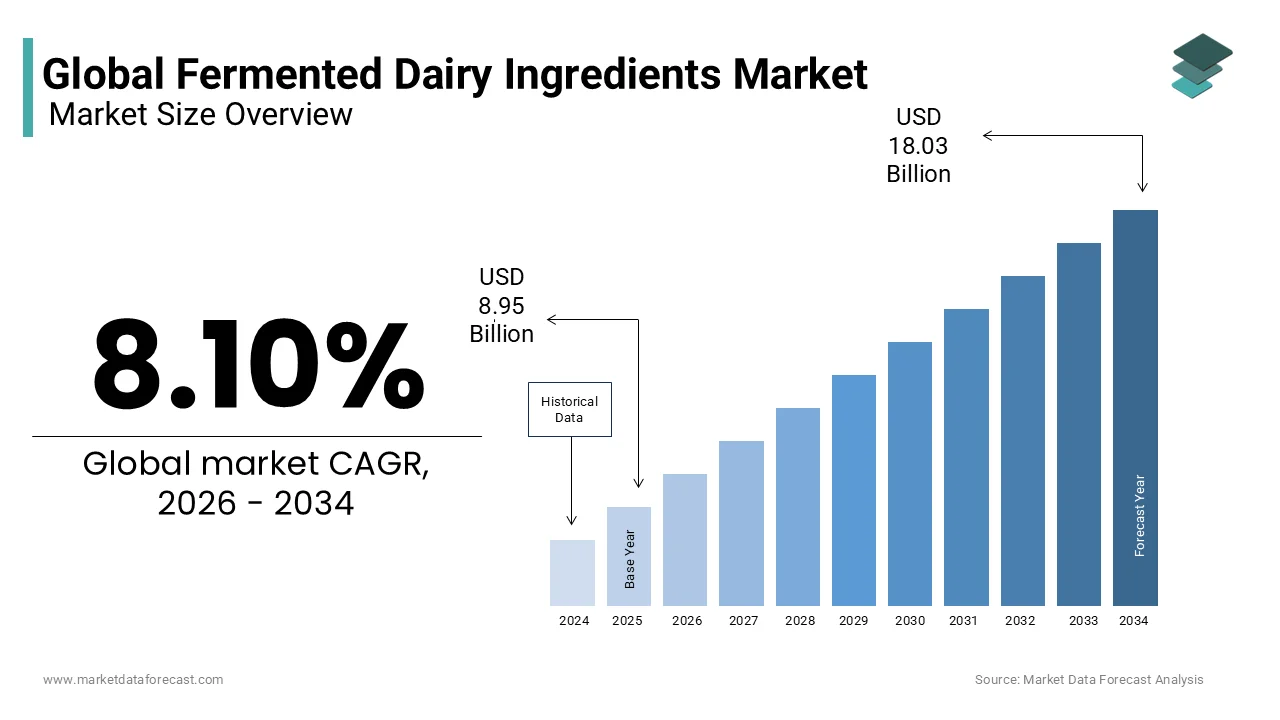
- Market Valuation: Valued at USD 8.95 billion in 2025, estimated at USD 9.67 billion in 2026, and projected to reach USD 18.03 billion by 2034, scaling at a compound annual growth rate (CAGR) of 8.10%.
- Primary Growth Drivers: Heightened health awareness regarding digestive health, management of lactose intolerance via lactic acid, lifestyle shifts, rising purchasing power, and expanding varieties of ready-to-eat convenience foods.
Key Market Segment Metrics (2026–2034)
| Category | Leading Segment Focus | Detailed Taxonomy & Sub-Segments |
|---|---|---|
| By Product Type | Cheese (Major shareholder) | Yoghurt (Sugar-added & sugar-free), Cheese (Natural & processed cheese, sweetener), Kefir, Sour Cream, & Buttermilk |
| By Application | Bakery (Fastest-growing application) | Bakery, Dairy, Snacks, & Others |
| By Region Focus | North America (Largest market) & Asia Pacific (Fastest-growing) | North America, Europe, Asia Pacific, Latin America, & Middle East and Africa |
Regional Insights & Market Dynamics
North America: Leads global market share driven by strong consumer awareness concerning the functional and therapeutic benefits of fermented nutrition (anchored by the US market).
Europe: Represents the second-largest market, supported by traditional daily dairy consumption patterns rich in proteins, calcium, and iodine.
Asia-Pacific: Projected to be the fastest-growing region, accelerated by rising popularity of flavored cultured options in China and Australia.
Market Restraints & Challenges: Vulnerability to cold-storage limitations, price fluctuations of raw ingredients, potential side effects (such as gas/bloating), and logistical supply chain bottlenecks.
Key Market Leaders Profiled: Danone S.A., Nestlé S.A., Chr. Hansen Holding A/S, Groupe Lactalis, Royal FrieslandCampina N.V., Arla Foods amba, Fonterra Co-operative Group Limited, Kerry Group plc, Saputo Inc., Glanbia plc, Dairy Farmers of America, Inc., Novonesis, International Flavors & Fragrances (IFF), Lallemand, Sacco System, DuPont de Nemours Inc., Cargill, Incorporated, Ingredion Incorporated, Tate & Lyle plc, and Corbion.
Global Fermented Dairy Ingredients Market Size
The global fermented dairy ingredients market size was valued at USD 8.95 billion in 2025 and is expected to reach USD 18.03 billion in 2034 from USD 9.67 billion in 2026, growing at a CAGR of 8.10%.
Fermented dairy ingredients are milk-derived components or products that have been processed and transformed through the action of live microorganisms, such as bacteria, yeasts, or moulds, which convert natural milk sugars into lactic acid and other active compounds. These ingredients serve as critical inputs for bakery, confectionery, and beverage manufacturers seeking natural preservation and texture modification. According to the Food and Agriculture Organisation (FAO), global milk production reached 930 million tonnes in 2022, providing a substantial raw material base for fermentation processes across major dairy regions. This volume ensures consistent availability of substrates necessary for producing high-quality fermented derivatives. As per the study, per capita dairy consumption in developing economies has risen over the last decade, reflecting shifting dietary patterns toward protein-rich foods. This trend directly stimulates demand for value-added fermented ingredients that offer superior digestibility and bioavailability compared to non-fermented alternatives. The market is further shaped by regulatory frameworks emphasising clean label declarations, which favour naturally processed dairy components over synthetic additives. Manufacturers are increasingly investing in advanced bioprocessing technologies to standardise flavour profiles and extend shelf life without compromising nutritional integrity. Consequently, this sector acts as a vital bridge between primary agriculture and sophisticated food manufacturing ecosystems worldwide.
MARKET DRIVERS
Rising Consumer Preference for Clean Label Formulations
The escalating consumer demand for transparent and minimally processed food labels drives the growth of the Fermented Dairy Ingredients Market. Modern shoppers actively scrutinise ingredient lists and prefer recognisable items over chemical preservatives or artificial stabilisers in packaged goods. According to research, clean label considerations exert a strong influence on consumer buying behaviour in European grocery markets, altering how manufacturers formulate snack and beverage portfolios. This behavioural shift compels food manufacturers to replace synthetic additives with functional fermented dairy powders that provide natural acidity and texture enhancement. As per the Journal of Dairy Science, certain compounds and structural qualities developed during dairy fermentation play a natural role in hindering microbial spoilage under experimental storage conditions. This dual functionality allows brands to simplify their ingredient decks while maintaining safety standards. The perception of fermentation as a traditional and wholesome process aligns perfectly with current wellness trends. Bakeries and snack producers utilise these ingredients to achieve sourdough notes or creamy textures naturally. Regulatory bodies globally are tightening restrictions on synthetic additives, further accelerating the transition toward biological alternatives. Consequently, ingredient suppliers are scaling up production of spray-dried yoghurt and cultured cream powders to meet this specific formulation need. This driver fundamentally reshapes product development strategies across the entire food industry.
Expansion of Functional Nutrition and Sports Recovery Products
The rapid growth of the functional nutrition sector, specifically within sports recovery and gut health categories, significantly propels the Fermented Dairy Ingredients Market forward. Athletes and health-conscious individuals increasingly seek bioavailable protein sources that support muscle synthesis and digestive balance simultaneously. According to the International Society of Sports Nutrition, dietary proteins and specific peptide fractions are analysed for their relative absorption rates and metabolic utility in post-exercise nutrition regimens. This physiological advantage drives supplement manufacturers to incorporate hydrolysed fermented dairy fractions into bars, shakes, and ready-to-drink beverages. As per the National Institutes of Health (NIH), the prevalence of lactose intolerance affects approximately 68% of the global population, while public nutrition data verify that fermentation processes lower the lactose content of dairy foods. This characteristic opens vast market opportunities for creating dairy-based functional foods accessible to sensitive demographics. The presence of bioactive peptides generated during fermentation also supports immune function and blood pressure regulation, adding multifunctional value. Sports nutrition brands leverage these benefits to differentiate products in a crowded marketplace. Ingredient processors respond by developing specialised fractions with standardised peptide profiles. This convergence of performance science and digestive health creates sustained demand for advanced fermented dairy inputs.
MARKET RESTRAINTS
Volatility in Raw Milk Prices and Supply Instability
Fluctuating raw milk prices and inconsistent supply chains restrict the stability and profitability of the Fermented Dairy Ingredients Market. Fermentation processes require high-quality fresh milk as a substrate, and any disruption in upstream supply directly impacts production costs and output volumes. According to sources, European farm-gate milk prices can experience substantial volatility driven by a combination of fluctuating feed costs, energy pricing, and regional climatic stressors. Such volatility makes long-term pricing contracts difficult for ingredient manufacturers who operate on thin processing margins. As per studies, severe drought conditions in major agricultural regions frequently alter regional feed availability and stress dairy herds, leading to periodic fluctuations in national milk production. Unlike commodity trading, fermented ingredient production cannot easily pause or restart without risking culture viability and batch consistency. Manufacturers must maintain expensive buffer stocks or hedge against price spikes, which ties up working capital. Downstream food manufacturers often resist passing these cost increases to consumers, leading to margin compression throughout the value chain. Furthermore, geopolitical tensions affecting fertiliser and energy supplies exacerbate farm-level uncertainties. This systemic instability discourages capital investment in new fermentation capacity. Smaller speciality producers are particularly vulnerable to being priced out during peak cycles. Ultimately, this restraint limits the market's ability to offer stable competitive pricing essential for mass adoption.
Technical Complexity in Maintaining Culture Viability During Processing
The technical difficulty of preserving live cultures and bioactive compounds during industrial processing hinders the scalability of the Fermented Dairy Ingredients Market. Transforming liquid fermented dairy into stable powder or concentrate forms requires heat treatment that can degrade sensitive probiotics and enzymes. According to research, standard spray drying methods expose microorganisms to thermal and osmotic stress, which can significantly reduce the cell viability of sensitive probiotic strains. This loss of potency forces manufacturers to overfeed cultures, increasing raw material costs significantly to meet label claims. As per sources, drying dairy powders to a low moisture threshold while retaining protein solubility and structure demands precise regulation of thermal processing parameters. Deviations lead to batch failures or downgraded products unsuitable for premium applications. The equipment needed for gentle drying, such as freeze dryers or low-temperature vacuum systems, entails high capital expenditure and energy consumption. Small and medium enterprises often lack the R&D resources to optimise these complex processes. Additionally, storage and logistics require strict cold chain management for certain live culture ingredients, adding further operational burdens. These technical barriers slow innovation and limit the diversity of available formats. They also create quality inconsistency risks that erode brand trust. Thus, the market remains concentrated among large players with advanced technological capabilities.
MARKET OPPORTUNITIES
Integration into Plant-Based Hybrid Product Formulations
The emerging trend of hybrid plant-based products offers a transformative opportunity for the fermented dairy ingredients market. Consequently, this innovation enables expansion beyond traditional dairy applications. Consumers seeking sustainable alternatives often miss the authentic taste and texture of real dairy, creating a gap that fermented ingredients can uniquely fill. According to the Good Food Institute, blended and hybrid options that combine distinct protein categories are explored by food brands looking to target flexitarian consumer preferences. Fermented dairy powders impart characteristic tangy notes and creamy mouthfeel to oat, almond, or coconut bases, masking beany off-flavours effectively. As per the Journal of Food Science, introducing specialised dairy fractions into alternative plant formulations can modify structural stability parameters and texture properties during sensory evaluation trials. This functional synergy allows plant-based brands to elevate product quality without fully abandoning sustainability positioning. Ingredient suppliers can develop specialised blends optimised for specific plant matrices, creating new revenue streams. The hybrid approach also addresses nutritional gaps in plant-based foods by adding complete proteins and B12 naturally present in fermented dairy. Regulatory frameworks in many regions now accommodate hybrid labelling, facilitating market entry. This opportunity enables the fermented dairy sector to participate in the alternative protein boom rather than competing against it. It represents a strategic pivot toward complementary rather than substitutive growth.
Development of Upcycled Acid Whey Valorisation Streams
The valorisation of acid whey byproducts provides a significant circular economy opportunity for the fermented dairy ingredients market. This process successfully turns waste into revenue. Greek yoghurt and cheese production generate massive volumes of acid whey, which has historically been treated as an environmental disposal problem. According to the Cornell University Department of Food Science, managing and utilising co-products like acid whey from Greek yoghurt and fresh cheese manufacturing represents an operational focus for the modern dairy industry. Advanced membrane filtration and fermentation technologies now enable extraction of galactooligosaccharides, minerals, and proteins from this stream for use as functional ingredients. As per the Journal of Cleaner Production, finding scalable pathways to process acid whey can potentially mitigate manufacturing environmental metrics and lower processing operational burdens. These upcycled ingredients carry strong sustainability credentials appealing to eco-conscious brands and consumers. They serve as cost-effective alternatives to virgin dairy ingredients in bakery and beverage applications. Government incentives for waste reduction in the European Union and North America further support investment in valorisation infrastructure. Research institutions continue discovering novel bioactive compounds in acid whey, expanding potential applications. This opportunity transforms a liability into a competitive advantage. It aligns economic incentives with environmental goals, creating resilient business models. Companies leading in this space gain differentiation through verified circularity claims.
MARKET CHALLENGES
Stringent Regulatory Divergence Across Global Markets
Navigating fragmented and evolving regulatory landscapes is a formidable challenge to the global expansion of the Fermented Dairy Ingredients Market. Definitions of fermented dairy terms, probiotic claims, and compositional standards vary significantly between jurisdictions, creating compliance complexity for exporters. According to sources, trade in specialised fermented milk powders faces regulatory complexities due to differences in import criteria and regional composition standards across various global jurisdictions. A product approved as a food ingredient in one region may require novel food authorisation or pharmaceutical registration in another, delaying market entry by years. As per research, the European Food Safety Authority applies a rigorous assessment framework for microbes intentionally added to the food chain, maintaining a Qualified Presumption of Safety list to ensure public health safety. Labelling restrictions prevent manufacturers from communicating specific health benefits even when supported by robust science, limiting marketing effectiveness. Compliance testing for each destination market adds substantial cost and administrative burden. Reformulation may be necessary to meet local compositional minima or additive restrictions, disrupting supply chains. Emerging regulations around precision fermentation and cell-cultured dairy add further layers of ambiguity. Small innovators often lack resources to manage this regulatory maze, stifling competition. The absence of mutual recognition agreements means redundant safety assessments. This fragmentation impedes efficient global trade and slows the diffusion of beneficial innovations across borders.
Consumer Misconceptions Regarding Live Cultures and Safety
Persistent consumer misconceptions about microbial safety and shelf stability challenge the broader acceptance of these products in the Fermented Dairy Ingredients Market. Despite scientific consensus on safety, many consumers still associate bacteria with spoilage or illness rather than health benefits. According to the study, consumer attitudes toward live cultures in packaged food products involve varying degrees of awareness and technical understanding regarding product stability and shelf life. This scepticism leads to rejection of ambient-stable fermented ingredients that could otherwise expand distribution reach. As per research, educational outreach and transparent labelling often play a key role in shaping public acceptance and addressing consumer perceptions regarding the use of beneficial microorganisms in food products. Negative media coverage of rare foodborne outbreaks disproportionately affects perception of all fermented products regardless of actual risk profile. Retailers sometimes refuse to stock live culture ingredients due to perceived liability or customer complaints. Manufacturers must invest heavily in packaging messaging and third-party certifications to reassure buyers. The clean label movement paradoxically complicates this as consumers want minimal processing yet fear natural microbial activity. Shelf-stable formats face greater scrutiny than refrigerated ones despite equivalent safety records. Overcoming these ingrained beliefs requires sustained public education campaigns beyond simple label claims. Until trust is built, market penetration remains limited to niche health enthusiast segments. This challenge constrains the category from achieving true mainstream status.
REPORT COVERAGE
| REPORT METRIC | DETAILS |
| Market Size Available | 2025 to 2034 |
| Base Year | 2025 |
| Forecast Period | 2026 to 2034 |
| CAGR | 8.10% |
| Segments Covered | By Product Type, Application, and Region |
| Various Analyses Covered | Global, Regional and Country Level Analysis; Segment-Level Analysis; DROC; PESTLE Analysis; Porter’s Five Forces Analysis; Competitive Landscape; Analyst Overview of Investment Opportunities |
| Regions Covered | North America, Europe, APAC, Latin America, Middle East & Africa |
| Market Leaders Profiled | Danone S.A., Nestlé S.A., Chr. Hansen Holding A/S, Groupe Lactalis, Royal FrieslandCampina N.V., Arla Foods amba, Fonterra Co-operative Group Limited, Kerry Group plc, Saputo Inc., Glanbia plc, Dairy Farmers of America, Inc., Novonesis, International Flavors & Fragrances (IFF), Lallemand, Sacco System, DuPont de Nemours Inc., Cargill, Incorporated, Ingredion Incorporated, Tate & Lyle plc, and Corbion |
SEGMENTAL ANALYSIS
By Product Type Insights
The yoghurt segment led the Fermented Dairy Ingredients Market and captured a significant share in 2025. This leading position was attributed to its widespread consumption and versatility as both a standalone product and an ingredient base. The production of yoghurt powders and concentrated yoghurt cultures supports a vast array of applications, including snacks, beverages, and confectionery. According to the Global Dairy Platform, yoghurt and related fermented products comprise a primary commercial segment within the broader global dairy ecosystem, showing strong distribution and volume across various geographic sectors. This significant market share drives continuous investment in production capacity and ingredient innovation. As per the United States Department of Agriculture, tracking per capita consumption trends across dairy segments helps characterise long-term shifts in national dietary habits and total commodity demand. Manufacturers leverage yoghurt ingredients to impart creamy texture and tangy flavour to diverse food products. The availability of both sugar-added and sugar-free variants caters to different dietary preferences and regulatory requirements. Yoghurt powders offer extended shelf life and ease of transport compared to fresh products. The segment benefits from strong health associations related to probiotics and gut health. Regulatory frameworks in many regions recognize yogurt as a healthy food option, supporting marketing efforts. Innovation focuses on improving heat stability and flavour intensity in powdered forms. The dominance of yoghurt is reinforced by its acceptance across all age groups. This broad appeal ensures sustained demand for yoghurt-based functional ingredients.
The kefir segment is the fastest-growing in the fermented dairy ingredients market due to increasing consumer interest in diverse probiotic sources and gut health solutions. Unlike yoghurt, kefir contains a wider variety of bacterial strains and yeasts, which offers enhanced microbial diversity and potential health benefits. According to the International Scientific Association for Probiotics and Prebiotics, complex fermented foods like kefir present a unique matrix of diverse microorganisms that are studied for their distinct interactions with the human intestinal microbiome. This scientific validation drives formulation interest among functional food manufacturers. As per the Food and Agriculture Organisation of the United Nations, traditional fermented beverages are recognised globally for their nutritional attributes, prompting increased interest across diverse manufacturing and agricultural markets. Consumers are seeking alternatives to traditional yoghurt due to flavour fatigue or specific health goals. Kefir ingredients provide unique effervescence and tartness suitable for beverages and dressings. The rise of water kefir and dairy kefir blends expands application possibilities. Manufacturers are developing stable kefir cultures and powders for industrial use. The segment benefits from the clean label trend as kefir is perceived as a natural and traditional food. Retailers are dedicating more shelf space to kefir-based products. Investment in research explores new health claims related to immunity and digestion. This momentum positions kefir as a key growth driver for the future.
By Application Insights
In 2025, the dairy segment held the majority share in the fermented dairy ingredients market because of the intrinsic nature of these ingredients being derived from and primarily utilised within dairy formulations. Manufacturers use fermented dairy powders, cultured whey, and yoghurt concentrates to standardise flavour, texture and acidity in products such as drinking yoghurts, ice cream and cheese spreads. According to sources, global industrial output of fermented milk varieties rests on an expansive raw processing capacity that calls for standard, repeatable functional inputs. This volume drives steady demand for high-quality ingredients that ensure batch-to-batch consistency in large-scale processing. As per studies, consumer demand for value-added dairy solutions across European markets continues to expand, driven by a growing public awareness of protein functionality and digestibility benefits. Fermented ingredients provide natural preservation and enhance the sensory profile of these products without synthetic additives. The dairy industry’s established supply chains facilitate efficient distribution of these specialised components. Processors rely on these ingredients to reduce production time and improve yield in cheese and yoghurt manufacturing. Regulatory support for dairy health claims further reinforces market stability. Innovation focuses on creating cleaner labels through natural fermentation processes. The segment benefits from strong consumer loyalty to traditional dairy formats. Continuous product development in functional dairy beverages sustains ingredient demand. This entrenched usage ensures the dairy application remains the primary revenue generator for the market.
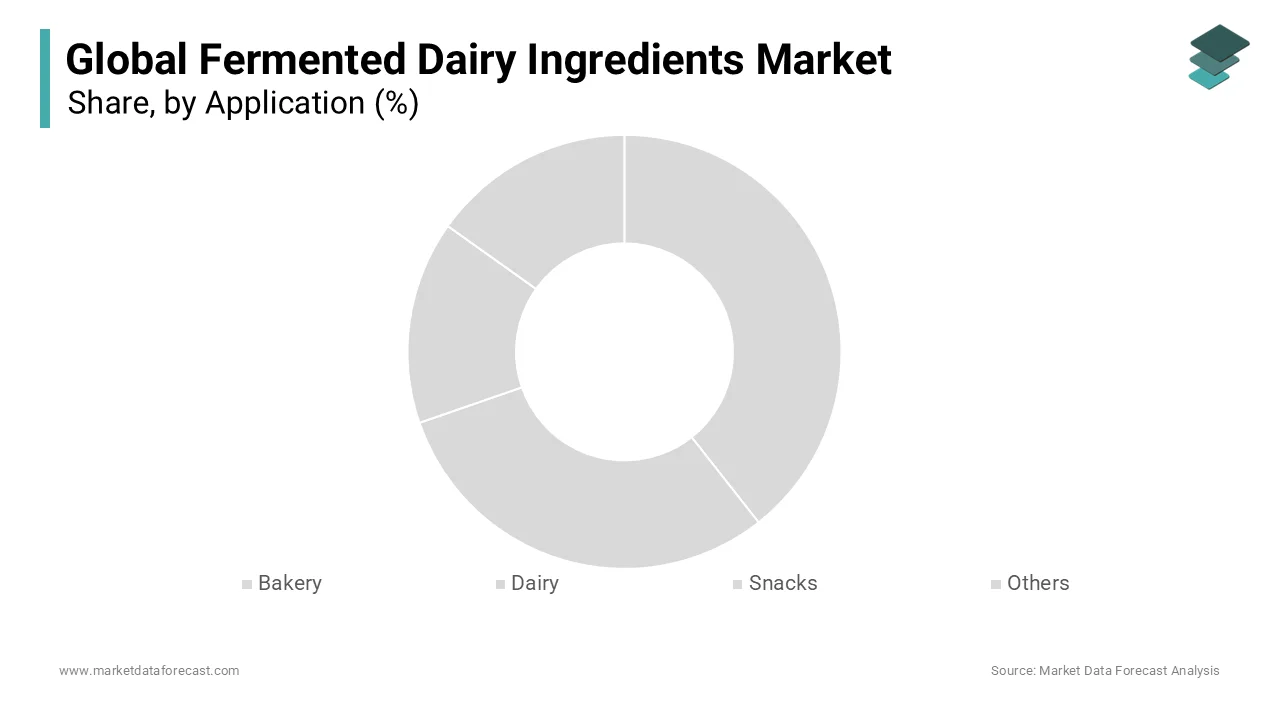
The bakery segment is witnessing quick acceleration in the fermented dairy ingredients market owing to the rising demand for clean label dough conditioners and natural flavour enhancers. Bakers are increasingly replacing chemical leavening agents and artificial souring agents with fermented dairy powders to achieve authentic taste and improved texture. According to the American Bakers Association, changing consumer perceptions regarding health and clean labels have significantly shifted how commercial bakers prioritise natural ingredient options in their recipes. The shift creates a robust market for fermented whey and yoghurt powders that provide acidity and moisture retention. As per the Journal of Cereal Science, bio-preservation pathways involving specific fermented food cultures are researched for their ability to naturally inhibit common mould strains and extend bakery freshness parameters. The functional benefit reduces food waste and appeals to retailers seeking longer-lasting products. The trend toward artisanal and sourdough-style baked goods further accelerates demand for tangy flavour profiles provided by cultured dairy. Industrial bakeries utilise these ingredients to replicate slow fermentation processes quickly and consistently. Health-conscious consumers appreciate the added protein and probiotic potential in fortified baked goods. Manufacturers are developing specialised blends optimised for high-temperature baking stability. This innovation expands the application scope beyond traditional uses. The segment benefits from the global expansion of quick service restaurant chains offering premium bakery items. Consequently, bakery applications represent a high growth opportunity for ingredient suppliers.
REGIONAL ANALYSIS
North America Fermented Dairy Ingredients Market Analysis
North America was positioned second in the Fermented Dairy Ingredients Market in 2025. This growth is driven by high consumer awareness and advanced processing technologies. The region leads in innovation for functional dairy products targeting specific health outcomes such as immune support and digestive wellness. According to research, investments in research and development for value-added dairy commodities across North America reflect an ongoing focus on meeting shifting consumer nutrition preferences. The investment drives the adoption of specialised fermented ingredients in mainstream foods. As per Health Canada regulations, probiotic claims are well-defined, providing clarity for manufacturers and building consumer trust. The prevalence of lactose intolerance has spurred demand for low-lactose fermented options. Major players in the region focus on clean label formulations and sustainable sourcing. The sports nutrition sector extensively uses fermented whey proteins for recovery products. Retail channels are highly developed, facilitating wide distribution of premium dairy items. Consumer education campaigns by industry bodies reinforce health benefits. The market is competitive, with strong brand loyalty to established dairy cooperatives. Innovation focuses on convenience formats such as drinkable yoghurts and snack bars. North America serves as a trendsetter for global product launches.
Europe Fermented Dairy Ingredients Market Analysis
Europe was the largest player in the Fermented Dairy Ingredients Market and accounted for a substantial share in 2024. The region's prominence in the global market was propelled by deep cultural traditions of consuming fermented foods and strict quality standards. Countries like France, Germany, and Greece have long histories of producing yoghurt, cheese, and kefir, which supports a robust ingredient supply chain. According to the European Dairy Association, the European Union is one of the world's top dairy producers, generating over 140 million tonnes of raw milk annually, with a substantial share utilised for fermented and value-added goods. This scale ensures abundant raw material availability for ingredient processors. As per the European Food Safety Authority, rigorous assessment of health claims ensures that only scientifically validated products reach the market, enhancing credibility. Consumers prioritise organic and locally sourced ingredients, driving demand for premium fermented inputs. The region leads in developing novel probiotic strains with documented health benefits. Regulatory support for traditional specialities protects artisanal methods while encouraging innovation. Sustainability initiatives focus on reducing carbon footprints in dairy processing. The market is characterised by high quality expectations and willingness to pay for premium attributes. Cross-border trade within the EU facilitates efficient distribution. Europe remains a hub for scientific research in dairy fermentation.
Asia Pacific Fermented Dairy Ingredients Market Analysis
The Asia Pacific region is swiftly growing in the Fermented Dairy Ingredients Market due to rising incomes and changing dietary habits. Urbanisation and westernisation of diets have increased consumption of yoghurt and cheese, particularly in China, India, and Southeast Asia. According to the Asian Development Bank, the middle class in Asia is expanding rapidly, leading to higher spending on health and wellness products. This demographic shift creates a vast consumer base for functional dairy ingredients. As per sources, domestic yoghurt production and consumption across major East Asian markets have demonstrated consistent expansion over recent years due to robust local demand. Governments promote dairy consumption to address nutritional deficiencies, supporting market expansion. Local manufacturers are adapting traditional fermentation techniques to modern industrial scales. The popularity of probiotic drinks drives demand for stable cultures and powders. E-commerce platforms facilitate access to diverse dairy products in remote areas. Investment in cold chain infrastructure improves product quality and availability. The region offers significant potential for innovation in flavoured and fortified fermented foods. Cultural acceptance of fermented foods like kimchi and miso provides a foundation for dairy fermentation.
Latin America Fermented Dairy Ingredients Market Analysis
Latin America is an emerging player within the Fermented Dairy Ingredients Market, supported by strong dairy traditions and increasing health consciousness. Countries like Brazil, Argentina, and Mexico are major producers of milk and fermented products such as dulce de leche and yoghurt. According to the Inter-American Institute for Cooperation on Agriculture, dairy production in the region has stabilised, providing a reliable base for ingredient manufacturing. This stability encourages investment in value-added processing facilities. As per the Brazilian Ministry of Agriculture, exports of dairy ingredients have increased as local companies improve quality standards to meet international demands. Consumers are increasingly aware of gut health benefits, driving sales of probiotic yoghurts and drinks. Economic volatility poses challenges but also drives demand for affordable nutritious options. Local brands compete with multinationals by offering culturally relevant flavours. Government programs support smallholder dairy farmers, improving supply chain resilience. The market is characterised by price sensitivity but growing interest in premium segments. Innovation focuses on extending shelf life for distribution in tropical climates. Latin America offers opportunities for partnerships between local and global ingredient suppliers.
Middle East and Africa Fermented Dairy Ingredients Market Analysis
The Middle East and Africa region is projected to expand in the Fermented Dairy Ingredients Market from 2026 to 2034, owing to population growth and urbanisation. Traditional fermented dairy products like labneh and amasi are staples in many countries, providing a cultural basis for market expansion. According to studies, milk and wider dairy consumption across the African continent are expected to grow significantly in the coming decades, driven by rapid urbanisation and population growth. This growth trajectory supports investment in local processing capabilities. As per the Gulf Organisation for Industrial Consulting, the GCC countries are investing heavily in food security initiatives, including dairy self-sufficiency projects. These initiatives drive demand for high-quality fermentation cultures and ingredients. Rising disposable incomes in urban centres increase access to packaged fermented products. Challenges include infrastructure gaps and climate constraints on local milk production. Import dependence remains high for specialised ingredients, but local production is growing. Consumer awareness of health benefits is rising through education campaigns. The market is fragmented with varying levels of development across countries. Opportunities exist for technology transfer and capacity building. The region offers potential for niche products tailored to local tastes.
COMPETITIVE LANDSCAPE
The competition in the fermented dairy ingredients market is characterized by a mix of specialized bioscience firms and large diversified ingredient suppliers who compete on technological expertise and product quality. Leading players leverage extensive research capabilities to develop proprietary probiotic strains and fermentation processes that offer unique functional benefits. They differentiate themselves through scientific validation and clinical studies supporting health claims. Smaller niche companies often focus on traditional or artisanal fermentation methods appealing to premium segments. Price competition exists but is less intense than in commodity markets due to the value added nature of these ingredients. Regulatory compliance acts as a significant barrier to entry favoring established players with robust quality assurance systems. The market sees frequent collaborations between ingredient suppliers and dairy processors to co develop innovative products. Consumer trends toward gut health and clean labels drive continuous innovation in strain selection and formulation. Companies that can demonstrate tangible health benefits and sustainability credentials gain a competitive edge. The landscape is dynamic with constant entry of new players focusing on specific health niches. This diversity ensures a vibrant market environment focused on meeting diverse consumer needs. Strategic alliances and licensing agreements are common to expand geographic reach and product offerings.
Key Market Players
Some of the key players in the global fermented dairy ingredients market are
- Danone S.A.
- Nestlé S.A.
- Chr Hansen Holding A/S
- Groupe Lactalis
- Royal FrieslandCampina N.V.
- Arla Foods amba
- Fonterra Co-operative Group Limited
- Kerry Group plc
- Saputo Inc.
- Glanbia plc
- Dairy Farmers of America, Inc.
- Novonesis
- International Flavors & Fragrances (IFF)
- Lallemand
- Sacco System
- Dupont de Nemours Inc
- Cargill, Incorporated
- Ingredion Incorporated
- Tate & Lyle plc
- Corbion
Top Players in the Market
- Chr Hansen Holding A/S operates as a global leader in biosolutions with a strong focus on fermented dairy cultures and enzymes. The company provides specialized starter cultures that ensure consistent flavor texture and probiotic benefits in yogurt cheese and kefir products. Chr Hansen recently expanded its production facility in Denmark to increase capacity for high quality probiotic strains. This investment supports the growing demand for functional dairy ingredients with documented health benefits. The company collaborates with dairy processors worldwide to develop customized fermentation solutions. Their research teams focus on identifying novel bacterial strains that enhance gut health and immunity. Chr Hansen emphasizes sustainability by reducing water and energy usage in culture production. They also provide technical support to help manufacturers optimize fermentation processes. By leveraging deep scientific expertise Chr Hansen maintains a competitive edge in innovation. Their commitment to quality and safety builds trust with industrial clients globally.
- Dupont de Nemours Inc plays a pivotal role in the Fermented Dairy Ingredients Market through its advanced nutrition and biosciences division. The company offers a wide range of probiotic strains and protective cultures that extend shelf life and improve product safety. Dupont recently launched new heat stable probiotic formulations designed for baked goods and pasteurized beverages. This innovation allows manufacturers to incorporate live cultures into products requiring high temperature processing. The company invests heavily in clinical research to validate health claims for its probiotic ingredients. Dupont partners with major dairy brands to create differentiated products targeting specific consumer needs. Their global supply chain ensures reliable delivery of high quality cultures to diverse markets. Dupont also focuses on digital tools to help customers monitor fermentation performance. These efforts strengthen their position as a trusted partner for functional dairy innovation. The company’s broad portfolio addresses various applications from yogurt to cheese.
- Kerry Group plc contributes significantly to the Fermented Dairy Ingredients Market by integrating taste and nutrition solutions. The company specializes in developing fermented dairy powders and flavor systems that enhance sensory profiles in food applications. Kerry recently opened a new innovation center in Europe focused on clean label fermentation technologies. This facility enables faster development of natural preservatives and texturizers derived from dairy fermentation. The group works closely with customers to create customized ingredient blends for bakery and snack products. Kerry emphasizes sustainability by sourcing milk from responsible suppliers and optimizing production efficiency. Their expertise in encapsulation protects sensitive probiotics during processing and storage. Kerry also provides consumer insights to help brands tailor marketing strategies effectively. The company’s strong distribution network ensures timely access to ingredients globally. These strategic actions enhance their ability to meet evolving consumer demands for healthy and tasty foods.
Top Strategies Used by Key Market Participants
Key players in the Fermented Dairy Ingredients Market primarily focus on innovation and strategic partnerships to maintain competitive advantage. Companies invest heavily in research and development to discover novel probiotic strains and improve fermentation efficiency. This strategy addresses the growing consumer demand for scientifically validated health benefits. Mergers and acquisitions are frequently employed to expand product portfolios and gain access to new technologies. Firms also prioritize sustainability by optimizing resource usage and supporting responsible dairy farming practices. Digital transformation is another critical strategy where companies use data analytics to predict trends and optimize supply chains. Collaboration with academic institutions facilitates breakthroughs in microbial science and application techniques. Marketing strategies emphasize transparency and clean label attributes to build consumer trust. Pricing models are adapted to accommodate varying market conditions and raw material costs. These multifaceted approaches ensure resilience against regulatory changes and shifting dietary preferences while fostering long term growth in the dynamic global landscape.
MARKET SEGMENTATION
This research report on the global fermented dairy ingredients market has been segmented and sub-segmented based on By Product Type, Application and Region.
By Product Type
- Yoghurt
- Sugar added yoghurt
- Sugar-free yoghurt
- Cheese
- Natural cheese
- Processed cheese
- Sweetener
- Kefir
- Sour Cream
- Buttermilk
By Application
- Bakery
- Dairy
- Snacks
- Others
By Region
- North America
- Europe
- The Asia Pacific
- Latin America
- Middle East and Africa