- Product Description Description
- Table of Contents TOC
- List of Table & Figure LOT
- Get Free Sample PDF Sample PDF
Market Size, 2025
$403.54 BnMarket Estimate, 2026
$428.40 BnMarket Forecast, 2034
$691.09 BnCAGR, 2026–2034
6.16%Global Fertilizers Market Summary
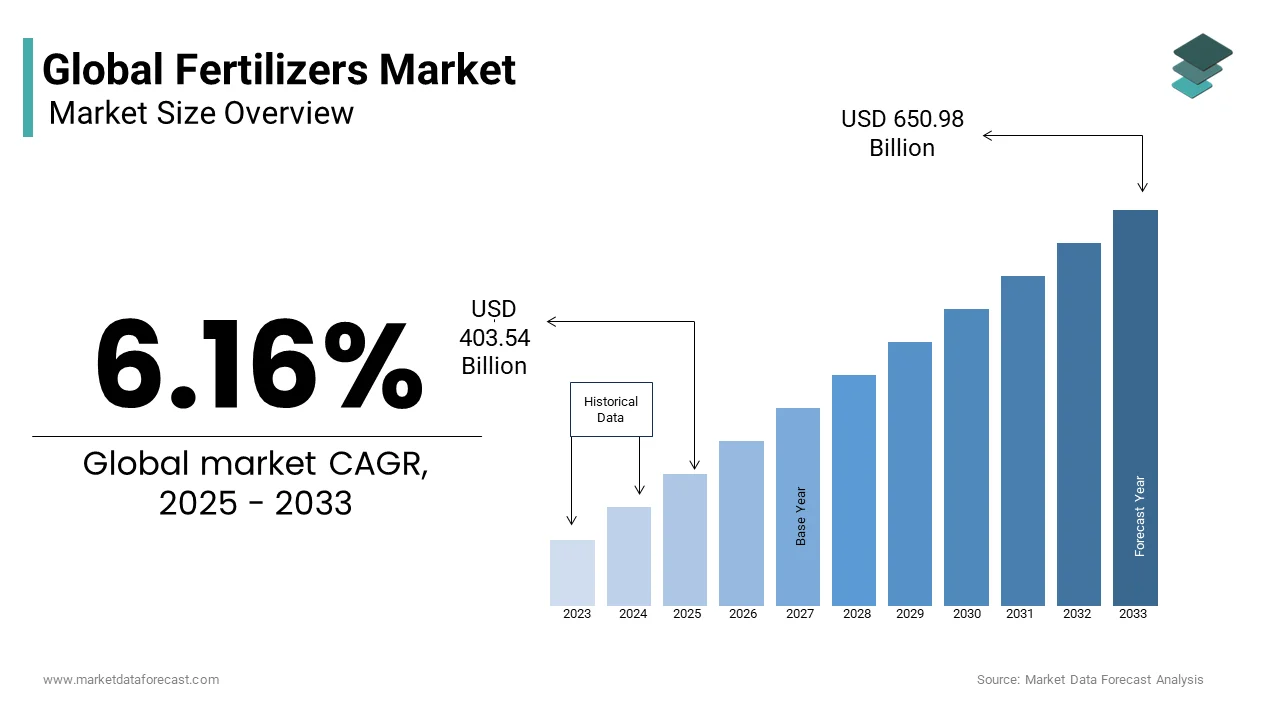
The global fertilizers market size was valued at USD 403.54 billion in 2025 and is anticipated to reach USD 428.40 billion in 2026 and USD 691.09 billion by 2034, growing at a CAGR of 6.16% during the forecast period from 2026 to 2034. The growth of the global fertilizers market is driven by the rising demand for high-yield crops, expanding global population, increasing adoption of modern farming techniques, and government support for sustainable agricultural practices.
Key Market Trends
- Growing adoption of precision farming and smart fertilizer applications.
- Rising demand for nitrogen-based fertilizers to boost cereal and grain production.
- Increasing focus on sustainable and eco-friendly fertilizers.
- Expansion of the agrochemical industry in emerging markets.
- Integration of digital tools in fertilizer distribution and farm management.
Segmental Insights
- Based on type, the nitrogenous fertilizers segment led the global fertilizers market by capturing 56.3% share in 2025.
- Based on form, the conventional fertilizers segment dominated the market by holding a substantial share in 2025.
- Based on application mode, the soil application segment held the leading share of the global fertilizers market in 2025.
Regional Insights
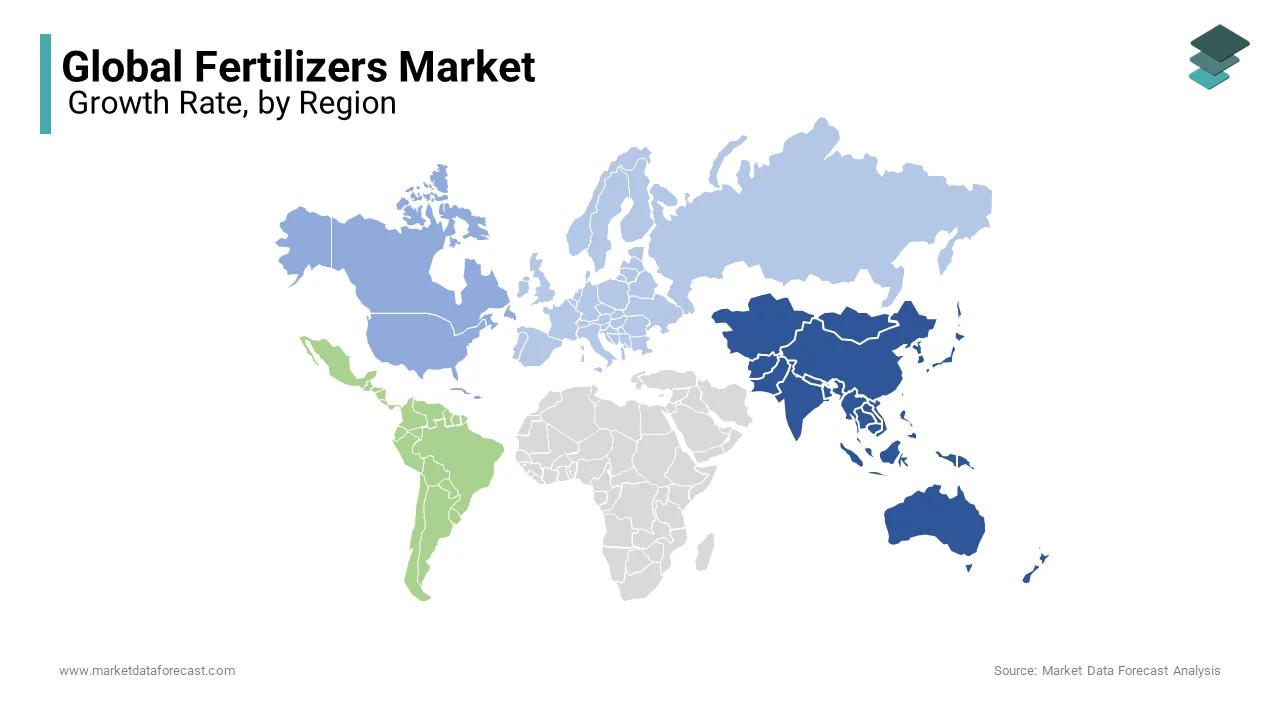
- Asia-Pacific was the top performer in the global fertilizers market in 2025, accounting for 52.8% of the total share, driven by strong agricultural activity in India, China, and Southeast Asia.
- North America showed steady demand with advanced farming practices and adoption of specialty fertilizers.
- Europe witnessed significant growth with a focus on eco-friendly and organic fertilizers.
- Latin America and the Middle East & Africa are emerging markets with rising investments in agriculture and crop enhancement.
Competitive Landscape
Key players operating in the global fertilizers market include CF Industries Holdings, Inc., Coromandel International Ltd., Grupa Azoty S.A. (Compo Expert), Haifa Group, ICL Group Ltd., Indian Farmers Fertiliser Cooperative Limited, Nutrien Ltd., Sociedad Quimica y Minera de Chile SA, The Mosaic Company, and Yara International ASA. These companies focus on innovation in nutrient efficiency, expansion of production capacity, and strengthening distribution networks across developing regions.
Global Fertilizers Market Size
The global fertilizers market size was valued at USD 403.54 billion in 2026 and is anticipated to reach USD 428.40 billion in 2026 to reach USD 691.09 billion by 2034, growing at a CAGR of 6.16% during the forecast period from 2026 to 2034.
Fertilizers refer to the nitrogenous, phosphatic, potassic, and complex nutrient formulations designed to replenish soil fertility and enhance crop productivity. As global agricultural systems face a mounting burden to feed a growing population under shrinking arable land, fertilizers remain indispensable in maintaining yield stability. The sector is undergoing a structural shift from conventional bulk inputs toward precision-enriched, environmentally adaptive nutrient solutions. As per the study, a portion of global crop production relies on synthetic fertilizers to compensate for natural soil nutrient depletion. Furthermore, according to research, soil degradation affects a portion of the world’s agricultural land, which intensifies the need for targeted nutrient management. Innovations in slow-release, bio-based, and nitrification-inhibited products are redefining efficacy standards, which align with agronomic performance and ecological responsibility in modern farming ecosystems.
MARKET DRIVERS
Rising Global Food Demand Due to Population Growth
The escalating global population is attributed to the expansion of the fertilizer market. According to the United Nations Department of Economic and Social Affairs, the world population is projected to reach 9.7 billion by 2050, necessitating a 60% increase in food production compared to 2010 levels. Intensification through nutrient supplementation becomes important because there is only limited potential for new farmland. Cereal crops, which account for a portion of human dietary energy intake, require substantial nitrogen and phosphorus inputs to sustain yields. According to a study, fertilizer use contributes to a portion of global crop yields, particularly in staple grains. This dependency emphasizes the irreplaceable role of fertilizers in bridging the food gap, especially in densely populated regions such as South Asia and sub-Saharan Africa.
Government Subsidies and Agricultural Support Programs
Government-backed subsidy frameworks accelerate the growth of the fertilizer market. It significantly influences fertilizer accessibility and usage, particularly in emerging economies where smallholder farmers dominate agricultural output. As per the study, India allocated a substantial amount in fertilizer subsidies, which ensures affordable access for millions of farming households. These initiatives directly stimulate demand by reducing input costs and encouraging the adoption of improved agronomic practices. The targeted fertilizer distribution programs increased teff and sorghum productivity. Such policy-driven interventions not only enhance food security but also institutionalize fertilizer use as a cornerstone of national agricultural development strategies.
MARKET RESTRAINTS
Environmental Impact of Nutrient Runoff and Eutrophication
Excessive or misapplied fertilizer use contributes significantly to freshwater eutrophication, which impedes aquatic ecosystems and drinking water safety, and restrains the expansion of the fertilizers market. As per the study, nutrient runoff, primarily nitrogen and phosphorus, from agricultural fields is the leading cause of water quality impairment in notable miles of U.S. rivers and streams. In Europe, a portion of surface waters exceed safe nitrate levels defined by the EU Water Framework Directive. These ecological consequences have prompted stringent regulatory actions, including usage caps and buffer zone mandates, which constrain conventional fertilizer application.
Volatility in Feedstock and Energy Prices
Fluctuations in natural gas and phosphate rock prices, both of which are fundamental to production, hinder the growth of the fertilizer market. Natural gas constitutes a portion of the manufacturing cost for ammonia-based nitrogen fertilizers, as per the study. In addition, European natural gas prices surged due to geopolitical disruptions, forcing several ammonia and urea plants to curtail operations, as per the study. Similarly, China’s export restrictions on phosphate rock led to a spike in diammonium phosphate (DAP) prices within months, according to research.
MARKET OPPORTUNITY
Adoption of Controlled-Release and Stabilized Fertilizers
The shift toward precision nutrient management is accelerating the adoption of controlled-release and nitrification-inhibited fertilizers, which introduces new prospects for the fertilizers market. It minimizes losses and improves uptake efficiency. The traditional urea application results in nitrogen use efficiency of only a percentage, with the remainder lost to volatilization or leaching. In contrast, polymer-coated urea and urease inhibitors can increase efficiency, as per a study. Companies have expanded production of products, which reduces ammonia emissions. According to a study, adoption of enhanced-efficiency fertilizers has grown annually, driven by environmental regulations and cost-saving incentives. These advanced formulations offer a sustainable pathway to maintain yields while reducing environmental impact, which positions them as a transformative segment within the global fertilizer market.
Expansion of Bio-Based and Organic Fertilizer Integration
The incorporation of bio-based inputs into mainstream agriculture offers a new opportunity for the fertilizers market. As per the research, global organic farmland reached millions of hectares, with demand for organic-compliant fertilizers rising annually. Biofertilizers containing nitrogen-fixing bacteria are used on millions of hectares globally, according to a study. Similarly, the European Union’s Farm to Fork Strategy mandates a reduction in mineral fertilizer use by 2030, promoting blended systems combining organic composts with reduced-rate synthetics. These trends reflect a growing consensus that hybrid nutrient models can balance productivity with ecological stewardship, which opens new commercial and regulatory pathways for innovation.
MARKET CHALLENGES
Regulatory Burden and Compliance with Environmental Standards
Fertilizer producers and agricultural users face escalating regulatory scrutiny aimed at mitigating greenhouse gas emissions and nutrient pollution, which challenges the expansion of the fertilizers market. As per research, agricultural soils contribute a portion of total EU methane and nitrous oxide emissions, with synthetic fertilizers being a major source of the latter. In response, the EU’s 2023 revision of the Industrial Emissions Directive imposes stricter emission limits on ammonia and NOx from fertilizer plants. Similarly, California’s State Water Resources Control Board enacted mandatory nitrogen management plans for all farms in high-nitrate risk zones, affecting notable hectares of cropland. These evolving standards increase operational complexity and capital expenditure by compelling manufacturers to invest in cleaner technologies and farmers to adopt precision application methods, which reshape the entire value chain.
Limited Access and Distribution in Sub-Saharan Africa
Limited access and distribution in sub-Saharan Africa stand as a major impediment to the fertilizer market. As per the study, the average fertilizer application rate in the region is just kgs per hectare, far below the African Union’s target and the global average. Structural barriers, including poor rural infrastructure, fragmented supply chains, and limited credit access, hinder effective distribution. As per research, only a portion of smallholder farmers in countries have reliable access to quality fertilizers during planting seasons. These challenges perpetuate low productivity, with cereal yields averaging fewer tons per hectare, less than half the global average, which constrains food security and economic development.
REPORT COVERAGE
| REPORT METRIC | DETAILS |
| Market Size Available | 2025 to 2034 |
| Base Year | 2025 |
| Forecast Period | 2026 to 2034 |
| CAGR | 6.16% |
| Segments Covered | By Type, Form, Application, and Region |
| Various Analyses Covered | Global, Regional & Country Level Analysis, Segment-Level Analysis, DROC, PESTLE Analysis, Porter’s Five Forces Analysis, Competitive Landscape, Analyst Overview of Investment Opportunities |
| Regions Covered | North America, Europe, APAC, Latin America, Middle East & Africa |
| Market Leaders Profiled | CF Industries Holdings, Inc., Coromandel International Ltd, Grupa Azoty S.A. (Compo Expert), Haifa Group, ICL Group Ltd, Indian Farmers Fertiliser Cooperative Limited, Nutrien Ltd., Sociedad Quimica y Minera de Chile SA, The Mosaic Company, Yara International ASA |
SEGMENTAL ANALYSIS
By Type Insights
In 2024, the nitrogenous fertilizers segment led the fertilizers market by accounting for 56.3% 2025. The domination of the nitrogenous fertilizers segment is primarily driven by the indispensable role of nitrogen in promoting vegetative growth, chlorophyll synthesis, and protein formation in crops. Cereals such as maize, rice, and wheat occupy a portion of global arable land. According to a study, this leads to a structurally elevated nitrogen demand. Urea, the most widely used nitrogenous compound, constitutes more than aa portion of total nitrogen fertilizer consumption globally. According to a study, global urea production reached millions of metric tons, supported by high application rates in staple crop systems across Asia and North America. Furthermore, the integration of nitrogen into high-yield farming models, particularly in intensive rice cultivation in China and India, has entrenched its centrality in modern agronomy.
The secondary macronutrients segment is expected to lead the fertilizers market with the highest CAGR of 7.6% from 2025 to 2033 due to the increasing recognition of soil nutrient depletion beyond nitrogen, phosphorus, and potassium. As per the Indian Council of Agricultural Research, over 45% of Indian soils are deficient in sulfur, an important component for amino acid synthesis, leading to yield gaps in oilseeds and pulses. Similarly, according to research, magnesium deficiency affects a portion of cultivated land in sub-Saharan Africa, impairing photosynthetic efficiency. Apart from these, the European Commission’s 2023 Soil Health Law proposal mandates nutrient balance monitoring, accelerating the adoption of balanced fertilization. These developments are shifting agronomic focus toward holistic soil nutrition, which positions secondary macronutrients as a pivotal growth frontier.
By Form Insights
The conventional fertilizers segment was the prominent segment of the fertilizers market by capturing a substantial share in 2024. Their widespread affordability, ease of application through existing farm equipment, and compatibility with large-scale monoculture systems are propelling the growth of the conventional fertilizers segment. Products such as granular urea, diammonium phosphate (DAP), and muriate of potash (MOP) remain staples in major agricultural economies due to their high nutrient concentration and logistical simplicity. According to a study, a portion of corn and soybean acreage in the U.S. Great Plains relies on broadcast-applied conventional fertilizers during pre-planting operations. In India, the government’s nutrient-based subsidy (NBS) scheme heavily favors conventional formulations, with millions of metric tons distributed through the public system, as per a study. The entrenched infrastructure and farmer familiarity with these products ensure their continued dominance, especially in regions where mechanization and input access are still evolving, despite environmental concerns.
The specialty fertilizers segment is projected to have the strongest CAGR of 8.3% over the forecast period. The rising adoption of precision agriculture and the need for improved nutrient use efficiency are accelerating the expansion of the specialty fertilizers segment. Specialty products, including water-soluble fertilizers, chelated micronutrients, and stabilized nitrogen formulations that offer targeted delivery, reduced leaching, and compatibility with drip irrigation and fertigation systems. Besides, China has promoted specialty fertilizers through its Zero Growth in Chemical Inputs initiative, resulting in a rise in specialty product usage. These trends reflect a structural shift toward sustainable intensification, which drives rapid uptake of advanced formulations.
By Application Mode Insights
The soil application mode segment held the leading share of the fertilizers market in 2024. This prevalence is attributable to its compatibility with traditional farming practices, broad crop applicability, and integration with tillage and planting operations, which are largely attributed to the growth of the soil application mode segment in the global market. Broadcast, banding, and side-dressing methods remain the primary means of nutrient delivery across vast cereal, oilseed, and fiber crop systems. According to research, a portion of fertilizer use in India, the world’s second-largest consumer, occurs via soil application, particularly during kharif and rabi sowing seasons. Despite concerns about nutrient loss, soil application remains the most accessible method for smallholder farmers, who constitute millions of the world’s large number of farms, according to research. The continued reliance on tractors, spreaders, and seed drills ensures that soil-based delivery remains the backbone of global nutrient management, especially in regions with limited irrigation infrastructure.
The fertigation segment is slated to expand at the fastest CAGR of 9.1% from 2025 to 2033. The convergence of water scarcity, precision farming, and technological adoption in high-value agriculture is boosting the expansion of the irrigation segment. As per research, the area of drip-irrigated land globally exceeded millions of hectares, with Israel, Spain, and California leading in adoption. In Israel, a portion of agricultural land uses fertigation, achieving nitrogen use efficiency rates, as per a study. The U.S. Department of Agriculture notes that fertigation reduces fertilizer usage while increasing yields in tomato and almond farms.
REGIONAL ANALYSIS
Asia Pacific Fertilizers Market Analysis
Asia-Pacific was the top performer in the fertilizers market in 2024 and accounted for 52.8% of the global market share in 2024. High population density, intensive cropping patterns, and state-supported input distribution systems are primarily driving the domination of the Asia Pacific in the global market. It is functioning as both the largest producer and consumer of nitrogenous and complex fertilizers. China and India are the twin engines of regional demand, collectively accounting for a portion of global urea consumption. China produced millions of metric tons of nitrogen fertilizers, according to research, primarily to support its millions of hectares of grain cultivation program. India’s demand is further amplified by government subsidies and a growing push for self-sufficiency in food production.
North America Fertilizers Market Analysis
North America claims the second spot in the fertilizers market and captured 18.8% share in the global market in 2024, with the United States serving as the primary consumer and technological innovator in nutrient management. The U.S. applied millions of metric tons of nitrogen fertilizers, primarily in the Corn Belt states of Iowa, Illinois, and Nebraska, where maize cultivation spans millions of hectares, as per the study. Canada contributes significantly through potash production; Saskatchewan produced millions of metric tons, which makes it the world’s largest exporter, according to a study. The region is also at the forefront of adopting enhanced-efficiency fertilizers, with a portion of corn acreage using stabilized nitrogen products, as per research.
Europe Fertilizers Market Analysis
Europe witnessed a sustained rise in the fertilizer market due to environmental imperatives. Germany, France, and Poland are the largest consumers, with cereal and rapeseed cultivation driving demand for balanced NPK formulations. Countries like the Netherlands and Denmark have implemented mandatory nutrient action programs, reducing fertilizer runoff into waterways. Europe remains a leader in specialty fertilizer innovation, despite production cutbacks due to high energy costs, with companies advancing nitrification inhibitors and precision delivery systems.
Latin America Fertilizers Market Analysis
Latin America is a high-growth region in the global fertilizer market, with Brazil emerging as the dominant force in regional consumption. Brazil consumed millions of metric tons of fertilizers, an increase from the previous year, driven by record soybean and corn production across the Cerrado and southern states, as per a study. The country imports a portion of its potash and its phosphate, which makes it highly dependent on global supply chains. Argentina and Colombia are also increasing fertilizer use in expanding agricultural frontiers. Investments in port infrastructure and domestic blending facilities are enhancing supply resilience despite logistical challenges.
Middle East And Africa Fertilizers Market Analysis
The Middle East and Africa are likely to expand in the fertilizers market, with the Gulf Cooperation Council (GCC) countries serving as major producers and exporters, while sub-Saharan Africa remains under-fertilized. Saudi Arabia and Qatar are expanding their ammonia and urea production capacities, with Saudi Arabia exporting millions of metric tons of urea, according to a study. In Africa, Nigeria initiated the National Fertilizer Technical Committee in 2023 to improve distribution efficiency, targeting a rise in application rates from 18 kg/ha to 35 kg/ha by 2030, as per a study. However, structural challenges persist; only a portion of farmers in East Africa have consistent access to quality fertilizers.
COMPETITIVE LANDSCAPE
The competition in the fertilizers market is evolving beyond price and volume toward innovation, sustainability, and agronomic service integration. While traditional producers dominate bulk supply, a new tier of agile, technology-driven firms is gaining ground through precision formulations and digital engagement. The sector is marked by a dichotomy between large, integrated petrochemical-based manufacturers and specialized agri-tech firms offering next-generation nutrient solutions. Regional disparities in regulation, infrastructure, and farming practices are shaping competitive dynamics, with Asia-Pacific and Latin America emerging as battlegrounds for market expansion. Differentiation is increasingly achieved through carbon footprint reduction, traceability, and farmer advisory services. Mergers, joint ventures, and cross-border collaborations are reconfiguring the landscape, as companies seek to balance scale with adaptability.
KEY MARKET PLAYERS
- CF Industries Holdings, Inc.
- Coromandel International Ltd.
- Grupa Azoty S.A. (Compo Expert)
- Haifa Group
- ICL Group Ltd
- Indian Farmers Fertiliser Cooperative Limited
- Nutrien Ltd.
- Sociedad Quimica y Minera de Chile SA
- The Mosaic Company
- Yara International ASA
Top Players In The Market
- Yara International is a global leader in nitrogen-based fertilizers and precision nutrient solutions, with a growing strategic presence across the Asia-Pacific region. The company has established technical service centers in India, Vietnam, and Indonesia to support farmers with crop-specific nutrition programs, particularly in rice, sugarcane, and horticulture. In collaboration with local agri-retailers, the company expanded its YaraMila complex fertilizer distribution network across Southeast Asia.
- Nutrien Ltd. plays a pivotal role in the Asia-Pacific fertilizers landscape through its extensive supply chain and advanced product portfolio, particularly in potash and NPK blends. Although headquartered in Canada, Nutrien has strengthened its footprint in India, China, and Southeast Asia via long-term supply agreements and agronomic alliances. The company’s proprietary nitrogen stabilizer, Agrotain, has gained traction in Australian broadacre farms and is now being adapted for use in Thai cassava and Indonesian palm oil plantations.
- SABIC (Saudi Basic Industries Corporation) has emerged as a key supplier of nitrogen and compound fertilizers in the Asia-Pacific region, leveraging its cost-advantaged production in the Middle East and strategic shipping routes. The company supplies urea and NPK formulations to India, Bangladesh, and China, where demand for high-purity, low-biuret nitrogen products is rising in horticulture and greenhouse farming. Furthermore, SABIC is advancing its sustainability agenda by piloting blue ammonia production at its Jubail complex, which aims to supply low-carbon fertilizers to environmentally conscious markets in Japan and South Korea.
Top Strategies Used By Key Market Participants
Key players in the fertilizers market are deploying integrated strategies centered on technological differentiation, supply chain resilience, and sustainability transformation. Companies are investing in enhanced-efficiency fertilizers, such as nitrification inhibitors, polymer-coated products, and stabilized urea, to improve nutrient uptake and reduce environmental impact. Digital agronomy platforms are being scaled to deliver field-specific recommendations, enhancing farmer engagement and input precision. Vertical integration is a growing trend, with producers expanding into downstream blending, logistics, and retail distribution to capture value across the chain. Strategic partnerships with research institutions and governments are enabling localized product development for diverse soil and crop systems. Apart from these, firms are pursuing decarbonization through green ammonia pilots, carbon capture, utilization, and energy-efficient manufacturing.
MARKET SEGMENTATION
This research report on the global fertilizers market is segmented and sub-segmented into the following categories.
By Type
- Complex
- Straight
- Micronutrients
- Nitrogenous
- Phosphatic
- Potassic
- Form
- Secondary Macronutrients
By Application Mode
- Conventional
- Specialty
- CRF
- Liquid Fertilizer
- SRF
- Water Soluble
By Crop Type
- Field Crops
- Horticultural Crops
- Turf & Ornamental
By Region
- North America
- Europe
- Asia Pacific
- Latin America
- The Middle East and Africa