- Product Description Description
- Table of Contents TOC
- List of Table & Figure LOT
- Get Free Sample PDF Sample PDF
Market Size, 2025
$48.65 BnMarket Estimate, 2026
$50.57 BnMarket Forecast, 2034
$68.95 BnCAGR, 2026–2034
3.95%Executive Summary: Global Fighter Aircraft Market
- Market Scope: Comprehensive market evaluation of the global fighter aircraft sector, analyzing aircraft types (fixed-wing vs. rotary-wing), take-off and landing configurations (vertical, short, and conventional), and regional performance across Asia-Pacific, North America, Europe, Latin America, and the Middle East & Africa.
- Market Valuation: Valued at USD 48.65 billion in 2025, reaching USD 50.57 billion in 2026, and projected to scale up to USD 68.95 billion by 2034, registering a steady CAGR of 3.95% throughout the forecast period from 2026 to 2034.
- Primary Growth Drivers: Escalating geopolitical rifts and border tensions forcing nations to modernize conventional aerial forces, rapid technological advancements in stealth capabilities, hypersonic speeds, and armament precision, alongside extensive fleet re-equipment cycles among industrialized countries.
Key Market Segment Metrics
| Category | Leading Segment (Base Year Position) | Fastest-Growing / High-Impact Segment |
|---|---|---|
| By Type & Take-Off/Landing | Fixed-Wing Segment (dominates the market share due to heavy demand for expanding combat fleets and higher military expenditure) | Rotary-Wing & Conventional Take-Off and Landing (CTOL) Segments (CTOL registers the highest CAGR due to lower procurement costs, greater weapon payloads, extended combat ranges, and ongoing 4.5/5th generation upgrades like the F-35A and J-20) |
| By Region | Asia-Pacific (projected to register the highest market share, propelled by regional political rivalries and aggressive fleet modernizations in China, India, and South Korea) | North America (experiencing substantial high-value growth supported by the U.S. Department of Defense's strategy to expand fighter squadrons and fund advanced next-gen concepts) |
Major Market Players & Market Structure
Market Structure: A heavily consolidated, defense-driven global aerospace marketplace characterized by state-supported primes, cross-border industrial partnerships, and advanced technological R&D focused on stealth, avionics, and multirole capability.
Key Companies: Lockheed Martin Corporation, The Boeing Company, Dassault Aviation, Saab AB, United Aircraft Corporation, Chengdu Aircraft Industrial Co. Ltd., Sukhoi, Russian Aircraft Corporation MiG, KAI, and HAL.
Global Fighter Aircraft Market Size
The global fighter aircraft market size was valued at USD 48.65 billion in 2025 and is anticipated to reach USD 50.57 billion in 2026 to reach USD 68.95 billion by 2034, growing at a CAGR of 3.95% during the forecast period from 2026 to 2034.
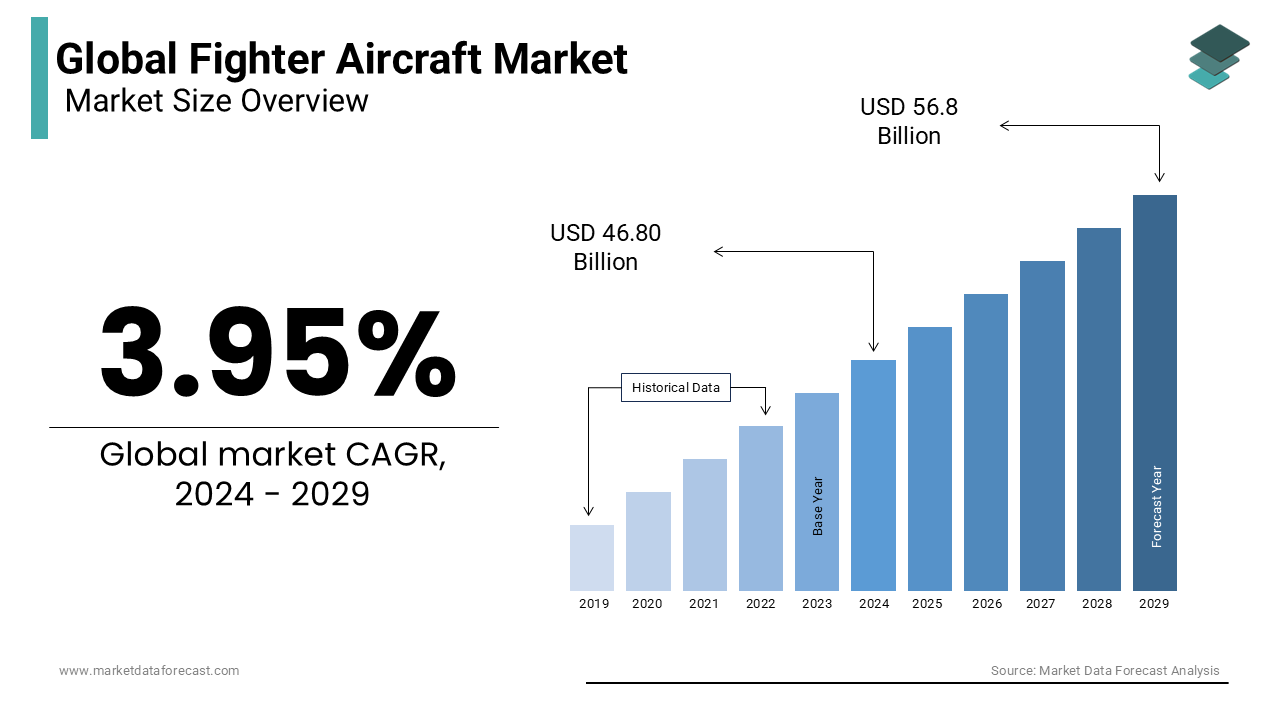
A fighter aircraft is a high-speed military plane designed for combat, dogfights, and stealth mode against enemy planes. Growing technological advancements in fighter aircraft, particularly in stealth mode, hypersonic speed, and armament precision, combined with rising demand for fighter aircraft, backed by an increase in production of fighter aircraft in the following years, and a growing need among nations to improve their aerial combat capabilities, are some of the factors predicted to drive the global fighter aircraft market. Even though many countries' defense resources are being decreased, the forecast for fighters remains constant. The world's industrialized countries are undergoing a significant re-equipment cycle, and the long-term structure of fighter acquisition plans will protect fighter manufacturing from the financial crisis.
MARKET DRIVERS
The growing geopolitical rift between states has prompted the deployment of advanced fighter aircraft to upgrade the existing fleet and strengthen their conventional aerial forces.
A fighter aircraft is considered a high-speed military aircraft that can fight in air-to-air combat. Fighter planes are characterized by their great speed, maneuverability, and small size. These planes can also carry heavy payloads and engage in electronic warfare, ground attack, and air-to-air combat. Growing technological advancements in fighter aircraft, particularly in stealth mode, hypersonic speed, and armory precision, combined with rising demand for fighter aircraft, backed by an increase in fighter aircraft production in the next decade compared to the previous decade, and the growing need among nations to improve their aerial combat capabilities are the primary factors expected to drive the growth of the global fighter aircraft market.
MARKET RESTRAINTS
Observation and surveillance, target acquisition, and intelligence are all made by unmanned aerial vehicles (UAVs). In addition, battle damage management, distribution and transportation, and combat operations are all provided. The safety of the crew members is driving an increase in demand for UAVs. Nonetheless, increased UAV usage will stifle the fighter jet aircraft market's growth. However, despite the growing need for fighter aircraft, financial constraints may prohibit emerging countries from selecting next-generation fighter aircraft, forcing them to continue upgrading existing fighters to save money and increase aircraft market growth.
REPORT COVERAGE
| REPORT METRIC | DETAILS |
| Market Size Available | 2025 to 2034 |
| Base Year | 2025 |
| Forecast Period | 2026 to 2034 |
| CAGR | 3.95% |
| Segments Covered | By Type, Take-Off and Landing, and Region |
| Various Analyses Covered | Global, Regional & Country Level Analysis, Segment-Level Analysis, DROC, PESTLE Analysis, Porter’s Five Forces Analysis, Competitive Landscape, Analyst Overview on Investment Opportunities |
| Regions Covered | North America, Europe, APAC, Latin America, Middle East & Africa |
| Market Leaders Profiled | HAL, Lockheed Martin Corporation, Saab AB, The Boeing Company, United Aircraft Corporation, Chengdu Aircraft Industrial Co. Ltd., Russian Aircraft Corporation MIG, Dassault Aviation, Sukhoi, KAI. |
SEGMENTAL ANALYSIS
By Type Insights
Based on type, the Fixed-wing segment is anticipated to have the largest share in the fighter jet market during foreseen period, owing to a rise in demand for the expansion of the fighter fleet and an increase in military expenditure for combat aircraft.
The Rotary-wing segment is expected to be the fastest-growing fighter jet market over the forecast period. According to the Leonardo Company, over the next 20 years, 14,000 fighter jets are scheduled to be constructed globally. Fighter jets are in higher demand in Asia, the Middle East, Africa, and Eastern Europe. As a result, the market is being driven by the increasing number of fighter jet aircraft deliveries around the globe.
By Take-Off and Landing Insights
The conventional Takeoff and Landing segment is anticipated to register the highest CAGR in the fighter jet aircraft market over the forecast period. Two of the major drivers in the fighter aircraft industry are technological innovation and lower procurement costs associated with aircraft that conduct conventional takeoff and landing. These aircraft can also carry a bigger payload of weapons and equipment and have a longer combat range. Over the projection period, new fighter aircraft initiatives such as the F-35A, China's J-20, Su-37, Mig-35, Su-57, and India's Tejas MK2 are expected to replace aging fourth-generation fighter aircraft with 4.5 and 5th generation. In addition, aircraft modernization efforts for the F-16, F-15, and F/A-18 are expected to keep users motivated by enhancing aircraft capabilities and extending aircraft life. Some countries, like Canada, India, Brazil, Saudi Arabia, the United Arab Emirates, and Taiwan, have chosen to fly improved current aircraft platforms rather than the more expensive stealth aircraft, which also have a longer delivery lead time. As a result of this improvement, the conventional takeoff and landing segment has a great demand during the predicted period.
REGIONAL ANALYSIS
Asia Pacific Market Analysis
The Asia-Pacific region is anticipated to register the highest share of the fighter aircraft market during the forecast period. Political rifts exist in the Asia-Pacific region, affecting countries such as China, India, Japan, and South Korea. This has aided regional countries' efforts to modernize their fighter aircraft fleets, whether through foreign procurement or local manufacture of sophisticated combat aircraft. China has attempted to compete with the United States in designing and producing newer-generation fighter aircraft in recent years. China has built a range of modern fighter aircraft, including the stealth fighter J-20, despite being behind in developing aircraft engines. After a series of disasters and mechanical issues, China is also developing a new carrier-based fighter plane to replace its J-15 fighter. China decided to build at least four aircraft carrier groups to achieve its naval aspirations. The new aircraft is planned to make its first flight in 2024, and it might enter service between 2024 to 2029.
North America Market Analysis
North America is projected to experience the highest share of the fighter aircraft market over the forecast period. Various advances in fighter aircraft are likely to contribute to substantial growth in the North American region. Since the end of the Second World War, the US Air Force has been regarded as the world's supreme air force. The United States now has approximately 2,000 fighter aircraft, and the US Department of Defense is concentrating its efforts on improving the fighter aircraft industry. To deal with China's and Russia's expanding military strength, the US Air Force aims to raise its fighter aircraft squadrons from 55 to 65 in the next years. The F-22 Raptor Hybrid is Lockheed Martin's idea to combine the best elements of the F-35 and the F-22 aircraft. As a result, many ongoing innovations in fighter aircraft are projected to drive their rise in the near future in North America.
Europe region is predicted to have a significant fighter aircraft market share over the forecast period. Due to increased security risks and geopolitical tensions, European defense spending will rise.
KEY MARKET PLAYERS
These are the market players that are dominating the global aircraft fighter market.
- HAL
- Lockheed Martin Corporation
- Saab AB
- The Boeing Company
- United Aircraft Corporation,
- Chengdu Aircraft Industrial Co. Ltd.
- Russian Aircraft Corporation MIG
- Dassault Aviation
- Sukhoi
- KAI
RECENT MARKET NEWS
- Canada has barred Boeing from the fighter contest, claiming that the airliner row would harm its proposal in November 2021. Canada Boeing Co (BA.N) has been eliminated from a multibillion-dollar competition to supply 88 new fighter jets, citing a historical feud between the US Corporation and a Canadian aircraft manufacturer as a factor in the decision.
- BEL and Lockheed Martin have signed an agreement to investigate the potential of the F-21 fighter jet program. In February 2020, Lockheed Martin signed an agreement with BEL to examine the F-21 fighter jet program prospects. In addition, Lockheed Martin has made an exclusive offer to India for its F-21 military aircraft, hoping to win an $ 18 billion contract to provide 114 fighters to the Indian Air Force. To promote Lockheed Martin's F-21 proposal for the Indian Air Force, the corporation stated it is strengthening and expanding its partnerships with the Indian industry.
MARKET SEGMENTATION
This research report on the global fighter aircraft market has been segmented and sub-segmented based on the type, take-off and landing, and region.
By Type
- Fixed-wing
- Rotary-wing
By Take-Off and Landing
- Vertical Take-Off and Landing Aircraft
- Short Take-off and Landing Aircraft
- Conventional Takeoff and Landing Aircraft
By Region
- North America
- Asia-Pacific
- Europe
- Latin America
- Middle-East-Africa