- Product Description Description
- Table of Contents TOC
- List of Table & Figure LOT
- Get Free Sample PDF Sample PDF
Market Size, 2025
$829.1 MnMarket Estimate, 2026
$883.1 MnMarket Forecast, 2034
$1,463.8 MnCAGR, 2026–2034
6.52%Executive Summary: Global Flexible Epoxy Resin (FER) Market
- Market Scope: Comprehensive global market analysis covering product types (urethane modified, rubber modified, dimer acid), applications, and regional market dynamics for high-elongation and tough epoxy formulations.
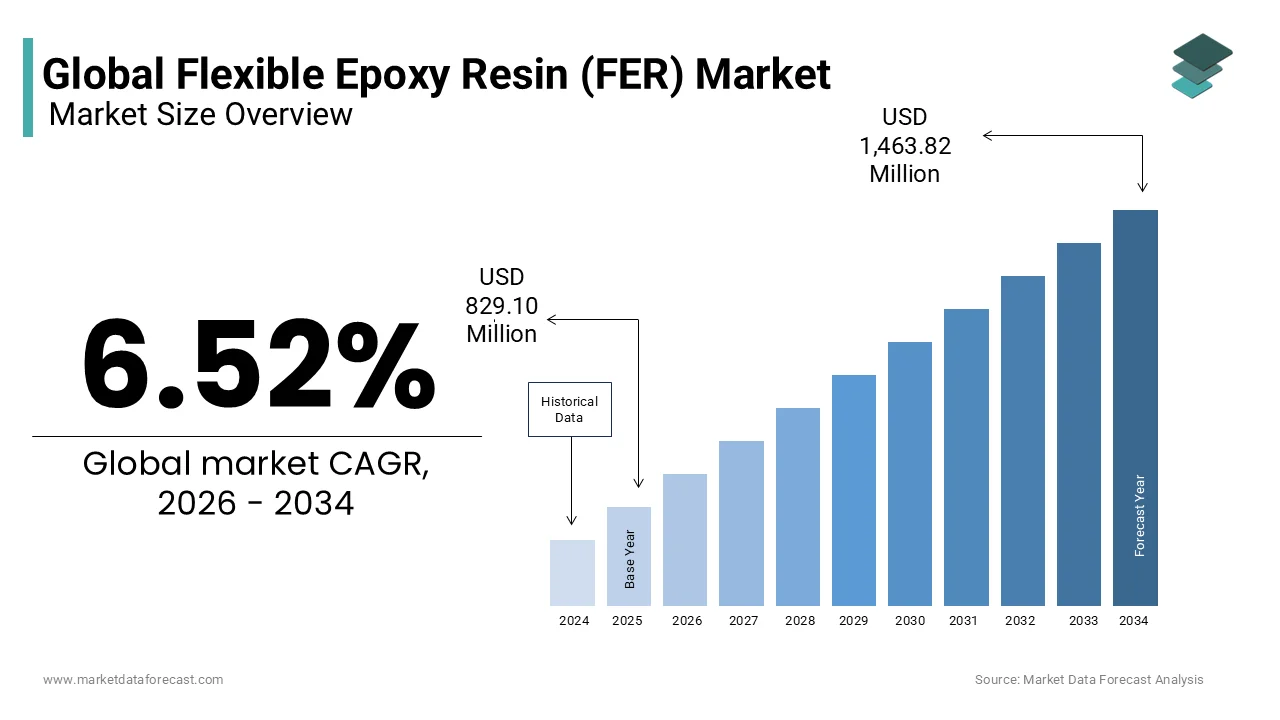
- Market Valuation: Valued at USD 829.10 million (2025), estimated at USD 883.16 million (2026), and projected to reach USD 1,463.82 million by 2034, registering a CAGR of 6.52% (2026–2034).
- Primary Growth Drivers: Significant growth in paints and coatings industries across developing economies, increased deployment in automotive composites and electronics, and the industry-wide shift toward bio-based polymers.
Key Market Segment Metrics (2026–2034)
| Category | Leading Segment (2025 Position) | Fastest-Growing / Key Segment Trends |
|---|---|---|
| By Type | Rubber-Modified & Urethane-Modified Resins (widely deployed for high-reliability applications) | Bio-Based Flexible Epoxy Resins (driven by environmental concerns and renewable building blocks like starches and vegetable oils) |
| By Application | Paints & Coatings (major revenue contributor due to durability, flexibility, and corrosion resistance) | Composites & Adhesives (expanding rapidly in automotive light-weighting and electronics) |
| By Region | North America (traditionally commanding significant revenue share due to robust coatings and adhesive demand) | Asia-Pacific (projected to dominate and register the fastest growth driven by massive construction and electronics hubs in China, Japan, and South Korea) |
Major Market Players & Market Structure
Market Structure: Globally competitive market landscape featuring leading chemical corporations focusing on strategic geographic expansions, local partnerships, and sustainable bio-based polymer R&D.
Key Companies: Olin Corporation, Hexion, Kukdo Chemical, Aditya Birla Chemicals, Huntsman Corporation, and DIC Corporation.
Global Flexible Epoxy Resin (FER) Market Size
The global flexible epoxy resin (FER) market was valued at USD 829.10 million in 2025 and is expected to reach USD 1,463.82 million by 2034 from USD 883.16 million in 2026, growing at a CAGR of 6.52%.
The flexible epoxy resin materials are tailored thermosetting polymers synthesized by integrating long chain aliphatic flexibilizers, polyols, or rubber modifiers into standard bisphenol A backbones to overcome intrinsic brittleness. These elastomeric networks deliver high fracture toughness, superior thermal shock endurance, and sustained dynamic elongation across broad operational temperature gradients. Primary industrial applications span protective structural coatings, microelectronic encapsulants, structural adhesives, and flexible printed circuit board assemblies. Furthermore, as per production metrics released by the Semiconductor Industry Association, global semiconductor sales reached 526.8 billion dollars, necessitating flexible dielectric encapsulants to safeguard microchips against mechanical stress during high temperature operations.
MARKET DRIVERS
Accelerating integration of flexible epoxy potting compounds in electric vehicle power electronics and battery modules
The electric vehicle powertrains and battery management architectures subject internal electronic assemblies to intense thermal cycling, severe operational vibrations, and mechanical expansion stress. The integration of flexible epoxy potting compounds in electric vehicle power electronics is greatly influencing the growth of the flexible epoxy resin market. The accelerating integration of flexible epoxy potting compounds in electric vehicle power electronics and battery modules is propelling the growth of the flexible epoxy resin market. Standard rigid epoxy matrix systems frequently crack or delaminate under these dynamic thermal conditions, exposing delicate circuitry to moisture ingress and short circuits. Flexible epoxy resins modified with polyether amine or dimer acid segments absorb mechanical micro vibrations while accommodating differential thermal expansion between dissimilar metallic and ceramic substrates. These physical operational mandates directly elevate demand for flexible epoxy resin systems to preserve long term electrical insulation, secure terminal joints, and prevent fatigue failure in modern automotive battery architectures.
Surging adoption of structural flexible adhesives in lightweight aerospace and wind turbine blade manufacturing
The modern commercial aircraft and utility scale wind turbines rely heavily on lightweight fiber reinforced composite structures to maximize energy efficiency and structural performance, which is also surging the growth of the flexible epoxy resin market. The surging adoption of structural Joining carbon fiber or fiberglass panels to internal metallic frames requires structural adhesives that provide exceptional shear strength alongside sufficient mechanical elasticity to dissipate wind gust loads and aerodynamic flexure. Flexible epoxy resins engineered with elastomeric rubber phases deliver high impact resistance and crack arrest capabilities within the bond line. According to aviation delivery statistics published by Boeing, global commercial airplane deliveries reached 528 units, with modern composite intensive designs consuming extensive flexible bonding agents. Additionally, as per wind energy deployment metrics released by the Global Wind Energy Council, global new wind power capacity additions exceeded 106 gigawatts in a single year, requiring thousands of tons of structural epoxy compounds for turbine blade root joint bonding. The continuous global shift toward lightweight structural composites reinforces the direct operational necessity for flexible epoxy adhesive formulations.
MARKET RESTRAINTS
Sustained price volatility and supply chain vulnerabilities regarding core bisphenol A and epichlorohydrin feedstocks
The synthesis of high-performance flexible epoxy resin systems depends fundamental precursor chemicals derived directly from crude oil and refined petrochemical cracking operations. Fluctuations in energy markets create unpredictable cost variations for basic monomers, forcing resin formulators to continuously adjust product pricing and operate under unstable profit margins. Because flexible epoxy resins require specialized flexibilizing modifiers in addition to standard bisphenol resins, compounders face doubled exposure to raw material price inflation.
Stringent occupational safety compliance costs regarding bisphenol A toxicity and diisocyanate flexibilizer additives
The chemical regulations governing hazardous substances have tightened globally, placing heavy compliance burdens on manufacturers utilizing traditional epoxy resins and reactive flexibilizing agents. The stringent occupational safety compliance costs regrading bisphenol A toxicity and dissocyanate flexibilizer additives is also degrading the growth of the flexible epoxy resin market. Regulatory health agencies classify certain unreacted epoxy monomers and curing agents as skin sensitizers and potential endocrine disruptors, requiring chemical plants to install expensive automated containment systems and ventilation equipment. These regulatory mandates increase manufacturing overhead costs and restrict market expansion across safety sensitive consumer sectors.
MARKET OPPORTUNITIES
Expanding utilization of flexible epoxy encapsulants in next generation wearable electronics and flexible printed circuit boards
The rapid evolution of consumer electronics toward foldable smartphones, wearable health monitors, and flexible printed circuit board assemblies creates unprecedented performance requirements for protective dielectric materials. This factor is likely to fuel new opportunities for the growth of the flexible epoxy resin market. Traditional rigid potting resins crack when subjected to repeated bending cycles, causing trace disconnection and electronic device failure. Flexible epoxy resin formulations containing polyurethane or silane backbones provide high elongation properties while maintaining superior dielectric strength and moisture barrier protection. Furthermore, as per electronic component production data released by the Japan Electronics and Information Technology Industries Association, production value for multilayer flexible printed circuit boards reached 3.2 billion dollars, with manufacturers specifying ultra thin flexible epoxy solder masks to ensure fatigue resistance over thousands of flexural cycles. This technological transition opens massive commercial avenues for specialized low viscosity flexible epoxy resins tailored for microelectronic dispensing.
Growing implementation of bio based flexibilizers derived from renewable cardanol and plant oil derivatives
The industrial manufacturing sectors face increasing pressure to reduce Scope 3 carbon emissions and eliminate petroleum derived components from their chemical supply chains. The growing implementation of bio-based flexibilizers derived from renewable cardinal and plant oil derivatives are to promote the growth of the flexible epoxy resin market. Synthesizing flexible epoxy resin systems using bio-based modifiers like cardanol from cashew nut shell liquid or epoxidized vegetable oils allows formulators to create high-performance resins with significantly lower carbon footprints. According to agricultural processing data published by the Food and Agriculture Organization of the United Nations, global cashew nut production reached 4.2 million metric tons, yielding substantial volumes of raw cardanol byproduct suitable for eco friendly resin modification. Furthermore, as per life cycle assessment research published by the European Polymer Federation, replacing synthetic petro chemical flexibilizers with plant derived bio polyols reduces net carbon dioxide emissions during resin production by 38% per metric ton.
MARKET CHALLENGES
Maintaining mechanical tensile strength while achieving high elastomeric flexibility under elevated operating temperatures
The chemical formulators face severe physical trade-offs when designing flexible epoxy resin systems for high stress applications that is to act as a major challenge for the growth of the flexible epoxy resin market. Introducing long chain aliphatic flexibilizers or rubber segments into the epoxide matrix reduces the overall crosslink density, which successfully enhances flexibility and elongation but significantly lowers the glass transition temperature and mechanical tensile strength. According to material testing standards published by ASTM International, standard flexible epoxy formulations exhibit a drop in mechanical tensile strength of up to 50% when exposure temperatures exceed 80 degrees Celsius. Furthermore, as per reliability engineering studies published by the IEEE Electronics Packaging Society, microelectronic encapsulants experiencing thermal exposure above their glass transition temperature suffer an increase in the coefficient of thermal expansion, leading to severe thermal mismatch stress and bond line delamination in electronic components. Developing advanced interpenetrating polymer networks that deliver high elongation without compromising elevated temperature mechanical properties remains a paramount technical hurdle for resin chemists.
Achieving consistent curing behavior and humidity resistance in outdoor field applications and marine environments
Applying flexible epoxy resin coatings, sealants, and structural repair compounds in field conditions presents severe technical execution challenges compared to controlled factory environments that is also to impede the growth of the flexible epoxy resin market. Moisture cure flexible epoxies and amine cured flexibilized systems are highly sensitive to ambient humidity and low temperatures during their initial crosslinking reaction. High atmospheric moisture levels cause carbamate formation on the curing resin surface, leading to structural amine blush, loss of surface adhesion, and incomplete crosslinking. Additionally, as per civil infrastructure repair statistics released by the Federal Highway Administration, field applied elastomeric epoxy joint sealants exposed to ambient temperatures below 5 degrees Celsius experience cure delays exceeding 48 hours, leaving open concrete expansion joints vulnerable to water infiltration and road debris accumulation.
REPORT COVERAGE
| REPORT METRIC | DETAILS |
| Market Size Available | 2025 to 2034 |
| Base Year | 2025 |
| Forecast Period | 2026 to 2034 |
| CAGR | 6.52% |
| Segments Covered | By Type, Application, and Region. |
| Various Analyses Covered | Global, Regional & Country Level Analysis, Segment-Level Analysis, DROC, PESTLE Analysis, Porter’s Five Forces Analysis, Competitive Landscape, Analyst Overview of Investment Opportunities |
| Regions Covered | North America, Europe, APAC, Latin America, Middle East & Africa |
| Market Leaders Profiled | Olin Corporation (U.S.); Hexion (US); Kukdo Chemical (South Korea); Aditya Birla Chemicals (Thailand); Huntsman Corporation (U.S.); DIC Corporation (Japan); Westlake Chemical Corporation |
SEGMENTAL ANALYSIS
By Type Insights
The rubber modified chemistry segment was accounted in holding 41.3% of the flexible epoxy resin market share in 2025. Wind turbine manufacturing represents a primary catalyst driving the dominance of rubber modified flexible epoxy resins across global supply chains. Utility scale turbine blades experience extreme aerodynamic fatigue, cyclical mechanical bending, and high velocity wind gusts that induce micro cracks within traditional rigid epoxy matrices. Rubber modified epoxy chemistries arrest crack propagation at microscopic interfaces by making them essential for bonding structural composite spar caps and root joints. According to wind capacity metrics published by the Global Wind Energy Council, total installed global wind power capacity surpassed 1,000 gigawatts, generating substantial material consumption across blade manufacturing facilities worldwide. The continuous expansion of offshore wind installations requiring high durability composite components sustains the leading position of rubber modified resin formulations.
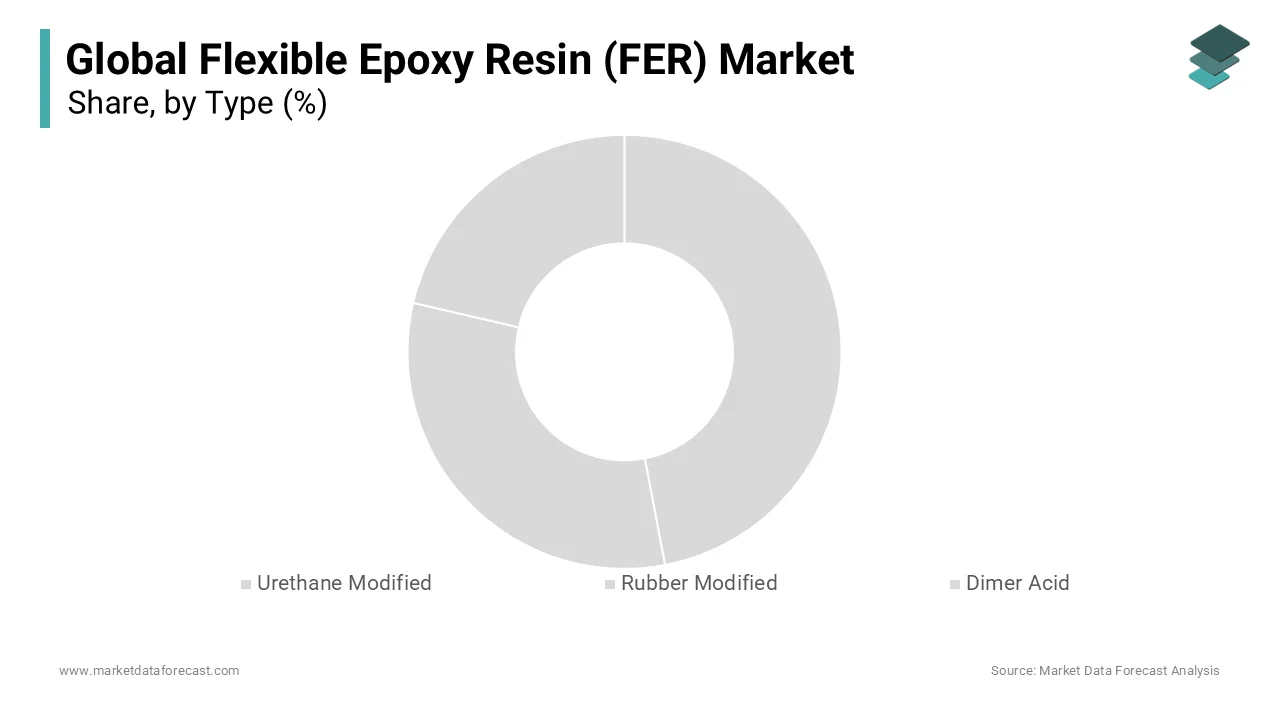
The urethane modified flexible epoxy resins segment is likely to witness a fastest CAGR of 6.24% during the forecast period. The rapid evolution of smart devices, wearable health monitors, and flexible display technologies creates unprecedented demand for urethane modified epoxy formulations. Electronic components undergo intense thermal stress, flexural strain, and mechanical drop impacts that cause rigid potting resins to crack and fail. Urethane modified epoxy encapsulants offer exceptional mechanical elongation and low modulus characteristics, protecting delicate microchips without exerting destructive stress on delicate solder joints. The rapid integration of flexible circuitry in consumer electronics accelerates the adoption of urethane modified epoxy resins.
By Application Insights
The adhesives segment was the largest by holding 34.27% of the flexible epoxy resin market share in 2025. Automotive and aerospace original equipment manufacturers are actively replacing traditional mechanical rivets and spot welds with structural flexible epoxy adhesives to reduce vehicle weight and improve fuel efficiency. Joining light aluminum alloys to carbon fiber composites requires an adhesive that can bridge differences in thermal expansion while providing high fatigue resistance under dynamic mechanical loads. Furthermore, as per aerospace materials data released by the Federal Aviation Administration, structural composite bonding applications in commercial airliners expanded with modern widebody aircraft utilizing structural epoxy adhesives per airframe.
The composites segment is anticipated to grow at a fastest CAGR of 6.1% during the forecast period. Flexible epoxy resin matrices provide superior fracture toughness, high impact resistance, and crack arrest performance in advanced fiber reinforced polymer composites used in aerospace, wind energy, and sporting goods. The global transition toward renewable energy requires larger wind turbine blades that generate higher mechanical loads and experience extreme flexural stress during operation. Flexible epoxy resins impregnated into fiberglass and carbon fiber matrix structures prevent delamination and matrix cracking under high wind loads. Furthermore, wind blade lengths exceeded 100 meters, requiring flexible epoxy resin systems that reduce internal residual curing stress in thick composite laminates by 25%, as per the study.
REGIONAL ANALYSIS
North America Flexible Epoxy Resin Market Analysis
North America was the largest contributor by holding 28.2% of the flexible epoxy resin market share in 2025. Momentum across the United States and Canada is propelled by advanced aerospace manufacturing, expanding commercial construction, and high demand for automotive structural adhesives. According to the study, United States aerospace and defense sales surpassed 950 billion dollars, driving high volume consumption of flexible epoxy composite resins and structural adhesives.
Europe Flexible Epoxy Resin Market Analysis
Europe flexible epoxy resin market was ranked second by holding 24.3% of the share in 2025. European Union member states is heavily anchored by green building mandates, wind energy infrastructure projects, and strict chemical safety regulations governing low emission materials. According to wind energy deployment data published by WindEurope, European offshore wind installation capacity expanded by 4.2 gigawatts in a single year, generating substantial demand for toughened composite epoxy matrices in turbine blade production. Additionally, as per chemical compliance reports released by the European Chemicals Agency under the REACH framework, regional resin manufacturers invested over 180 million euros to transition toward low volatile organic compound and hazardous monomer free epoxy formulations.
Asia Pacific Flexible Epoxy Resin Market Analysis
Asia Pacific flexible epoxy resin market is anticipated to have significant CAGR throughout the forecast period. The massive electronic manufacturing hubs, rapid urbanization, and high volume automotive production across China, India, Japan, and South Korea. According to vehicle assembly metrics published by the International Organisation of Motor Vehicle Manufacturers, Asia Pacific produced over 51 million vehicles, accounting for over half of total global output. Furthermore, as per semiconductor production statistics released by the China Semiconductor Industry Association, regional integrated circuit manufacturing output expanded by 16.8%, driving massive demand for flexible epoxy chip encapsulants.
Latin America Flexible Epoxy Resin Market Analysis
Latin America flexible epoxy resin market growth is driven by the expanding industrial manufacturing, commercial construction projects, and foreign direct investment in automotive assembly plants. According to economic development reports published by the Economic Commission for Latin America and the Caribbean, regional infrastructure spending expanded by 3.4%, increasing consumption of protective industrial coatings and structural sealants. Additionally, as per automotive production metrics released by the Association of the Mexican Automotive Industry, domestic vehicle assembly surpassed 3.7 million units, boosting procurement of flexible bonding adhesives.
Middle East and Africa Flexible Epoxy Resin Market Analysis
The Middle East and Africa flexible epoxy resin market growth is driven by the mega infrastructure initiatives, industrial city development, and large scale desalination plant construction requiring specialized corrosion protection coatings. According to regional construction reports published by the Gulf Cooperation Council Secretariat, active infrastructure and real estate projects across the region exceeded 2.6 trillion dollars. Strategic infrastructure diversification programs secure strong long term expansion across the region.
COMPETITIVE LANDSCAPE
The competition in the flexible epoxy resin market is highly dynamic and moderately consolidated, with a small group of multinational chemical leaders alongside specialized regional formulators driving industry development. Competition centers on technical innovation, product quality, custom formulation capabilities, and reliable raw material supply chains. Tier one manufacturers leverage vertical integration to maintain pricing advantages, while smaller regional players focus on niche application requirements like customized potting compounds and local civil engineering adhesives. Strategic consolidation plays a crucial role in reshaping dynamics as major chemical corporations execute mergers and acquisitions to scale up production and combine upstream raw material assets with downstream technical expertise. Furthermore, increasing demand from high tech industries like electronic vehicle assembly, offshore wind energy, and advanced aerospace composites intensifies product differentiation strategies among market participants.
KEY MARKET PLAYERS
The major key players in the global Flexible Epoxy Resin (FER) market are
- Olin Corporation (U.S.)
- Hexion (US)
- Kukdo Chemical (South Korea)
- Aditya Birla Chemicals (Thailand)
- Huntsman Corporation (U.S.)
- DIC Corporation (Japan)
- Westlake Chemical Corporation
Top Players in the Market
- Olin Corporation operates as a primary global producer and distributor of epoxy resin systems, holding an essential presence in the flexible epoxy chemistry sector. The company utilizes backward integration into chlorine and bisphenol A raw materials to supply specialized liquid and solid modified epoxy resins used in protective coatings, electronic packaging, and structural adhesives. To strengthen its overall global footprint and downstream specialty resin capabilities, Olin Corporation announced a definitive agreement in June 2026 to execute a transformative all stock merger of equals with Huntsman Corporation. This strategic consolidation enhances its operational resilience, supply chain control, and production capacity for high performance flexible formulations.
- Huntsman Corporation is a leading specialty chemical manufacturer that develops advanced flexible epoxy resins through its Advanced Materials business division. The company specializes in formulating toughened epoxy systems, polyurethane modified chemistries, and specialized curing agents tailored for high performance aerospace composites, automotive structural adhesives, and industrial encapsulants. Huntsman Corporation has actively reinforced its market position by driving strategic growth and expanding its global footprint, culminating in the approval by its shareholders in August 2026 of a definitive merger of equals with Olin Corporation. This strategic combination establishes an integrated global specialty platform that optimizes cost structures and accelerates advanced material technological developments across diverse industrial sectors.
- Westlake Chemical Corporation, through its Epoxy business unit created via the acquisition of Hexion's global epoxy enterprise, is a major global provider of specialty epoxy resins, modifiers, and curing agents. The company produces specialized flexible epoxy formulations that enhance impact resistance, flexural performance, and thermal cycling durability in civil engineering coatings, structural composite blades, and automotive adhesives. Westlake Chemical Corporation has continuously strengthened its position in the flexible epoxy resin sector by optimizing its global manufacturing network, investing in low volatile organic compound chemical processes, and expanding its regional distribution footprint to meet escalating industrial demand across major growth regions worldwide.
Top Strategies Used by Key Market Participants
Key market participants in the flexible epoxy resin industry focus heavily on backward integration to secure raw material supply chains and maintain cost competitive production of specialty epoxy formulations. Leading manufacturers invest significantly in research and development to synthesize novel rubber modified, dimer acid modified, and urethane modified epoxy chemistries that offer superior elongation, peel strength, and fracture toughness. Companies actively pursue strategic mergers, acquisitions, and joint ventures to expand regional footprint and access high growth downstream areas such as electric vehicle battery encapsulation, offshore wind blade composites, and microelectronics packaging.
MARKET SEGMENTATION
This research report on the global flexible epoxy resin (FER) market has been segmented and sub-segmented based on type, application, and region.
By Type
- Urethane Modified
- Rubber Modified
- Dimer Acid
By Application
- Paints & Coatings
- Composites
- Adhesives
- Others (tooling, electrical castings, electrical laminates, and fibers)
By Region
- North America
- Europe
- Asia Pacific
- Latin America
- The Middle East and Africa