Global Epoxy Resin Market Size, Share, Trends & Growth Forecast Report - Segmented By Physical Form (Liquid, Solid, and Solution), Application, and Region (North America, Europe, Asia Pacific, Latin America, Middle east and Africa) – Industry Analysis (2026 to 2034)
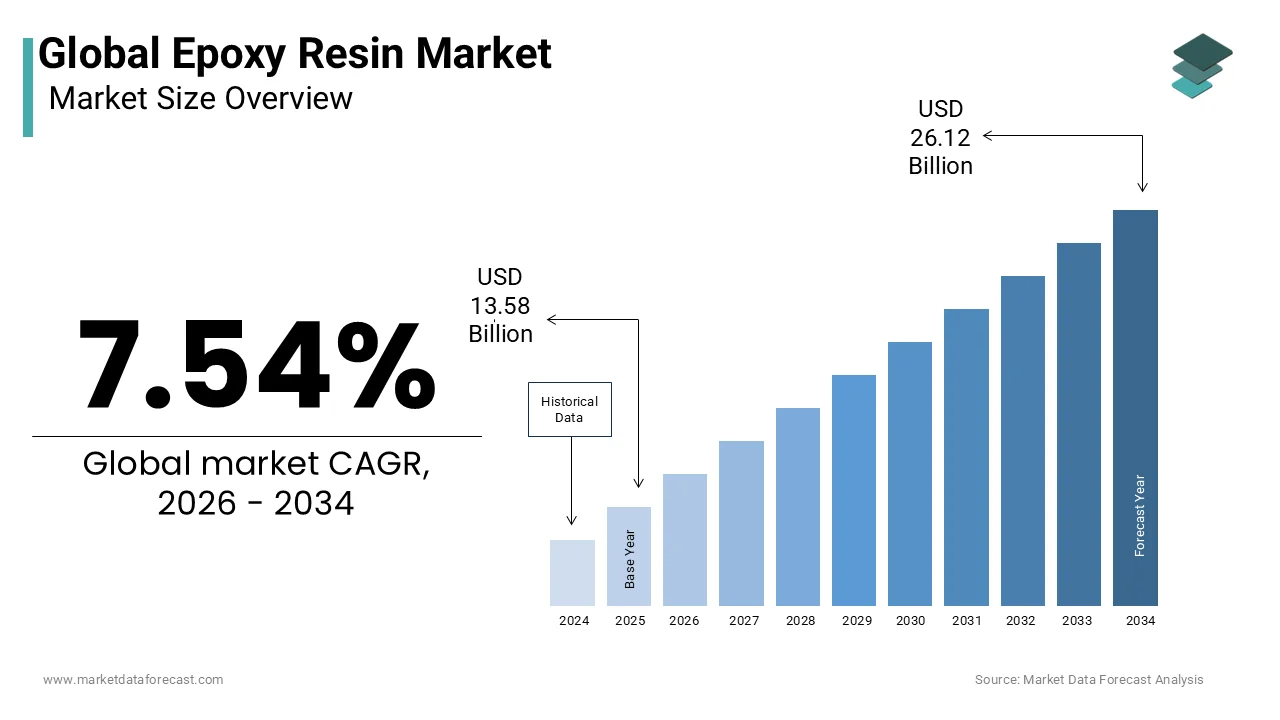
Market Size, 2025
$13.58 BnMarket Estimate, 2026
$14.6 BnMarket Forecast, 2034
$26.12 BnCAGR, 2026–2034
7.54%Global Epoxy Resin Market Size
The global epoxy resin market size was valued at USD 13.58 billion in 2025 and is expected to reach USD 26.12 billion by 2034 from USD 14.60 billion in 2026, growing at a CAGR of 7.54%.
Epoxy resin is a thermosetting polymer characterized by exceptional adhesion, chemical resistance, and mechanical durability, formed through the reaction of epichlorohydrin with bisphenol compounds or alternative polyfunctional reactants. Its utility spans aerospace composites, wind turbine blade matrices, marine coatings, and microelectronics encapsulation. According to the World Wind Energy Association (WWEA), global installed wind capacity surpassed 1,047 gigawatts (GW) in 2023. The International Energy Agency (IEA) also showed that global wind capacity additions in 2023 were a record 116 GW. Simultaneously, as per study, offshore wind projects require more epoxy per megawatt than onshore installations due to corrosion resistance demands.
MARKET DRIVERS
Rising Renewable Energy Demand Boosts Epoxy Resin Growth
The exponential growth in renewable energy infrastructure, particularly wind power, where epoxy resins serve as the indispensable matrix for carbon and glass fiber composites in turbine blades, is a major factor contributes to the growth of the epoxy resin market. According to the study, notable gigawatts of new wind capacity were commissioned globally, which necessitates large metric tonnes of high-performance epoxy systems. Offshore installations, which grew year-over-year, demand epoxy formulations with enhanced hydrolytic stability and fatigue resistance, specifications unmet by polyester or vinyl ester alternatives. Siemens Gamesa’s offshore turbine, for instance, integrates tonnes of epoxy composite per blade.
Semiconductor Miniaturization Fuels Epoxy Resin Expansion
The relentless miniaturization and performance intensification in semiconductor packaging, where epoxy mold compounds (EMCs) provide thermal stability, moisture barrier properties, and electrical insulation for advanced chip-scale packages, which accelerates the expansion of the epoxy resin market. As per research, global semiconductor packaging materials revenue surged, with EMCs constituting a portion of that volume. The transition to fan-out wafer-level packaging and 3D-stacked ICs demands ultra-low-stress, halogen-free epoxy formulations capable of surviving many thermal cycles between -65°C and 150°C without delamination.
MARKET RESTRAINTS
BPA and Epichlorohydrin Regulations Restrain Epoxy Resin
The regulatory-driven phase-out of bisphenol A (BPA) and epichlorohydrin in key jurisdictions, which support a portion of conventional epoxy synthesis, which is degrading the growth of epoxy resin market. Simultaneously, California’s Proposition 65 requires warning labels for BPA-containing products, which triggers formulation reformulations across North American supply chains. As per the study, epichlorohydrin is classified as a probable human carcinogen with an inhalation reference concentration of 0.003 mg/m³, by forcing plant-level engineering controls that increase production costs, according to the study. These constraints compel manufacturers into costly reformulation cycles without guaranteed performance parity.
Epoxy Brittleness Limits Adoption in High-Impact Uses
The intrinsic brittleness of cured epoxy networks, which limits their utility in high-impact or dynamically loaded applications without costly toughening agents, is inhibiting the epoxy resin market. The unmodified epoxy exhibits fracture toughness values below 0.6 MPa·m½, less than half that of polyurethane systems. In automotive structural adhesives, this necessitates blending with core-shell rubber particles or thermoplastic modifiers, increasing raw material costs. According to the study, crashworthiness standards for EV battery enclosures require adhesive joints to absorb 15 joules/cm² of impact energy, unattainable with standard epoxy without nanosilica or hyperbranched polymer additives. Therefore, epoxy’s penetration into mobility and infrastructure markets remains conditional on costly performance augmentation until next-generation intrinsic toughening mechanisms achieve commercial scalability.
MARKET OPPORTUNITIES
Bio-Based Epoxy Resins Create Sustainable Growth Paths
The development of bio-based epoxy monomers derived from lignin, cardanol, or itaconic acid, which circumvent petrochemical and toxicological constraints while retaining thermomechanical performance, provides new opportunities for the expansion of the epoxy resin market. As per the research, plant-derived epoxides from epoxidized linseed oil demonstrated glass transition temperatures exceeding 140°C in peer-reviewed trials, comparable to DGEBA standards. According to study, bio-epoxies could displace large metric tonnes of fossil-based resin if scaled via existing fatty acid and lignocellulosic biorefineries.
Self-Healing Epoxies Offer Lifecycle Cost Revolution
The integration of self-healing chemistries into epoxy matrices by enabling autonomous crack repair in inaccessible or safety-essential structures that creates new opportunities for the epoxy resin market. As per research, microcapsule-based systems containing dicyclopentadiene monomer restored portion of fracture toughness in aerospace-grade epoxy after simulated fatigue damage. The U.S. Air Force Research Laboratory has validated that such systems extend composite service life in rotorcraft components subjected to vibrational fatigue. Commercial deployment is accelerating. Thus, self-healing epoxies offer not material substitution but lifecycle cost revolution because of offshore wind O&M costs exceeds, which transforms maintenance economics in energy and aerospace sectors.
MARKET CHALLENGES
Lack of Recycling Standards Hampers Epoxy Resin Recovery
The absence of standardized recycling protocols for thermoset epoxy composites, rendering end-of-life wind blades and circuit boards largely non-recoverable despite regulatory burden, which challenges the growth of the epoxy resin market. As per the research, less portion of decommissioned wind turbine blades were recycled, with the remainder landfilled or incinerated due to crosslinked matrix intractability. Pyrolysis and solvolysis methods exist but operate at energy intensities exceeding 3.2 kWh/kg by rendering them economically unviable without subsidy, as per study. The European Composites Industry Association confirms that no commercial-scale epoxy composite recycling facility currently meets ISO 14001 waste recovery thresholds.
Supply Chain Fragility of Epoxy Intermediates Creates Risk
The global supply chain fragility for key epoxy intermediates, particularly epichlorohydrin and bisphenol F, which remain concentrated in fewer global production facilities that hampers the growth of the epoxy resin market. As per the research, China accounts for a percentage of global epichlorohydrin capacity, with just three plants supplying over half of export volumes. The 2022 drought in the Yangtze River Basin did force industrial production cuts in provinces like Sichuan due to reduced hydropower, as per research. Geopolitical friction compounds risk. The U.S. detained metric tonnes of epoxy intermediates. Diversification remains elusive.
REPORT COVERAGE
| REPORT METRIC | DETAILS |
| Market Size Available | 2025 to 2034 |
| Base Year | 2025 |
| Forecast Period | 2026 to 2034 |
| CAGR | 7.54% |
| Segments Covered | By Technology, Application, and Region. |
| Various Analyses Covered | Global, Regional & Country Level Analysis, Segment-Level Analysis, DROC, PESTLE Analysis, Porter’s Five Forces Analysis, Competitive Landscape, Analyst Overview of Investment Opportunities |
| Regions Covered | North America, Europe, APAC, Latin America, Middle East & Africa |
| Market Leaders Profiled | Aditya Birla Chemicals (India), GE Plastics (U.S.), Olin Corporation (U.S.), Chang Chung Plastics Co. Ltd. (Taiwan), Nan Ya Plastics Co. Ltd. (Taiwan), Huntsman Corporation (Taiwan), Kukdo Chemicals (U.S.), and Hexion Inc. (U.S.) |
SEGMENTAL ANALYSIS
By Technology Insights
The liquid epoxy resin segment dominated epoxy resin market by accounting for 63.5% of share in 2025 with the processing versatility. Liquid systems enable ambient-temperature curing, spray application, and infusion into fiber preforms without solvent dilution, which is vital for wind blade manufacturing and structural adhesives. According to the research, a portion of composite wind blades produced globally utilized liquid epoxy systems due to their low viscosity (<800 cP at 25°C), permitting deep fiber wet-out. In electronics encapsulation, a portion of underfill applications demand liquid epoxy for capillary flow into 20-micron gaps.
The solution-based epoxy segment is likely to experience the fastest CAGR of 9.8% from 2026 to 2034. The growth of the solution-based epoxy segment is propelled by demand for waterborne and solvent-reduced formulations in architectural and automotive refinish coatings, where regulatory compliance supersedes performance compromise. The U.S. Environmental Protection Agency’s National Volatile Organic Compound Emission Standards mandate VOC content below 250 g/L for industrial maintenance coatings—forcing formulators toward aqueous epoxy dispersions. According to research, a percentage of their new coating launches in India and Southeast Asia are waterborne epoxy solutions, driven by National Clean Air Programme targets. Performance enhancements are closing the gap.
By Application Insights
The composites segment captured the largest share of 41.5% of the global market share in 2025. The prominence of the composites segment is due to energy and aerospace infrastructure. Every megawatt of wind capacity requires 10–12 tonnes of epoxy-fiber composite, and every commercial aircraft airframe integrates over 20 tonnes of epoxy-based CFRP. As per the study, a percentage of turbine blades installed employed epoxy matrices due to their fatigue resistance exceeding 10⁷ cycles at certain percentage of ultimate tensile strength.
The adhesives & sealants segment is expected to register CAGR of 11.2% CAGR during the forecast period owing to electrification and lightweighting mandates. EV battery packs require thermally conductive, flame-retardant epoxy adhesives to bond cooling plates and module housings, with Tesla and CATL specifying lap shear strengths. As per the study, global EV production will reach notable millions of units annually by 2030, each requiring KGs of structural epoxy adhesive. In construction, epoxy anchors dominate seismic retrofitting. Epoxy systems command premium pricing due to performance non-substitutability unlike commodity adhesives, which insulates growth from price competition.
The building & Construction segment was the top performer in the epoxy resin market by occupying 38.3% of the global market share in 2025. The growth of the building & construction segment is regulatory and infrastructural. Epoxy flooring systems are mandated in FDA-regulated food processing facilities and GMP-certified pharmaceutical plants due to seamless, chemical-resistant surfaces. The U.S. requires slip-resistant, non-porous flooring in industrial kitchens, specifications met only by quartz-filled epoxy terrazzo. In infrastructure, epoxy-coated rebar extends bridge service life.
The Wind Power segment is expected to exhibit a noteworthy CAGR of 14.6% during the forecast period. The growth of the Wind Power segment is propelled by offshore turbine scaling: Siemens Gamesa’s model requires tonnes of epoxy composite per blade, more than its 8 MW predecessor. Material innovation is accelerating. China’s Five-Year Plan allocates GWs of new wind capacity, with Goldwind and Envision mandating epoxy resin traceability to carbon footprint thresholds. This convergence of gigawatt-scale deployment and circular material mandates creates unprecedented demand velocity unmatched by other sectors.
REGIONAL ANALYSIS
North America Market Analysis
North America was position second by capturing epoxy resin market with 28.8% of share in 2025 due to volume, high-value formulation supremacy and regulatory precedent. The U.S. Department of Defense’s Qualified Products List mandates MIL-PRF-24141-compliant epoxy coatings for naval vessels—specifications driving funds in annual defense procurement. In aerospace, FAA airworthiness directives require epoxy-based composite repairs for a portion of commercial airframes over several years old. Canada’s Green Construction Strategy promotes epoxy-enhanced FRP for all federal bridge projects, consuming notable tonnes annually.
Europe Market Analysis
Europe is a major player in the epoxy resin market due to circular economy integration and chemical regulation that reshapes global formulation standards. REACH Annex XIV restrictions on bisphenol A and epichlorohydrin have forced a portion of EU epoxy producers to reformulate toward bio-based or halogen-free systems. Germany developed enzymatic depolymerization for wind blade epoxy, achieving monomer recovery. The EU classifies bio-epoxy investments as green by unlocking notable funds in Horizon Europe grants. Europe’s regulatory architecture doesn’t suppress demand.
Asia Pacific Market Analysis
Asia Pacific was the outperformed other regions in the epoxy resin market by accounting for 35.7% of share in 2025. The growth of expanding capacity, upgrading formulations, and enforcing environmental compliance. China’s recommeds VOC content below 300 g/L for all architectural coatings by triggering a shift to waterborne epoxy systems. India’s Production-Linked Incentive scheme allocated millions to domestic epoxy producers by reducing import dependence. Japan’s NEDO funds self-healing epoxy R&D for Shinkansen rail components, which targets maintenance cost reduction.
Latin America Market Analysis
Latin America is moving ahead steadfastly in the epoxy resin market owing to the highest per-capita growth in infrastructure-driven epoxy adoption, particularly in Brazil and Mexico. Brazil mandates epoxy-coated rebar for all coastal highway bridges, consuming notable tonnes annually to combat salt-induced corrosion. Mexico requires offshore wind developers to use fire-retardant epoxy composites certified under NMX-E-561, specifications driving import growth. Chile’s mining sector deploys epoxy-grouted rock anchors in copper tailings dams.
Middle East and Africa Market Analysis
The Middle East and Africa region is likely to expand in the epoxy resin market which exhibits the most accelerated adoption curve in energy and desalination infrastructure. Saudi Arabia’s NEOM project specifies epoxy-coated carbon steel for 100% of its million cubic meter/day desalination piping, which resists chloride corrosion at 45°C brine temperatures, as per study.
RECENT HAPPENINGS IN THE EPOXY RESIN MARKET
- Park Electrochemical Corp., a worldwide developed materials industry that advances and produces high-technology digital and microwave printed circuit elements, has confirmed the launch of its new E-752-LT hardened 350°F (177°C) cure epoxy resin system that is vital for Automated Fibre Placement (AFP) processing.
MARKET SEGMENTATION
This research report on the global epoxy resin market has been segmented and sub-segmented based on technology, application, and region.
By Technology
- Liquid Epoxy
- Solid Epoxy
- Waterborne Epoxy
- Solvent Cut Epoxy
- Others
By Application
- Building & Construction
- Automotive & Transportation
- Electrical & Electronics
- Adhesives & Sealants
- Paints And Coatings
- Marine
- Others
By Region
- North America
- Latin America
- Europe
- Asia Pacific
- Middle East & Africa
Frequently Asked Questions
1. What is epoxy resin?
Epoxy resin is a thermosetting polymer formed from the reaction of epoxide resins with curing agents, widely used for adhesives, coatings, composites, and electronics.
2. What drives the growth of the epoxy resin market?
The market growth is driven by demand in construction, automotive, aerospace, wind energy, and electronics industries, along with infrastructure development.
3. What are the key applications of epoxy resin?
Epoxy resins are used in adhesives, paints & coatings, laminates, composites, sealants, and encapsulation materials.
4. Which region dominates the epoxy resin market?
Asia-Pacific leads the market, driven by strong industrial growth in China, India, and Southeast Asia.
5. Who are the major players in the epoxy resin market?
Key companies include BASF SE, DowDuPont Inc., Huntsman Corporation, Olin Corporation, Nan Ya Plastics, 3M Company, and Kukdo Chemical.
6. What are the challenges in the epoxy resin market?
Challenges include fluctuating raw material prices, environmental concerns, and the availability of bio-based alternatives.
7. What role does epoxy resin play in the automotive industry?
They are used in lightweight composites, adhesives, and protective coatings, contributing to fuel efficiency and durability.
8. What is the future outlook for the epoxy resin market?
The market is expected to grow steadily with advancements in composites, renewable energy, electronics, and sustainable epoxy formulations.
Related Reports
Access the study in MULTIPLE FORMATS
Purchase options starting from
$ 2500
Didn’t find what you’re looking for?
TALK TO OUR ANALYST TEAM
Need something within your budget?
NO WORRIES! WE GOT YOU COVERED!
Call us on: +1 888 702 9696 (U.S Toll Free)
Write to us: sales@marketdataforecast.com