- Product Description Description
- Table of Contents TOC
- List of Table & Figure LOT
- Get Free Sample PDF Sample PDF
Market Size, 2025
$11.02 BnMarket Estimate, 2026
$11.58 BnMarket Forecast, 2034
$17.24 BnCAGR, 2026–2034
5.10%Global Unsaturated Polyester Resins (UPR) Market Size
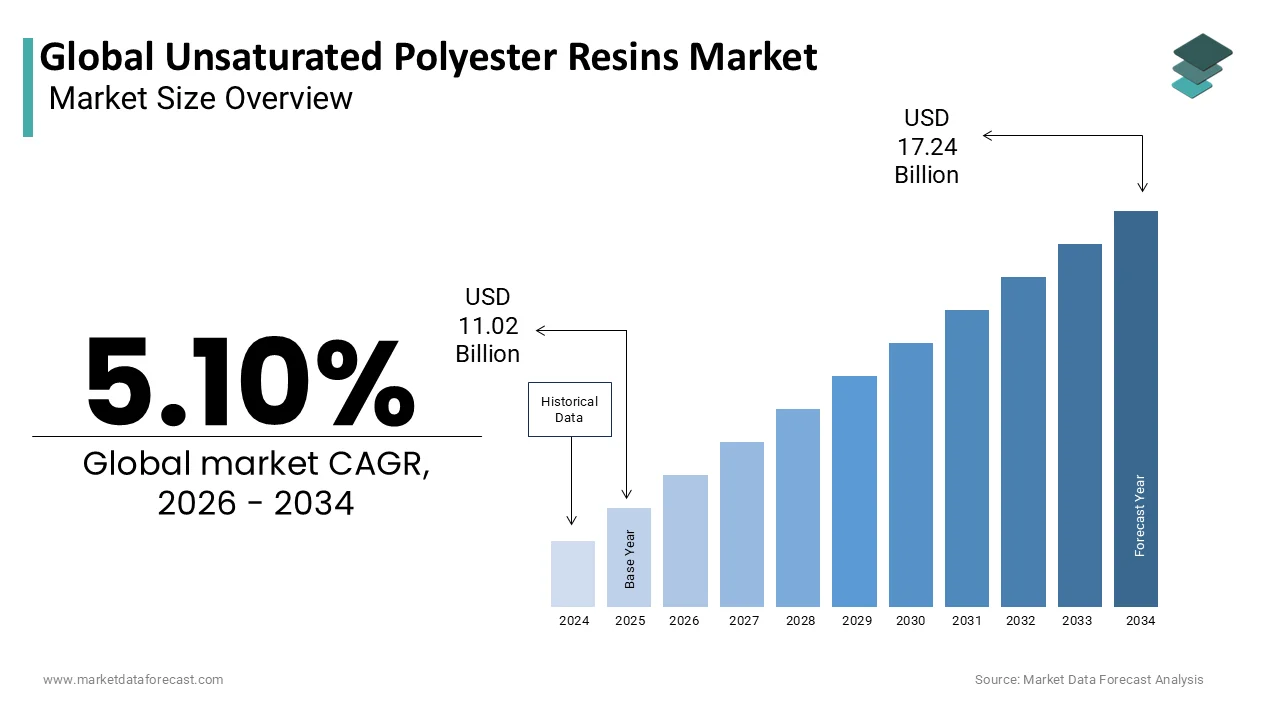
The global unsaturated polyester resins market size was valued at USD 11.02 billion in 2025 and is expected to reach USD 17.24 billion by 2034 from USD 11.58 billion in 2026. The market is projected to grow at a CAGR of 5.10%.
Unsaturated polyester resins are thermosetting polymers synthesized by polycondensation of dibasic organic acids, typically maleic anhydride and phthalic anhydride, with polyhydric alcohols such as propylene glycol, subsequently dissolved in reactive vinyl monomers like styrene. Their molecular architecture enables cross-linking under ambient or elevated temperatures, yielding rigid, corrosion-resistant matrices ideal for fiber-enhanced composites. As per the American Composites Manufacturers Association, over 80% of marine hulls and wind turbine blades produced in North America rely on UPR-based laminates for structural integrity. Globally, annual UPR consumption exceeds 10 million metric tons, with China alone producing 4.3 million metric tons in 2023 according to the China Federation of Petroleum and Chemical Industry. Their dominance stems from cost-performance equilibrium unmatched by epoxy or vinyl ester alternatives in non-aerospace applications.
MARKET DRIVERS
Wind Energy Demand Drives UPR Resin Growth
Its entrenched role in wind energy infrastructure, particularly in turbine blade manufacturing where cost efficiency and rapid cure kinetics are non-negotiable, is primarily driving the unsaturated polyester resins market. Each 80-meter blade requires metric tons of UPR-fiberglass composite, as per study, which pointed out gigawatts of new global installations, which translates to millions of metric tons of resin demand. India saw domestic blade production surged year-over-year in 2023 to meet a portion of new farm deployments, which directly correlates with regional procurement. Unlike epoxies, UPR permits ambient-temperature curing, which reduces energy intensity per blade.
Sanitaryware and Bathroom Fixtures Boost UPR Market
The proliferation of sanitaryware and bathroom fixtures in emerging economies, where UPR-based solid surface materials offer moldability, stain resistance, and low maintenance, also contributes to the expansion of the unsaturated polyester resins market. As per the study, millions of vanity tops and bathtubs were fabricated using filled UPR systems, growing annually due to urban housing incentives. In Southeast Asia, modern Indonesian initiatives, including those involving the Ministry of Villages and other ministries, focus on linking sanitation improvements to wider environmental goals, such as combating climate change and moving towards a circular economy. UPR’s compatibility with mineral fillers like alumina trihydrate also enables fire-retardant formulations, vital for compliance with Building Code on combustibility.
MARKET RESTRAINTS
Styrene Emission Regulations Restrict UPR Growth
Tightening regulatory scrutiny over styrene emissions, a volatile organic compound integral to UPR curing, restricts the growth of the unsaturated polyester resins market. As per research, composite manufacturing facilities contributed notable tons of styrene annually by prompting the agency to lower permissible exposure limits. Styrene is registered under the EU's REACH regulation and does have other classifications. These include classifications as a skin and eye irritant and a Category 2 reproductive toxicant. In the U.S., the Environmental Protection Agency (EPA) is prioritizing styrene for risk evaluation under the Toxic Substances Control Act (TSCA). This starts a multi-year review process and is not an immediate finding of unreasonable risk. These compliance burdens disproportionately impact small molders lacking capital for abatement infrastructure.
Bio-Based Alternatives Reduce UPR Market Share
The accelerating substitution by bio-based and low-VOC alternatives in architectural and consumer applications further impacts the unsaturated polyester resins market growth. As per the study, polyurethane-acrylate hybrids exhibit a portion of UPR’s mechanical strength with lower VOC off-gassing, which makes them preferred for indoor countertops and furniture. Also, IKEA's requirements for composite wood products emphasize controlling formaldehyde and other volatile organic compound (VOC) emissions, but this is handled through its own testing and standards. Home Depot stocks a variety of shower pans in different materials, including acrylic, fiberglass, and solid-surface, to meet various price points and consumer demands, according to research
MARKET OPPORTUNITIES
Lightweight UPR Composites Expand Marine Applications
The decarbonization of marine transport through lightweight UPR-composite hulls for short-sea shipping and electric ferries, gives new opportunities for the expansion of unsaturated polyester resins market. As per DNV’s Maritime Forecast 2023, Replacing a steel hull with a lighter UPR-glass fiber laminate will reduce overall vessel weight, leading to a smaller, but still significant, improvement in battery range for a zero-emission ferry. Norway pioneered the first all-electric car ferry, the Ampere, in 2015. The nation continues to lead in electrifying its extensive ferry network, which is essential for connecting its coastal communities. The marine composites landscape, including the use of UPR, is indeed growing, driven by a general desire for lightweight and corrosion-resistant materials, particularly in the recreational boating and luxury yacht sectors. UPR’s saltwater corrosion resistance further eliminates maintenance cycles, offering lifecycle cost advantages over metals.
Chemical Recycling Unlocks Circular Economy Potential
Circular economy integration, wherein chemical recycling of end-of-life UPR composites unlocks virgin-equivalent monomers, is another emerging opportunity for the unsaturated polyester resins market growth. As per the study, microwave-assisted glycolysis can recover a percentage of original polyester chains from shredded wind turbine blades. Siemens Gamesa is a Spanish company, the first commercial RecyclableBlades were produced at its factory in Aalborg, Denmark. They were then installed and piloted at the Kaskasi offshore wind farm in Germany. The innovation involves a new type of recyclable resin used in the manufacturing of new blades. UPR producers investing in depolymerization infrastructure can monetize waste streams while securing regulatory-compliant feedstock, a dual-value proposition absent in thermoplastic alternatives.
MARKET CHALLENGES
Feedstock Price Volatility Impacts UPR Margins
The volatility of upstream feedstock pricing, particularly propylene glycol and phthalic anhydride, whose costs are tethered to crude oil and benzene markets, challenges the unsaturated polyester resins market. As per the research, propylene glycol spot prices surged following Middle East refinery outages, compressing UPR producer margins below. Simultaneously, in China, independent refineries in Shandong were operating at 40% lower rates, and some plants with a capacity of 4200 KTPA completely ceased production. The broader crackdown also led to the closure of nearly 3,000 chemical companies in Shandong, representing approximately one-third of the province's chemical enterprises, and eliminated 10.8 million tons of backward production capacity. This disruption in supply chains affected the production of various raw materials, potentially including phthalic anhydride, leading to higher prices for certain affected chemicals. Thus, regional compounders face existential margin erosion.
UPR Unsuitable for 3D Printing Limits Adoption
The technical incompatibility of conventional UPR systems with next-generation continuous fiber 3D printing, which demands precisely controlled rheology and ultra-low shrinkage, also affects the growth of the unsaturated polyester resins market. As per the study, additive manufacturers increasingly favor vinyl ester and epoxy acrylate resins for layer-adhesion fidelity, leaving UPR confined to compression molding and hand lay-up. Instead of UPR, GE uses high-performance materials like titanium, aluminum, and nickel superalloys (such as Inconel) for flight-critical, high-temperature parts, and high-performance polymers (like PEKK and Ultem) for interior components and lower-pressure ducts. These materials are selected to meet the demanding requirements of aerospace for strength, weight, and thermal resistance. Therefore, UPR risks exclusion from Industry 4.0 manufacturing ecosystems, despite its cost advantage, which erodes relevance in high-growth and high-margin digital fabrication sectors.
REPORT COVERAGE
| REPORT METRIC | DETAILS |
| Market Size Available | 2025 to 2034 |
| Base Year | 2025 |
| Forecast Period | 2026 to 2034 |
| CAGR | 5.10% |
| Segments Covered | By Type, By End-Use Industry, and Region. |
| Various Analyses Covered | Global, Regional & Country Level Analysis, Segment-Level Analysis, DROC, PESTLE Analysis, Porter’s Five Forces Analysis, Competitive Landscape, Analyst Overview of Investment Opportunities |
| Regions Covered | North America, Europe, APAC, Latin America, Middle East & Africa |
| Market Leaders Profiled | BASF SE, Dow Chemical Company, Ashland, Inc., Swancor, AOC LLC, E. I. du Pont de Nemours and Company, Reichhold LLC, DSM, LanxessAktiengesellschaft, Scott Bader Royal DSM. |
SEGMENTAL ANALYSIS
By Type Insights
In 2025, the orthophthalic resins segment led the global unsaturated polyester resins market with 62% share in 2025. Their cost efficiency and adequate performance in non-essential applications such as bathtubs, automotive body panels, and general-purpose fiberglass laminates largely propels the growth of the orthophthalic resins segment in global market. Their hegemony is supported by feedstock accessibility. Phthalic anhydride, derived from coal tar or naphtha, remains cheaper than isophthalic acid per metric ton, as per study. In India, orthophthalic consumption exceeded notable metric tons, driven by sanitaryware manufacturers prioritizing price over chemical resistance, according to the research. The segment’s entrenched position in low-margin and high-volume sectors ensures structural resilience despite regulatory and substitution burdens.
The isophthalic resins segment is predicted to witness the highest CAGR of 7.1% from 2026 to 2034. The demand in chemically aggressive environments such as chemical storage tanks, marine hulls, and offshore platforms boosts the expansion of the isophthalic resins segment. Moreover, Isophthalic resins offer good hydrolytic stability and chemical resistance, which makes them suitable for applications involving water or mild chemical exposure. Chemical resistance testing is performed according to standards like ASTM D543 to evaluate a material's performance against specific chemical reagents. However, isophthalic resins generally show less resistance to strong alkalis like sodium hydroxide (NaOH) compared to specialized resins like vinyl esters. The choice of resin depends on the specific application's chemical environment, not solely on a fabricator's ISO 9001 certification. Within the FRP domain, isophthalic resins are an appropriate choice due to their strength and corrosion resistance.
By End-Use Industry Insights
The building and construction segment dominated the unsaturated polyester resins market by accounting for 38.3% of global market in 2025. The prominence of the building and construction segment is attributed to the demand for artificial marble countertops, roofing sheets, and corrosion-resistant cladding. In addition, the market for UPR in India's building and construction segment is significant. India's rapid infrastructure growth, including bridges, pipes, and tanks, is a major driver of UPR demand. UPR's properties, such as corrosion resistance and durability, make it ideal for these applications. In Southeast Asia, Indonesia's sanitation efforts have relied on diverse, community-based solutions rather than a single, large-scale mandate for UPR tanks. The material’s moldability and low maintenance in humid climates further supports its dominance over ceramics and metals.
The wind energy segment is predicted to grow at the fastest rate of 9.4% CAGR over the forecast period due to global turbine blade production scaling to meet net-zero targets. Wind turbine blades and nacelles are the primary parts made from composites, accounting for about 11–16% of a turbine's total mass, as per study. Furthermore, China installed 74.7 GW of new wind capacity in 2023. The split was 67.8 GW onshore and nearly 7 GW offshore. This record-breaking installation pace confirms the high demand for wind turbine components, including composite materials, according to research. Simultaneously, the U.S. Department of Energy allocated $5.1 million in 2023 for developing recyclable wind turbine materials. Lightweighting imperatives and ambient-cure economics make UPR irreplaceable despite emerging bio-alternatives.
REGIONAL ANALYSIS
North America Market Analysis
North America expanded steadily in the global unsaturated polyester resins market du e to marine, wind energy, and infrastructure rehabilitation sectors. The region’s position is supported by performance-driven specifications. According to study, a share of new recreational boats under 30 feet use orthophthalic UPR for hulls due to cost-performance balance. The U.S. Department of Transportation's (DOT) Bridge Investment Program (BIP) received multi-year funding through the Bipartisan Infrastructure Law, with a large-scale grant opportunity announced in late 2023.
Latin America Market Analysis
Latin America also grows in the unsaturated polyester resins market, with Brazil and Mexico driving consumption through automotive aftermarket and sanitaryware production. Brazil’s automotive refinish sector expanded, according to the study, relying on orthophthalic UPR for fender and bumper repairs due to ambient cure and sandability. Mexico’s initiative added notable number of residential units, each incorporating bathroom fixtures. Rising coastal infrastructure investment, particularly in Chile and Colombia, is accelerating marine-grade isophthalic adoption, with boat production growing annually.
Europe Market Analysis
Europe captured the second-largest share of 26% of the unsaturated polyester resins market. The growth of Europe in the global market is propelled by circular economy mandates and offshore wind expansion. Germany recycled large metric tons of UPR composites via glycolysis, as per the study, which reduces virgin resin demand. The offshore wind sector is a major driver of growth for the European UPR market, according to research. Simultaneously, styrene is under regulatory review, driving voluntary reformulation efforts among manufacturers. German resin producers are actively increasing R&D investments to develop less-hazardous alternatives like vinyl toluene and methyl methacrylate to address regulatory pressures and market demand for more sustainable solutions.
Asia Pacific Market Analysis
Asia Pacific was the top performer in the unsaturated polyester resins market with 41% share of the global market in 2025, which is propelled by China’s wind blade manufacturing and India’s construction boom. China produced millions of metric tons of UPR, according to the study, with a percentage consumed by wind turbine factories clustered. India’s sanitaryware output grew by absorbing large metric tons of orthophthalic resin. Southeast Asia’s artificial stone export sector relies on UPR-mineral composites for countertop fabrication, with Vietnam and Thailand increasing production capacity to meet U.S. and EU demand.
Middle East & Africa Market Analysis
The Middle East & Africa collectively is likely to grow, with Gulf infrastructure and African sanitation projects shaping regional dynamics. Saudi Arabia’s NEOM megaproject consumed metric tons of fire-retardant UPR composites for modular housing and utility tunnels, as per study. Egypt’s Suez Canal Economic Zone attracted funds in composite manufacturing FDI by targeting European wind blade exports.
COMPETITIVE LANDSCAPE
KEY MARKET PLAYERS
Some of the key players dominating the global unsaturated polyester resins market are
- BASF SE
- Dow Chemical Company
- Ashland, Inc.
- Swancor
- AOC LLC
- E. I. du Pont de Nemours and Company
- Reichhold LLC
- DSM
- Lanxess Aktiengesellschaft
- Scott Bader
- Royal DSM
TOP STRATEGIES USED BY KEY MARKET PLAYERS
Leading unsaturated polyester resin producers prioritize formulation innovation, developing low-VOC, bio-based, and recyclable variants to comply with tightening environmental regulations. They vertically integrate upstream into monomer production to hedge against feedstock volatility and secure cost stability. Strategic partnerships with OEMs, particularly in wind energy and marine sectors, embed resin chemistry into proprietary manufacturing systems. Companies deploy AI and IoT-enabled process controls to ensure rheological consistency important for automated composite fabrication. Export-focused players establish regional compounding hubs to tailor cure profiles and filler compatibility to local climatic and regulatory conditions, which reduces logistics spoilage and enhancing customer retention.
COMPETITION OVERVIEW
The unsaturated polyester resins market exhibits moderate concentration, with competition pivoting on technical differentiation, regulatory compliance, and supply chain resilience rather than price alone. European and North American players emphasize sustainability and traceability, while Asian producers leverage scale and feedstock proximity. Innovation centers on solving application-specific challenges—ambient cure for wind blades, chemical resistance for tanks, low shrinkage for artificial stone. New entrants face prohibitive barriers due to capital-intensive reactor systems and stringent OEM certifications. Market leaders increasingly monetize circularity, offering take-back programs and depolymerization services, transforming waste liability into value-added service revenue and securing long-term procurement contracts under ESG-aligned procurement policies.
TOP PLAYERS IN THE MARKET
- Ashland Global Holdings Inc. engineers performance-driven unsaturated polyester resins for wind energy, marine, and corrosion-resistant infrastructure, emphasizing low-VOC and styrene-reduced formulations. The company partnered with to co-develop ambient-cure blade resins compatible with automated fiber placement, reducing energy use per blade. Ashland also commissioned a closed-loop recycling pilot to recover glycol and acid monomers from end-of-life composites, which aligns with circular economy mandates in North America and Europe.
- Polynt-Reichhold Group operates as a vertically integrated leader, controlling upstream monomer supply and downstream composite solutions across countries. Polynt launched an isophthalic resin optimized for chemical tank linings in mining operations, validated under NORSOK M-501 standards.
- AOC Aliancys, formed through the merger of Aliancys and AOC, delivers application-specific UPR systems with regional formulation centers in China, Germany, and the U.S. The company co-engineered fire-retardant UPR laminates with Saudi Arabia’s NEOM construction division for underground utility tunnels. AOC Aliancys also deployed blockchain-tracked resin batches to Siemens Gamesa, ensuring traceability of recycled content in wind blades by meeting EU Circular Economy Action Plan compliance without compromising mechanical performance.
MARKET SEGMENTATION
This research report on the global unsaturated polyester resins market has been segmented and sub-segmented based on type, end-user industry, and region.
By Type
- Orthophthalic
- Isophthalic
- DCPD
By End-Use Industry
- Building and Construction
- Marine
- Land transportation
- Pipes and tanks
- Artificial stone
- Wind energy
- Electrical and electronics
By Region
- North America
- Europe
- Asia Pacific
- Latin America
- Middle East & Africa