- Product Description Description
- Table of Contents TOC
- List of Table & Figure LOT
- Get Free Sample PDF Sample PDF
Market Size, 2025
$0.92 BnMarket Estimate, 2026
$0.95 BnMarket Forecast, 2034
$1.21 BnCAGR, 2026–2034
3.10%Global Friction Modifiers Market Size, Growth, Trends & Forecast (2026–2034)
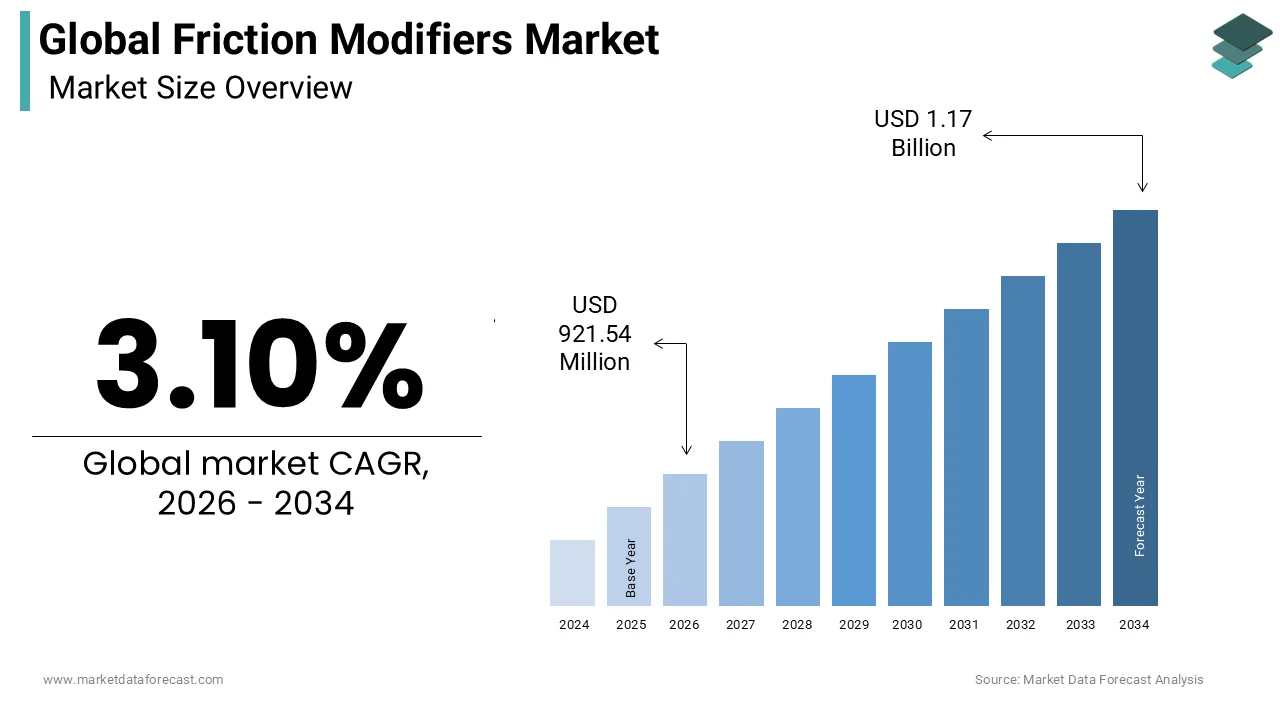
The global friction modifiers market size was calculated to be USD 0.92 billion in 2025, is anticipated to reach USD 0.95 billion in 2026, and is projected to scale up to USD 1.21 billion by 2034, registering a compound annual growth rate (CAGR) of 3.10% during the forecast period from 2026 to 2034. Driven by stringent fuel economy regulations, the proliferation of electric vehicle (EV) powertrain technologies, and the growing industrial emphasis on tribological energy conservation, the chemical additive and lubrication industry continues to expand steadily worldwide.
Key Executive Metrics (At-a-Glance)
- 2025 Base Valuation: USD 0.92 Billion
- 2026 Current Valuation: USD 0.95 Billion
- 2034 Forecast Valuation: USD 1.21 Billion
- Compound Annual Growth Rate (CAGR): 3.10% (2026–2034)
- Dominant Type Segment: Organic Friction Modifiers (holding majority share due to excellent compatibility with low-viscosity base oils and superior cost efficiency)
- Dominant End-User Segment: Automotive (capturing a major share backed by massive global vehicle parc and strict fuel economy mandates)
- Fastest-Growing Type Segment: Inorganic Friction Modifiers (projected at a CAGR of 6.2% driven by nanotechnology and extreme-pressure applications)
- Fastest-Growing End-User Segment: Industrial (projected at a CAGR of 5.8% fueled by wind energy infrastructure and automation/robotics)
- Dominant Region: Asia-Pacific (holding a 35.1% market share in 2025, driven by massive vehicle production and rapid industrialization)
Core Market Drivers
- Stringent Fuel Economy & Emission Standards: Regulatory frameworks (such as NHTSA CAFE standards and EU CO2 performance targets) compelling OEMs to minimize mechanical and tribological energy losses.
- Electric Vehicle Powertrain Evolution: High-speed EV reduction gears and specialized electromechanical operating conditions driving demand for dielectric-compatible e-fluids.
- Energy Efficiency & Tribology Focus: Mitigating the substantial worldwide energy consumption lost to friction through advanced boundary lubrication films.
Primary Market Restraints & Challenges
- Raw Material Price Volatility: Severe supply chain swings for key oleochemicals and molybdenum precursors compressing additive manufacturer margins.
- Technical & Formulation Complexity: Complex additive compatibility challenges, long validation cycles, and balancing performance across diverse operating regimes.
Global Friction Modifiers Market Segmentation Breakdown
| Segment Category | Leading Sub-Segment (2025 Base) | Fastest-Growing Sub-Segment (2026–2034) |
|---|---|---|
| By Type | Organic Friction Modifiers (dominant share due to low-viscosity oil compatibility and cost efficiency) | Inorganic Friction Modifiers (fastest at 6.2% CAGR, driven by nano-materials and extreme-pressure demands) |
| By End-User Industry | Automotive (dominant share backed by massive vehicle parc and fuel economy regulations) | Industrial (fastest at 5.8% CAGR, fueled by wind energy infrastructure and robotics) |
| By Region | Asia-Pacific (largest regional market with 35.1% share led by China and India) | Asia-Pacific & Latin America (driven by manufacturing scale and resource-based industrial sectors) |
Major Industry Players Profiled
Key enterprises shaping the global friction modifiers and specialty chemical ecosystem include Cabot Corporation, INX International Ink Co., Kornit Digital, Marabu GmbH & Co. KG, Nazdar, Nutec Digital Ink, Sensient Imaging Technologies, Siegwerk Druckfarben AG & Co. KGaA, Sun Chemical, Toyo Ink Co., Ltd., and Wikoff Color Corporation.
 Download Free Sample Report
Global Friction Modifiers Market Size
The global friction modifiers market size was calculated to be USD 0.92 billion in 2025 and is anticipated to be worth USD 1.21 billion by 2034, growing from USD 0.95 billion in 2026 at a CAGR of 3.10% during the forecast period.
Friction modifiers are specialized chemical additives engineered to alter the coefficient of friction between interacting surfaces, primarily within lubricants, metalworking fluids, and functional coatings. These compounds function by adsorbing onto metal surfaces to form protective boundary films that minimize wear, reduce energy loss, and prevent stick-slip phenomena in precision machinery. The global significance of these additives is underscored by the immense scale of tribological inefficiency. According to the journal Friction, approximately 23% of total worldwide energy consumption originates from tribological contacts, with 20% of global energy spent directly on overcoming friction. This staggering statistic illustrates the critical role friction modifiers play in global energy conservation efforts beyond simple mechanical maintenance. Furthermore, research shows that implementing advanced lubrication and surface technologies can reduce parasitic energy losses by up to 40% long-term, helping sectors meet net-zero carbon emissions targets. The application of these modifiers extends across automotive transmissions, wind turbine gearboxes, and heavy industrial equipment, where precise friction control is paramount for operational reliability. The evolution of friction modifier chemistry now increasingly intersects with sustainability mandates, driving the development of bio-based and ashless formulations that maintain performance while adhering to stringent environmental regulations regarding aquatic toxicity and biodegradability.
MARKET DRIVERS
Stringent Fuel Economy Regulations and Emission Standards
The imposition of rigorous fuel economy standards and emission reduction targets propels the growth of the friction modifiers market. This serves as a primary demand driver for advanced friction modifiers in the automotive and industrial sectors. Regulatory bodies worldwide have established aggressive benchmarks that compel original equipment manufacturers to minimize mechanical losses through optimized tribology. According to the National Highway Traffic Safety Administration (NHTSA), the Corporate Average Fuel Economy (CAFE) standards require new passenger vehicles to reach an overall fleet average of roughly 49 miles per gallon by model year 2026, forcing the integration of ultra-low viscosity oils. Similarly, the European Union’s CO2 emission performance standards mandate a 15 percent reduction in fleet-wide emissions for new cars by 2025 compared to 2021 baselines, directly correlating with increased formulation complexity. As per research from the Society of Automotive Engineers, optimizing friction coefficients in engine valve trains and transmission systems can yield fuel efficiency improvements ranging from 1 percent to 3 percent, which translates to billions of tons of avoided carbon dioxide emissions annually across global vehicle fleets. This regulatory pressure forces lubricant formulators to transition from traditional fatty acid amides to sophisticated organomolybdenum and polymeric friction modifiers that deliver stable friction characteristics under extreme thermal stress. The direct link between compliance and additive technology ensures sustained demand for next-generation friction control solutions that enable smaller displacement engines and electrified powertrains to meet legislative requirements without sacrificing durability or drivability.
Expansion of Electric Vehicle Powertrain Technologies
The rapid proliferation of electric vehicles creates a distinct and growing demand for specialized friction modifiers tailored to unique electromechanical operating conditions, which fuels the expansion of the global market. Unlike internal combustion engines, electric motors operate at significantly higher rotational speeds, often exceeding 20000 revolutions per minute while generating substantial heat within compact housings. According to the International Energy Agency, global electric car sales surpassed 14 billion units in 2023, representing a 35 percent year-on-year increase that fundamentally reshapes lubricant requirements. Electric vehicle transmissions and reduction gears require friction modifiers that provide consistent torque transfer while maintaining electrical insulation properties and compatibility with copper windings. Tribology Letters reveals that improper balancing of lubricant electrical properties in electric drivetrains causes destructive electrical bearing currents and severe micro-pitting. The absence of combustion byproducts in electric systems also demands friction modifiers with enhanced oxidative stability since oil drain intervals are typically extended. Furthermore, the acoustic sensitivity of electric vehicles requires additives that eliminate gear whine and bearing noise through precise friction damping. Lubricant manufacturers are consequently developing novel ester-based and ionic liquid friction modifiers specifically designed for dielectric compatibility and high-speed shear stability. This technological divergence from conventional automotive lubricants opens new revenue streams and necessitates dedicated research investment, positioning electric mobility as a transformative growth vector for the friction modifier industry throughout the forecast period.
MARKET RESTRAINTS
Volatility in Raw Material Supply Chains
Significant price volatility and supply chain insecurity for key raw materials are a major restraint impacting the friction modifiers market. Many high-performance friction modifiers rely on specialty chemicals derived from petrochemical feedstocks or specific natural fats whose availability fluctuates based on geopolitical tensions and agricultural yields. According to the World Bank Commodity Markets Outlook, prices for key oleochemical precursors such as palm kernel oil and tallow have experienced swings exceeding 30 percent within single fiscal years due to weather disruptions and export restrictions in producing nations. Molybdenum, a critical component in premium antiwear friction modifiers, faces similar instability. According to industrial metals trading data, molybdenum, the core element for oil-soluble MoDTC friction modifiers, has faced sharp market volatility, with spot prices spiking over 40% due to structural supply deficits. This unpredictability compresses profit margins for additive manufacturers who often cannot immediately pass cost increases to price-sensitive end users in competitive lubricant markets. Formulators must therefore maintain costly inventory buffers or reformulate products frequently, both of which erode operational efficiency. The inability to secure stable long-term pricing contracts for these niche intermediates discourages capital investment in capacity expansion and limits the commercial viability of certain high-performance formulations, thereby constraining overall market growth despite robust underlying demand signals.
Technical Complexity in Multifunctional Additive Compatibility
The intricate chemical interactions required to balance friction modification with other lubricant functions impede the expansion of the friction modifiers market. This is a significant technical hurdle in product development and market adoption. Modern lubricants contain complex packages of detergents, dispersants, antioxidants, and antiwear agents that must coexist without antagonism. Lubricant Additives: Chemistry and Applications demonstrates that competitive surface adsorption between polar friction modifiers and ZDDP antiwear agents can heavily restrict tribofilm formation. As per testing protocols documented by ASTM International, validating a new friction modifier formulation typically requires over 2000 hours of bench testing and multiple full-scale engine trials costing hundreds of thousands of dollars before commercial release. This extensive validation burden slows innovation cycles and raises barriers to entry for smaller specialty chemical firms. The trend toward lower viscosity oils exacerbates compatibility challenges because reduced base oil film strength places greater reliance on additive surface chemistry, narrowing the acceptable performance window. Furthermore, the shift toward bio-based and ashless formulations introduces novel molecular structures whose interaction mechanisms with legacy additives remain poorly characterized. Formulators must navigate this multidimensional optimization space without compromising any single performance attribute, making successful product launches increasingly rare and expensive. This technical barrier restricts the pace at which superior friction modifiers can reach the market, even when clear performance advantages exist in isolation.
MARKET OPPORTUNITIES
Development of Bio-Based and Sustainable Additives
The accelerating transition toward circular economy principles creates a pathway for bio-based and environmentally benign friction modifiers, which are expected to boost the growth of the global market. Regulatory frameworks and corporate sustainability commitments are driving demand for additives derived from renewable feedstocks that offer comparable performance to petroleum-based counterparts. According to the European Chemicals Agency, revisions to the REACH regulation and upcoming restrictions on per- and polyfluoroalkyl substances are pushing formulators toward safer alternatives, with bio-based esters and vegetable oil derivatives emerging as preferred friction modifier platforms. Advances in green chemistry now enable the synthesis of high-purity dimer acids and polyol esters from non-food biomass sources, eliminating previous performance gaps related to oxidative stability and hydrolytic resistance. Major agricultural processors are investing in fractionation technologies to produce consistent oleochemical streams specifically for lubricant applications, improving supply reliability. The premium pricing achievable for sustainable formulations offsets higher production costs, creating attractive margin structures for early movers. Additionally, end-of-life vehicle directives and industrial wastewater regulations increasingly favor readily biodegradable additives, expanding addressable markets in marine, forestry, and mining sectors where environmental exposure is unavoidable. This convergence of regulatory push, technological maturity, and market pull positions bio-based friction modifiers as a high-growth segment with long-term structural tailwinds.
Integration with Smart Manufacturing and Predictive Maintenance
The digital transformation of industrial operations offers a novel opportunity for these modifiers integrated with condition monitoring and smart lubrication systems, which is likely to accelerate the expansion of the friction modifiers market. Industry 4.0 initiatives are creating demand for additives that not only modify friction but also serve as chemical sensors or respond dynamically to changing operating conditions. According to research, predictive maintenance technologies could reduce machine downtime by 30 percent to 50 percent by 2025, driving integration of lubricant analytics into asset management platforms. As per research published in Sensors and Actuators B: Chemical, novel friction modifiers incorporating fluorescent or electroactive moieties can provide real-time feedback on film thickness and degradation state through embedded sensors, enabling proactive intervention before failure occurs. This functionalization transforms passive additives into active components of digital twin ecosystems. Lubricant companies partnering with sensor manufacturers and industrial Internet of Things platform providers can offer bundled solutions that command premium pricing and deepen customer lock-in. The rise of centralized lubrication systems in automated factories further amplifies this opportunity, as precisely metered delivery of responsive friction modifiers optimizes consumption and extends service intervals. Early adopters leveraging this convergence gain competitive differentiation in an increasingly commoditized market. The intersection of tribology and digitalization is still nascent. However, it represents a Blue Ocean Strategy for forward-looking additive suppliers seeking to escape pure price competition and capture value through performance-based service models.
MARKET CHALLENGES
Balancing Performance Across Diverse Operating Regimes
Achieving consistent friction modification across widely varying temperature, load, and speed conditions remains a persistent technical challenge for the global market. Real-world machinery rarely operates at steady state, yet most friction modifiers exhibit optimal performance only within narrow windows. According to experimental data from the STLE Annual Meeting proceedings, the friction coefficient of common organic friction modifiers can vary by more than 50 percent between 40 degrees Celsius and 120 degrees Celsius, causing shudder in automatic transmissions or chatter in metal cutting operations during warmup and cooldown phases. Developing molecules with flat temperature response curves requires sophisticated molecular design and extensive empirical screening, increasing development costs and time to market. The challenge intensifies with hybrid and electric powertrains that experience rapid thermal transients and bidirectional loading patterns absent in conventional systems. Furthermore, the industry trend toward universal lubricants that serve multiple functions across different equipment types compounds the difficulty, as optimal friction for wet brakes may be detrimental to gear protection. This fundamental tension between specialization and versatility forces formulators into iterative compromise, limiting the performance ceiling achievable in any single application and perpetuating customer dissatisfaction that constrains premium pricing potential.
Regulatory Uncertainty and Reclassification Risks
Evolving chemical safety regulations and potential reclassification of established friction modifier chemistries create significant uncertainty that hampers long-term planning and investment in the global market. Regulatory agencies worldwide are reassessing legacy substances under updated toxicological frameworks, threatening to restrict or ban compounds that have served as industry workhorses for decades. Under the European Chemicals Agency (ECHA) CoRAP guidelines, several standard chemical additives face evaluation for high aquatic toxicity, creating persistent compliance and replacement pressures for lubricant blenders. The lack of harmonized global standards means companies must maintain region-specific formulations, fragmenting production and increasing complexity. Precautionary substitution driven by retailer or OEM restricted substance lists often precedes formal regulatory action, creating de facto bans based on incomplete data. This regulatory overhang discourages capital expenditure on capacity for affected chemistries and diverts research resources toward defensive reformulation rather than genuine innovation. Market participants currently face elevated risk premiums and delayed product launches until clearer guidance emerges. Hence, this suppresses growth potential despite strong underlying demand for friction control solutions.
REPORT COVERAGE
| REPORT METRIC | DETAILS |
| Market Size Available | 2025 to 2034 |
| Base Year | 2025 |
| Forecast Period | 2026 to 2034 |
| CAGR | 3.1% |
| Segments Covered | By Type, Application, And Region |
| Various Analyses Covered | Global, Regional & Country Level Analysis, Segment-Level Analysis, DROC, PESTLE Analysis, Porter’s Five Forces Analysis, Competitive Landscape, Analyst Overview on Investment Opportunities |
| Regions Covered | North America, Europe, Asia Pacific, Latin America, and the Middle East & Africa |
|
Market Leaders Profiled | Cabot Corporation, INX International Ink Co, Kornit DigitalMarabu GmbH & Co. KG, Nazdar, Nutec Digital Ink, Sensient Imaging Technologies, Siegwerk Druckfarben AG & Co, KgaA, Sun Chemical, Toyo Ink Co., Ltd, And Wikoff Color Corporation |
SEGMENTAL ANALYSIS
By Type Insights
In 2025, the organic friction modifiers segment held the majority share of the global market because of its exceptional compatibility with modern low viscosity base oils and ability to form stable boundary films without leaving abrasive residues. As automotive and industrial equipment manufacturers shift toward thinner lubricants to reduce churning losses, organic compounds such as fatty acid amides, esters, and glycerol monooleates provide the necessary surface protection that inorganic solids cannot offer in hydrodynamic regimes. According to technical data from the Society of Tribologists and Lubrication Engineers, organic modifiers can reduce the coefficient of friction by up to 40 percent in steel-on-steel contacts under boundary lubrication conditions, which is critical for preventing wear in start-stop cycles. The molecular structure of organic additives allows them to adsorb reversibly onto metal surfaces, ensuring consistent performance across varying thermal loads without clogging fine filtration systems. Also, the regulatory and technical alignment ensures that organic variants remain the preferred choice for high-volume applications. Their solubility in synthetic base stocks further enhances their utility in premium lubricants where clarity and stability are paramount. The versatility of organic chemistry enables formulators to tailor chain lengths and functional groups for specific applications, maintaining their leadership position despite the emergence of alternative technologies.
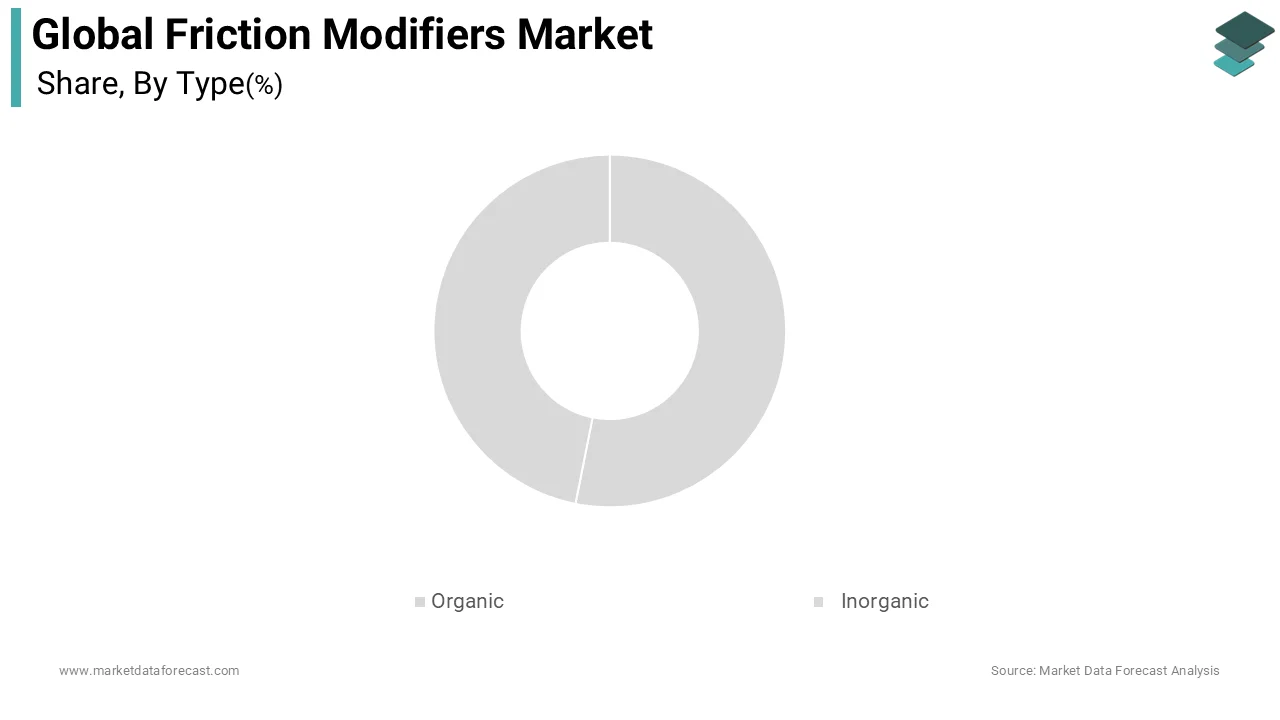
The dominance of organic friction modifiers is reinforced by a mature global manufacturing infrastructure and superior cost efficiency compared to specialized inorganic alternatives. Production facilities for key organic precursors such as oleic acid and tall oil fatty acids are widely distributed across North America, Europe, and Asia, ensuring stable supply chains and competitive pricing. According to industry cost analyses, organic friction modifiers are typically 30 percent to 50 percent less expensive per unit of performance than nano-engineered inorganic additives, making them economically viable for mass market lubricants. The scalability of organic synthesis processes allows manufacturers to meet fluctuating demand without significant capital expenditure delays. Furthermore, the established regulatory status of many organic compounds simplifies compliance with international chemical safety standards, accelerating time to market for new formulations. Formulators benefit from extensive historical data on performance and toxicity, reducing the need for costly new testing protocols. This economic and operational advantage ensures that organic friction modifiers remain the backbone of the global lubricant additive industry, particularly in price-sensitive segments such as commercial transportation and general industrial machinery, where volume drives profitability.
The inorganic friction modifiers segment is anticipated to witness the fastest CAGR of 6.2% from 2026 to 2034 due to breakthroughs in nanotechnology and the demand for extreme pressure performance in heavy-duty applications. Materials such as molybdenum disulfide, graphene, and boron nitride nanoparticles offer unparalleled load-bearing capacity and thermal stability that organic molecules cannot match. According to research published in the journal Carbon, graphene-based additives can reduce friction coefficients to below 0.1 even under loads exceeding 1 gigapascal, making them ideal for wind turbine gearboxes and mining equipment. The ability of inorganic particles to fill surface asperities creates a polishing effect that smooths metal interfaces over time, leading to progressive efficiency gains. These solid lubricants remain effective at temperatures above 300 degrees Celsius, where organic films decompose, expanding their applicability in aerospace and high-speed machining. The development of dispersion technologies has overcome previous challenges related to particle agglomeration and sedimentation, enabling stable formulations. Manufacturers are increasingly incorporating these advanced inorganics into specialty greases and metalworking fluids where performance outweighs cost considerations. This technological renaissance positions inorganic modifiers as the premium choice for next-generation high-stress applications.
The growing requirement for extended oil drain intervals and enhanced component durability is accelerating the adoption of inorganic friction modifiers in commercial and industrial sectors. Inorganic additives such as zinc dialkyldithiophosphate and molybdenum complexes provide robust antiwear protection that persists throughout prolonged service life, reducing maintenance frequency and total cost of ownership. The economic incentive drives heavy-duty engine manufacturers to specify lubricants with high concentrations of durable inorganic friction modifiers. In addition, the resilience of inorganic films against oxidation and hydrolysis ensures consistent friction control over thousands of operating hours. Furthermore, the trend toward downsized high-output engines in passenger vehicles increases thermal stress on lubricants, favoring inorganic additives that resist breakdown. This shift toward longevity and reliability creates a strong value proposition for inorganic solutions, driving their rapid growth despite higher initial costs compared to organic alternatives.
By End User Industry Insights
The automotive segment led the friction modifiers market and captured a significant share in 2025. This leading position of the segment was attributed to the vast global vehicle parc and stringent fuel economy regulations that mandate efficient lubrication. With over 1.4 billion passenger cars in operation worldwide, the volume of lubricant consumption creates immense demand for friction-reducing additives. According to the International Organization of Motor Vehicle Manufacturers, global vehicle production reached 93 billion units in 2023, each requiring multiple liters of engine transmission and differential fluids formulated with precision friction modifiers. Regulatory pressures such as the Euro 7 emissions standard and US Corporate Average Fuel Economy rules force manufacturers to optimize every source of mechanical loss, with tribology offering one of the most cost-effective pathways to compliance. As per the International Council on Clean Transportation, improving lubricant friction properties can contribute up to 2 percent of the total fuel savings required to meet 2030 targets. This regulatory driver ensures that friction modifiers remain a critical component in every new vehicle formulation. The transition to automatic and continuously variable transmissions further increases the complexity and volume of friction modifier usage, as these systems require precise friction characteristics for clutch engagement. The sheer scale of the automotive sector, combined with its regulatory sensitivity, cements its position as the dominant end user.
The evolution of electric and hybrid powertrains is reshaping but sustaining the dominance of the automotive segment through new and specialized lubrication requirements. Electric vehicles require distinct friction modifiers for reduction gears and bearings that operate at high speeds and must be compatible with electrical components. According to BloombergNEF, electric vehicles are projected to capture over 40% of global new car sales by 2030, expanding the specialized market segment for dielectric fluids and targeted e-additives. Hybrid vehicles present unique challenges as they cycle between internal combustion and electric modes, requiring lubricants that perform well in both thermal regimes. The absence of combustion contaminants in EVs allows for different additive chemistries, prompting formulators to develop dedicated e-fluids. This technological shift does not reduce demand but rather diversifies it, keeping the automotive sector at the forefront of innovation. The high value placed on efficiency and range in electric vehicles ensures that premium friction modifiers will continue to be specified, maintaining the segment's leadership in terms of revenue and technological advancement.
The industrial segment is likely to experience the fastest CAGR of 5.8% during the forecast period, mainly owing to the rapid expansion of renewable energy infrastructure, particularly wind and solar power generation. Wind turbines require specialized gearbox oils with advanced friction modifiers to handle extreme loads and variable speeds while minimizing maintenance in remote locations. According to the Global Wind Energy Council, global wind capacity is set to double by 2030, requiring billions of liters of high-performance lubricants annually. Solar tracking systems also utilize geared motors that benefit from low-friction coatings to improve positioning accuracy and reduce energy consumption. The harsh operating conditions of these installations necessitate robust friction modifiers that resist oxidation and moisture ingress. Furthermore, the trend toward larger turbine sizes increases the torque loads on gearboxes, pushing the limits of traditional additives and driving the adoption of novel inorganic solutions. This structural shift in energy generation creates a sustained growth trajectory for industrial friction modifiers that outpaces mature automotive markets.
The rise of industrial automation and precision manufacturing is fueling rapid growth in the demand for high-performance friction modifiers in robotics and CNC machinery. Automated systems rely on precise motion control, where stick-slip phenomena can cause significant errors and reduced productivity. According to the International Federation of Robotics, the global stock of operational industrial robots exceeded 3.5 billion units in 2023, each requiring specialized greases and oils with tailored friction properties. The miniaturization of mechanical components in electronics manufacturing also demands ultra-thin lubricant films with consistent friction behavior. Industries such as semiconductor fabrication and aerospace assembly require cleanliness and stability that only advanced friction modifiers can provide. The shift toward Industry 4.0 emphasizes predictive maintenance and efficiency, encouraging the use of premium lubricants that extend component life and reduce downtime. This technological intensification in manufacturing processes drives the adoption of high-value friction modifiers, making the industrial sector the most dynamic growth area in the market.
REGIONAL ANALYSIS
North America Friction Modifiers Market Analysis
North America holds a significant position in the global friction modifiers market and accounted for a 28.3% share in 2025. This growth of the regional market was driven by the fact that it is a leader in the adoption of advanced lubricant technologies, driven by strict environmental regulations and a strong focus on energy efficiency. The country’s market is known for mature automotive and industrial sectors with high regulatory standards. According to the Society of Tribologists and Lubrication Engineers (STLE), tightening federal energy regulations are the primary drivers forcing lubricant formulators to adapt advanced friction modifiers to achieve compliance. The presence of major additive manufacturers and research institutions in the United States fosters innovation in bio-based and ashless formulations. As per sources, the demand for automotive friction modifier additives in North America remains highly resilient, with automotive lubricants commanding over 50% of the additive market share. The growing electric vehicle market in the United States and Canada further stimulates demand for specialized e-fluids. The region’s well-established infrastructure for distribution and technical support ensures rapid adoption of new technologies. Additionally, the shale gas boom has increased demand for industrial lubricants in drilling and processing equipment, supporting market growth. North America’s emphasis on sustainability and performance maintains its position as a key value driver in the global market.
Europe Friction Modifiers Market Analysis
Europe is another prominent region in the global friction modifiers market. This position of the European market was supported by its rigorous environmental legislation and leadership in automotive engineering. The European Union’s Green Deal and REACH regulations drive the shift toward environmentally friendly and biodegradable friction modifiers, influencing global formulation trends. According to the European Automobile Manufacturers Association, the push for zero-emission vehicles is accelerating the development of new lubricant standards for electric powertrains. Germany, France, and the United Kingdom are primary hubs for lubricant innovation with strong collaboration between chemical companies and OEMs. Driven by stringent ECHA chemical compliance laws, advanced material research published by Springer Chemistry demonstrates that eco-friendly organic esters and tunable ionic liquids are serving as high-performance, green replacements for traditional friction additives. The region’s dense industrial base, including aerospace and machinery manufacturing, requires high-reliability lubricants with precise friction control. Europe’s commitment to circular economy principles also encourages the use of recycled base oils compatible with modern friction modifiers. The mature market focuses on value addition through performance and sustainability rather than volume growth. This regulatory and technological leadership ensures Europe remains a critical market for high-end friction modifier solutions.
Asia Pacific Friction Modifiers Market Analysis
Asia Pacific was the largest and fastest-growing region in the global friction modifiers market and captured a 35.1% share in 2025. This dominance of the APAC market was propelled by rapid industrialization and expanding automotive production. China, India, Japan, and South Korea are key contributors, with China alone accounting for over 30 percent of global vehicle production. According to the China Association of Automobile Manufacturers (CAAM), steady automotive sales and manufacturing volumes are directly fueling regional demand for high-tier engine and transmission lubricants. The region’s manufacturing sector is expanding into high-value areas such as electronics and renewable energy, increasing the need for precision friction modifiers. Japan remains a technology leader in developing advanced friction modifiers for hybrid and electric vehicles. The presence of low-cost manufacturing bases attracts global additive suppliers who are localizing production to serve regional demand. Rising awareness of fuel efficiency and equipment maintenance among consumers and industries further supports market growth. Asia Pacific’s demographic dividend and economic expansion ensure it remains the primary engine of volume growth for the global friction modifiers market.
Latin America Friction Modifiers Market Analysis
Latin America is moving ahead steadfastly in the global friction modifiers market due to a strong agricultural and mining sector that drives industrial lubricant demand. Brazil, Mexico, and Argentina are the primary markets with significant automotive manufacturing capabilities. According to Anfavea (the National Association of Motor Vehicle Manufacturers), domestic production of light vehicles and heavy trucks in Brazil sustains a stable baseline demand for specialized engine oils and transmission fluids. The mining industry in Chile and Peru requires heavy-duty lubricants with robust friction modifiers to handle extreme operating conditions in open-pit mines. Also, the Inter-American Development Bank's industrial sector data indicates that rising construction activity is steadily driving the demand for heavy-duty lubricants across Latin America. However, economic volatility and currency fluctuations can impact purchasing power and delay the adoption of premium products. The market is gradually shifting toward higher-quality lubricants as multinational companies expand operations and raise maintenance standards. Local refiners and blenders are partnering with global additive suppliers to improve product quality. Despite challenges, the region’s natural resource wealth and growing middle class provide a stable foundation for moderate market growth.
Middle East and Africa Friction Modifiers Market Analysis
The Middle East and Africa region is predicted to expand notably in the global friction modifiers market from 2026 to 2034, owing to oil and gas activities and emerging industrialization. Saudi Arabia, the United Arab Emirates, and South Africa are key markets with significant lubricant consumption. The construction boom in Gulf countries supports demand for heavy equipment lubricants. In Africa, South Africa serves as a hub for automotive manufacturing and mining, driving demand for both passenger car and industrial lubricants. The African Development Bank's Infrastructure Development Index reveals that expanding construction and agricultural mechanization programs are actively accelerating the heavy equipment lubricants market across Africa. However, limited local refining capacity means much of the market relies on imports. Economic diversification efforts in the Middle East are fostering growth in non-oil sectors such as manufacturing and logistics, creating new opportunities for friction modifiers. The market is characterized by price sensitivity, but growing awareness of the benefits of high-performance lubricants is gradually shifting preferences.
COMPETITION OVERVIEW
The competition in the global friction modifiers market is characterized by intense rivalry among established chemical giants and specialized niche players. Major companies compete primarily based on technological innovation, product performance, and regulatory compliance. The market features a mix of large integrated additive suppliers and smaller specialty chemical firms, creating a diverse landscape where differentiation is achieved through proprietary chemistries and application expertise. Innovation drives competitive advantage as firms strive to develop bio-based and ashless friction modifiers that meet stringent environmental standards while maintaining superior tribological performance. Pricing strategies play a crucial role, particularly in price-sensitive segments such as commercial transportation and general industrial lubricants. Companies invest significantly in research and development to create customized solutions for original equipment manufacturers, fostering long-term partnerships and high switching costs. The entry of regional manufacturers in the Asia Pacific adds pressure on global players to offer competitive pricing and localized support. Regulatory harmonization efforts and sustainability mandates are reshaping competitive dynamics, favoring companies with robust compliance frameworks and green portfolios. Collaborations with academic institutions and industry consortia are becoming increasingly common to accelerate innovation. This multifaceted competition ensures a steady flow of technological advancements but requires substantial investment in capital and human resources.
KEY MARKET PLAYERS
A few major players of the global friction modifiers market include
- Cabot Corporation
- INX International Ink Co.
- Kornit Digital Marabu GmbH & Co. KG
- Nazdar
- Nutec Digital Ink
- Sensient Imaging Technologies
- Siegwerk Druckfarben AG & Co. KgaA
- Sun Chemical
- Toyo Ink Co., Ltd.
- Wikoff Color Corporation
Top Strategies Used by Key Market Participants
Key players in the friction modifiers market employ several strategic approaches to maintain and enhance their competitive positions. Product innovation remains a primary strategy with companies investing heavily in research and development to create novel formulations with improved efficacy and safety profiles. Expansion into digital health solutions is another critical tactic as firms integrate telemedicine and mobile applications to support patient engagement and adherence. Strategic partnerships with healthcare providers and insurance companies help facilitate better access to treatments and improve reimbursement coverage. Marketing campaigns focused on disease awareness and education are widely used to drive diagnosis rates and encourage early intervention. Companies also pursue geographic expansion within the region to tap into underserved markets and increase their customer base. Additionally, many firms focus on portfolio diversification by adding combination therapies that address multiple symptoms simultaneously. These strategies collectively enable market participants to navigate regulatory challenges, meet evolving patient needs, and sustain growth in a dynamic healthcare environment.
Leading Players in the Global Friction Modifiers Market
- Infineum Holdings Limited stands as a premier global supplier of lubricant additives with a strong focus on advanced friction modifier technologies for automotive and industrial applications. The company leverages its extensive research capabilities to develop organic and organometallic compounds that enhance fuel efficiency and reduce wear in modern engines. Recent strategic initiatives include the expansion of its production facilities in Singapore to better serve the growing Asia Pacific market and meet increasing demand for high-performance lubricants. Infineum actively collaborates with original equipment manufacturers to co-engineer customized additive packages that comply with stringent emission standards. The company also invests heavily in sustainability programs, aiming to introduce bio-based friction modifiers that maintain superior performance while reducing environmental impact. By integrating digital tools for formulation optimization, Infineum accelerates product development cycles. This commitment to innovation and customer partnership solidifies its reputation as a technology leader in the global tribology sector.
- Afton Chemical Corporation plays a pivotal role in the global friction modifiers market by providing specialized additive solutions for transmission fluids, engine oils, and industrial lubricants. The company is renowned for its expertise in developing friction modifiers that ensure smooth shifting and optimal torque transfer in automatic transmissions. Recent actions include the launch of new ashless friction modifier platforms designed specifically for electric vehicle drivetrains, addressing the unique requirements of high-speed gears and electrical compatibility. Afton has also strengthened its global footprint by expanding technical service centers in Europe and North America to support customers with rapid formulation assistance. The company prioritizes sustainability by introducing renewable raw materials into its supply chain and reducing the carbon footprint of its manufacturing processes. Through continuous investment in laboratory testing and field trials, Afton ensures its products meet the evolving performance demands of global automotive and industrial sectors.
- Lubrizol Corporation contributes significantly to the global friction modifiers market through its comprehensive portfolio of viscosity index improvers and friction-reducing additives. The company focuses on delivering solutions that improve energy efficiency and extend equipment life across diverse applications, including passenger cars, heavy-duty trucks, and wind turbines. Recent strategic moves include the acquisition of specialized chemical assets to enhance its capability in producing high-purity organic friction modifiers. Lubrizol has also partnered with leading base oil producers to develop integrated lubricant solutions that maximize the benefits of advanced additive technologies. The company emphasizes regulatory compliance by proactively adapting its formulations to meet global chemical safety standards such as REACH. By offering tailored technical support and custom blending services, Lubrizol helps customers optimize their lubricant formulations for specific operating conditions. This customer-centric approach and technological versatility reinforce its position as a key player in the global additives industry.
MARKET SEGMENTATION
This research report on the global friction modifiers market has been segmented and sub-segmented based on type, application, and region.
By Type
- Organic
- Inorganic
By Application
- Transportation lubricants
- Industrial lubricants
By Region
- North America
- Europe
- Asia Pacific
- Latin America
- Middle East & Africa