- Product Description Description
- Table of Contents TOC
- List of Table & Figure LOT
- Get Free Sample PDF Sample PDF
Global Fuel Additives Market Summary
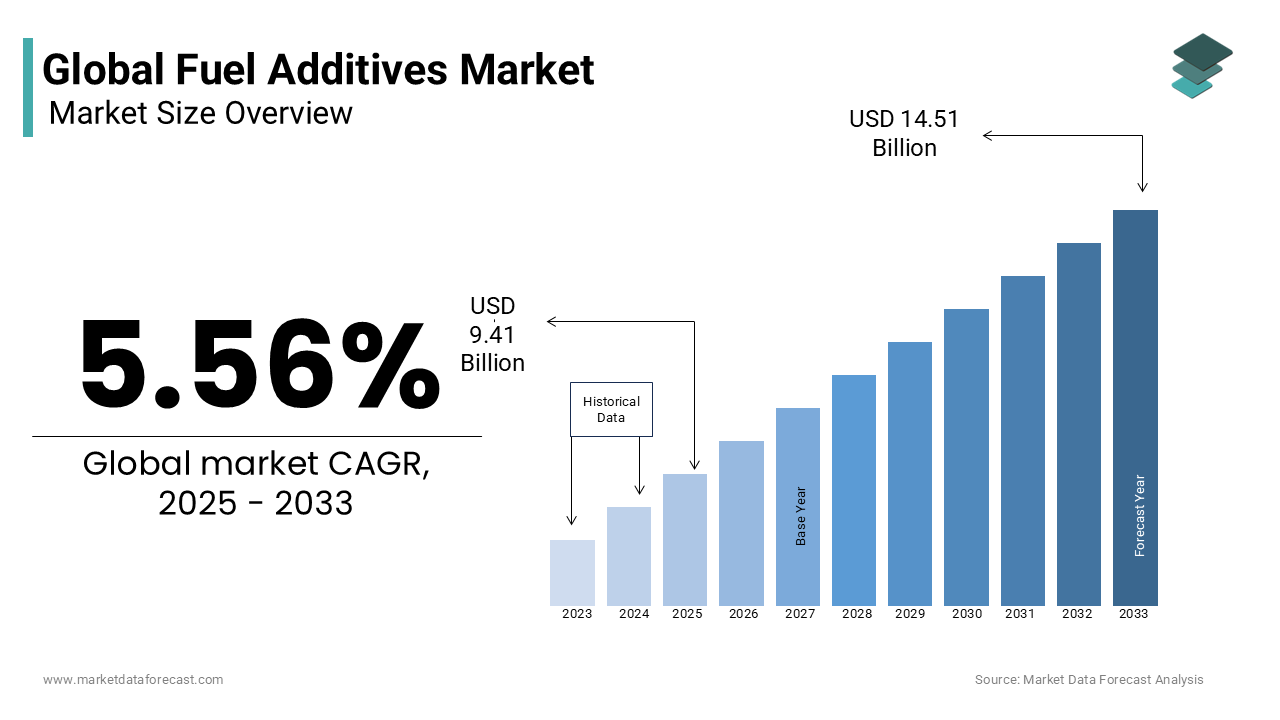
The global fuel additives market was valued at USD 8.91 billion in 2024, is estimated to reach USD 9.41 billion in 2025, and is projected to reach USD 14.51 billion by 2033, growing at a CAGR of 5.56% from 2025 to 2033. The growth of the global fuel additives market is driven by rising demand for cleaner fuels, stringent environmental regulations on emissions, and increasing adoption of fuel-efficient technologies across automotive, aviation, and marine sectors. Moreover, ongoing research into advanced multifunctional additives is boosting market expansion.
Key Market Trends
- Growing demand for deposit control and anti-knock additives to improve engine efficiency.
- Expansion of the automotive and aviation sectors in emerging economies.
- Adoption of biofuels and alternative energy blends requires advanced additives.
- Regulatory pressure for low-emission vehicles and cleaner air quality.
- Increasing investment in nanotechnology-based and eco-friendly additives.
Segmental Insights
- Based on type, the deposit control additives segment dominated the global fuel additives market by capturing 34.4% share in 2024.
- Based on application, the gasoline segment was the largest, accounting for 46.7% share in 2024.
Regional Insights
- Asia-Pacific led the global fuel additives market in 2024 with a 38.4% share, supported by rising fuel consumption in China, India, and Southeast Asia.
- North America showed strong demand due to strict EPA regulations and the adoption of advanced automotive technologies.
- Europe maintained steady growth driven by emission reduction policies and diesel fuel quality standards.
- Latin America and the Middle East & Africa are emerging markets with growing automotive and aviation fuel consumption.
Competitive Landscape
Key players in the global fuel additives market include BASF SE, Innospec Inc., The Lubrizol Corporation, Afton Chemical Corporation, Chevron Oronite Company LLC, Infineum International Limited, Evonik Industries AG, LANXESS AG, Clariant AG, Dorf Ketal Chemicals LLC, Dow Inc., TotalEnergies, Croda International Plc, Baker Hughes, Solvay SA, Huntsman Corporation, Eastman Chemical Company, BARDAHL Manufacturing Corporation, and Wynn’s. These companies focus on innovation in eco-friendly formulations, strategic partnerships, and expanding distribution networks to strengthen their global presence.
Global Fuel Additives Market Size
The Global Fuel Additives Market was valued at USD 8.91 billion in 2024, is estimated to reach USD 9.41 billion in 2025, and is projected to reach USD 14.51 billion by 2033, growing at a CAGR of 5.56% from 2025 to 2033.
Fuel additives are chemical formulations blended into gasoline, diesel, and alternative fuels to enhance combustion efficiency, protect engine components, and reduce harmful emissions. These substances perform important functions such as preventing carbon deposits, improving cetane or octane ratings, inhibiting corrosion, and stabilizing fuel during storage. The sector has evolved beyond performance enhancement to become integral to regulatory compliance, particularly as engine designs grow more sophisticated and emission standards tighten globally. According to the International Council on Clean Transportation, modern direct-injection engines are more prone to intake valve coking than port-injected systems, necessitating advanced detergent packages. As per the U.S. Department of Energy, unadditized gasoline can lead to a loss in fuel economy miles due to injector fouling. There are large number of internal combustion engines still in operation worldwide, as per study.
MARKET DRIVERS
Stringent Global Emission Regulations Driving Advanced Additive Formulations
Governments worldwide are enforcing increasingly rigorous tailpipe and fuel quality standards is boosting the growth of fuel additives market. This compells refiners and automakers to adopt high-performance fuel additives. According to the European Environment Agency, Euro 6d standards limit particulate numbers (PN) to 6×10¹¹ particles/km, requiring cleaner combustion and reduced soot formation, achievable through detergents and dispersants in diesel and gasoline. In the United States, the Environmental Protection Agency’s Tier 3 program mandates sulfur content below 10 ppm. The International Maritime Organization’s 2020 global sulfur cap for marine fuels has also spurred demand for stabilizers and lubricity enhancers in low-sulfur diesel. These regulatory shifts are transforming fuel additives from optional performance enhancers into mandatory components of compliant fuel formulations.
Proliferation of Advanced Engine Technologies Requiring Enhanced Fuel Stability
The widespread adoption of turbocharged direct-injection (GDI) and high-pressure common rail diesel engines has intensified the need for deposit control additives, which accelerates the expansion of fuel additives market. As per study, gasoline direct-injection engines generate more intake valve deposits than traditional port-fuel-injected systems due to the absence of fuel washing over the valves. According to research, untreated GDI engines exhibited a decline in airflow efficiency after notable miles, directly impacting power and emissions. Diesel particulate filters (DPFs) and exhaust gas recirculation (EGR) systems are equally vulnerable to fuel-derived contaminants, with ash accumulation reducing DPF lifespan, according to study. Automakers like BMW, Toyota, and Ford now specify TOP TIER or equivalent fuel standards in owner manuals to mitigate warranty risks.
MARKET RESTRAINTS
Volatility in Crude Oil and Base Chemical Feedstock Prices
High sensitivity to fluctuations in crude oil and petrochemical feedstock prices, which directly impact the cost of key constituents such as polyisobutylene (PIB), succinimides, and organic acids, is an important barrier impacting the fuel additives market. According to the study, crude oil prices swung per barrel between January and October 2023, creating uncertainty in additive manufacturing budgets. This instability compresses profit margins for additive producers and discourages long-term formulation investments. This has limited pricing flexibility and hindered R&D allocation for next-generation additive technologies. Mid-tier suppliers have been particularly impacted.
Regulatory Restrictions on Certain Additive Chemistries Due to Environmental and Health Concerns
Certain fuel additive components are facing increasing regulatory scrutiny due to their environmental persistence and potential health impacts, which constitutes a major restraint for the fuel additives market. As per the European Chemicals Agency, alkylphenol ethoxylates, historically used as surfactants in fuel stabilizers, have been classified as substances of very high concern (SVHC) due to endocrine-disrupting properties, leading to phase-outs under REACH. The U.S. Environmental Protection Agency has also raised scrutiny over certain friction modifiers containing organomolybdenum compounds, citing aquatic toxicity. These restrictions compel formulators to reformulate products using safer, often more expensive alternatives, which delays time-to-market and increases compliance costs, particularly in regions with divergent regulatory frameworks.
MARKET OPPORTUNITIES
Growth in Biofuel Blending Requiring Stabilization and Compatibility Additives
The global expansion of biofuel mandates is creating strong demand for specialized additives that ensure fuel stability and material compatibility is providing new prospects for the growth of fuel additives market. According to the research, ethanol blending in gasoline reached an average of 10.38% in the United States and 27% in Brazil in 2023, levels that increase risks of phase separation, corrosion, and elastomer degradation. As per the study, E15 causes faster degradation of fuel system seals than conventional gasoline, necessitating corrosion inhibitors and seal swell agents. Similarly, biodiesel (B100) is prone to oxidation, with untreated biodiesel can exceed oxidation stability limits within few weeks. Additives such as antioxidants, metal deactivators, and biocides are now essential in biofuel supply chains. These developments are opening new revenue streams for additive suppliers in evolving renewable fuel ecosystems.
Rising Adoption of Fuel Additive Packages by Independent Fuel Retailers and Aftermarket Brands
Independent fuel stations and aftermarket product providers are increasingly branding their own additive-enhanced fuels to differentiate quality and build consumer loyalty, which is generating new growth opportunities for the fuel additives market. As per research, a portion of U.S. retail fuel brands market detergent-containing gasoline to appeal to performance-conscious drivers. In Europe, companies have launched premium diesel formulations with cetane boosters and water demulsifiers to reduce injector wear in modern commercial fleets. Aftermarket additive sales are also surging. Brands have expanded into pre-mixed fuel additives for small engines and marine use. This trend reflects a shift from commodity fuel to value-added energy products, which enables additive suppliers to partner directly with retailers and capture premium margins.
MARKET CHALLENGES
Complexity of Formulating Additives for Diverse Fuel and Engine Combinations
Increased complexity in development due to wide variation in fuel compositions, engine architectures, and operating conditions is a significant barrier for the growth of fuel additives market. As per research, many unique fuel specifications exist worldwide, each with different base stock qualities, ethanol content, and contaminant levels, which requires region-specific additive packages. Modern engines vary significantly, high-turbo GDI, lean-burn CNG, and heavy-duty SCR systems each demand tailored detergent, dispersant, and lubricity profiles. Furthermore, compatibility with elastomers, seals, and aftertreatment systems must be rigorously tested. According to study, additive-induced catalyst poisoning accounts for a portion of premature DPF failures in field studies. This complexity increases R&D costs and testing timelines, with full engine validation taking up to several months, which makes it difficult for smaller players to compete with integrated suppliers like Lubrizol and Afton Chemical.
Counterfeit and Substandard Additive Products affecting Performance and Trust
The growing infiltration of counterfeit and under-dosed products, particularly in emerging economies, is degrading the growth of fuel additives market. This compromises engine performance and erode consumer confidence. According to India’s Bureau of Indian Standards, a portion of fuel additive samples tested failed to meet claimed active ingredient concentrations, with some containing less share of labeled detergent content. The U.S. Federal Trade Commission warns that substandard octane boosters can cause detonation and engine knock, leading to costly repairs. In China, unlicensed blenders often dilute additive concentrates to cut costs, risking fuel instability and injector clogging. These practices not only damage vehicles but also discredit legitimate brands, which forces original manufacturers to invest in anti-counterfeiting technologies such as holograms and blockchain traceability. This increases operational complexity and reduces market efficiency.
REPORT COVERAGE
| REPORT METRIC | DETAILS |
| Market Size Available | 2024 to 2033 |
| Base Year | 2024 |
| Forecast Period | 2025 to 2033 |
| Segments Covered | By Type, Application and Region |
| Various Analyses Covered | Global, Regional, & Country Level Analysis; Segment-Level Analysis, Drivers, Restraints, Opportunities, Challenges, PESTLE Analysis, Porter’s Five Forces Analysis, Competitive Landscape, Analyst Overview of Investment Opportunities |
| Regions Covered | North America, Europe, Asia Pacific, Latin America, Middle East, and Africa |
| Key Market Players | BASF SE, Innospec Inc., The Lubrizol Corporation, Afton Chemical Corporation, Chevron Oronite Company LLC, Infineum International Limited, Evonik Industries AG, LANXESS AG, Clariant AG, Dorf Ketal Chemicals LLC, Dow Inc., TotalEnergies, Croda International Plc, Baker Hughes, Solvay SA, Huntsman Corporation, Eastman Chemical Company, BARDAHL Manufacturing Corporation, and Wynn’s. |
SEGMENTAL ANALYSIS
By Type Insights
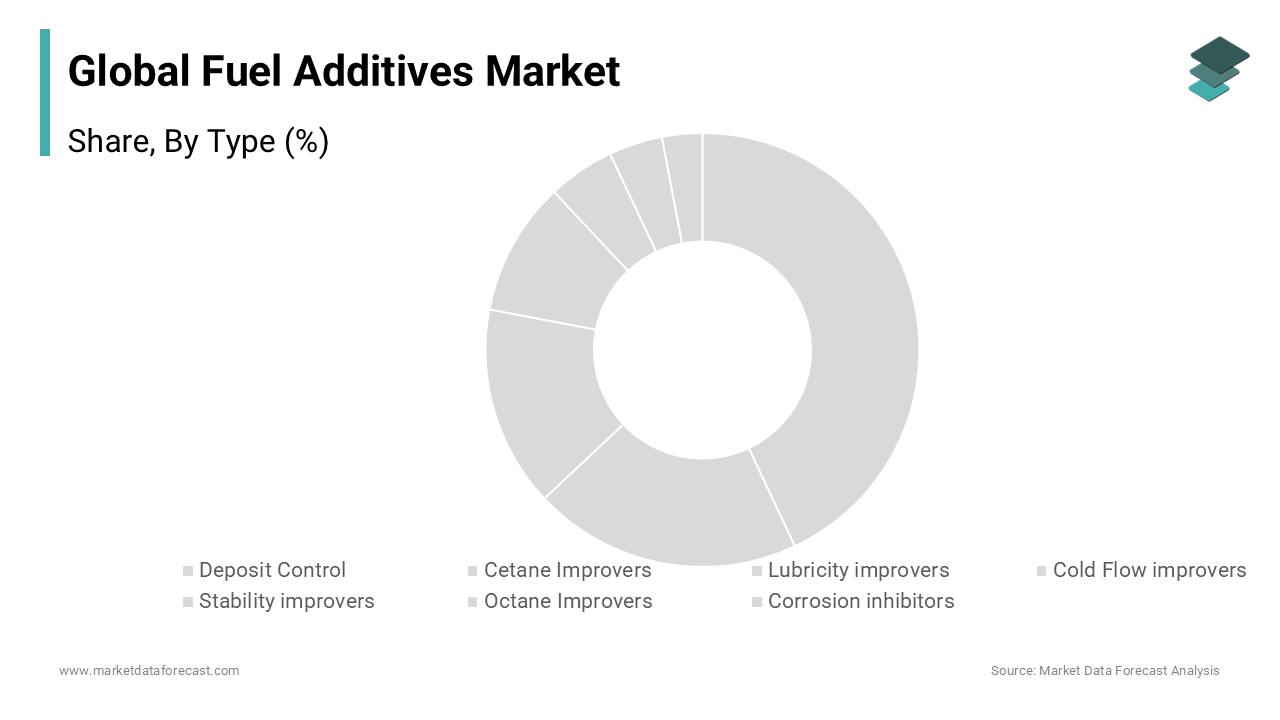
The deposit control additives segment dominated the fuel additives market by capturing 34.4% share of the global market in 2024. The prominence of deposit control additives segment is primarily driven by their important role in maintaining engine efficiency and emissions compliance across both gasoline and diesel platforms. Detergent packages have become essential due to the proliferation of gasoline direct injection (GDI) engines, which are highly susceptible to intake valve and fuel injector deposits. According to research, untreated GDI engines accumulate carbon deposits at a rate faster than port-injected systems, leading to misfires and increased hydrocarbon emissions. The U.S. Environmental Protection Agency notes that fuel injector fouling can reduce fuel economy over time. Automakers such as General Motors and Honda now recommend TOP TIER Detergent Gasoline, a standard adopted by over 20 fuel brands in North America.
The cold flow improvers (CFIs) segment is likely to experience the fastest CAGR of 7.3% from 2025 to 2033. The increasing use of biodiesel and renewable diesel in colder climates, where poor low-temperature performance poses operational risks, are boosting the expansion of cold flow improvers (CFIs) segment in the global market. Biodiesel blends, particularly B20 and higher, exhibit higher cloud points and wax crystallization tendencies, leading to fuel filter clogging. As per study, untreated biodiesel can gel at temperatures as high as 4°C, rendering engines inoperable in winter conditions. Apart from these, China’s National VI diesel standards include cold operability requirements, which compels refiners to blend CFIs into ultra-low-sulfur diesel. These climatic and regulatory burdens are fueling rapid adoption of advanced polymer-based CFIs to ensure uninterrupted fuel flow in extreme conditions.
By Application Insights
The gasoline segment was the largest segment of the fuel additives market by accounting for 46.7% of the global market in 2024. The widespread deployment of gasoline-powered vehicles, especially in passenger transportation, and the technical demands of modern engine architectures, has largely contributed to the growth of gasoline segment. Large number of gasoline vehicles are currently in operation worldwide, according to study, with a notable share in North America, Europe, and Asia-Pacific. The shift toward turbocharged direct-injection (GDI) engines has amplified the need for high-performance deposit control additives to prevent injector coking and intake valve deposits. Besides, octane improvers are increasingly used to support higher compression ratios in downsized engines, which improves efficiency and reducing CO₂ emissions. This further strengthens gasoline’s central role in the additives landscape.
The aviation fuel segment is on the rise and is expected to be the fastest growing segment in the global market by witnessing a CAGR of 6.8% during the forecast period owing to the recovery of global air travel and the stringent performance requirements of jet fuel under extreme operational conditions. With substantial volume of passengers flown, an increase from 2022, as per research, demand for high-integrity fuel systems has surged. Aviation fuel additives include thermal stability improvers, anti-icing agents, and biocides, all important for safe high-altitude operations. Furthermore, microbial contamination in fuel tanks necessitates routine biocide treatment. Therefore, the demand for specialized, high-purity additives is accelerating, particularly in long-haul and polar routes where environmental stresses are greatest.
REGIONAL ANALYSIS
Asia-Pacific Fuel Additives Market Analysis
Asia-Pacific was the leading player in the fuel additives market and accounted for 38.4% share of the global market in 2024. Industrial expansion, urbanization, and transportation growth are contributing to the dominance of Asia Pacific in the global market. China and India are the primary drivers, with China accounting for a portion of regional demand due to its massive vehicle fleet and refining capacity. According to study, China consumed millions of metric tons of refined petroleum, with gasoline and diesel additives integrated into a portion of retail fuel volumes. India’s push for Bharat Stage VI (BS-VI) emission norms, equivalent to Euro 6, has mandated cleaner fuels, which prompts Indian Oil Corporation and Reliance Industries to adopt advanced detergent and cetane improver packages. Apart from these, Southeast Asia’s rising biodiesel mandates have increased demand for stability and cold flow additives. Therefore, Asia-Pacific remains the most strategically vital region for fuel additive innovation and deployment as millions of internal combustion engine vehicles are on the road and growing aviation and marine activity.
North America Fuel Additives Market Analysis
North America is the second-largest in fuel additives market share with 27.1% share in 2024, with the United States functioning as a technological and regulatory benchmark for fuel quality. The U.S. consumes millions of barrels of petroleum per day, with additives blended into nearly all retail gasoline and diesel, as per the study. The widespread adoption of TOP TIER Detergent Gasoline by major refiners like ExxonMobil, Chevron, and Shell has institutionalized high-detergency standards, covering a portion of U.S. fuel stations. Besides, the proliferation of E15 and E85 ethanol blends has increased the need for stabilizers and corrosion inhibitors. Canada’s Cold Lake and Arctic regions require cold flow improvers for winter diesel operations, while Mexico’s refining modernization under the Dos Bocas project is creating new opportunities for additive integration in national fuel supply chains.
Europe Fuel Additives Market Analysis
Europe witnessed a sustained rise in the fuel additives market due to advanced regulatory frameworks for fuel and emissions. Germany, France, and the UK are the largest consumers, with diesel historically dominant in commercial transport, though gasoline demand is rising with GDI adoption. The European Commission’s Euro 6 require fuels that minimize particulate and NOx emissions, necessitating deposit control and lubricity additives. As per the study, a portion of new diesel vehicles use high-pressure common rail systems, which are highly sensitive to fuel quality. Furthermore, the EU’s Renewable Energy Directive (RED III) mandates 29% renewable energy in transport by 2030, accelerating biodiesel and hydrotreated vegetable oil (HVO) use—fuels that require stability and cold flow additives. Countries like Sweden and Finland have implemented winter-grade diesel standards requiring additive treatment, which ensures year-round operability in sub-zero climates.
Latin America Fuel Additives Market Analysis
Latin America experienced growth in the fuel additives market, with Brazil and Argentina leading in additive adoption due to biofuel integration and vehicle fleet modernization. Brazil consumed significant liters of gasoline. This high bio-content increases oxidation and phase separation risks, necessitating antioxidants and demulsifiers. The Andean region’s high-altitude operations also demand fuel stability additives to prevent vapor lock. However, inconsistent fuel quality in remote areas and limited regulatory enforcement constrain broader adoption. Rising vehicle ownership and government-led fuel quality upgrades are creating incremental demand for performance-enhancing additives despite challenges.
MEA Fuel Additives Market Analysis
The Middle East and Africa is likely to grow in the fuel additives market, with the Gulf Cooperation Council (GCC) countries driving most of the regional demand through refining modernization and export-oriented strategies. Saudi Arabia’s King Abdullah Petroleum Research Center (KAPSARC) reports that over a portion of domestic gasoline is now blended with octane and detergent additives to meet internal quality standards and support Vision 2030 goals. The UAE’s ENOC and ADNOC have launched premium fuel brands, incorporating advanced deposit control and friction modifier packages. In Africa, South Africa is the only country with a structured fuel additives program.
COMPETITIVE LANDSCAPE
KEY MARKET PLAYERS
Some of the companies that are playing a dominating role in the global fuel additives market include
- BASF SE
- Innospec Inc.
- The Lubrizol Corporation
- Afton Chemical Corporation
- Chevron Oronite Company LLC
- Infineum International Limited
- Evonik Industries AG
- LANXESS AG
- Clariant AG
- Dorf Ketal Chemicals LLC
- Dow Inc.
- TotalEnergies
- Croda International Plc
- Baker Hughes
- Solvay SA
- Huntsman Corporation
- Eastman Chemical Company
- BARDAHL Manufacturing Corporation
- Wynn’s
The competition in the fuel additives market is characterized by a concentrated yet dynamic landscape where technological expertise and regulatory foresight determine market dominance. A handful of vertically integrated chemical companies dominate due to their proprietary chemistries, global infrastructure, and deep OEM relationships. However, regional players and specialty formulators are gaining ground by offering cost-effective, localized solutions. The battleground is shifting from bulk supply to performance validation, with automakers and refiners demanding data-backed evidence of engine protection and emissions compliance. Differentiation is achieved through advanced deposit control, biofuel compatibility, and cold-weather performance. Regulatory divergence across regions requires agile formulation capabilities.
Top Players in the Fuel Additives Market
Afton Chemical Corporation is a global leader in fuel and lubricant additive technologies, with a significant and growing influence across the Asia-Pacific region. The company has established technical centers in Singapore, Japan, and India to develop region-specific formulations that address local fuel quality, engine types, and regulatory requirements. Afton collaborates closely with major refiners such as Indian Oil and PetroChina to formulate deposit control packages compliant with Bharat Stage VI and China VI emission standards. Afton also partnered with Southeast Asian biodiesel producers to enhance oxidation stability in palm-based diesel blends. Its investment in local application engineering and field testing has strengthened trust among OEMs and fuel marketers, positioning Afton as a strategic enabler of fuel performance and regulatory compliance in one of the world’s most dynamic transportation markets.
Lubrizol Corporation, a Berkshire Hathaway company, plays a pivotal role in advancing high-performance fuel additives throughout Asia-Pacific, leveraging its deep R&D capabilities and global supply network. The company operates a state-of-the-art technology center in Yokohama, Japan, focused on deposit control, cetane enhancement, and biofuel compatibility solutions. In India, it collaborated with private refiners to launch premium diesel brands with improved cold flow and stability properties for northern regions. Its emphasis on co-development with automakers and fuel retailers has strengthened its reputation as a science-driven partner in engine longevity and emissions reduction.
Infineum International Limited is a major innovator in fuel additive chemistry, with a strong footprint in Asia-Pacific through localized manufacturing, technical support, and regulatory engagement. The company supplies advanced deposit control, corrosion inhibition, and stability additives to key markets including China, South Korea, and Australia. Infineum’s regional technical team conducts extensive field trials with commercial fleets and OEMs, ensuring real-world efficacy. Its focus on sustainable chemistry, such as developing biodegradable dispersants, aligns with emerging environmental regulations, which strengthens its long-term relevance in the region’s evolving fuel landscape.
Top Strategies Used by Key Market Participants
Key players in the fuel additives market are pursuing strategies centered on technological differentiation, regulatory alignment, and vertical integration with refiners and automakers. Companies are investing heavily in next-generation detergent chemistries to address deposit formation in advanced engines, particularly gasoline direct injection and high-pressure diesel systems. Collaborative formulation development with OEMs ensures additive compatibility with engine warranties and emission systems. Expansion into high-growth regions like Asia-Pacific is being accelerated through localized R&D centers and technical service teams. Strategic partnerships with national oil companies are enabling tailored solutions for biofuel blending and low-sulfur fuels. Digitalization is being leveraged through predictive modeling of deposit formation and additive performance under real-world conditions. Apart from these, firms are focusing on sustainability by developing biodegradable, low-metal, and renewable-based additive components. These integrated strategies reflect a shift from commodity supply to engineered performance solutions that align with global decarbonization and engine durability goals.
MARKET SEGMENTATION
The research report on the Fuel Additives Market has been segmented and sub-segmented based on categories.
By Type
- Deposit Control
- Cetane Improvers
- Lubricity improvers
- Cold Flow improvers
- Stability improvers
- Octane Improvers
- Corrosion inhibitors
By Application
- Gasoline
- Diesel
- Aviation Fuel
By Region
- North America
- Europe
- Asia-Pacific
- Latin America
- Middle East and Africa