- Product Description Description
- Table of Contents TOC
- List of Table & Figure LOT
- Get Free Sample PDF Sample PDF
Market Size, 2025
$46.07 BnMarket Estimate, 2026
$58.23 BnMarket Forecast, 2034
$379.44 BnCAGR, 2026–2034
26.4%Global Geomarketing Market Size
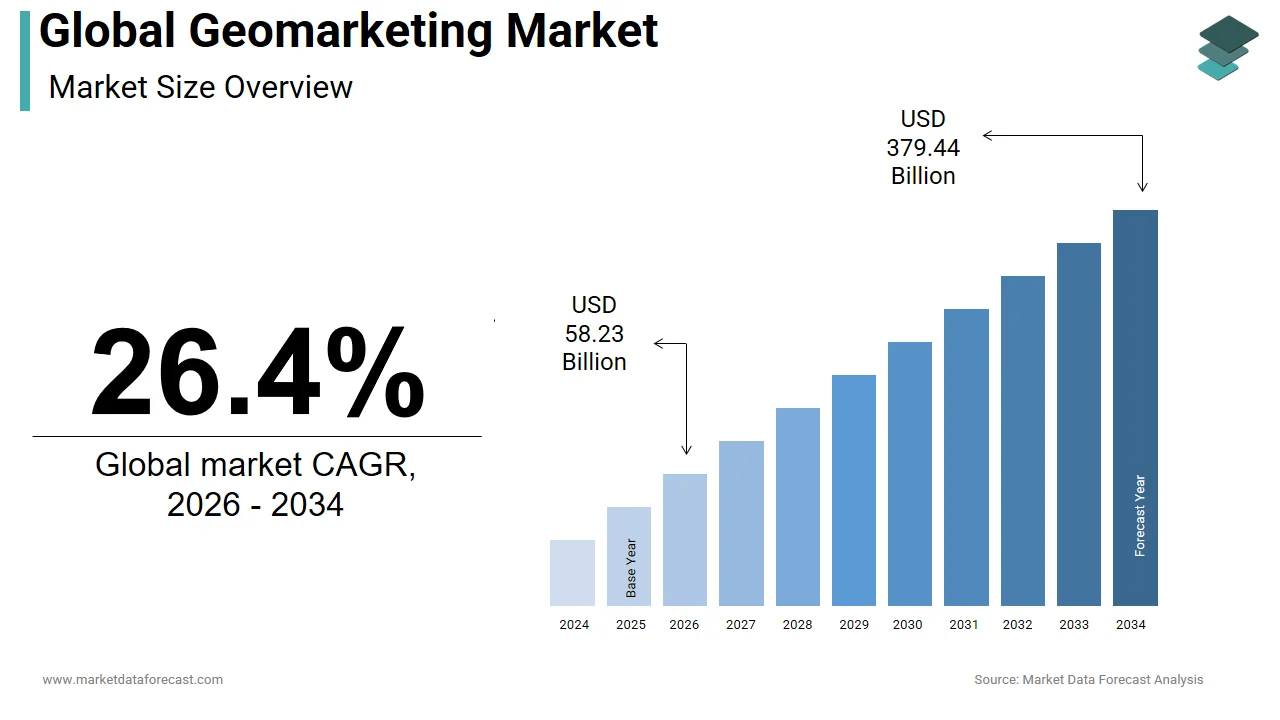
The global geomarketing market was valued at USD 46.07 billion in 2025. This market is expected to grow at a CAGR of 26.4% from 2026 to 2034 and be worth USD 379.44 billion by 2034 from USD 58.23 billion in 2026.
Geomarketing is a location-based marketing strategy that uses geographic and spatial data to target advertising, tailor messaging, and optimize business decisions. By analyzing demographic information alongside physical coordinates, organizations can deliver highly contextualized content to individuals based on their immediate surroundings. The foundational premise relies on the intersection of spatial computing and consumer psychology to drive meaningful engagement. The operational landscape of this domain is heavily influenced by the ubiquitous adoption of mobile technology and digital navigation tools. According to a study, there are currently over 5.8 billion unique mobile subscribers worldwide, representing roughly 70% of the global population. Furthermore, the reliance on spatial navigation is deeply embedded in daily consumer routines. Sources reveal that 90% of smartphone owners use their devices to get location-based directions and real-time recommendations. This profound behavioral shift allows brands to transition from broad demographic targeting to precise spatial engagement. The integration of spatial data transforms traditional advertising into a dynamic interaction, ensuring that promotional messages are delivered exactly when and where they are most relevant to the physical context of the consumer.
MARKET DRIVERS
Widespread Smartphone and GPS Adoption Driving Geomarketing Growth
The ubiquitous presence of mobile devices equipped with precise global positioning systems propels the growth of the geomarketing market. Also, the proliferation of advanced mobile hardware provides the essential infrastructure required to capture and transmit real-time spatial coordinates. Modern smartphones are embedded with sophisticated global positioning system chips that offer unprecedented accuracy in determining physical locations. The U.S. Department of Defense guarantees a civilian GPS global average horizontal accuracy of better than 1.89 meters with 95% probability, allowing for highly refined location targeting. This technological capability allows businesses to execute highly targeted campaigns based on exact physical proximity. Furthermore, the sheer volume of connected devices ensures a continuous stream of spatial data. Studies show that the worldwide smartphone user base has climbed past 5.5 billion, capturing the vast majority of the global population. This massive penetration ensures that geographic tracking is not limited to niche demographics but encompasses a vast majority of the consumer base. The constant connectivity of these devices means that spatial data is generated continuously throughout the day. When consumers carry these advanced devices, they inadvertently act as mobile data nodes, allowing marketers to analyze foot traffic patterns, dwell times, and spatial movement behaviors. This continuous flow of accurate spatial information empowers organizations to optimize store layouts, plan localized events, and trigger contextual notifications the moment a potential buyer enters a predefined geographic perimeter.
Rising Demand for Hyperlocal and Personalized Customer Experiences
Modern consumers increasingly expect tailored interactions that reflect their immediate physical surroundings and contextual needs, and thereby fuel the expansion of the geomarketing market. In addition, the contemporary retail environment is characterized by a demand for hyperlocal experiences, where customers anticipate that brands will understand their specific local context and preferences. Geographic marketing directly addresses this expectation by utilizing spatial data to deliver highly relevant offers. According to a comprehensive consumer survey conducted by Epsilon, 80 percent of consumers are significantly more likely to make a purchase when brands offer personalized experiences. When this personalization is tied to physical location, the conversion probability increases exponentially. Consumers are far more receptive to promotions that acknowledge their immediate environment, such as a discount for a nearby coffee shop when it is raining or a notification about a flash sale at a store they are currently passing. As per research published by McKinsey and Company, effective personalization strategies can reduce customer acquisition costs by up to 50 percent and increase revenues by 5 to 15 percent. By leveraging geographic parameters, businesses can ensure that their marketing budgets are not wasted on irrelevant audiences. Instead, resources are allocated exclusively toward individuals who are physically capable of acting on the offer immediately. This alignment between digital messaging and physical reality creates a seamless customer journey, fostering brand loyalty and driving immediate foot traffic to physical retail locations.
MARKET RESTRAINTS
Stringent Data Privacy Regulations Limiting Location Data Collection
Escalating regulatory frameworks surrounding user data protection severely limit the unrestricted collection and utilization of geographic information, which hampers the growth of the geomarketing market. The global regulatory landscape has shifted dramatically toward stringent data privacy, directly impacting the ability of organizations to harvest spatial coordinates. Legislation such as the General Data Protection Regulation in Europe and the California Consumer Privacy Act in the United States mandate explicit user consent before tracking physical movements. Benchmark data from the International Association of Privacy Professionals (IAPP) shows that enterprise-level firms dedicate a mean budget of $1 million annually to fund dedicated privacy infrastructure and maintain global compliance. This regulatory burden forces marketers to rely entirely on opt in mechanisms, which inherently restricts the volume of available spatial data. Furthermore, consumers are becoming increasingly aware of their digital rights and are actively exercising them. Sources point out that over half of all mobile application users have avoided installing or uninstalled specific apps entirely due to sudden concerns regarding personal data collection. When users deny spatial access, marketers lose the ability to execute proximity based campaigns or analyze regional foot traffic. The necessity to maintain transparent data practices and secure explicit permission creates significant friction in the data collection process. Consequently, the geographic databases utilized for marketing strategies become fragmented and incomplete, reducing the overall efficacy of spatial analytics and forcing companies to navigate a complex web of legal restrictions that vary significantly across different international jurisdictions.
Signal Accuracy Challenges Limiting Precise Location-Based Targeting
Signal degradation and physical obstructions in dense metropolitan areas frequently compromise the precision of geographic tracking mechanisms, which hinders the expansion of the geomarketing market. While global positioning systems are highly accurate in open environments, their reliability diminishes significantly in dense urban landscapes characterized by towering skyscrapers and subterranean infrastructure. This phenomenon, commonly known as the urban canyon effect, causes signal multipath errors where satellite signals bounce off buildings before reaching the receiver. Technical guidelines from the European Union Agency for the Space Programme (EUSPA) reveal that multi-constellation receivers successfully counteract urban boundary interference, sustaining reliable sub-meter accuracy in metropolitan areas. When a geographic marketing platform cannot accurately distinguish whether a consumer is on a specific street or the adjacent parallel avenue, the relevance of the delivered message is severely compromised. Furthermore, indoor environments present an even greater technological hurdle. To overcome this, businesses must invest in supplementary indoor positioning systems like Bluetooth beacons or ultra-wideband networks, which drastically increase infrastructure complexity. The inherent physical limitations of satellite navigation in complex architectural environments thus act as a persistent barrier to achieving flawless geographic targeting across all consumer touchpoints.
MARKET OPPORTUNITIES
Augmented Reality Integration Enhancing Location-Based Customer Engagement
The convergence of immersive augmented reality applications with geographic targeting opens unprecedented avenues for interactive customer engagement, which is anticipated to drive the growth of the geomarketing market. Also, the integration of AR into spatial marketing allows brands to overlay digital information onto the physical world, creating highly engaging and interactive promotional experiences. When consumers point their mobile devices at specific physical locations, they can view virtual products, interactive maps, or gamified advertisements superimposed onto their real-world surroundings. Sources indicate that utilizing augmented reality throughout the consumer journey can drive conversion rates up by 90% for brands adapting to immersive shopping. This technology transforms passive geographic notifications into active, immersive experiences. For instance, a consumer walking through a historic district could use an augmented reality application to see virtual historical facts or exclusive promotional offers hovering above specific storefronts. Research highlights that 56% of shoppers explicitly assert that using augmented reality tools gives them greater confidence in product quality and fit before purchasing. By anchoring these augmented reality experiences to specific geographic coordinates, marketers can drive foot traffic to precise locations while providing a memorable, interactive brand experience. This fusion of spatial data and immersive visual technology represents a largely untapped frontier, allowing organizations to differentiate their promotional strategies in an increasingly crowded digital landscape and capture the attention of tech-savvy consumers.
Connected Vehicles and IoT Expanding Location-Based Advertising Opportunities
The rapid proliferation of connected vehicles and smart internet of things devices provides a massive new frontier for contextual geographic advertising, which is likely to accelerate the expansion of the geomarketing market. Moreover, the expansion of the internet of things ecosystem extends geographic marketing beyond smartphones into vehicles and smart city infrastructure. Modern connected vehicles are essentially mobile data centers equipped with advanced navigation and telemetry systems, providing highly accurate and continuous spatial data. A study projects that cumulative global connected car sales will exceed 500 million units over the multi-year block between 2024 and 2030. This presents an extraordinary opportunity to deliver location-based audio advertisements or visual notifications directly to the vehicle infotainment system as drivers pass specific commercial zones. Furthermore, smart city infrastructure, including digital billboards and intelligent streetlights, can be integrated with geographic marketing platforms to deliver dynamic content based on real-time traffic and pedestrian density. Research projects that the global Internet of Things (IoT) will unlock up to $12.6 trillion in economic value by 2030, with B2B environments capturing the largest share of optimization. By tapping into this interconnected network of vehicles and smart devices, marketers can reach consumers in transit, delivering highly relevant offers based on their exact route, current speed, and destination, thereby maximizing the contextual relevance of their promotional campaigns.
MARKET CHALLENGES
High Implementation Costs and Technical Complexity Hindering Geomarketing Adoption
Deploying sophisticated geographic analytics platforms demands substantial financial investments and specialized technical expertise, which challenges the growth of the geomarketing market. Building and maintaining a robust geographic marketing infrastructure requires significant capital allocation for data acquisition, software licensing, and system integration. High-quality spatial data, particularly precise foot traffic analytics and demographic overlays, is extremely expensive to procure from specialized third-party data brokers. According to Gartner, poor data quality and the associated costs of data management burden organizations with an average annual financial loss of 12 million dollars. Furthermore, integrating these complex spatial analytics platforms with existing legacy customer relationship management systems often requires extensive custom development and ongoing technical maintenance. Small and medium-sized enterprises often find these initial setup costs and ongoing maintenance fees prohibitive, restricting the adoption of advanced geographic marketing to large multinational corporations with vast financial resources. The necessity to continuously update geographic databases, calibrate tracking algorithms, and manage cloud storage for massive spatial datasets creates a persistent operational overhead. This high barrier to entry prevents widespread market penetration and forces many organizations to rely on rudimentary, less effective targeting methods instead of leveraging the full potential of advanced spatial analytics.
Growing Privacy Concerns and Location Tracking Resistance Limiting Geomarketing Adoption
Growing public apprehension regarding constant surveillance leads to widespread resistance against geographic monitoring applications, which inhibits the expansion of the geomarketing market. Despite the utility of location-based services, a significant portion of the consumer base harbors deep skepticism regarding the continuous tracking of their physical movements. This psychological resistance, often termed location tracking fatigue, manifests in users routinely denying spatial permissions or actively spoofing their geographic coordinates to avoid targeted advertising. SimpleTexting highlights that 29% of forward-looking businesses are planning to incorporate location-based SMS targeting within their immediate customer engagement strategies. This pervasive distrust undermines the fundamental data collection mechanisms required for effective geographic campaigns. When consumers perceive spatial tracking as intrusive surveillance rather than a value-added service, they actively disengage from the brand. Marketers face the immense challenge of convincing a wary public to voluntarily share their spatial coordinates. Overcoming this deep-rooted skepticism requires brands to provide undeniable, immediate value in exchange for location access, a difficult proposition when consumer sentiment is heavily skewed toward protecting personal privacy against perceived corporate overreach and digital surveillance.
REPORT COVERAGE
| REPORT METRIC | DETAILS |
| Market Size Available | 2025 to 2034 |
| Base Year | 2025 |
| Forecast Period | 2026 to 2034 |
| Segments Covered | By Component, Deployment Mode, Location Type, End-Use Industry, Organization Size, and Region. |
| Various Analyses Covered | Global, Regional, and Country-Level Analysis, Segment-Level Analysis, Drivers, Restraints, Opportunities, Challenges; PESTLE Analysis; Porter’s Five Forces Analysis, Competitive Landscape, Analyst Overview of Investment Opportunities |
| Regions Covered | North America, Europe, APAC, Latin America, Middle East & Africa |
| Market Leaders Profiled | Google, Microsoft, IBM, Cisco, Oracle, Adobe, Salesforce, Esri, Software AG, Ericsson, Qualcomm, Xtremepush, Plot Projects, Rover, Mobile Bridge, Hyper, Reveal Mobile, Galigeo, Navigine, CleverTap, Urban Airship, Bluedot Innovation, Merkle, Foursquare, LocationGuru, and Others. |
SEGMENTAL ANALYSIS
By Component Insights
The software segment dominated the geomarketing market and accounted for a substantial share in 2025. This dominance of the segment was driven by the escalating necessity for sophisticated spatial data processing. Modern enterprises generate massive volumes of geographic data from mobile devices, Internet of Things sensors, and transactional records. Processing this raw spatial information requires highly specialized algorithms and robust computational frameworks. Studies estimate that the global datasphere has scaled past 175 zettabytes, exponentially increasing the baseline data ingestion loads handled by enterprise software applications. Geographic information systems and location intelligence platforms provide the essential computational architecture to transform raw coordinates into strategic business intelligence. Furthermore, the integration of machine learning algorithms into these software solutions enables predictive spatial modeling. Research states that integrating machine learning and predictive analytics tools into enterprise software frameworks directly drives localized business efficiency by mitigating risk and optimizing core marketing budgets. This software capability allows businesses to anticipate consumer movement patterns, optimize supply chain logistics, and forecast regional demand with unprecedented accuracy. The continuous evolution of spatial algorithms ensures that software remains the foundational pillar of the industry, empowering organizations to navigate complex geographic variables and maintain a competitive advantage in highly dynamic commercial environments.

The seamless integration of artificial intelligence capabilities within geographic platforms significantly accelerates software adoption. Contemporary businesses require more than simple mapping; they demand intelligent systems capable of autonomous spatial reasoning and automated decision-making. Artificial intelligence enhances geographic software by enabling real time pattern recognition and automated anomaly detection across vast spatial datasets. In the context of spatial analytics, artificial intelligence algorithms can automatically identify emerging geographic market trends, detect subtle shifts in regional consumer demographics, and optimize delivery routes dynamically. MIT's Computer Science and Artificial Intelligence Laboratory (CSAIL) emphasizes that automating complex analytical reasoning functions minimizes repetitive human engineering friction to optimize strategic decision-making pipelines. This profound enhancement in analytical capability makes advanced software indispensable. Organizations increasingly rely on these intelligent platforms to process complex spatial variables instantaneously, ensuring that their geographic marketing strategies are both highly responsive and deeply rooted in empirical spatial evidence.
The consulting segment is on the rise and is expected to be the fastest-growing segment in the market with a CAGR of 19.8% during the forecast period. This growth is propelled by the profound complexity of integrating spatial technologies with existing enterprise architectures, which necessitates expert consulting services. Implementing advanced geographic information systems and location intelligence platforms requires a deep understanding of both spatial data science and specific industry operational workflows. Many organizations lack the internal expertise required to design customized spatial strategies that align with their unique business objectives. Sources highlight that the specialized data skills gap remains the single most prominent structural barrier preventing modern enterprise leaders from fully executing advanced digital integrations. This critical deficiency forces businesses to rely heavily on external consulting firms to bridge the knowledge divide. Professional consultants provide essential guidance in selecting the appropriate spatial tools, designing robust data governance frameworks, and ensuring regulatory compliance regarding geographic privacy. The World Economic Forum shows that Data Analysts, Scientists, and Digital Transformation Specialists rank among the fastest-growing professional roles globally, heavily driving the demand for specialized consulting ecosystems. Organizations can avoid costly implementation failures and accelerate their time to value by leveraging expert consulting. This ensures that their geographic marketing initiatives are strategically sound and technologically robust.
The critical need for customized strategic alignment and change management drives the rapid expansion of consulting services. Geographic marketing is not merely a technological upgrade; it represents a fundamental shift in how organizations perceive and interact with their physical market environments. Successfully transitioning to a spatially aware business model requires comprehensive change management, stakeholder alignment, and the redefinition of internal operational processes. A study indicates that roughly 70% of complex, large-scale corporate transformations fail to hit their targeted objectives due to systemic cultural friction and misaligned internal leadership. Specialized consulting services address this vulnerability by facilitating organizational buy-in, designing targeted training programs, and restructuring workflows to fully leverage spatial insights. Consultants help businesses translate complex geographic data into actionable commercial strategies that resonate across all corporate departments, from marketing to supply chain management. Studies conducted by the Boston Consulting Group (BCG) reveal that companies achieving high digital transformation maturity generate up to two times more revenue growth than laggards who fail to align technology adoption strategies. This strategic facilitation ensures that geographic marketing becomes deeply embedded in the corporate culture, driving sustained commercial success and long-term operational excellence.
By Deployment Mode Insights
In 2025, the cloud segment held the majority share of the geomarketing market. The exceptional scalability and inherent cost efficiency of cloud infrastructure establish its dominance in the deployment landscape. Traditional on-premises geographic systems require massive upfront capital expenditures for physical servers, specialized networking equipment, and continuous hardware maintenance. In stark contrast, cloud deployment allows organizations to dynamically scale their computational resources based on real-time spatial data processing demands. The Cloud Security Alliance highlights that optimizing architecture, visibility, and misconfigured assets is necessary to maximize return on investment (ROI) across enterprise cloud deployments. This significant financial advantage is particularly crucial for geographic marketing, which involves processing massive, fluctuating volumes of spatial data generated by millions of mobile devices. Furthermore, cloud platforms offer a pay-as-you-go pricing model, ensuring that businesses only pay for the exact computational power and storage they consume. The financial flexibility and infinite scalability of cloud environments make it the undisputed standard for modern geographic analytics.
The unparalleled remote accessibility and seamless collaboration capabilities of cloud platforms drive their widespread adoption. Geographic marketing strategies often require input and coordination from diverse, geographically dispersed teams, including field marketers, data scientists, and regional managers. Cloud deployment ensures that all stakeholders have secure, real-time access to the same centralized spatial dashboards and analytical tools, regardless of their physical location. The ubiquitous access facilitates instantaneous collaboration, enabling teams to jointly analyze regional foot traffic patterns, adjust geofencing parameters, and optimize localized campaigns in real time. In the fast-paced environment of geographic marketing, the ability to instantly share spatial insights and coordinate responsive campaigns across global teams provides a critical competitive advantage, cementing the cloud as the foundational deployment mode for the industry.
The Software as a Service subsegment is expected to exhibit a noteworthy CAGR of 24.2% from 2026 to 2034. In addition, the widespread preference for subscription-based pricing models significantly lowers the initial barriers to entry for advanced spatial tools. Traditional software licensing often involves prohibitive upfront costs and complex, long-term maintenance contracts that deter small and medium enterprises from adopting sophisticated geographic marketing technologies. Software as a Service disrupts this paradigm by offering flexible, predictable monthly or annual subscription fees that encompass the software license, hosting, and ongoing maintenance. The financial accessibility allows a broader spectrum of businesses, including agile startups and regional retailers, to leverage enterprise-grade location intelligence without straining their initial budgets. This democratization of access ensures that advanced geographic marketing capabilities are no longer exclusive to multinational corporations, driving rapid market expansion across diverse commercial sectors.
The continuous delivery of automatic updates and seamless feature enhancements ensures that Software as a Service platforms remain at the technological forefront. The geographic marketing landscape is characterized by rapid technological evolution, with frequent advancements in spatial algorithms, privacy regulations, and data integration capabilities. Traditional on-premises software requires manual, resource-intensive upgrades that often result in system downtime and delayed access to new features. In contrast, Software as a Service providers deploy updates centrally, ensuring that all users instantly benefit from the latest analytical tools, security patches, and algorithmic improvements without any manual intervention. Studies reveal that data exposure risks and identity compromises remain the top vulnerabilities for modern enterprise systems, requiring robust patch management automation. This relentless pace of innovation ensures that geographic marketers always have access to state-of-the-art spatial analytics, enabling them to execute highly sophisticated, privacy-compliant campaigns and maintain a distinct competitive edge in an increasingly dynamic digital environment.
By Location Type Insights
The outdoor segment led the geomarketing market and captured a 62.3% share in 2025. This leading position of the segment was attributed to the ubiquitous reliance on global positioning systems for macro-level consumer tracking. Outdoor geographic marketing primarily leverages satellite-based navigation to track consumer movement across cities, highways, and large commercial districts. The foundational technology for outdoor tracking is mature, highly accurate, and universally supported by virtually every modern mobile device without requiring additional hardware infrastructure. Also, the universal compatibility allows marketers to execute large-scale geofencing campaigns, track regional commuting patterns, and analyze outdoor foot traffic with minimal technical friction. Furthermore, the extensive reach of outdoor spatial data enables brands to capture consumer attention during high mobility phases, such as driving or walking through commercial corridors. As per a comprehensive mobility study by the Federal Highway Administration, the average American spends over 50 minutes per day commuting, representing a massive window for outdoor location-based advertising. The sheer scale, reliability, and universal accessibility of outdoor spatial tracking make it the foundational and most widely utilized segment in the geographic marketing landscape.
The massive proliferation of mobile users engaging with outdoor digital signage and proximity-based advertising drives the outdoor segment. Modern outdoor marketing has evolved far beyond static billboards; it now encompasses dynamic digital signage integrated with real-time spatial data and mobile proximity triggers. When consumers enter specific outdoor zones, their mobile devices can receive targeted notifications, while digital billboards can dynamically alter their content based on the aggregated demographic and spatial profile of the passing audience. According to a detailed consumer engagement report by the Outdoor Advertising Association of America, dynamic outdoor digital signage generates a 45 percent higher recall rate compared to traditional static advertisements. This high engagement is amplified by mobile integration. The synergy between physical outdoor infrastructure and mobile spatial tracking creates a highly immersive, omnichannel experience. This powerful combination allows brands to dominate physical commercial spaces, capturing consumer attention exactly when they are in transit and most receptive to localized, contextually relevant promotional messages.
The indoor segment is predicted to witness the highest CAGR of 26.5% between 2026 and 2034 owing to the rapid proliferation of Bluetooth beacons and ultra-wideband technologies in retail environments. Unlike outdoor tracking, which relies on satellite signals that cannot penetrate modern building materials, indoor geographic marketing utilizes localized wireless transmitters to achieve precise spatial awareness inside shopping malls, airports, and large retail stores. Bluetooth low-energy beacons are inexpensive, battery-efficient, and can pinpoint a consumer location within a few meters, enabling highly granular proximity marketing. The massive hardware deployment allows retailers to track exact in-store dwell times, analyze aisle-level foot traffic, and trigger personalized mobile offers when a consumer pauses in front of a specific product display. The ability to bring the precision of digital spatial analytics into the physical retail environment transforms indoor spaces into highly measurable, interactive commercial ecosystems, driving explosive growth in this segment.
The escalating demand for precise indoor navigation solutions in complex, large-scale venues fuels the rapid expansion of the indoor segment. Modern commercial environments, such as massive international airports, expansive hospital campuses, and multi-level shopping centers, are notoriously difficult to navigate. Consumers increasingly expect seamless, turn-by-turn indoor navigation experiences similar to those they enjoy outdoors. Indoor positioning systems utilize a combination of wireless fidelity signals, magnetic field mapping, and inertial sensors to provide accurate indoor routing on mobile devices. Furthermore, in the healthcare sector, precise indoor navigation is vital for wayfinding in complex medical facilities. Solving the complex challenge of indoor wayfinding allows businesses to greatly enhance the customer experience while capturing invaluable spatial data on how individuals navigate physical spaces. This combination makes indoor navigation a highly lucrative and rapidly growing application.
REGIONAL ANALYSIS
North America Geomarketing Market Analysis
North America was the top performer in the global geomarketing market and accounted for a 42.8% share in 2025. The region's dominance was driven by its early adoption of advanced spatial technologies and the presence of major technology conglomerates that develop foundational geographic platforms. The United States, in particular, drives this regional supremacy through massive investments in artificial intelligence and spatial analytics infrastructure. The U.S. National Science Foundation indicates that federal and public-private investments in advanced cyberinfrastructure are scaling up rapidly to pioneer intelligent transportation systems and cloud-based spatial technologies. Furthermore, the widespread integration of location-based services in everyday consumer applications, from ride-sharing to food delivery, has normalized spatial tracking and created a highly receptive market for advanced geomarketing strategies. Sources reveal that 90% of smartphone owners aged 18–29 utilize their devices to actively pull up location-based directions and real-time recommendations. This profound consumer comfort with spatial data, combined with a highly mature digital advertising ecosystem, ensures that North America remains the primary hub for geographic marketing innovation, setting global standards for spatial analytics and location-based commercial strategies.

Europe Geomarketing Market Analysis
Europe was the next prominent region in the global geomarketing market and occupied a 26.1% share in 2025. The regional market growth was fuelled by its stringent approach to data privacy and consumer protection, which fundamentally shapes how geographic marketing strategies are developed and executed. The implementation of the General Data Protection Regulation has forced organizations to adopt highly transparent, consent-driven spatial data collection practices, fostering a market environment that prioritizes consumer trust and ethical data utilization. According to European Commission single market assessments, cross-border digital compliance keeps business legal friction under €737 million annually while heavily mitigating the billions lost by EU consumers to harmful commercial online tracking. Despite these regulatory complexities, European businesses are highly adept at leveraging privacy-compliant spatial analytics, particularly in the automotive and luxury retail sectors. The European Automobile Manufacturers' Association (ACEA) advocates for standardized cross-industry frameworks to govern the massive pool of anonymized spatial and safety data generated by connected vehicles. This unique combination of strict regulatory oversight and high technological sophistication ensures that Europe remains a critical, highly ethical hub for the development of privacy-conscious geographic marketing solutions.
Asia Pacific Geomarketing Market Analysis
Asia Pacific is a swiftly expanding region in the global geomarketing market due to the unprecedented proliferation of mobile internet users and the rapid digitalization of physical retail environments across emerging economies like China and India. Studies indicate that mobile internet users in the Asia-Pacific region will grow to 1.8 billion by 2030, representing an expansive regional base of digital spatial endpoints. Furthermore, the widespread adoption of super applications that integrate messaging, social media, and electronic commerce within a single platform provides a unique ecosystem for highly contextualized geographic marketing. Also, the Asian Development Bank confirms that mobile broadband expansion across Asia has catalyzed a massive wave of localized m-commerce platforms and mobile money ecosystems. The sheer scale of the consumer base, combined with rapid urbanization and the aggressive deployment of smart city infrastructure, positions Asia Pacific as the most lucrative growth engine for the global geographic marketing industry, offering vast untapped potential for spatial analytics and location-based commercial engagement.
COMPETITIVE LANDSCAPE
The competitive landscape of the geographic marketing market is characterized by intense rivalry among established technology conglomerates and highly specialized spatial analytics firms. Major players continuously strive to differentiate their offerings by integrating advanced artificial intelligence, enhancing real-time data processing capabilities, and ensuring strict compliance with evolving global privacy regulations. The market exhibits a high degree of fragmentation at the regional level, with numerous local providers offering customized location intelligence services tailored to specific cultural and commercial nuances. To maintain their dominance, industry leaders heavily invest in continuous research and development, focusing on the seamless integration of spatial data with broader enterprise resource planning and customer relationship management systems. Strategic mergers and acquisitions are frequently utilized to acquire niche technological capabilities, particularly in the rapidly expanding indoor positioning and augmented reality sectors. Furthermore, companies are increasingly competing on the basis of data security and ethical data governance, recognizing that consumer trust is paramount in an environment where physical location tracking is highly sensitive. This relentless pursuit of technological superiority and strategic expansion ensures a highly dynamic and aggressively competitive global market environment where continuous technological innovation is essential for long-term corporate survival and sustained profitability.
KEY MARKET PLAYERS
The major companies operating in the global geomarketing market include
- Microsoft
- IBM
- Cisco
- Oracle
- Adobe
- Salesforce
- Esri
- Software AG
- Ericsson
- Qualcomm
- Xtremepush
- Plot Projects
- Rover
- Mobile Bridge
- Hyper
- Reveal Mobile
- Galigeo
- Navigine
- CleverTap
- Urban Airship
- Bluedot Innovation
- Merkle
- Foursquare
- LocationGuru
TOP PLAYERS IN THE MARKET
- Esri stands as a foundational pioneer in geographic information systems, providing core spatial analytics infrastructure underpinning advanced geomarketing strategies globally. The company develops comprehensive mapping software allowing organizations to visualize, analyze, and interpret complex spatial data with exceptional precision. Esri continuously enhances its platform by integrating advanced machine learning algorithms and real-time data streaming capabilities, enabling marketers to execute highly sophisticated location intelligence campaigns. The company actively collaborates with global retail sectors to develop customized spatial solutions optimizing physical store placements and streamlining complex supply chain networks, thereby driving significant operational efficiencies and enhancing overall commercial performance across diverse international markets.
- Google leverages its ubiquitous mapping and mobile operating system ecosystems to dominate the consumer-facing aspect of the global geographic marketing landscape. The company provides unparalleled access to global spatial data through its mapping applications, local search algorithms, and digital advertising platforms. Google continuously innovates by integrating augmented reality features and advanced artificial intelligence into its location services, creating highly immersive and interactive consumer experiences. The company actively partners with global retail brands to optimize local search visibility and execute precise proximity-based advertising campaigns, ensuring businesses effectively reach consumers navigating physical commercial environments and actively seeking localized products.
- IBM utilizes its robust enterprise cloud infrastructure and advanced artificial intelligence capabilities to deliver secure and scalable geographic marketing solutions for large global corporations. The company integrates spatial analytics directly into its comprehensive customer relationship management and supply chain platforms, enabling organizations to contextualize geographic data alongside vast consumer information. IBM focuses heavily on ensuring data privacy and regulatory compliance within spatial tools, critical for multinational enterprises operating across diverse international jurisdictions. The company actively collaborates with financial and telecommunications sectors to develop fraud detection models and network optimization strategies relying on precise spatial tracking and advanced geographic pattern recognition.
TOP STRATEGIES USED BY KEY MARKET PARTICIPANTS
Key participants in the geographic marketing market predominantly utilize strategic partnerships and technological integration to expand their commercial reach and enhance their analytical capabilities. Companies frequently collaborate with mobile network operators and hardware manufacturers to secure access to high-quality, anonymized spatial data, ensuring their platforms maintain superior accuracy and comprehensive coverage. Furthermore, organizations heavily invest in research and development to integrate advanced artificial intelligence and machine learning algorithms directly into their geographic software, enabling predictive spatial modeling and automated decision-making. Acquisitions of specialized niche firms focusing on indoor positioning technologies or privacy-compliant data management are also common, allowing major players to rapidly acquire cutting-edge capabilities and broaden their service portfolios. Finally, expanding into emerging regional markets through localized consulting services helps global providers adapt their spatial strategies to diverse cultural and regulatory environments, ensuring sustained international growth.
MARKET SEGMENTATION
This research report on the global geomarketing market research report is segmented and sub-segmented into the following categories.
By Component
-
Software
-
Geographic Information Systems (GIS)
-
Location Intelligence Platforms
-
Data Visualization Tools
-
Predictive Analytics Software
-
-
Services
-
Consulting
-
Deployment & Integration
-
Support & Maintenance
-
By Deployment Mode
-
Cloud
-
SaaS (Software as a Service)
-
PaaS (Platform as a Service)
-
-
On-Premises
By Location Type
-
Indoor
-
Indoor Positioning Systems (IPS)
-
Proximity Marketing
-
Indoor Navigation Solutions
-
-
Outdoor
-
Geofencing
-
Location-Based Advertising
-
Outdoor Digital Signage
-
By End Use Industry
-
Retail & E-Commerce
-
In-Store Analytics
-
Personalized Promotions
-
Omnichannel Marketing
-
-
Travel & Hospitality
-
Location-Based Recommendations
-
Proximity Services
-
Smart Tourism Solutions
-
-
BFSI (Banking, Financial Services, and Insurance)
-
Branch Optimization
-
Customer Segmentation
-
Risk Assessment
-
-
IT & Telecommunications
-
Network Optimization
-
Customer Experience Enhancement
-
Service Coverage Analysis
-
-
Media & Entertainment
-
Audience Targeting
-
Event-Based Marketing
-
Content Personalization
-
-
Healthcare & Life Sciences
-
Patient Flow Analysis
-
Facility Management
-
Healthcare Service Optimization
-
-
Others
-
Government & Public Sector
-
Education
-
Transportation & Logistics
-
By Organization Size
- Large Enterprises
- Small & Medium Enterprises (SMEs)
By Region
- North America
- Europe
- Asia Pacific
- Latin America
- Middle East and Africa