- Product Description Description
- Table of Contents TOC
- List of Table & Figure LOT
- Get Free Sample PDF Sample PDF
Market Size, 2025
$9.92 BnMarket Estimate, 2026
$11.16 BnMarket Forecast, 2034
$28.63 BnCAGR, 2026–2034
12.50%Global Agricultural Microbials Market Size, Trends & Forecast (2026–2034)
- Market Scope: Comprehensive global agricultural microbials market analysis covering microbial types, crop application categories, formulation types, functional segments, application modes, and regional production frameworks.
- Market Valuation: Valued at USD 9.92 billion (2025), estimated at USD 11.16 billion (2026), and projected to reach USD 28.63 billion by 2034, registering a strong CAGR of 12.5% from 2026 to 2034.
- Primary Growth Drivers: Increasing demand for soil health maintenance and crop yield enhancement via nitrogen fixation, nutrient uptake, and carbon sequestration; rising government support for biological inputs; growing farmer awareness; and increasing adoption of sustainable organic fertilizers accelerated by post-pandemic trends.
Key Market Segment Metrics (2026–2034)
| Category | Leading Segment (2025 Position) | Fastest-Growing Segment |
|---|---|---|
| By Type | Bacteria (dominated with the largest share, backed by over 1.4 million recognized strains for root disease control and plant growth) | Fungi & Specialized Microbial Consortia |
| By Crop Type | Cereals & Grains (historically high volume consumption base) | Fruits & Vegetables (growing fastest due to rising global demand for organic produce) |
| By Formulation | Liquid (dominated with the largest market share due to ease of handling and application convenience) | Advanced Stabilized Liquid & Seed-Coat Formulations |
| By Function | Soil Amendment (dominated the market by enhancing soil fertility and supplying essential nutrients) | Targeted Crop Protection & Stress Tolerance Solutions |
| By Mode of Application | Foliar Spray (dominated due to efficient nutrient absorption by crops) | Seed Treatment & Precision Soil Applications |
| By Region | North America (dominated globally, backed by robust USDA and NSF support and major industry players) | Asia-Pacific (rapid expansion driven by agricultural modernization and rising biological adoption) |
Major Market Players & Market Structure
Market Structure: Highly competitive global bio-agricultural landscape where key industry leaders compete through strategic acquisitions, portfolio expansions, next-generation bio-insecticide integrations, and advanced eco-friendly soil fertility solutions.
Key Companies: Corteva Agriscience, BASF SE, FMC Corporation, Syngenta Crop Protection AG, Novozymes, Bayer CropScience, Fytofend S.A., IPL Biologicals, AgriLife Biosolutions, and Koppert Biological Systems.
Global Agricultural Microbials Market Size
The global agricultural microbials market size was valued at USD 9.92 billion in 2025 and is anticipated to reach a valuation of USD 11.16 billion in 2026 and USD 28.63 billion by 2034, growing at a CAGR of 12.5%, from 2026 to 2034.
Agricultural Microbials are made from naturally existing microorganisms like bacteria, fungi, viruses, and protozoa. The management of soil and plant health relies heavily on microbial communities and their variety of functions, which also aids in controlling agroecology, the environment, and agriculture.
MARKET DRIVERS
The increasing demand for maintaining soil health and enhancing crop yield is the main factor contributing to the growth of the global agricultural microbial market during the forecast period. In addition, microorganisms are essential for N-fixation, nutrient uptake, carbon sequestration, plant growth promotion, pathogen suppression, induced systemic resistance, and stress tolerance, all of which are utilized as indications of increased crop yield and long-term soil health. Hence, microbial's various benefits in agriculture boost the growth of the global agricultural microbial market. Additionally, the increasing government efforts to promote the use of microbes in the fields are accelerating the growth of the global agricultural microbial market. Furthermore, increasing awareness among farmers regarding the benefits of microbes in the agricultural field and the various market players coming up with innovations in their products are further contributing to the growth of the global agricultural microbial market during the forecast period.
MARKET RESTRAINTS
There are certain disadvantages concerning using microbes in agricultural fields, such as the microbial culture applied in the seed treatment results in the destruction of the accessibility of sowing seeds. Additionally, because microbes have a poor on-seed survival rate, their storage stability hinders their efficient usage. Furthermore, a lack of awareness among the farmers regarding the efficient use of agricultural microbials may prevent them from adopting them in their fields. Hence, the above-mentioned factors result in the low adoption of microbes in agricultural fields, hampering the growth of the global agricultural microbial market.
Impact of COVID-19 on the Global Agricultural Microbials Market
The COVID-19 pandemic positively impacted the global agricultural microbial market due to the growing demand for organic fertilizers to develop healthier and sustainable agricultural products.
REPORT COVERAGE
| REPORT METRIC | DETAILS |
| Market Size Available | 2025 to 2034 |
| Base Year | 2025 |
| Forecast Period | 2026 to 2034 |
| CAGR | 12.5% |
| Segments Covered | By Type, Crop Type, Formulation, Function, and Region. |
| Various Analyses Covered | Global, Regional, and Country Level Analysis; Segment-Level Analysis; DROC, PESTLE Analysis; Porter’s Five Forces Analysis, Competitive Landscape; Analyst Overview of Investment Opportunities |
| Regions Covered | North America, Europe, APAC, Latin America, Middle East & Africa |
| Market Leaders Profiled | Corteva Agriscience, BASF SE, FMC Corporation, Syngenta Crop Protection AG, Novozymes, Bayer CropScience, Fytofend S.A., IPL Biologicals, AgriLife Biosolutions, Koppert Biological Systems |
SEGMENT ANALYSIS
By Type Insights
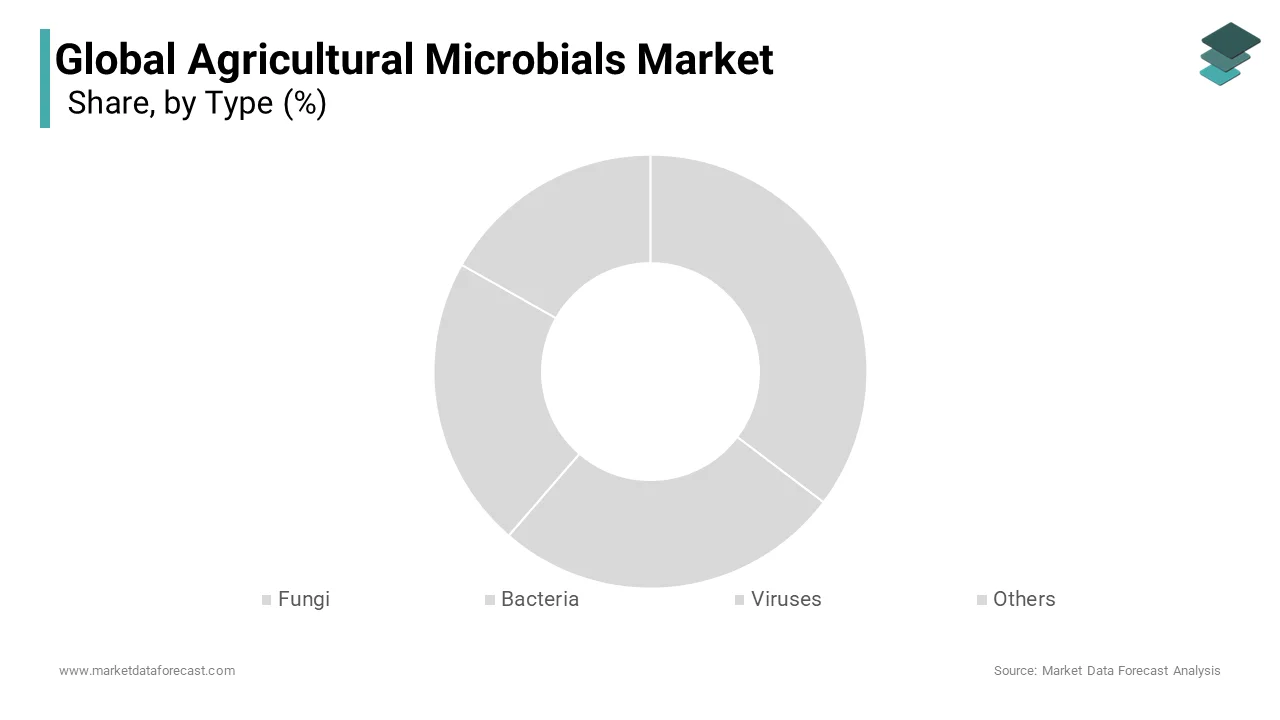
Based on type, the bacteria segment is expected to dominate the global agricultural microbial market with the largest shares during the forecast period. There are around 1,408,525 recognized bacteria strains. Bacteria are well known for their ability to control root fungus illness. Furthermore, they are widely used to enhance the growth of plants.
By Crop Type Insights
Based on crop type, the fruits & vegetables segment is expected to grow the fastest during the forecast period. The increasing demand for organic fruits & vegetables around the globe results in the increasing adoption of agricultural microbials in the fruits & vegetable industry.
By Formulation Insights
Based on formulation, the liquid segment is expected to dominate the global agricultural microbials market with the largest market share during the forecast period as they are convenient to use compared to dry agricultural microbials.
By Function Insights
Based on function, the soil amendment segment is expected to dominate the global agricultural microbial market, with the largest market share during the forecast period. As agricultural microbials enhance soil fertility by providing essential nutrients, they are widely used for amendment purposes. Hence this factor is driving the growth of the soil amendment segment during the forecast period.
By Mode of Application Insights
Based on the mode of application, the foliar spray segment is expected to dominate the global agricultural microbials market with the largest shares during the forecast period. With the help of foliar sprays, the crops can easily absorb the nutrients produced by the liquid microbial. Hence, most farmers adopt foliar sprays to spray the liquid microbial on their crops.
REGIONAL ANALYSIS
North America is expected to dominate the global agricultural microbials market with the largest market share during the forecast period. The increasing adoption of agricultural microbials in the region is driving the growth of the agricultural microbials market in North America. Moreover, government agencies such as the U.S. Department of Agriculture (USDA) and the National Science Foundation (NSF) are promoting agricultural microbials and propelling the growth of the agricultural microbials market. Also, the presence of the major market players in North America is further boosting the growth of agricultural microbials in the region.

Europe is expected to hold the largest market share after North America during the forecast period. The presence of huge agricultural lands in Europe is the major factor contributing to the growth of the agricultural microbials in the region. Furthermore, the rising awareness regarding agricultural microbials and the increasing adoption of organic fertilizers to enhance soil fertility and boost plant growth drives agricultural microbial growth in Europe.
KEY MARKET PLAYERS
Corteva Agriscience, BASF SE, FMC Corporation, Syngenta Crop Protection AG, Novozymes, Bayer CropScience, Fytofend S.A., IPL Biologicals, AgriLife Biosolutions, Koppert Biological Systems. These are some of the major market players that dominate the global agriculture microbial market.
RECENT HAPPENINGS IN THE MARKET
- In September 2022, FMC Corporation (India), an agricultural sciences company, expanded its portfolio with the introduction of three novel products for the management of pests and enhancing soil fertility. These new products are Talstar Plus insecticide, Petra Bio solution, and Cazbo crop nutrition.
- In January 2022, Syngenta Crop Protection AG acquired two next-generation bioinsecticides, NemaTrident and UniSpore, from Bionema Limited, a leading UK-based biocontrol technology developer. This acquisition provided clients with even more options while combating rising resistance and various insects and pests in horticulture and ornamentals, turf amenities, and forestry.
MARKET SEGMENTATION
This research report on the global agricultural microbial market is segmented and sub-segmented into the following categories.
By Type
- Fungi
- Bacteria
- Viruses
- Others
By Crop Type
- Oil Seeds & Pulses
- Cereals & Grains
- Fruits & Vegetables
- Others
By Formulation
- Liquid
- Dry
By Function
- Soil Amendment
- Crop Protection
By Mode of Application
- Soil Treatment
- Seed Treatment
- Foliar Spray
- Others
By Region
- North America
- Europe
- Asia-Pacific
- Latin America
- Middle East and Africa