- Product Description Description
- Table of Contents TOC
- List of Table & Figure LOT
- Get Free Sample PDF Sample PDF
Global Direct-Fed Microbials Market Size
The global direct-fed microbials market size was valued at USD 1,314.69 million in 2025 and is anticipated to reach a valuation of USD 1,403.432 million in 2026 and USD 2217.003 by 2034, growing at a CAGR of 6.75% from 2026 to 2034.
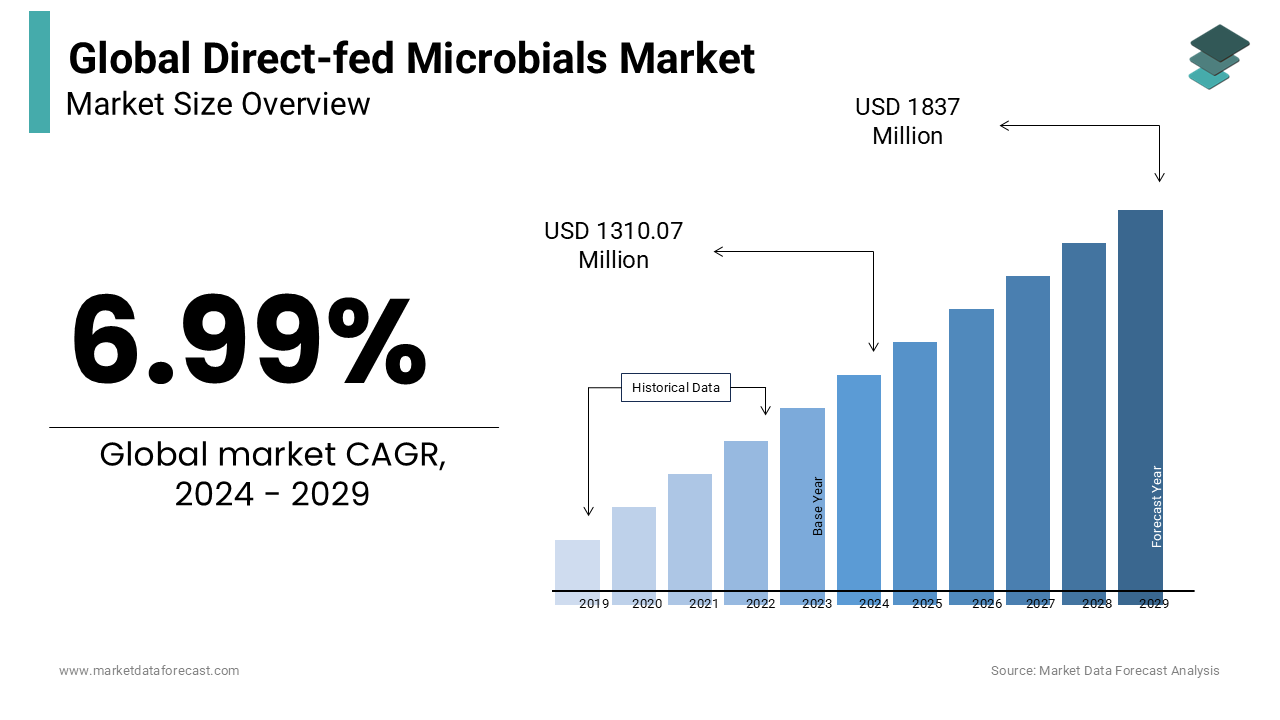
The concept of Direct-Fed Microbials (DFM) involves feeding dairy cattle beneficial microbes when they are under stress (disease, ration changes, production, or environmental challenges). Probiotics are another name for this type of feed additive. Probiotics or DFM have been shown to enhance animal performance in controlled studies.
Lactic acid bacteria are widely used to feed poultry and ruminants for healthy development. The functions of poultry include altering metabolism by increasing digestive enzyme activity, maintaining healthy intestinal microflora, and reducing the production of ammonia and bacterial enzyme activity.
MARKET DRIVERS
- Direct-fed microbials are recognized for their active role in the enhancement of the digestibility of feedstuffs. Increasing awareness of the physical health of cattle motivates the growth of the Direct-Fed Microbials Market.
- The increasing demand for treated animal feedstuffs is because of the increased population who consume a carnivorous diet.
- The high global demand for poultry meat, due to its high protein content, is expected to propel the Direct-Fed Microbials Market.
MARKET RESTRAINTS
- High cost of microbial and low shelf life are prompting an ascent in the price of production and limiting the development of the direct-fed microbials market.
REPORT COVERAGE
| REPORT METRIC | DETAILS |
| Market Size Available | 2025 to 2034 |
| Base Year | 2025 |
| Forecast Period | 2026 to 2034 |
| CAGR | 6.75% |
| Segments Covered | By End-Use, Bacteria Type, Form and Region |
| Various Analyses Covered | Global, Regional & Country Level Analysis, Segment-Level Analysis, DROC, PESTLE Analysis, Porter’s Five Forces Analysis, Competitive Landscape, Analyst Overview on Investment Opportunities |
| Regions Covered | North America, Europe, APAC, Latin America, Middle East & Africa |
| Market Leaders Profiled | Archer Daniels Midland Company (U.S.), E. I. Du Pont de Nemours and Company (USA), Bio-vet (U.S.), Novus International, Inc. (U.S.), Kemin Industries (U.S.), Chr. Hansen A / S (Denmark), Koninklijke DSM N. V. (Netherlands), Novozymes (Denmark), BIOMIN Holding GmbH (Austria), Lallemand Inc. (Canada) and Others. |
SEGMENTAL ANALYSIS
By End-Use Insights
Based on the End-Use, the Direct-Fed Microbials market is segmented into Poultry, Pork/Swine, Ruminant, and aquatic foods. Of these, the poultry segment is expected to be the fastest-growing, as direct-fed microbials provide protein to poultry birds, rising their growth rate. Due to the high demand for poultry meat worldwide and its high nutritional value, the market for direct-feed microbials is also expected to increase.
By Bacteria Insights
Based on the bacteria type, the direct-fed microbials market is segmented into lactic acid bacteria and bacterial. Of these segments, the lactic acid bacteria segment is expected to grow at a CAGR of 8.5%. Lactic acid bacteria are becoming increasingly popular in this market all over the world, and the demand for lactic acid bacteria in feed for animal health and nutrition has led to the growth of the market. Thanks to their ease of use, lactic acid bacteria are more widely used in many regions of the world. These are the most commonly used direct-fed microbials and are, therefore, projected to be the fastest-growing group of lactic acid bacteria during the forecast period.
REGIONAL ANALYSIS
Geographically, North America is leading the Direct-Fed Microbials market. It's followed by Europe. The U.S.A. and Canada are the largest contributors in North America. The ban on the use of antibiotics by the governments of the European Union to support the development of animals has led to an increase in demand for Direct-Fed Microbials in Europe. Asia Pacific is a rapidly developing region for this market. Rising animal health awareness and growing demand for animal protein in emerging nations, such as China and India are enhancing the growth of the global Direct-Fed microbials market.
KEY MARKET PLAYERS
The key players identified in this market are
- Archer Daniels Midland Company (U.S.)
- E. I. Du Pont de Nemours and Company (USA)
- Bio-vet (U.S.)
- Novus International, Inc. (U.S.)
- Kemin Industries (U.S.)
- Chr. Hansen A / S (Denmark)
- Koninklijke DSM N. V. (Netherlands)
- Novozymes (Denmark)
- BIOMIN Holding GmbH (Austria)
- Lallemand Inc. (Canada).
Global Direct-Fed Microbials Market Research Report Key Highlights
- Evaluation of the current stage of market and future implications of the market based on the detailed observation of Recent key developments.
- Address the matter by better understanding the market size estimates through CAGR analysis to forecast the future market.
- Comprehensive segmentation of the market, detailed evaluation of the market by further sub-segments.
- Address Market Drivers and restraints and provide insights for gaining market share.
- Porter’s Five Forces are used to analyze the factors responsible for the shaping of the industry as it is as a result of the competitive environment.
RECENT HAPPENINGS IN THE MARKET
In 2006, the EU imposed a ban on the use of antibiotics in feed. After an eight-year transition period, the EU completely stopped using AGP in 2014. According to the EU, the use of these medications has led to the development of antibiotic-resistant bacteria to treat infections in humans and animals. This ban has opened up tremendous potential opportunities for Direct-Fed Microbials; as feed manufacturers are seeking ways to improve product quality, they are willing to explore Direct-Fed Microbials as an alternative.
MARKET SEGMENTATION
This research report on the global direct-fed microbial market is segmented and sub-segmented into the following categories.
By End-Use
- Poultry
- Pork\swine
- Ruminants
- Aquatic Foods
By Bacteria Type
- Lactic Acid bacteria
- Bacillus
By Region
- North America
- Europe
- Asia-Pacific
- Latin America
- Middle East and Africa