- Product Description Description
- Table of Contents TOC
- List of Table & Figure LOT
- Get Free Sample PDF Sample PDF
Market Size, 2025
$10.38 BnMarket Estimate, 2026
$11.46 BnMarket Forecast, 2034
$25.29 BnCAGR, 2026–2034
10.4%Global Disposable Gloves Market Size
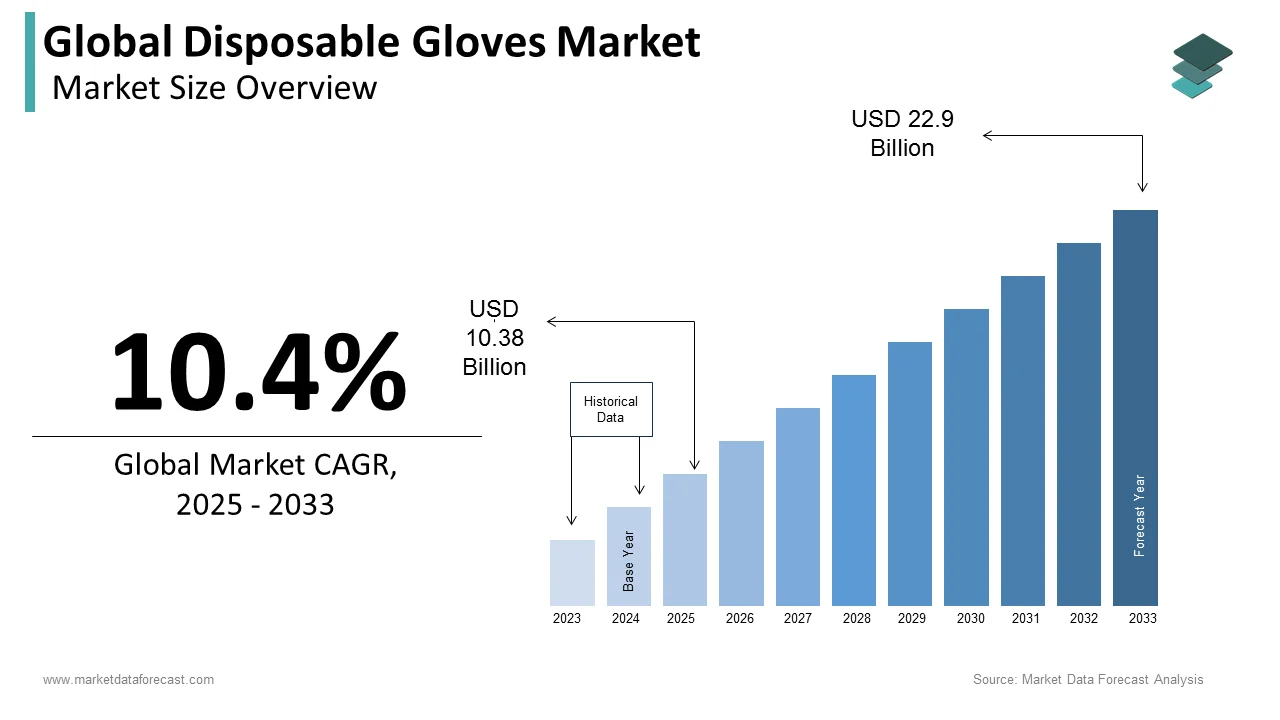
The global disposable gloves market was valued at USD 10.38 billion in 2025. The global market is anticipated to grow at a CAGR of 10.4% from 2026 to 2034 and be worth USD 25.29 billion by 2034, up from USD 11.46 billion in 2026.
Disposable gloves are single-use protective barriers made from latex, nitrile, vinyl, and neoprene. It is designed to prevent cross-contamination in clinical, industrial, and domestic settings. These are not mere accessories but important components of infection control infrastructure, embedded into the procedural DNA of modern hygiene protocols. According to the study, a portion of healthcare-associated infections could be mitigated through consistent glove use, yet global compliance remains inconsistent, particularly in low-resource settings where a smaller share of frontline workers have reliable access. In the United States, as per research, disposable gloves are consumed annually across hospitals, laboratories, food service, and manufacturing.
MARKET DRIVERS
Institutionalization of Infection Prevention Protocols Boosting Disposable Gloves Demand
The irreversible institutionalization of infection prevention protocols in healthcare systems following the global recognition of transmission risks beyond traditional pathogens is driving the growth of the disposable gloves market. This behavioral shift is strengthened by mandatory compliance frameworks. In Germany, failure to wear gloves during invasive procedures carries administrative penalties, while in Japan, hospitals and clinics are required to establish a medical safety management system. Even outside operating rooms, the routine use of gloves during patient transfers, wound dressing, and even vital sign checks has become standard in a portion of acute care facilities, as per the study. Gloves have evolved from situational tools to procedural constants, much like sterile drapes or calibrated instruments.
Stringent Hygiene Mandates in Non-Clinical Sectors Driving Disposable Gloves Demand
The expansion of stringent hygiene mandates into non-clinical sectors such as food processing, pharmaceutical manufacturing, and cleanroom environments where particulate and microbial control is legally enforced contributes to the expansion of the disposable gloves market. In the United States, the FDA's guidance emphasizes the processes and controls a manufacturer must use to prevent contamination, which includes protocols for wearing and changing gloves., according to the study. In semiconductor fabrication, where static discharge and particle contamination can render entire microchip batches defective, operators change gloves frequently during assembly. These industries do not treat gloves as consumables.
MARKET RESTRAINTS
Raw Material Scarcity Limiting Disposable Gloves Market Growth
The persistent scarcity of raw material supply chains for synthetic polymers, particularly nitrile butadiene rubber, which remains concentrated in a handful of geopolitical regions, hinders the growth of the disposable gloves market. According to the study, a portion of global nitrile production is controlled by three manufacturers based in China, Malaysia, and South Korea, which creates systemic vulnerability to trade disruptions. During the supply crunch, prices for nitrile gloves surged, triggering rationing in public hospitals, where procurement budgets were frozen, as per the research. Natural latex, though biodegradable, faces parallel constraints due to climate-induced tapping restrictions in Thailand, a major producer.
Environmental Impact of Single-Use Gloves Limiting Market Growth
The environmental burden of single-use plastic waste generated by billions of discarded gloves, which triggers regulatory backlash and institutional resistance, impedes the expansion of the disposable gloves market. As per a study, notable metric tons of disposable gloves entered global landfills and waterways, an increase since 2019, with a smaller share being recycled due to contamination and composite material composition. Institutions balance infection control with sustainability despite safety's paramount importance, creating an internal conflict between clinical and ESG mandates that slows adoption and inflates operational complexity.
MARKET OPPORTUNITIES
Smart Gloves with Antimicrobial Coatings and Real-Time Monitoring
The development of smart gloves embedded with antimicrobial coatings and real-time contamination sensors that alert users when barrier integrity is compromised provides an emerging opportunity for the growth of the disposable gloves market. Researchers have engineered gloves, including nitrile and silver-nanoparticle-coated versions, that effectively reduce bacterial loads on the glove's surface. These gloves are shown to significantly inhibit the growth of pathogens and reduce surface microbial contamination, thereby lowering the risk of pathogen transmission, as per the study. These are not passive barriers but active diagnostic tools, transforming gloves from consumables into intelligent interfaces that monitor hygiene compliance and flag breaches before transmission occurs. FDA clearance pathways for smart PPE now shift the paradigm as gloves move beyond simple protection to active participation in infection surveillance.
Reusable Glove Systems with Advanced Decontamination Technologies
The integration of reusable glove systems with advanced decontamination technologies in high-volume and high-risk environments is likely to promote new opportunities for the disposable gloves market. In addition, public hospitals piloted a closed-loop sterilization program using ozone plasma chambers to disinfect and reuse nitrile gloves up to five times without compromising tensile strength, reducing annual consumption while maintaining WHO-recommended barrier standards, as per the study. Similar systems are being deployed in oncology centers, where gloves used during chemotherapy compounding are cleaned via UV-C irradiation and revalidated for reuse under strict batch tracking. This model challenges the foundational assumption that disposability equals safety. It proves that rigorously engineered reusability can achieve equal or superior protection while slashing waste. Regulatory bodies like the CDC and ECDC are now reviewing guidelines to accommodate validated reuse protocols.
MARKET CHALLENGES
Lack of Standardized Global Testing Protocols for Glove Performance
The lack of standardized global testing protocols for glove performance metrics challenges the expansion of the disposable gloves market. This leads to widespread misrepresentation of barrier efficacy and false confidence among end-users. A portion of gloves marketed as medical grade in emerging economies failed permeability tests for bloodborne pathogen resistance, yet remained in circulation due to weak enforcement. In addition, as per the study, a share of sampled gloves purchased from local distributors showed visible micro-punctures after simulated needlestick stress, yet were still used in surgical prep, a practice that increased postoperative infection rates. Meanwhile, in Europe, competing certification labels, CE, EN455, and ISO 13485 are inconsistently applied, allowing substandard products to enter supply chains under misleading claims.
Cultural and Behavioral Resistance in Low-Resource Settings
The cultural and behavioral resistance to glove use in low-resource settings, where economic hardship and training gaps override clinical guidelines, hampers the growth of the disposable gloves market. As per the study, only a portion of frontline workers in rural clinics across Sub-Saharan Africa consistently don gloves during basic procedures like venipuncture or wound care, citing cost, discomfort, and lack of availability as primary reasons. In Bangladesh, midwives in remote districts routinely operate bare-handed during childbirth due to glove shortages, despite national policy mandating their use; maternal sepsis rates are higher in areas without consistent PPE access. Training programs often fail to address tactile sensitivity concerns or provide culturally appropriate education, leaving workers skeptical of protocols perceived as alien or impractical.
REPORT COVERAGE
| REPORT METRIC | DETAILS |
| Market Size Available | 2025 to 2034 |
| Base Year | 2025 |
| Forecast Period | 2026 to 2034 |
| Segments Covered | By Product, Material, End-User, and Region. |
| Various Analyses Covered | Global, Regional and Country-Level Analysis, Segment-Level Analysis, Drivers, Restraints, Opportunities, Challenges; PESTLE Analysis; Porter’s Five Forces Analysis, Competitive Landscape, Analyst Overview of Investment Opportunities |
| Regions Covered | North America, Europe, APAC, Latin America, Middle East & Africa |
| Market Leaders Profiled | Ansell Ltd., Supermax Corporation Bhd, Medline Industries, Inc., Hartalega Holdings Berhad, Smart Glove, Semperit AG Holding, Kossan Rubber Industries Bhd, The Glove Company, 3M Company, Kimberly Clark, B. Braun Melsungen AG, Cypress Medical Products LLC, Unigloves (UK) Limited, Dynarex Corporation, Cardinal Health, Inc., and Others. |
SEGMENTAL ANALYSIS
By Product Insights
The powder-free gloves segment was the dominant segment of the disposable gloves market by accounting for a substantial share in 2024. Regulatory mandates and clinical safety imperatives are the factors contributing to the dominance of the powder-free gloves segment. The European Union’s Medical Device Regulation (MDR) further strengthened this shift, requiring all Class I and IIa medical gloves to be labeled powder-free unless specifically exempted for non-clinical uses. In Japan, as per a study, hospitals saw a reduction in postoperative complications after transitioning entirely to powder-free nitrile gloves.
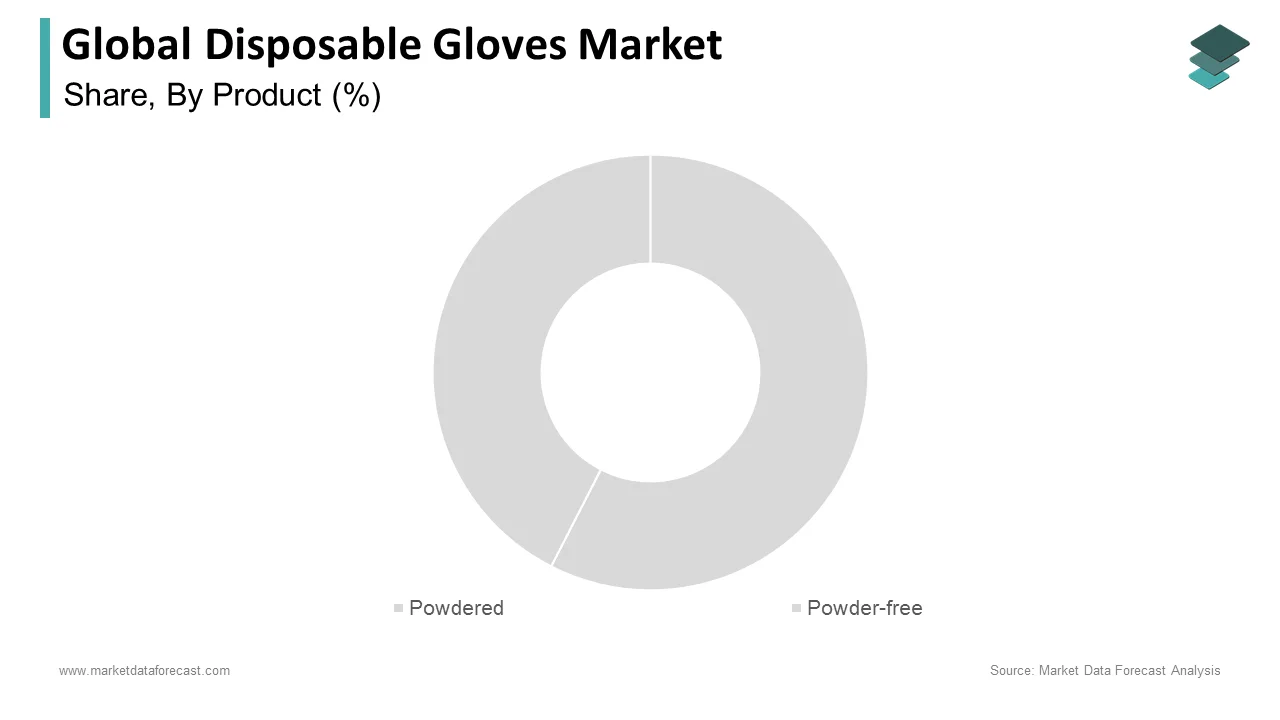
The powder-free gloves segment is also expected to exhibit a noteworthy CAGR of 8.9% from 2026 to 2034 due to the expanding applications beyond healthcare into high-precision manufacturing and cleanroom environments where particulate contamination is unacceptable. As per research, fabs in South Korea and Taiwan require powder-free nitrile gloves rated Class 100 cleanroom compliant, with operators changing gloves to prevent electrostatic discharge and particle shedding, a practice consuming a large number of pairs annually just in microchip production. Apart from these, food processing plants under EU Regulation are mandated to eliminate powder to avoid cross-contamination of consumables, which results in a surge in adoption across Germany and France. The rise of automation in assembly lines has further amplified demand, as robotic handlers cannot tolerate loose particles that disrupt sensor calibration. Powder-free is no longer a preference.
By Material Insights
The nitrile segment accounted for a dominant share of the disposable gloves market in 2024. Its superior puncture resistance, chemical inertness, and hypoallergenic properties are primarily driving the growth of the nitrile segment in the global market. In Europe, as per a study, a percentage of public hospitals have phased out latex entirely by replacing it with nitrile due to its resilience against solvents, disinfectants, and bodily fluids. The material’s performance advantages are quantifiable. Like, as per a study, nitrile gloves withstand more punctures than latex during needlestick simulations. Its scalability also supports mass production.
The polypropylene is on the rise and is expected to be the fastest-growing segment in the global market by witnessing a CAGR of 12.4% over the forecast period, owing to its adoption in low-cost, short-duration applications within emerging economies and non-medical sectors requiring basic barrier protection. Unlike traditional materials, polypropylene gloves are lightweight, non-latex, and produced using ultra-thin extrusion technology that slashes material usage by making them ideal for food handling, janitorial services, and retail in price-sensitive markets. In India, as per research, polypropylene glove usage surged between 2020 and 2023 in street food vendors and small clinics, where the cost per unit is lower than nitrile.
By End-User Insights
The medical & healthcare segment accounted for a 65.3% share of the disposable gloves market in 2024. The growth of the medical & healthcare segment is fuelled by the non-negotiable role of gloves in clinical safety protocols. According to research, a large number of patient interactions occur annually in hospitals worldwide, involving glove use for infection prevention. In the United States, as per research, a percentage of surgical teams wear double-gloving during procedures, and emergency departments require gloves for trauma triage, blood draws, and wound management. Even routine tasks such as vital sign checks, catheter insertion, and bed linen changes are standardized with glove use in a portion of accredited facilities, as per the study. The proliferation of outpatient clinics, dialysis centers, and home health services has expanded this footprint.
The non-medical segment is likely to experience the fastest CAGR of 11.7% from 2026 to 2034 due to factors such as industrialization, food safety regulation, and the rise of gig-economy service sectors requiring minimal-barrier hygiene. In the European Union, gloves are consumed annually in food processing. In the U.S., the rise of delivery logistics has transformed warehouses into glove-intensive environments. Like, Amazon’s fulfillment centers consume gloves annually to prevent product contamination and comply with FDA requirements. Similarly, in Japan, convenience stores and sushi bars must change gloves regularly under national hygiene codes, generating millions of units yearly. Electric vehicle battery manufacturing and semiconductor fabrication are industries where microscopic contamination equals financial loss, so they use powder-free nitrile or polypropylene gloves, which drives demand beyond traditional boundaries.
REGIONAL ANALYSIS
North America Disposable Gloves Market Analysis
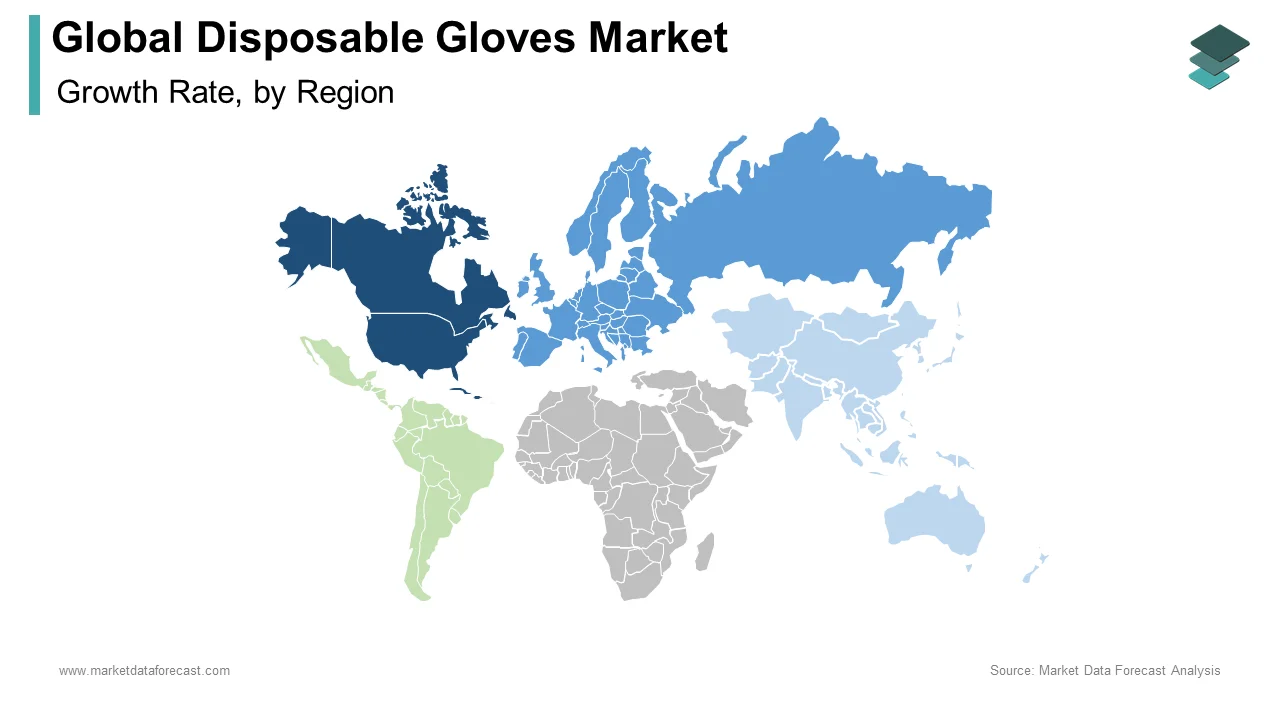
North America led the disposable gloves market by capturing 38.6% of the share in 2024. The prominence of North America in the global market is driven by the United States, where stringent regulatory frameworks and high procedural volumes define its dominance. According to a study, billions of gloves are consumed annually in U.S. healthcare alone, with a portion being nitrile and powder-free. Federal mandates have institutionalized best practices across all care tiers, from ERs to hospice homes. The pandemic accelerated adoption in non-medical sectors. Grocery chains, pharmacies, and school cafeterias increased glove procurement. The region has reduced reliance on imports by expanding domestic manufacturing capacity and enforcing strict quality controls. North America’s strength lies not in volume alone, but in the legal codification of glove use as a clinical and occupational imperative, which makes it the most regulated and consistent market globally.
Europe Disposable Gloves Market Analysis
Europe remained the next major region in the disposable gloves market by occupying 29.7% of the global market share in 2024. Harmonized regulations, sustainability burdens, and deeply ingrained hygiene culture are contributing to the expansion of Europe in the global market. The European Union’s Medical Device Regulation (MDR) and Food Safety Regulation (EC) create uniform standards across nations, ensuring that all gloves sold for medical or food contact must meet defined permeability, allergen, and particulate thresholds. Germany leads in adoption, with a portion of hospitals using only powder-free nitrile gloves, as per a study. Scandinavia is pioneering circular models. Yet environmental scrutiny is intensifying. France has banned non-recyclable vinyl gloves in public institutions, which forces suppliers to pivot toward bio-based alternatives.
Asia Pacific Disposable Gloves Market Analysis
Asia Pacific disposable gloves market is likely to grow with the production and evolving consumption. China produces a portion of the world’s disposable gloves, manufacturing billions of nitrile units annually, according to a study, supplying global demand while simultaneously domesticating usage. India’s non-medical sector is experiencing explosive growth. There has been a surge in glove use among street food vendors and small clinics, which is driven by new hygiene certifications required for licensing. Japan leads in precision applications, with semiconductor fabs mandating Class 100-rated gloves changed regularly, an annual consumption of millions of pairs, as per research. Meanwhile, Southeast Asia’s rapid urbanization has turned retail and logistics into major consumers.
Latin America Disposable Gloves Market Analysis
Latin America grew in the disposable gloves market. The market growth of the region is dominated by Brazil and Mexico, where economic growth and public health reforms are slowly increasing access. According to study, public hospital glove procurement rose between 2020 and 2023, with nitrile replacing latex in a percentage of. In Mexico City, private clinics adopted powder-free gloves in a percentage of procedures, which aligns with U.S. standards, as per a study.
Middle East and Africa Disposable Gloves Market Analysis
Middle East and Africa are likely to expand in the disposable gloves market during the forecast period, owing to the presence of advanced Gulf states and severely underserved African regions. In Saudi Arabia and the UAE, hospitals operate defibrillator-grade hygiene protocols, with compliance to nitrile as well as powder-free standards in ICUs and ORs, as per the study. Dubai International Airport uses gloves for all baggage handlers, which consumes millions of pairs annually. Conversely, sub-Saharan Africa faces vital shortages: as per the study, a smaller share of primary care clinics in Nigeria, Ethiopia, and Malawi maintain consistent glove supplies by forcing frontline workers to reuse or forego protection. Yet breakthrough initiatives are underway.
COMPETITIVE LANDSCAPE
Competition in the disposable gloves market has evolved from a race for lowest cost to a battle for systemic legitimacy, where dominance is defined not by how many gloves are made, but by how deeply they are woven into the fabric of safe, sustainable, and traceable care. Leading firms now compete by making their products intelligent, verifiable, and ethically rooted, which transforms simple protection into a signal of institutional responsibility. The most successful players no longer sell gloves. They sell confidence. Confidence that a barrier won’t fail, that a material won’t harm, and that a supply chain won’t exploit.
KEY MARKET PLAYERS
Some of the companies that are playing a dominating role in the disposable gloves market include
- Ansell Ltd.
- Supermax Corporation Bhd
- Medline Industries, Inc.
- Hartalega Holdings Berhad
- Smart Glove
- Semperit AG Holding
- Kossan Rubber Industries Bhd
- The Glove Company
- 3M Company
- Kimberly Clark
- B. Braun Melsungen AG
- Cypress Medical Products LLC
- Unigloves (UK) Limited
- Dynarex Corporation
- Cardinal Health, Inc.
Top Strategies Used by Key Market Participants
Key players are moving beyond volume-driven production to build end-to-end value ecosystems centered on safety intelligence, sustainability credibility, and supply chain transparency. They are embedding smart materials, such as contaminant-detecting sensors and antimicrobial coatings, into gloves to transform them from passive barriers into active diagnostic tools. Strategic alliances with public health agencies enable global protocol standardization by turning corporate innovation into institutional practice. Companies are investing heavily in bio-based polymers and circular manufacturing models to meet tightening environmental regulations, while blockchain and AI are being leveraged to ensure traceability and predict demand disruptions.
GLOBAL DISPOSABLE GLOVES MARKET NEWS
- On 3 Mar 2021, Ansell Limited, a specialist in security solutions, completed the purchase of the Primus brand and associated properties that include the Primus Gloves and Sanrea Healthcare Products Life Science company (Primus).
- On 29 April 2021, Yanimed, a Maltese manufacturer of nitrile gloves and safety masks, formed a joint venture with Guangdong Guyun Medical Technology Co., Ltd., a Chinese manufacturer of nitrile gloves. This partnership develops the new Yanimed – YaniPure brand, which will be available exclusively in the United States.
MARKET SEGMENTATION
This research report on the global disposable gloves market has been segmented and sub-segmented based on the product, material, end-user, and region.
By Product
- Powdered
- Powder-free
By Material
- Natural Rubber
- Nitrile
- Vinyl
- Neoprene
- Polypropylene
- Others
By End-User
- Medical & Healthcare
- Non-Medical
By Region
- North America
- Europe
- Asia-Pacific
- Latin America
- The Middle East and Africa