- Product Description Description
- Table of Contents TOC
- List of Table & Figure LOT
- Get Free Sample PDF Sample PDF
Market Size, 2025
$763.45 MnMarket Estimate, 2026
$802.38 MnMarket Forecast, 2034
$1,194.55 MnCAGR, 2026–2034
5.1%Executive Summary: Hair Mask Market
- Market Scope: Comprehensive global hair mask market analysis covering consumer hair health awareness, premium hair care products, organic and synthetic-free formulations, deep-conditioning treatments, and e-commerce channel accessibility.
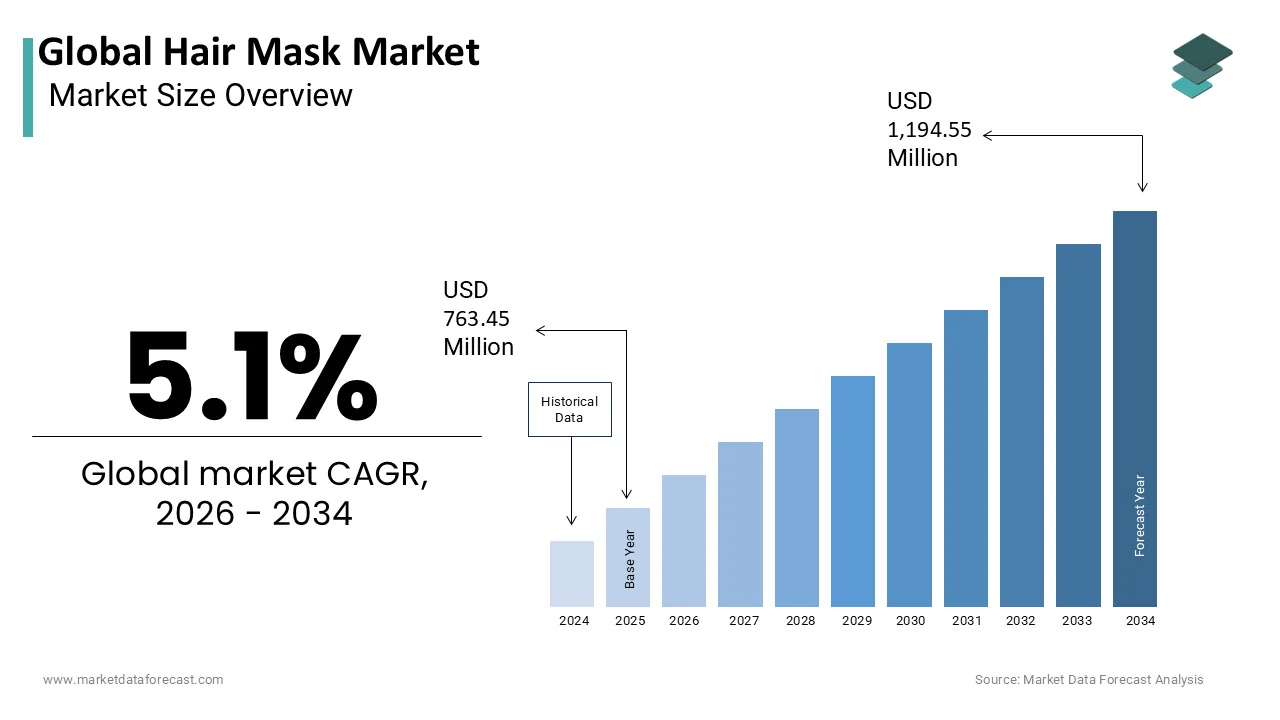
- Market Valuation: Valued at USD 763.45 million (2025), estimated at USD 802.38 million (2026), and projected to reach USD 1,194.55 million by 2034, registering a steady CAGR of 5.1% (2026–2034).
- Primary Growth Drivers: Increasing hair health awareness, rising disposable incomes, preference for premium and natural products, professionalization of hair care routines, and social media beauty standards. Key challenges include home remedies competition.
Key Market Segment Metrics (2026–2034)
| Category | Leading Segment (Position) | Fastest-Growing Segment |
|---|---|---|
| By Segment, End-User & Channel | Synthetic segment (holds largest value share due to affordability and wide availability) & Commercial end-users (dominate usage in salons/professionals) & Specialty stores (lead distribution) | Natural and organic variants & Household segment (expanding rapidly among millennials) & Online stores (high-growth distribution avenue) |
| By Region / Country | Global coverage across household and commercial segments | Regions with expanding e-commerce penetration and social media beauty influence |
Major Market Players & Market Structure
Market Structure: Highly competitive global beauty and personal care landscape featuring major multinational corporations and specialized hair care brands driving product innovations in natural ingredients, strategic pricing, and diverse distribution networks.
Key Companies: Procter & Gamble, Leonor Greyl USA, Aveda Corporation, L'Oréal Inc., Unilever Inc., Henkel Corporation, Coty Inc., Avalon Natural Products, Inc., and Cobiosa Industrias Asociadas SL.
 Download Free Sample Report
Global Hair Mask Market Size
The Global Hair Mask Market is projected to grow from USD 763.45 million in 2025 to USD 802.38 million in 2026 and reach USD 1,194.55 million by 2034, registering a CAGR of 5.1% from 2026 to 2034.
Current Scenario of the Global Hair Mask Market
In 2023, thermal steam accounted for the largest share of over 80% in terms of turnover. The predominant consumption of the product in spas and salons drove the growth of the segment.
The hair mask is a nourishing hair treatment for men and women. Hair masks are made with restorative, moisturizing, and hydrating ingredients. Human hair requires proper care and must be groomed properly. The hair mask is very important for those who have dry, damaged, frizzy, or very long or thin hair. Nowadays, grey hair is visible not only in the elderly but also in adolescents. This is due to the increasing contamination that is harmful to human hair, damaging the hair and scalp.
Currently, there are several beauty brands on the market that offer deep-conditioning hair masks. These brands are made from different ingredients like olive oil, avocado, egg, aloe vera, coconut oil, banana, etc. These ingredients are very helpful in repairing damaged hair and provide treatment for dry hair. With the help of hair masks, the hair becomes shinier and smoother and is deeply nourished and hydrated. All of these benefits and features make hair masks popular around the world.
Hair is easily damaged due to various reasons including exposure to hot and cold climates, excessive use of heated tools such as hair dryers, straighteners, and curling irons, exposure to ultraviolet rays harmful effects of the sun, excessive washing with strong alcohols and soaps, use of chemical treatments, excessive combing and stress. As a result, the hair loses its shine and becomes dry. Also, split ends, rough texture, and itchy scalp are some of the other signs of damaged hair. Due to all these factors, the demand for hair mask products has increased all over the world over time. However, there are home remedies available to the end-user that can be used as hair masks, such as banana hair packs, coffee seeds, henna packs, and the like. This may hamper the growth of the global hair mask market during the outlook period.
The growing concern about maintaining the quality of hair is one of the major factors responsible for the market demand. As a result, customers take a holistic approach when considering hair care products in their daily routines. This increases the demand for various hair care products such as shampoos, conditioners, and other hair treatment products. The hair mask is one of those hair care products that has generated higher demand from its target customers. The hair mask is a deep conditioning treatment that is made up of rich ingredients like natural oils and lipids in comparatively higher concentrations than normal conditioners. The hair mask has several key features facilitating smooth and shiny hair, reversing hair damage, rehydrating dry hair, and others.
REPORT COVERAGE
| REPORT METRIC | DETAILS |
| Market Size Available | 2025 to 2034 |
| Base Year | 2025 |
| Forecast Period | 2026 to 2034 |
| Segments Covered | Based on nature, end-user, distribution channel, and Region |
| Various Analyses Covered | Global, Regional & Country Level Analysis, Segment-Level Analysis, DROC, PESTLE Analysis, Porter’s Five Forces Analysis, Competitive Landscape, Analyst Overview of Investment Opportunities |
| Regions Covered | North America, Europe, Asia Pacific, Latin America, Middle East & Africa |
| Market Leaders Profiled | Procter & Gamble, Leonor Greyl USA, Aveda Corporation, L'Oréal Inc., Unilever Inc., Henkel Corporation, Coty Inc., Avalon Natural Products, Inc. and Cobiosa Industrias Asociadas SL. |
SEGMENTAL ANALYSIS
Global Hair Mask Market By Nature
The synthetic segment represents a higher value share. The easy availability of the product at affordable prices is one of the main reasons for the consideration of the synthetic segment for the market share of higher-value hair masks. However, due to the increasing level of awareness of the adverse effects of using synthetic cosmetics, customers are gradually changing their preference for hair mask products derived from natural ingredients, opening up opportunities in the market over the foreseen period.
Global Hair Mask Market By End-User
The commercial segment represents a larger share of the hair mask market. Key sectors included in the business segment include salons and hair care professionals. When it comes to hair care or styling, most clients prefer to consult hair care professionals for the same. These professionals are trained to recognize and use the right type of hair mask for different scalps. For the household segment, hair mask products are available through distribution channels such as hypermarkets, supermarkets, franchise stores, and specialty stores. Among the household segment, the millennial population represents a significant share of the target customers of the global hair mask market because they are highly conscious of their hair in terms of quality and density.
Global Hair Mask Market By Distribution Channel
Specialty stores have a comparatively larger number of product offerings, as well as a lucrative pricing strategy. In addition to their product offerings, these stores also launch customer loyalty programs, seasonal price offers, and one-time discounts.
KEY MARKET PLAYERS
Procter & Gamble, Leonor Greyl USA, Aveda Corporation, L'Oréal Inc., Unilever Inc., Henkel Corporation, Coty Inc., Avalon Natural Products, Inc., and Cobiosa Industrias Asociadas SL are some of the major players in the global hair mask market.
MARKET SEGMENTATION
This research report on the global hair mask market has been segmented and sub-segmented based on nature, end-user, distribution channel, and region.
By Nature
- Natural
- Organic
- Synthetic
By End-User
- Household
- Commercial
By Distribution Channel
- Supermarkets/hypermarkets
- Specialty stores
- Online stores
By Region
- North America
- Europe
- Asia-Pacific
- Latin America
- Middle East and Africa