- Product Description Description
- Table of Contents TOC
- List of Table & Figure LOT
- Get Free Sample PDF Sample PDF
Market Size, 2025
$7.04 BnMarket Estimate, 2026
$7.65 BnMarket Forecast, 2034
$14.79 BnCAGR, 2026–2034
8.6%Global Rhinoconjunctivitis Market Size, Growth, Trends & Forecast (2026–2034)
The global rhinoconjunctivitis market size was valued at USD 7.04 billion in 2025, is estimated to reach USD 7.65 billion in 2026, and is projected to scale up to USD 14.79 billion by 2034, registering a compound annual growth rate (CAGR) of 8.6% during the forecast period from 2026 to 2034. Driven by the rising prevalence of non-food allergies, increasing global pollution, escalating awareness levels, and expanding pharmaceutical R&D, the market continues to expand robustly across key international regions.
Key Executive Metrics (At-a-Glance)
- 2025 Base Valuation: USD 7.04 Billion
- 2026 Current Valuation: USD 7.65 Billion
- 2034 Forecast Valuation: USD 14.79 Billion
- Compound Annual Growth Rate (CAGR): 8.6% (2026–2034)
- Dominant Treatment Segment: Antihistamines (favored for their safety profile in pediatric care and direct relief of itching/sneezing)
- Dominant Product Segment: Tablets (most commonly prescribed, highly consumable, and reliable oral format)
- Dominant Age Group: Pediatrics (higher prevalence and recurring manifestation among children)
- Dominant Regional Market: North America (leading via advanced technology adoption and major pharmaceutical production, with Asia Pacific growing at the fastest pace)
Core Market Drivers
- Rising Prevalence of Allergies & Pollution: Escalating incidence of non-food allergies, allergic asthma, industrialization, and air pollution triggering widespread allergic rhinitis and conjunctivitis.
- Growing Awareness & Healthcare Infrastructure: Rapidly increasing public awareness regarding allergy management, alongside expanding health expenditures and R&D activities in developing nations.
Primary Market Restraints & Challenges
- Awareness & Treatment Costs: Limited awareness regarding conjunctivitis in certain areas, high costs associated with specialized treatments, and a shortage of skilled medical professionals.
Global Rhinoconjunctivitis Market Segmentation Breakdown
| Segment Category | Leading Sub-Segment (Largest) | Fastest-Growing Sub-Segment |
|---|---|---|
| By Treatment | Antihistamines (dominant due to safety in children and proven histamine reduction) | Intranasal Corticosteroids (standard combination treatments for severe symptom relief) |
| By Product | Tablets (most easily consumable and frequently prescribed oral antihistamine form) | Eye Solutions, Gels & Creams (rapid recovery and immediate external relief) |
| By Dosage Forms | Solid (tablets represent the most common form of consumption) | Liquid & Semi-Solid (rising demand for nasal sprays, topical gels, and creams) |
| By Route of Administration | Oral and Topical (primary combination mode of treatment) | Nasal and Parenteral (accelerating via specialized sprays and acute clinical care) |
| By Age | Pediatrics (higher prevalence and vulnerability due to developing immune systems) | Geriatrics (growing susceptibility driven by declining immune function) |
| By End-User / Distribution | Hospital Pharmacy & Offline Channels (rapid patient influx and easy drug availability) | Online Pharmacy & Digital Channels (scaling via rising internet penetration and OTC preferences) |
| By Region | North America (leading market due to advanced technology and major drug manufacturing) | Asia Pacific (fastest-growing market propelled by rising awareness and healthcare infrastructure) |
Major Industry Players Profiled
Key enterprises shaping the global rhinoconjunctivitis market include Johnson & Johnson Inc., Merck & Co., Inc., GlaxoSmithKline, Sanofi, and Adiga Life Sciences Inc., among others.
 Download Free Sample Report
Global Rhinoconjunctivitis Market Size
The size of the global rhinoconjunctivitis market was worth USD 7.04 billion in 2025. The global market is anticipated to grow at a CAGR of 8.6% from 2026 to 2034 and be worth USD 14.79 billion by 2034 from USD 7.65 billion in 2026.
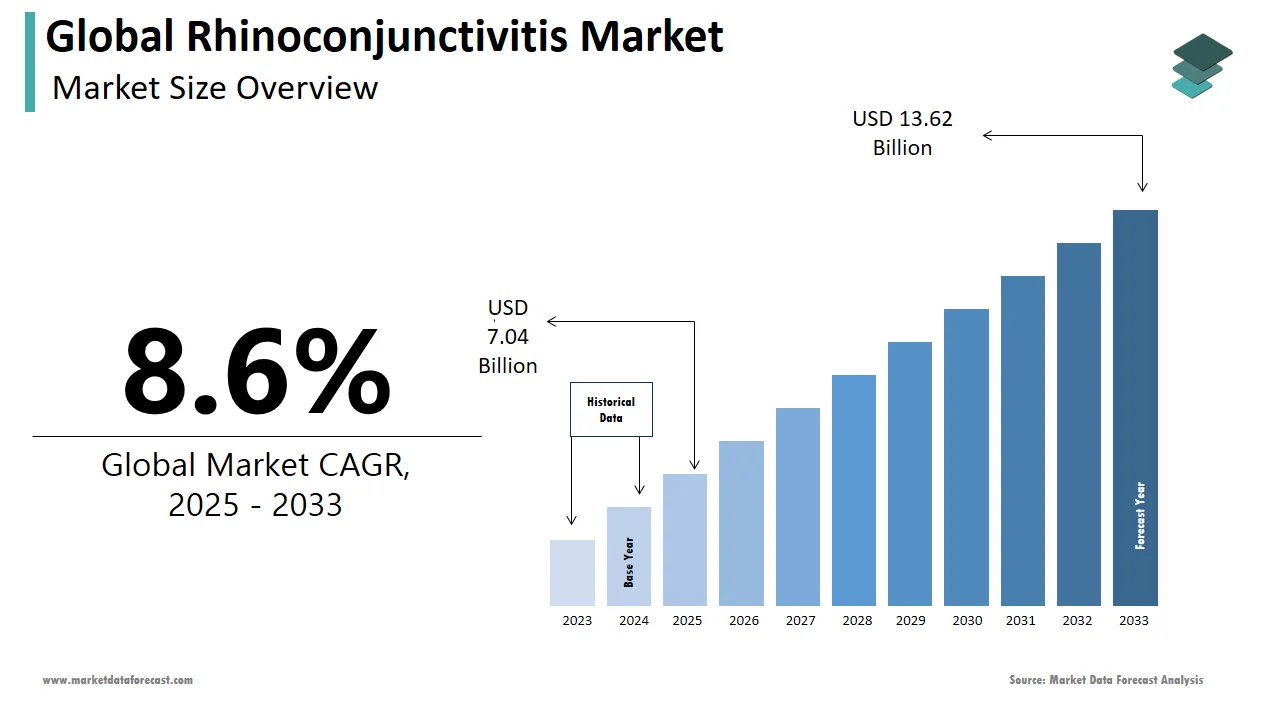
Rhino conjunctivitis is an allergic medical problem combined with rhino and conjunctivitis. This affects the nose and mucous membrane and causes redness and pinkeye combination. This disorder commonly occurs in children and is very prevalent in developed countries. The infection can cause cough and cold symptoms and problems like fatigue, fever, and tiredness. These nose and eye problems occur at least once a week in patients and must be taken care of regularly. The allergy is caused either due to internal allergens inside the home, like house dust, mites, and pet allergens, or outside allergens, like pollen, grass, trees, seasonal allergens, etc. Rhinoconjictivtitis may severely affect the patient's physical and mental health, leading to work, school, college, and daily life obstructions. It may also aggravate to lead to more severe conditions like rhinosinusitis, middle ear disease, asthma, etc. Therefore, it is essential to take regular and early treatment.
MARKET DRIVERS
The rising prevalence of non-food allergies and allergic asthma is an increasing concern for many countries driving the global rhinoconjunctivitis market.
Growing awareness about allergies and increasing healthcare infrastructure would also influence market growth, particularly in emerging nations. The prevalence of allergic rhinitis has risen dramatically in both adults and children. According to research published in the Allergy, Asthma & Immunology Research Journal, rising prevalence is also due to the consumption of food that has been kept extensively in freezers, industrialization, and air pollution. In India, Korea, Singapore, and other Asian countries, similar problems exist.
Y-O-Y growth in the awareness levels regarding allergies and conjunctivitis among people is primarily accelerating the global rhinoconjunctivitis market growth.
According to National Institute for Health Research, more than 1 million population in the UK suffer from allergic rhinitis. People with this allergic rhinitis keep suffering from eye-related symptoms and asthma. Growing R&D activities, increased intake of food stored in the refrigerators for days, and growing pollution levels further favour the global rhinoconjunctivitis market. Increasing awareness among the people in the developed and developing nations is another significant favouring market growth. Rapid changes in the healthcare infrastructure, growing expenditure on healthcare, and the number of existing key players participating in the R&D of developing nations are also expected to drive the global rhinoconjunctivitis market growth.
Various pharmaceutical firms and research institutions are researching to find new ways to treat allergies, which is projected to propel the market forward. Increasing the number of pharmaceutical players involved in R&D and spreading awareness about rhinoconjunctivitis further expand the market growth. In addition, government initiatives and growing investment & funding by the government in developing nations such as China and India are likely to augment the regional market growth.
MARKET RESTRAINTS
Less awareness regarding conjunctivitis is one of the factors that restrain the global rhinoconjunctivitis market growth. Also, high costs associated with the treatments and lack of skilled professionals required during the treatment further restrict the market growth from unleashing its full potential.
REPORT COVERAGE
| REPORT METRIC | DETAILS |
| Market Size Available | 2025 to 2034 |
| Base Year | 2025 |
| Forecast Period | 2026 to 2034 |
| Segments Covered | By Treatment, Product, Dosage Forms, Route Of Administration, Age, Gender, End-User, Prescription Type, Distribution Channel, and Region. |
| Various Analyses Covered | Global, Regional and country Level Analysis, Segment-Level Analysis, Drivers, Restraints, Opportunities, Challenges; PESTLE Analysis; Porter’s Five Forces Analysis, Competitive Landscape, Analyst Overview of Investment Opportunities |
| Regions Covered | North America, Europe, Asia Pacific, Latin America, the Middle East, and Africa |
| Market Leaders Profiled | Johnson & Johnson Inc., Merck & Co., Inc., GlaxoSmithKline, and Sanofi Adiga Life Sciences Inc., and Others. |
SEGMENT ANALYSIS
By Treatment Insights

The Antihistamines segment is expected to dominate the market during the forecast period due to the fact that they are the safest to use with kids and can help to learn ability in children. In addition, Histamine is a chemical in the body that causes severe itching in the nose and sneezes, rhinorrhea, etc. Therefore, the use of antihistamines is proven to help reduce the production of histamines leading to allergy relief.
Intranasal Corticosteroids like beclomethasone dipropionate, budesonide, etc., are also expected to show growth during the forecast as it is a standard method used for treatment and is often used in combination with antihistamines for relief of symptoms.
By Product Insights
The tablets segment is expected to dominate the market during the forecast period as they are the most easily consumable and reliable products in the market. In addition, antihistamines come in tablet forms and are most frequently prescribed for treatment procedures supporting segment growth.
Additionally, eye solutions, gels, and creams are often provided in combination with tablets for immediate treatment and recovery, leading to more growth for these segments. The external relief provided by these products supports the segment's growth.
By Dosage Forms Insights
The Solid segment is expected to dominate the market during the forecast period, as tablets are the most common form of consumption for this allergy. However, the liquid and semi-solid forms are also expected to witness growth due to the growing use of nasal sprays, gels, creams, etc.
By Route Of Administration Insights
The Oral and Topical segments are expected to dominate the market during the forecast period. The primary mode of treatment for rhinoconjunctivitis includes applying external (topical) medications in combination with several drugs ingested orally, leading to growth in the market.
The nasal and parenteral segments are also expected to grow due to the growing use of nasal sprays and treatment in hospitals and remote care settings in severe cases. Additionally, there are several cases in which oral and topical medication may prove to be ineffective, and the doctors have to shift to a more straightforward procedure.
By Age Insights
The Pediatrics segment is expected to dominate the market during the forecast period as this condition is found to be more prevalent and reoccurring in children than in adults. In addition, it is easier for children to be affected by allergens as their immune system is still developing, and they are also more easily exposed to allergens due to messy playtimes and no concern for hygiene.
The geriatrics may also be affected due to their old age and declining immunity. In addition, negligence toward personal care in older people may also lead to this allergy.
By Gender Insights
The Male population is more prone to the allergy than the females, which can be assumed to be due to a higher sense of cleanliness in girls compared to boys.
By End-User Insights
The Hospital Pharmacy segment is expected to dominate the market due to the rapid influx of patients in hospitals and the availability of a wide range of medications in these centers. However, the retail and online pharmacy segments are also growing as people prefer over-the-counter drugs and also generic medications to lower costs.
By Prescription Type Insights
The over-the-counter drugs segment is expected to grow during the forecast period due to the rising cases of allergies and the availability of several common allergy drugs without needing a prescription. However, the growing severity of the cases of rhinoconjunctivitis may lead to more markets for the prescription segment.
By Distribution Channel Insights
The Offline segment is currently dominating the market due to the easy availability of these drugs; however, the growing internet penetration and shift toward a digitalized society may lead to more growth for the online segment.
REGIONAL ANALYSIS

Geographically, North America Rhinoconjunctivitis market is predicted to lead the global market during the forecast period owing to the quick adoption of advanced technologies. However, the Asia Pacific and Europe were the second and third largest markets for rhinoconjunctivitis, respectively. Asia Pacific Rhinoconjunctivitis market is expected to rise at the fastest pace, owing to rapidly growing awareness, expanding healthcare infrastructure, and increasing the number of pharmaceutical companies engaged in R&D.
The Rhinoconjunctivitis market in Europe holds the second largest share throughout the period due to the factors such as an expected increase in fever, the presence of key players in the region, and the alliances among industry players in developing products portfolios. Furthermore, the availability of advanced drugs for allergic rhinitis treatment supports the region's market development. In North America, the rhinoconjunctivitis market is dominated by the United States. An increasing predominance is fueling the market in supplying cost-competitive product ranges. The availability of advanced medical and drug production technologies and the expansion of many pharmaceutical companies are driving the market growth. Owing to a rise in allergic rhinitis cases and the immense economic burden of allergic rhinitis, Canada is expected to see substantial growth in the Rhinoconjunctivitis industry. According to the American Academy of Allergy, Asthma, and Immunology, allergy rhinitis affects 7.8% of Americans aged 18 and up.
KEY MARKET PLAYERS
- Johnson & Johnson Inc.
- Merck & Co., Inc.
- GlaxoSmithKline
- Sanofi
- Adiga Life Sciences Inc.
GLOBAL RHINOCONJUNCTIVITIS MARKET NEWS
- In December 2019, Glenmark Pharmaceuticals, a drug maker and leading company, received acceptance from the Australian regulator to commercialize Ryaltris. Ryaltris is used as a combination of nasal spray and antihistamine used to treat patients who are suffering from the symptoms of allergic rhinitis and rhinoconjunctivitis.
- In April 2014, Merck announced its U.S. FDA acceptance for GRASTEK tablet for Sublingual use. GRASTEK is an allergy taken out, which is indicated as immunotherapy to treat allergic rhinitis conjunctivitis.
- On March 21, 2024, Neurent Medical released a 3-month data from the CLARITY study. The study is a prospective single-arm, multicenter safety and efficacy study for patients with chronic rhinitis. The company is a pioneer in innovative non-surgical interventions to treat chronic inflammatory sinonasal diseases. The results are expected to be promising.
MARKET SEGMENTATION
This research report on the global rhinoconjunctivitis market has been segmented and sub-segmented based on type of test, product type, application, end-user, and region.
By Treatment
-
Decongestants
-
Mast-Cell Stabilizers
-
Antihistamines
-
Nonsteroidal Anti-Inflammatory Drugs
-
Intranasal Corticosteroids
By Product
-
Eye Solutions
-
Gels
-
Tablets
-
Creams
-
Others
By Dosage Forms
-
Liquid
-
Solid
-
Semi-Solid
By Route Of Administration
-
Nasal
-
Topical
-
Parenteral
-
Oral
By Age
-
Pediatrics
-
Adults
-
Geriatrics
By Gender
-
Female
-
Male
By End-User
-
Online Pharmacy
-
Retail Pharmacy
-
Hospital Pharmacy
By Prescription Type
-
Prescription Rx drugs
-
Over-the-counter drugs
By Distribution Channel
-
Online
-
Offline
By Region
- North America
- Europe
- Asia Pacific
- Latin America
- Middle East & Africa