- Product Description Description
- Table of Contents TOC
- List of Table & Figure LOT
- Get Free Sample PDF Sample PDF
Market Size, 2025
$0.78 BnMarket Estimate, 2026
$0.94 BnMarket Forecast, 2034
$4.24 BnCAGR, 2026–2034
20.7%Global GPU Database Market Size, Growth, Trends & Forecast (2026–2034)
The global GPU database market was valued at USD 0.78 billion in 2025, is predicted to reach USD 0.94 billion in 2026, and is projected to scale up to USD 4.24 billion by 2034, registering a compound annual growth rate (CAGR) of 20.7% during the forecast period from 2026 to 2034. Driven by the surging demand for high-performance computing, massive data generation across enterprise verticals, and the parallel processing capabilities required for artificial intelligence, the global graphics processing unit database sector continues to experience rapid expansion.
Key Executive Metrics (At-a-Glance)
- 2025 Base Valuation: USD 0.78 Billion
- 2026 Current Valuation: USD 0.94 Billion
- 2034 Forecast Valuation: USD 4.24 Billion
- Compound Annual Growth Rate (CAGR): 20.7% (2026–2034)
- Dominant Region: North America (anchored in early technology adoption, strong vendor presence, and strategic industry partnerships)
Core Market Drivers
- Massive Data Generation: Exponential data growth across data-intensive sectors like BFSI, retail, media, and telecommunications requiring fast, real-time analytics.
- AI & Machine Learning Workloads: High-speed memory and location scans, classification, and grouping operations efficiently run in parallel via GPUs rather than sequential CPUs.
- Operational & Supply Chain Optimization: Real-time tracking capabilities supporting digitized business operations, automated sensor fleets, and AI-assisted workflows.
Global GPU Database Market Segmentation Breakdown
| Segment Category | Key Sub-Segments / Details |
|---|---|
| By Type | On-Premises GPU Database, Cloud-Based GPU Database |
| By Deployment Mode | Public Cloud, Private Cloud, Hybrid Cloud |
| By Database Type | Relational GPU Database, Non-Relational GPU Database |
| By Application | Artificial Intelligence & Machine Learning, Big Data Analytics, Healthcare, Finance & Banking, Automotive, Retail & E-commerce, Telecommunications, Government & Defense, Others |
| By End User | IT & Telecom, BFSI, Healthcare & Life Sciences, Automotive & Transportation, Retail & Consumer Goods, Manufacturing, Media & Entertainment, Government & Defense |
| By Region | North America, Europe, Asia-Pacific, Latin America, The Middle East and Africa |
Major Industry Players Profiled
Key market leaders and innovators shaping the global GPU database ecosystem include Kinetica, OmniSci, SQream, Neo4j, NVIDIA, Brytlyt, Blazegraph, Zilliz, Jedox, H2O.ai, IBM Corporation, Oracle, SAP SE, and TIBCO Software Inc.
Global GPU Database Market Analysis Size
The global GPU database market was worth USD 0.78 billion in 2025. The global market is predicted to reach USD 0.94 billion in 2026 and USD 4.24 billion by 2034, growing at a CAGR of 20.7% from 2026 to 2034.
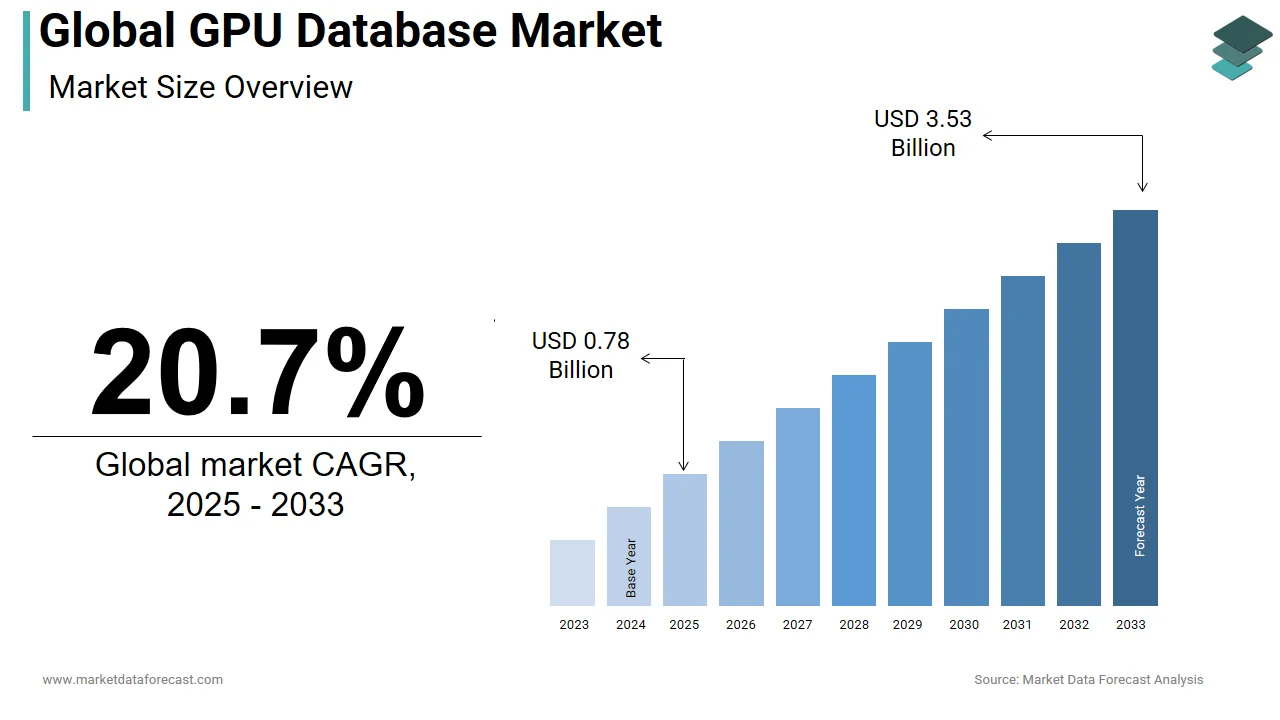
The GPU database uses a graphics processing unit to perform database operations, unlike the CPU. These are faster and relatively flexible in handling large volumes and amounts of data. The growing demand for high-performance computing is driving the growth of the global GPU database market. Furthermore, the wide availability of open source solutions further strengthens the market landscape for major players.
GPU databases handle large volumes of data faster and more efficiently than processors because they run in parallel rather than in sequence. GPUs accelerate memory and location scans, machine learning, and artificial intelligence. Aggregation, classification, and grouping operations require a lot of workload for a processor, but they can be efficiently run in parallel in a GPU database.
MARKET TRENDS
The GPU Database Tools segment is further divided into GPU-accelerated databases and GPU-accelerated analysis. GPU database market vendors offer a variety of GPU-accelerated databases and analytics tools to meet the diverse data and analytics requirements of organizations across industries and applications. Organizations are looking for data and analytics solutions to effectively use the data generated to increase their operational efficiency and maximize their value proposition to gain an advantage in the highly competitive business environment.
GPU-accelerated databases, with their notable brute-force computing power, can generate a large amount of customer information from various sources. Businesses can analyze this data and gain real-time insight into their consumers' buying behavior, understand market dynamics and trends, forecast demand and supply, and identify service issues, bottlenecks, and performance concerns in the service chain.
GPU databases can offer businesses a significant advantage by facilitating their supply chain operations and enabling them to optimize them by providing real-time location information throughout the supply chain. Many companies have digitized their businesses and field operations and are rapidly adopting cutting-edge technologies, including a mobile workforce, fleets equipped with sensors, artificial intelligence-assisted workstations and vehicles, and automated drones.
MARKET DRIVERS
The prominent aspects of the global GPU database market comprise huge data generation in verticals like BFSI, retail, and media and entertainment sectors.
In addition to this, the massive use of GPU Database for GRC, fraud identification and prevention, threat intelligence, SCM, and CEM is likely to drive the market trends for GPU Database in the years to come. The massive popularity of databases and GPU-accelerated tools in banks, insurance companies, and many other financial institutions will contribute significantly to the GPU database market revenues in the years to come. With the start of the supercomputer, the demand for GPU databases is gaining momentum around the world for efficient data analysis and accurate results.
The launch of GPU-accelerated tools has made operations easier, enabling fast data processing operations and real-time analysis. These tools help businesses perform risky calculations and simulations in real time. Parallel computing with GPU applications should help businesses monitor irregularities in different transaction streams and record data. All of these aforementioned factors are likely to further drive the growth trajectory of the global GPU Database market in the coming years.
REPORT COVERAGE
| REPORT METRIC | DETAILS |
| Market Size Available | 2026 to 2034 |
| Base Year | 2024 |
| Forecast Period | 2025 to 2033 |
| CAGR | 20.7% |
| Segments Covered | By Type, Deployment Mode, Database Type, Application, End User, and Region |
|
Various Analyses Covered | Global, Regional & Country Level Analysis, Segment-Level Analysis, DROC, PESTLE Analysis, Porter’s Five Forces Analysis, Competitive Landscape, Analyst Overview on Investment Opportunities |
| Regions Covered | North America, Europe, APAC, Latin America, Middle East & Africa |
|
Market Leaders Profiled | IBM Corporation, Fair Isaac Corporation, Pegasystems Inc., Oracle, Broadcom, Red Hat Inc., SparklingLogic, OpenText Corp, Software AG, SAS Institute Inc., and ACTICO GmbH are some of the main competitors currently operating in the systems market. Newgen Software Technologies Limited, FUJITSU, Intellileap Solutions, Signavio, Agiloft Inc., Decisions LLC, Business Rule Solutions LLC., Experian Information Solutions Inc., TIBCO Software Inc., SAP SE, Robert Bosch GmbH, InRule Technology Inc., and Others. |
REGIONAL ANALYSIS
The North America region dominated the worldwide market because of the early adoption of GPU-accelerated tools and significant initiatives taken by industry players in the form of partnerships with different technology players to offer rapid solutions for data analysis and processing. The strong presence of GPU database vendors in countries like the United States and the widespread awareness of these solutions in the region should help the region maintain its largest market share over the forecast period.
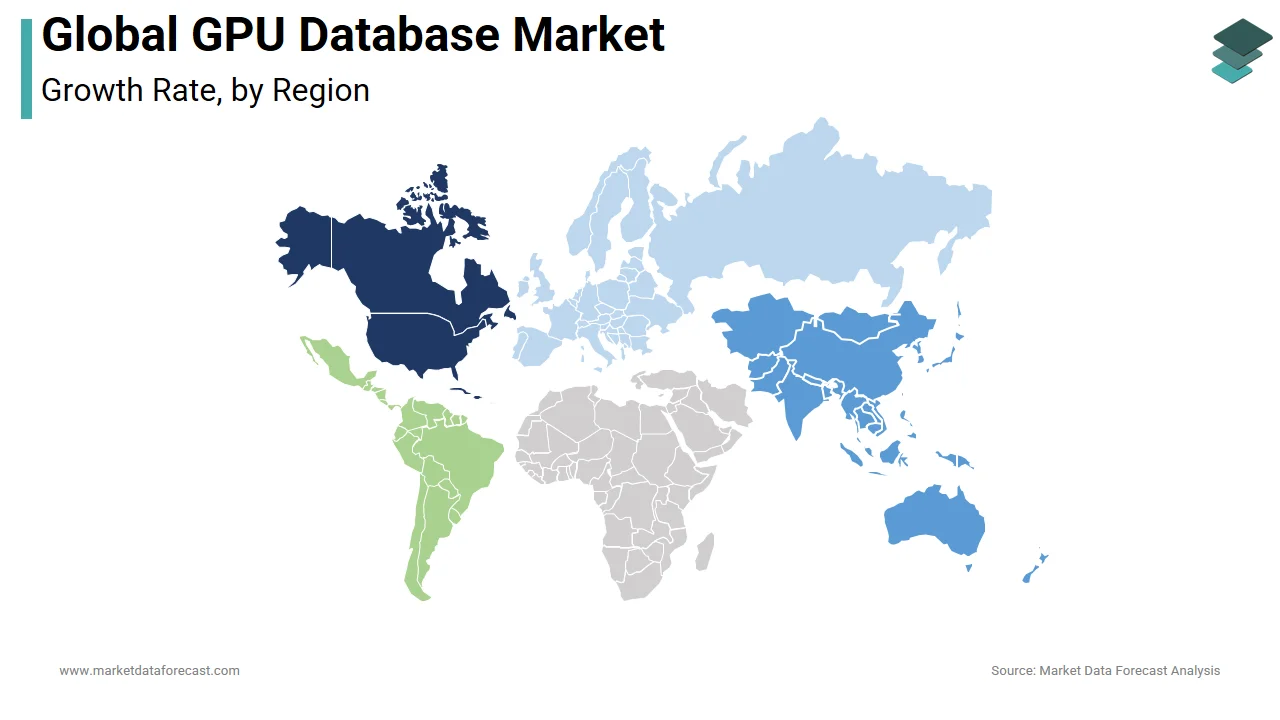
The GPU database market in Asia-Pacific is also likely to experience lucrative growth in the coming years, subject to the massive use of supercomputers and new technologies in weather forecasting. Banking sectors in countries like India, Japan, and China. There is a need for secure solutions in a myriad of financial institutions in these emerging economies. Countries like Germany and the UK are expected to drive growth in the GPU database market in Europe in the predicted years.
KEY PLAYERS IN THE MARKET
Major players in the global GPU database market include Kinetica, OmniSci, SQream, Neo4j, NVIDIA, Brytlyt, Blazegraph, BlazingDB, Zilliz, Jedox, HeteroDB, H2O.ai, FASTDATA.io, Fuzzy Logix, Anaconda, and Graphistry.
RECENT HAPPENINGS IN THE MARKET
- In June 2018, Kinetica collaborated with Dell EMC OEM solutions to offer an integrated solution to develop a data platform capable of correlating massive data sets between users, digital objects, and edge devices. The joint solution from Kinetica and Dell EMC enables companies to process large data sets and create actionable insights by combining hardware acceleration with the NVIDIA GPU-accelerated database, machine learning, and display engine.
- In April 2018, OmniSci launched MapD Cloud, a GPU-accelerated analytics SaaS offering. It would help users access the faster open source SQL engine and visual analytics platform.
- In October 2018, NVIDIA launched an open-source GPU acceleration software platform for machine learning and data science. This platform provides data scientists with the tools to run a GPU data science pipeline. Additionally, in April 2018, OmniSci launched a GPU-accelerated SaaS analytics offering called MapD Cloud. It helps its users access the fastest open-source SQL engine and visual analytics platform.
MARKET SEGMENTATION
This research report on the global GPU database market is segmented and sub-segmented into the following categories.
By Type
- On-Premises GPU Database
- Cloud-Based GPU Database
By Deployment Mode
- Public Cloud
- Private Cloud
- Hybrid Cloud
By Database Type
- Relational GPU Database
- Non-Relational GPU Database
By Application
- Artificial Intelligence & Machine Learning
- Big Data Analytics
- Healthcare
- Finance & Banking
- Automotive
- Retail & E-commerce
- Telecommunications
- Government & Defense
- Others
By End User
- IT & Telecom
- BFSI (Banking, Financial Services, and Insurance)
- Healthcare & Life Sciences
- Automotive & Transportation
- Retail & Consumer Goods
- Manufacturing
- Media & Entertainment
- Government & Defense
By Region
- North America
- Europe
- Asia-Pacific
- Latin America
- The Middle East and Africa