- Product Description Description
- Table of Contents TOC
- List of Table & Figure LOT
- Get Free Sample PDF Sample PDF
Global Green Methanol Market Summary
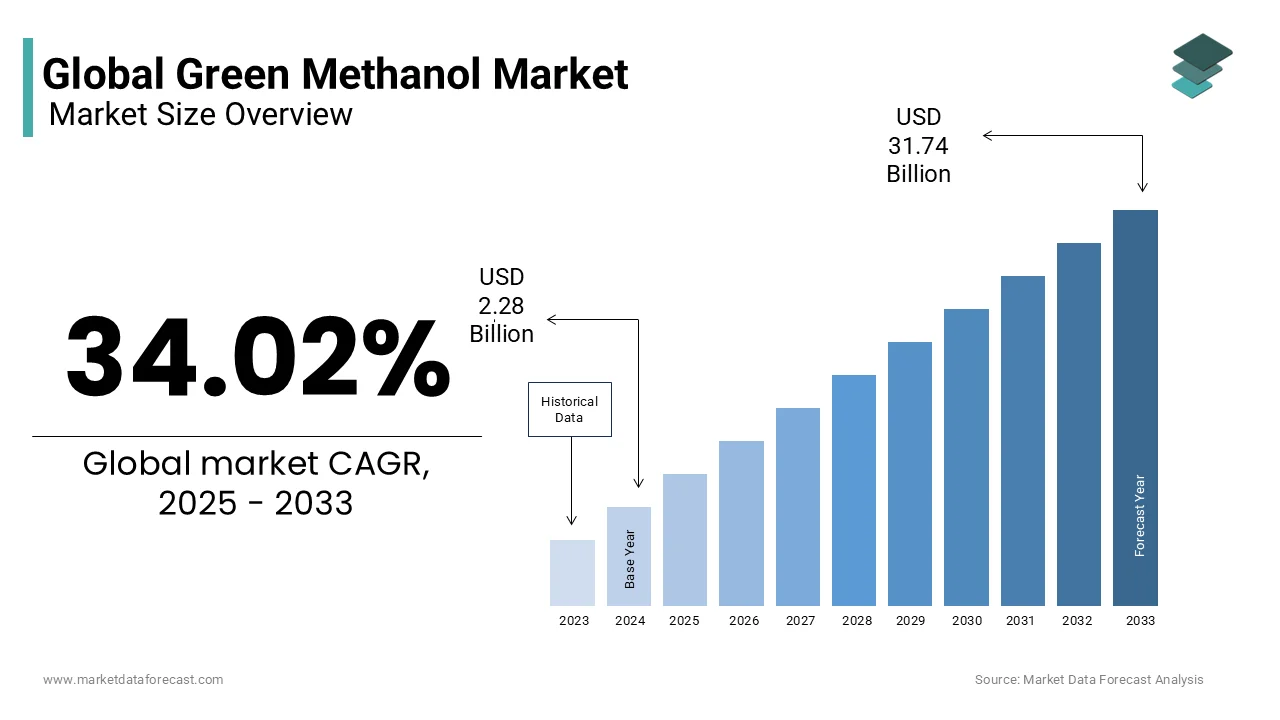
The global green methanol market size was USD 2.28 billion in 2024 and is projected to grow from USD 3.05 billion in 2025 to USD 31.74 billion by 2033, expanding at a CAGR of 34.02% (2025–2033). Growth is driven by the rising shift toward renewable fuels, decarbonization of shipping, and regulatory pressure to adopt sustainable alternatives to fossil-based methanol.
Key Market Trends
- Growing adoption of green methanol as a marine fuel to support carbon neutrality in shipping.
- Increasing investments in biomass and CO₂-based methanol production technologies.
- Expansion of circular economy models through waste-to-methanol projects.
- Rising government incentives and regulations promote renewable fuel adoption.
Segmental Insights
- Based on feedstock, the biomass-based feedstock segment dominated with a 52.7% share in 2024, supported by abundant availability and sustainable sourcing.
- Based on derivatives, the formaldehyde segment held the largest share at 44.6% in 2024, driven by strong demand from construction and automotive applications.
- Based on application, the chemical feedstock segment commanded the market in 2024, highlighting its importance in producing resins, plastics, and solvents.
Regional Insights
- Europe was the top-performing region, accounting for a 37.5% share in 2024, backed by strong policy frameworks, green shipping initiatives, and investment in renewable fuels.
- Asia-Pacific is expected to grow rapidly due to industrial expansion, rising energy demand, and government-led clean fuel programs.
- North America shows robust growth prospects, driven by renewable energy mandates and technological innovation.
- Latin America is emerging as a promising market, supported by waste-to-fuel initiatives.
- Middle East & Africa are gradually adopting green methanol as part of diversification strategies in energy transition.
Competitive Landscape
Leading players in the global green methanol market include Enerkem Inc. (Canada), Carbon Recycling International Inc. (Iceland), Methanex Corporation (Canada), Proman (Switzerland), and Södra (Sweden). These companies are focusing on scaling up production capacity, forming partnerships with shipping and chemical industries, and developing innovative carbon capture and utilization technologies.
Global Green Methanol Market Size
The global green methanol market size was valued at USD 2.28 billion in 2024 and is expected to reach USD 31.74 billion by 2033 from USD 3.05 billion in 2025. The market is projected to grow at a CAGR of 34.02%.
Green methanol is a carbon-neutral liquid fuel synthesized from renewable hydrogen and captured carbon dioxide, is emerging as a pivotal energy vector in the global decarbonization agenda. Unlike conventional methanol derived from natural gas or coal, green methanol is produced via power-to-X processes using renewable electricity, making it a sustainable alternative for hard-to-abate sectors. The compound is gaining traction as a marine fuel, chemical feedstock, and energy storage medium by aligning with international climate targets. According to the study, many pilot and commercial-scale green methanol projects were under development globally, with a combined capacity increasing per year.
MARKET DRIVERS
Decarbonization Imperatives In The Maritime Industry
The maritime sector’s shift away from heavy fuel oil is driving the growth of the green methanol market. As per IMO’s 2023 strategy, international shipping must achieve net-zero greenhouse gas emissions by or around 2050, compelling operators to adopt low-carbon fuels. Maersk, the world's second-largest container line, has ordered 25 methanol-powered vessels and plans to operate them on green methanol, but securing sufficient supply for its fleet remains a challenge. Each vessel consumes significant tonnes of fuel annually, creating substantial demand for certified green methanol. The FuelEU Maritime regulation mandates a 6% reduction in well-to-wake emissions by 2030, further incentivizing fuel switching.
Expansion of Renewable Hydrogen Infrastructure
The proliferation of green hydrogen is propelling the growth of the green methanol market. As per the study, global electrolyzer capacity surged and is projected to further exceed by 2030 under current policy frameworks. Countries such as Chile, Australia, and Saudi Arabia are advancing large-scale green hydrogen hubs, many of which include integrated methanol production. The HyDeal Ambition project in Europe, for instance, aims to deliver green hydrogen at €1.5/kg by 2030, enabling cost-competitive green methanol. Additionally, the U.S. Department of Energy’s initiative targets a reduction in clean hydrogen costs within a decade. These developments are propelling the economic feasibility of green methanol, particularly in regions with abundant solar and wind resources where renewable electricity costs are low.
MARKET RESTRAINTS
Limited Availability of Biogenic and Direct Air-Captured CO₂
The scarcity of sustainably sourced carbon dioxide is restraining the growth of the green methanol market. While green hydrogen production is scaling rapidly, the supply of CO₂ from biogenic sources such as biomass plants or direct air capture (DAC) remains constrained. According to the research, operational DAC facilities worldwide had a low combined capacity per year in 2023, with Climeworks’ Orca plant in Iceland capturing just 4,000 tonnes annually. Biogenic CO₂ sources, such as ethanol fermentation units, are geographically dispersed and often lack pipeline connectivity. The European Environment Agency notes that less share of industrial CO₂ emissions in the EU are currently captured and utilized. This feedstock limitation restricts green methanol output and increases production costs which hinders widespread commercialization despite growing demand from end-users.
High Production Costs Relative to Fossil-Based Alternatives
High production cost compared to convention alternatives also restrains the growth of the green methanol market. As per study, the production cost of green methanol varied per tonne in 2023, primarily due to high electricity and electrolyzer expenses. Even with falling renewable energy pGreen Methanols, the capital intensity of electrolysis and carbon capture units keeps the levelized cost elevated. The U.S. National Renewable Energy Laboratory estimates that electrolyzer stacks account for a portion of total plant investment. Furthermore, green methanol requires dedicated storage and handling infrastructure, adding to logistical costs.
MARKET OPPORTUNITIES
Integration with Carbon Capture and Utilization (CCU) Policies
Governments are increasingly prioritizing carbon capture and utilization as a strategic way to circular carbon economies, which is ascribed to bolster for the green methanol market. The U.S. Inflation Reduction Act provides a 45Q tax credit per tonne of CO₂ utilized in fuel production, significantly improving project economics. As per the study, this incentive could reduce green methanol production costs. In Canada, the federal government’s Net-Zero Accelerator Fund has backed green methanol initiatives in Alberta and British Columbia. These policies reduce investment risks and positions green methanol as a compliance solution for emission-constrained industries by creating opportunities for new revenue and public-private collaboration.
Emerging Demand from the Chemical and Polymer Industry
The use of green methanol as a feedstock for chemicals like formaldehyde and acetic acid is also enhancing the green methanol market. The global methanol demand for chemical synthesis increases annually, with a portion used in formaldehyde production. BASF and Mitsubishi Chemical have initiated trials to replace grey methanol with green variants in their production chains, aiming for carbon-neutral certifications. The shift is supported by corporate sustainability mandates; for instance, Unilever has committed to sourcing renewable carbon for its chemical inputs by 2030. As per the study, replacing fossil methanol with green alternatives in polymers could abate up to significant tonnes of CO₂ annually by 2040. This industrial transition presents a scalable and non-transport application that complements maritime fuel demand.
MARKET CHALLENGES
Scalability of Renewable Energy Supply for Continuous Production
The need for a steady and large supply of renewable electricity to run electrolyzers and synthesis units effectively is challenging the growth of green methanol market. Also, the intermittent nature of solar and wind power poses operational challenges. According to the International Energy Agency, grid-connected electrolyzers in Europe operated at an average capacity factor of only a portion due to variable power availability.
Lack of Standardization in Certification and Sustainability Criteria
The absence of globally harmonized standards for green methanol is major challenging factor for the growth of the global green methanol market. Different jurisdictions apply varying criteria for renewable content, carbon intensity, and lifecycle emissions. The International Sustainability and Carbon Certification (ISCC) and the Roundtable on Sustainable Biomaterials (RSB) offer frameworks, but adoption remains fragmented. As per the International Chamber of Shipping, over 18 different certification schemes were in use in 2023, creating compliance complexity for fuel suppliers and shipowners. This regulatory divergence increases transaction costs and affects investor confidence by delaying large-scale financing and cross-border supply chain formation.
REPORT COVERAGE
| REPORT METRIC | DETAILS |
| Market Size Available | 2024 to 2033 |
| Base Year | 2024 |
| Forecast Period | 2025 to 2033 |
| CAGR | 34.02% |
| Segments Covered | By Feedstock, Derivative, Application, and Region |
| Various Analyses Covered | Global, Regional, & Country Level Analysis; Segment-Level Analysis; DROC; PESTLE Analysis; Porter’s Five Forces Analysis; Competitive Landscape; Analyst Overview of Investment Opportunities |
| Regions Covered | North America, Europe, APAC, Latin America, Middle East & Africa |
| Market Leaders Profiled | Enerkem Inc. (Canada), Carbon Recycling International Inc. (Iceland), Methanex Corporation (Canada), Proman (Switzerland), and Södra (Sweden), and others |
SEGMENTAL ANALYSIS
By Feedstock Insights
The biomass-based feedstock segment dominated the green methanol market by capturing 52.7% share in 2024. The growth of the biomass-based feedstock segment is driven by the from the maturity of biomass gasification technologies and the availability of organic waste streams from forestry, agriculture, and municipal solid waste. In Sweden, for instance, Södra Cell’s Mönsterås biorefinery produces over 5,000 tonnes of bio-methanol annually using black liquor, a byproduct of pulp production, demonstrating the viability of industrial symbiosis. According to the study, sustainably managed forests in the EU generate over millions of cubic meters of residual wood annually, sufficient to support large-scale bio-methanol plants. Besides, the U.S. Department of Energy confirms that biomass gasification can achieve carbon intensity values below −40 gCO₂e/MJ due to biogenic carbon recycling, making it eligible for stringent low-carbon fuel credits under California’s LCFS program.
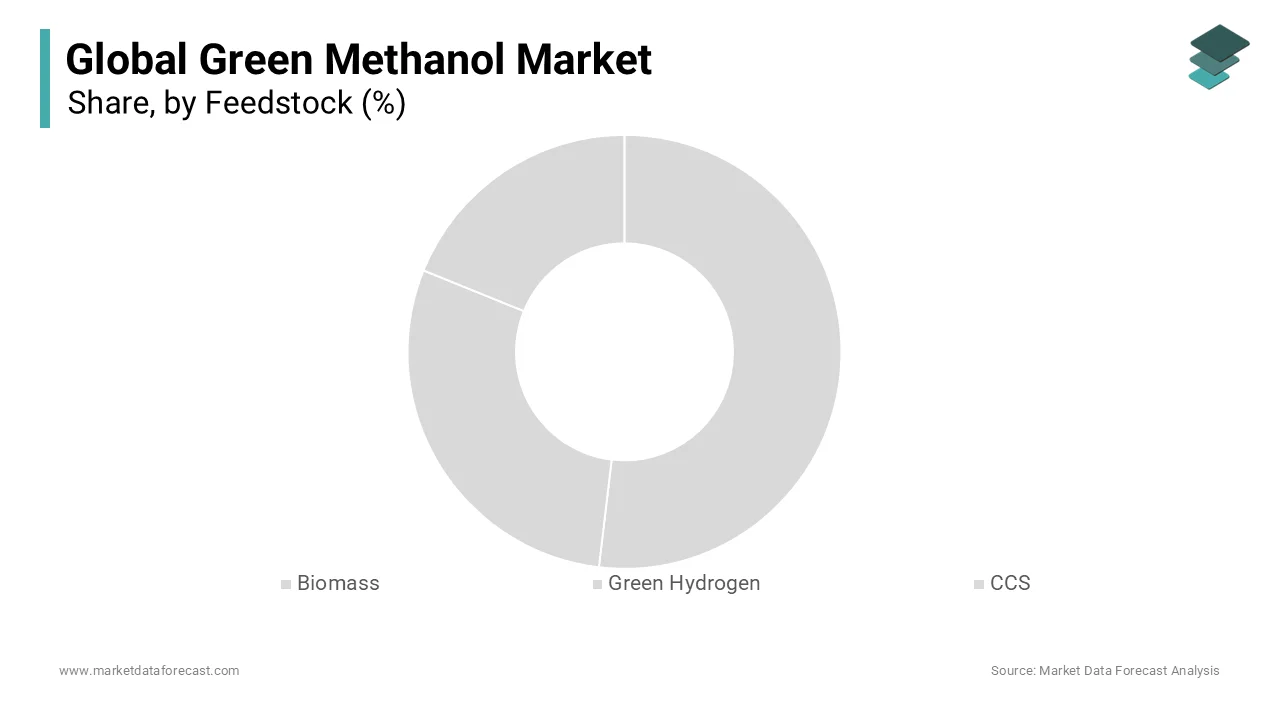
The green hydrogen feedstock segment is predicted to witness the highest CAGR of 38.6% from 2025 to 2033 due to the rapid scaling of electrolysis capacity and declining renewable electricity costs, particularly in sun- and wind-rich regions. Green hydrogen, when combined with captured CO₂, enables fully synthetic green methanol with near-zero lifecycle emissions. Chile is constructing e-methanol facility, powered by wind energy to produce significant tonnes annually. According to the study, renewable hydrogen costs could fall by 2030 in optimal locations, reducing green methanol production costs. The U.S. Inflation Reduction Act’s 45V tax credit, offering up to $3 per kg for clean hydrogen, further incentivizes investment by establishing a tiered credit system based on lifecycle emissions. This is designed to position low-carbon hydrogen, including but not limited to green hydrogen.
By Derivative Insights
The formaldehyde segment led the green methanol derivatives market by accounting for 44.6% share in 2024. The growth of the segment is attributed to its functing as a key intermediate in resins, adhesives, and construction materials, relies heavily on methanol as a primary feedstock. The global formaldehyde production capacity exceeds significant tonnes annually, with China alone consuming millions of tonnes of methanol for this purpose. As corporate sustainability mandates intensify, manufacturers like Georgia-Pacific and Kronospan are piloting green methanol-to-formaldehyde processes to decarbonize wood-based panel production. According to the Fraunhofer Institute, replacing conventional methanol with green alternatives in formaldehyde synthesis can reduce process emissions, given the integration of renewable energy and carbon capture. The European Green Deal’s emphasis on sustainable building materials further accelerates demand for low-carbon formaldehyde in insulation and furniture sectors.
The methanol-to-olefin (MTO) segment is estimated to register the fastest CAGR of 16.3% over the forecast period owing to the petrochemical industry’s shift toward circular feedstocks and the increasing demand for ethylene and propylene in plastics manufacturing. China has pioneered MTO technology, with many MTO plants already operational, consuming millions of tonnes of methanol annually. As global plastic production surpasses 400 million tonnes per year, according to the research, the pressure to decarbonize feedstocks is mounting. Companies are exploring green methanol-based MTO routes to produce bio-based polyethylene. The Dutch government has funded a project at the Port of Rotterdam to integrate green methanol into MTO chains, aiming to abate thousands of tonnes of CO₂ annually. These developments position MTO as a high-value outlet for green methanol beyond traditional applications.
By Application Insights
The chemical feedstock segment commanded the green methanol market by accounting a substantial share in 2024 with the entrenched use of methanol as a building block for formaldehyde, acetic acid, and methyl methacrylate to industrial manufacturing. Also, a notable share of global methanol consumption occurs in chemical synthesis, with Asia-Pacific serving as the primary hub due to its vast polymer and resin production capacity. Companies are actively testing green methanol in their crackers to meet Scope 3 emission targets. According to the research, replacing fossil methanol with green variants in chemical production could eliminate significant quantity of CO₂ emissions annually by 2035. Besides, the EU’s Carbon Border Adjustment Mechanism incentivizes importers to source low-carbon chemicals, further driving adoption across supply chains.
The fuel application segment is anticipated to witness a CAGR of 31.8% from 2025 to 2033. The growth of the fuel application segment can be attributed to the maritime industry’s urgent need to comply with International Maritime Organization (IMO) regulations requiring a reduction in carbon intensity and net-zero emissions. Maersk, CMA CGM, and MSC have ordered over 100 methanol-fueled vessels, with Maersk alone requiring 600,000 tonnes of green methanol annually by 2026 to operate its fleet. According to study, numerous methanol-ready ships are on order or in operation globally. The FuelEU Maritime regulation further mandates increasing use of renewable fuels, with green methanol contributing majorly energy mix by 2030. Port infrastructure in Singapore, Rotterdam, and Los Angeles is being upgraded to handle methanol bunkering, signalling a structural shift in marine energy systems.
REGIONAL ANALYSIS
Europe Green Methanol Market Insights
Europe was the top performer in the global green methanol market in 2024 and accounted for 37.5% of share in 2024. The domination of Europe in global market is primarily driven by the binding regulations and funding mechanisms. The RePowerEU plan allocates substantial amount for renewable fuels, including green hydrogen and e-methanol, to reduce dependence on imported fossil fuels. Germany’s H2Global initiative uses a double auction model to subsidize green methanol imports, ensuring pGreen Methanol stability. According to the study, many green methanol projects are in advanced development in the region, supported by national hydrogen strategies and EU Innovation Fund grants.
North America Green Methanol Market Insights
North America green methanol market growth is attributed to grow with its robust policy support and private-sector innovation. The U.S. Inflation Reduction Act provides a $3/kg production tax credit for clean hydrogen, drastically improving the economics of green methanol. In California, the Low Carbon Fuel Standard credit pGreen Methanol is currently around $50–$60 per tonne of CO₂ abated. The pGreen Methanol was once near the program's maximum allowable level of over $200 but has fallen due to an oversupply of renewable fuels like renewable diesel and biomethane. Canada’s Alberta and British Columbia are advancing projects, which funds e-methanol production using carbon capture from ethanol plants. According to study, the country has the potential to produce significant tonnes of green methanol annually by 2030 using its abundant hydropower and biomass resources, positioning North America as a key exporter.
Asia Pacific Green Methanol Market Insights
Asia Pacific green methanol market is substantially growing with a significant CAGR during the forecast period. The region is witnessing a dual-track development: China and India are scaling green methanol for domestic chemical use, while Australia and Japan are positioning themselves as technology and export hubs. China has launched a green methanol plant in Inner Mongolia, powered by solar and wind energy. Also, Japan has included green energy in its Green Growth Strategy, aiming for 3 million tonnes of annual demand by 2030, primarily for power generation and shipping. Australia plans to export significant tonnes of e-methanol annually to Japan and South Korea. According to CSIRO, Australia’s renewable energy potential could support notable million tonnes of green methanol exports by 2040, transforming it into a major energy supplier.
Middle East and Africa Green Methanol Market Insights
Middle East and Africa grew steadily in the global green methanol market. The Gulf Cooperation Council (GCC) countries are leveraging their vast solar resources and existing gas infrastructure to pivot toward green methanol. Saudi Arabia’s NEOM Oxagon project includes a green hydrogen and e-methanol facility, set to produce substantial tonnes annually by 2026. The UAE’s Masdar is developing a green methanol plant in Abu Dhabi using desalinated seawater and 100 GW of solar power. According to the King Abdullah City for Atomic and Renewable Energy, Saudi Arabia aims to become a top-three exporter of e-fuels by 2035. In Africa, Egypt and Morocco are advancing green hydrogen and methanol projects to boost industrialization and export revenue, and the African Development Bank’s Desert to Power initiative, which targets 10 GW of solar capacity by 2030.
Latin America Green Methanol Market Insights
Latin America is expected to be the most lucrative region for caravans worldwide and is predicted to expand from 2025 to 2033 due to its unparalleled renewable energy potential. Chile leads the region with its National Green Hydrogen Strategy, targeting notable million tonnes of annual e-fuel exports by 2040, including green methanol. The HIF Chile project in Magallanes aims to produce significant quantity of e-methanol annually using Patagonian wind power. Brazil is exploring green methanol production using biogas from sugarcane ethanol plants, which generate millions of tonnes of CO₂ annually.
KEY MARKET PLAYERS AND COMPETITIVE LANDSCAPE
Key players in the green methanol market are Enerkem Inc. (Canada), Carbon Recycling International Inc. (Iceland), Methanex Corporation (Canada), Proman (Switzerland), and Södra (Sweden).
The green methanol market is characterized by a nascent but intensifying competitive landscape, where technological leadership and project execution capability are replacing traditional scale advantages. While established chemical firms leverage existing distribution networks, new entrants backed by sovereign wealth and renewable developers are advancing gigawatt-scale projects that could redefine cost benchmarks. Competition is increasingly shaped by access to low-cost renewable electricity, proximity to CO₂ sources, and alignment with national hydrogen strategies. In Asia, local champions are emerging through state-supported industrial decarbonization programs, while European and Middle Eastern firms position themselves as exporters.
TOP PLAYERS IN THE MARKET
Methanex Corporation
Methanex, a global leader in methanol production, has strategically pivoted toward green methanol by integrating low-carbon feedstocks into its existing infrastructure. Methanex has also engaged with Japanese and South Korean shipping firms to supply certified green methanol for marine bunkering. Methanex is advancing lifecycle analysis protocols to ensure compliance with EU FuelEU and IMO sustainability standards. These initiatives position Methanex as a bridge between conventional methanol markets and emerging renewable demand in high-growth Asian industrial and maritime sectors.
Haldor Topsoe
Haldor Topsoe, a Danish technology innovator, plays an important role in enabling green methanol production through its proprietary e-methanol synthesis solutions, including the SynCOR Methanol reactor. In the Asia Pacific, Topsoe has entered into multiple licensing and engineering partnerships to support large-scale projects. Topsoe’s technology reduces energy loss in methanol synthesis, according to the study, enhancing overall plant efficiency. Topsoe is emerging as a key enabler of Asia’s green methanol transition, particularly in nations pursuing energy independence and decarbonized industry.
NEOM Green Hydrogen Company
NEOM Green Hydrogen Company, a joint venture between ACWA Power, Air Products, and NEOM, is developing the world’s largest green hydrogen and e-methanol complex in Saudi Arabia, with export ambitions across Asia. NGHC is positioning itself as a cornerstone supplier for the region’s future green fuel economy by leveraging scale and cost-competitive renewable inputs.
TOP STRATEGIES USED BY THE KEY MARKET PLAYERS
Key players in the green methanol market are deploying a combination of technological innovation, strategic partnerships, and policy alignment to promote their positions. Companies are investing in proprietary catalytic processes and electrolyzer integration to improve conversion efficiency and reduce energy consumption. Joint ventures with renewable energy developers and industrial CO₂ emitters are enabling secure feedstock supply chains. Geographic diversification into regions with abundant solar and wind resources is a common trend, ensuring cost-effective production. Firms are also engaging in early-stage offtake agreements with shipping lines and chemical manufacturers to de-risk project financing. Besides, active participation in regulatory consultations and sustainability certification frameworks helps align product offerings with evolving compliance requirements in the EU, U.S., and Asia by ensuring market access and investor confidence.
MARKET SEGMENTATION
This research report on the global green methanol market has been segmented and sub-segmented based on feedstock, derivative, application, and region.
By Feedstock
- Biomass
- Green Hydrogen
- CCS
By Derivative
- Formaldehyde
- Dimethyl Ether & Methyl Tert-Butyl Ether
- Gasoline
- Methanol-to-Olefin
- Solvents
By Application
- Chemical Feedstock
- Fuel
By Region
- North America
- Europe
- Asia-Pacific
- Latin America
- Middle East and Africa