- Product Description Description
- Table of Contents TOC
- List of Table & Figure LOT
- Get Free Sample PDF Sample PDF
Market Size, 2025
$5.02 BnMarket Estimate, 2026
$5.33 BnMarket Forecast, 2034
$8.05 BnCAGR, 2026–2034
6.01%Executive Summary: Global Hair Oil Market
- Market Scope: Comprehensive global analysis of the hair oil market covering product variants, application types, distribution channels, and regional industry dynamics across the personal care and beauty sector.
- Market Valuation: Valued at USD 5.02 billion in 2025, estimated at USD 5.33 billion in 2026, and projected to reach USD 8.05 billion by 2034, registering a steady CAGR of 6.01% from 2026 to 2034.
- Primary Growth Drivers: High consumer demand for healthy, manageable, and shiny hair; rising preference for natural, organic, and plant-based ingredients (such as almond, coconut, argan, and rosemary oils); increasing prevalence of hair damage and scalp issues due to pollution; and organized retail expansion with competitive pricing strategies. Key market restraints include the rising popularity of oil-free hair care products, sulfate-free shampoos, and online misinformation regarding follicle blockage.
Key Market Segment Metrics (2026–2034)
| Category | Leading Segment (2025 Position) | Fastest-Growing Segment |
|---|---|---|
| By Product Type | Coconut Oil (traditional dominant share across major consumer demographics) | Almond Oil & Argan Oil (scaling rapidly due to consumer preference for lightweight, non-sticky formulations and aromatherapy benefits) |
| By Application | Individual / Personal Care (largest market share driven by rising household scalp treatments and personal hair care routines) | Commercial (expanding via beauty salons, wellness spas, and specialized hair care centers) |
| By Distribution Channel | Online Stores (account for the highest market portion, propelled by e-commerce adoption and beauty influencer marketing) | Hypermarkets, Supermarkets & Specialty Retail Stores |
| By Region | Asia-Pacific / APAC (dominates the global market driven by high regional population, traditional hair oil rituals, and rising pollution-induced hair concerns, led by India, China, and Japan) | Latin America & Middle East & Africa |
Major Market Players & Market Structure
Market Structure: A competitive global marketplace featuring multinational consumer goods giants and specialized regional herbal/Ayurvedic brands innovating through natural formulations, lightweight textures, and targeted botanical rollouts (e.g., rosemary oil blends).
Key Companies: Johnson & Johnson, Coty Inc., L'Oréal S.A., Unilever PLC, Dabur India Limited, Marico Limited, Emami Group, Bajaj Corp Ltd., Procter & Gamble, and The Himalaya Drug Company.
Global Hair Oil Market Size
The Global hair oil market was valued at USD 5.02 billion in 2025. The global market size is expected to grow at a CAGR of 6.01% from 2026 to 2034 and be worth USD 8.05 billion by 2034 from USD 5.33 billion in 2026.

Current Scenario of the Global Hair Oil Market
Hair oil is a hair care product specifically designed to balance hair moisture and is used as a nutrient before and after washing. Hair oil is considered a conditioner that makes hair soft and smooth. Since hair is widely affected by harmful factors such as pollution, dust, and unhealthy eating habits, hair oil has become an integral part of the hair care system, as it improves the texture and condition of the hair. The hair oil guarantees nutrition, hair strengthening, reduced hair loss, and rapid growth. Many consumers believe that hair oil massage has a cooling effect on the hair and helps with styling while keeping it smooth, soft, and shiny.
MARKET DRIVERS
The hair oil market is expected to expand at a constant pace during the forecast period due to the demand for healthy, manageable, and shiny hair that drives the buying decisions of most consumers. As the demand for natural and organic hair care products increases, women are spending more on hair care products like hair oils, shampoos, conditioners, and serums. The hair oil is an integral part of the hair care routine and efficiently handles various problems such as hair loss, dandruff, drying, and breakage. In addition, manufacturers have been increasing their R&D activities to further improve hair oils in response to changing consumer demands. Hair oils that contain natural ingredients in the formulation are experiencing enormous popularity and significant growth. Hair oil companies are launching light hair oils such as avocado oil and olive oil, which are opportunities in the hair oil market.
The growing popularity of branded products is boosting the growth of the hair oil market. The higher propensity to certain ingredients of origin and the absence of preparations are expected to accelerate market growth. Organized retailers are maximizing their market share by attracting consumers and offering a variety of products based on competitive pricing schemes. Retail stores offer consumers a new shopping experience by providing the convenience of buying and great value.
MARKET RESTRAINTS
The use of sophisticated shampoos and oil-free hair care products is hindering the growth of the hair oil market. The consumer's inclination towards sulfate-free, anti-dandruff, and solid clay shampoos has decreased the consumption and demand for hair oils. Apart from this, people have also increased the usage of oil-free hair care products which is further restraining the market growth. This includes sensory modifiers, UV filters, skin bio-actives and hair care polymers. Moreover, many customers have this perception that consistent use of hair oils blocks the hair follicle and reduces the growth cycle. One of the reasons for this misconception is the easy availability of information over the Internet and YouTube which is also hurting the market expansion.
REPORT COVERAGE
| REPORT METRIC | DETAILS |
| Market Size Available | 2025 to 2034 |
| Base Year | 2025 |
| Forecast Period | 2026 to 2034 |
| Segments Covered | By Type of Product, Application, Distribution Channel and Region |
| Various Analyses Covered | Global, Regional, and country Level Analysis; Segment-Level Analysis; DROC, PESTLE Analysis; Porter’s Five Forces Analysis; Competitive Landscape; Analyst Overview of Investment Opportunities |
| Regions Covered | North America, Europe, Asia Pacific, Latin America, Middle East & Africa |
| Market Leader Profiled | Johnson & Johnson, Coty Inc., L'Oreal S.A., Unilever PLC, Dabur India Limited, Marico Limited, Emami Group, Bajaj Corp Ltd, Procter & Gamble and Himalaya Drug Company. |
SEGMENTAL ANALYSIS
Global Hair Oil Market By Type
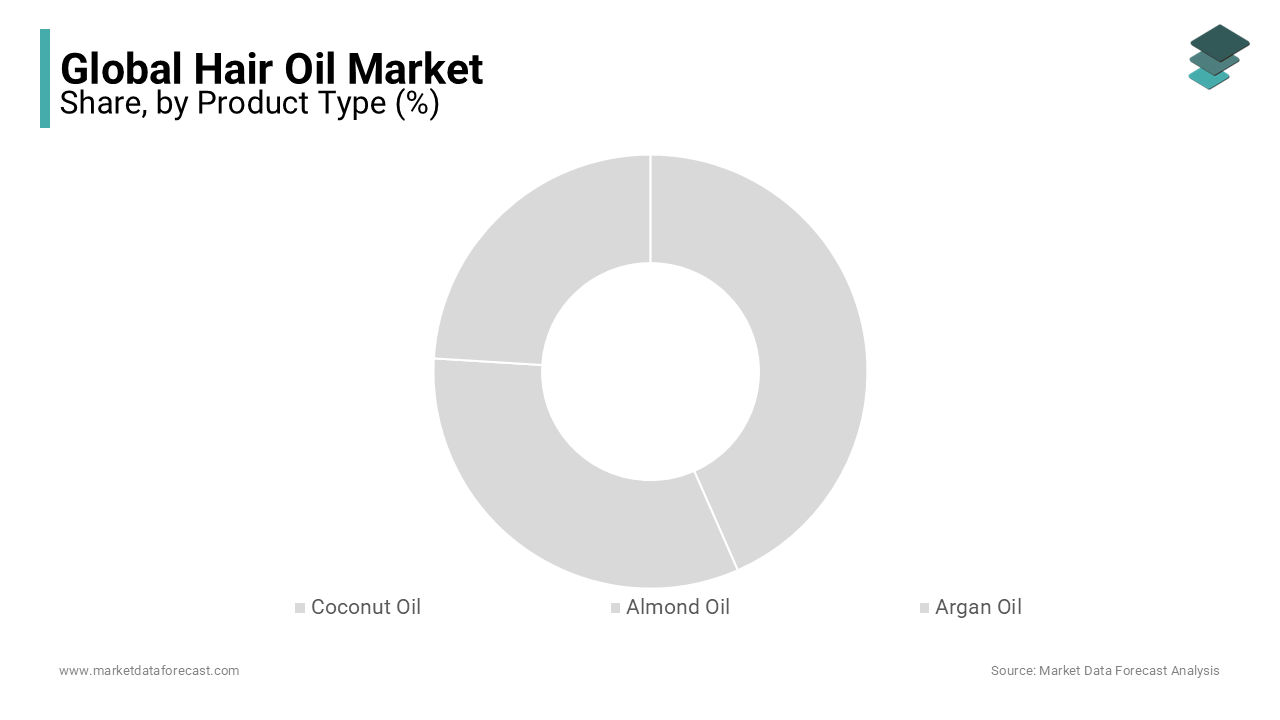
The almond oil segment is expected to grow at a rapid pace. This is because consumers are choosing more light and non-sticky hair oil. And, the current generation seems to be attracted to it. In addition, the growing need for aromatherapy for multiple health problems is becoming popular around the world. Moreover, the accessibility of a large number of spa customers will increase the segment’s market share. Another factor fuelling the expansion of this category is the evolving cosmetic industry and consumer preferences owing to the rising demand for natural element–based body lotions, face and hair creams, and other products for moisturizing and cleansing. Therefore, all these factors are expected to augment the segment’s development.
Global Hair Oil Market By Application
The individual segment is the bigger category in terms of market share. The increasing frequency of hair damage and baldness among both males and females is driving the segment market value upward. As per the Google data of 2022, the word “scalp treatment” got the monthly average search value of 162300. The experts also stated that this pattern will steadily get stronger in the coming years. Whereas the commercial segment also holds a noticeable market share. It is separated into beauty salons and spas. The rising disposable income, along with the launch of several hair care centers, is promoting the commercial segment around the world.
Global Hair Oil Market By Distribution Channel
The online stores account for the highest portion of the hair oil market. The change in customer buying patterns coupled with the increased awareness and penetration of e-commerce applications into younger and older generation people are accelerating the market share of the segment. Apart from this, the extensive use of social media platforms, the visibility and popularity of beauty influencers and online fashion groups and communities are influencing the adoption of this distribution channel.
REGIONAL ANALYSIS
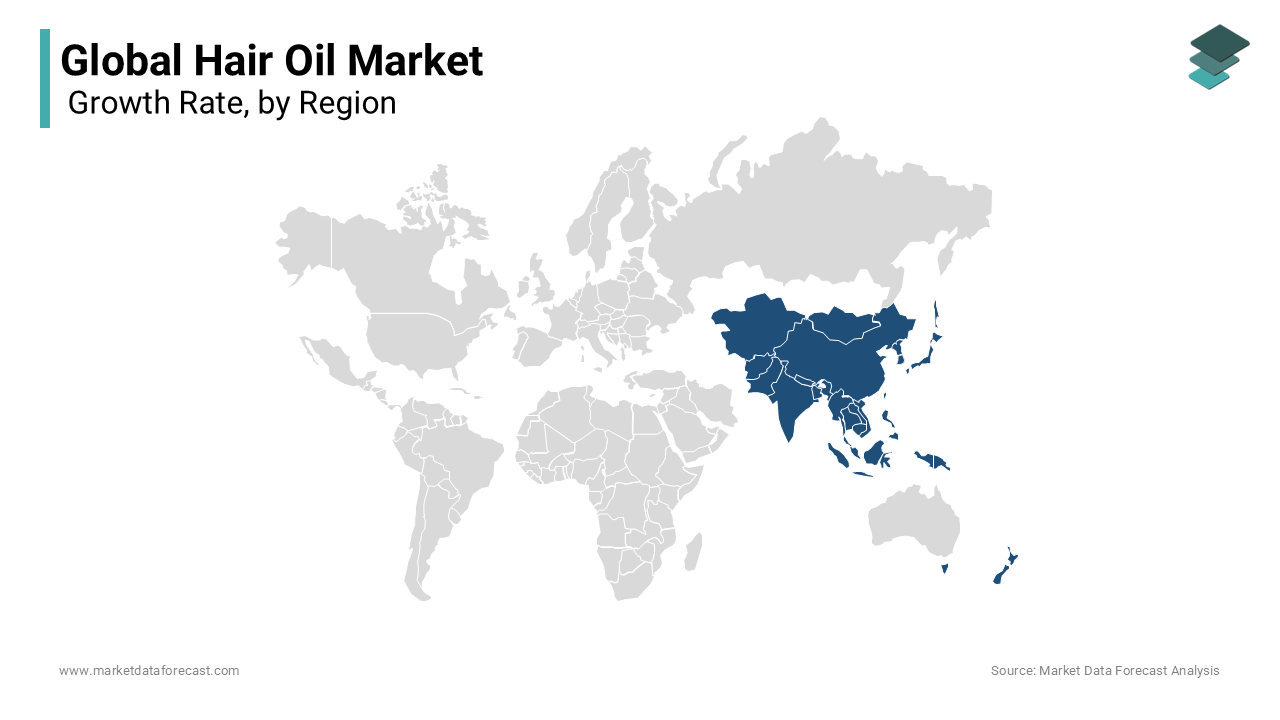
The Asia-Pacific hair oil market is likely to dominate the hair oil market worldwide during the forecast period owing to the rapid growth in the population across the Asia-Pacific region, increasing hair-related problems and pollution levels, and overgrowing demand for hair growth. There are a growing number of people facing scalp issues, such as hair loss, dry and damaged hair, split ends, and others. In addition, awareness about the appearance of youthful hair is increasing, supporting the local market. The Indian market is foreseen to grow faster in the Asia-Pacific region, followed by China and Japan.
KEY MARKET PLAYERS
Companies that play a notable role in the global hair oil market are Johnson & Johnson, Coty Inc., L'Oreal S.A., Unilever PLC, Dabur India Limited, Marico Limited, Emami Group, Bajaj Corp Ltd, Procter & Gamble, and Himalaya Drug Company.
RECENT HAPPENINGS IN THE MARKET
- In December 2024, a study was published that found various chemicals in hair care products. Cyclic volatile methyl siloxanes were specially highlighted. These substances remain in the air after utilization.
- In December 2024, Dabur India Ltd. introduced the Vatika Rosemary hair growth oil. This new product is blended with coconut oil, hibiscus, and Rosemary.
MARKET SEGMENTATION
This research report on the global hair oil market has been segmented and sub-segmented into the following categories.
By Product Type
- Coconut Oil
- Almond Oil
- Argan Oil
- Others
By Application
- Individual
- Commercial
By Distribution channel
- Hypermarkets/supermarkets
- Specialty stores
- Online stores
- Others
By Region
- North America
- Europe
- Asia Pacific
- Latin America
- Middle East and Africa