- Product Description Description
- Table of Contents TOC
- List of Table & Figure LOT
- Get Free Sample PDF Sample PDF
Market Size, 2025
$12.43 BnMarket Estimate, 2026
$13.24 BnMarket Forecast, 2034
$21.93 BnCAGR, 2026–2034
6.51%Executive Summary: Global Natural Hair Care Products Market
- Market Scope: Global industry assessment of natural and plant-based hair care formulations examining product types, distribution channels, consumer demographics, and regional market expansion.
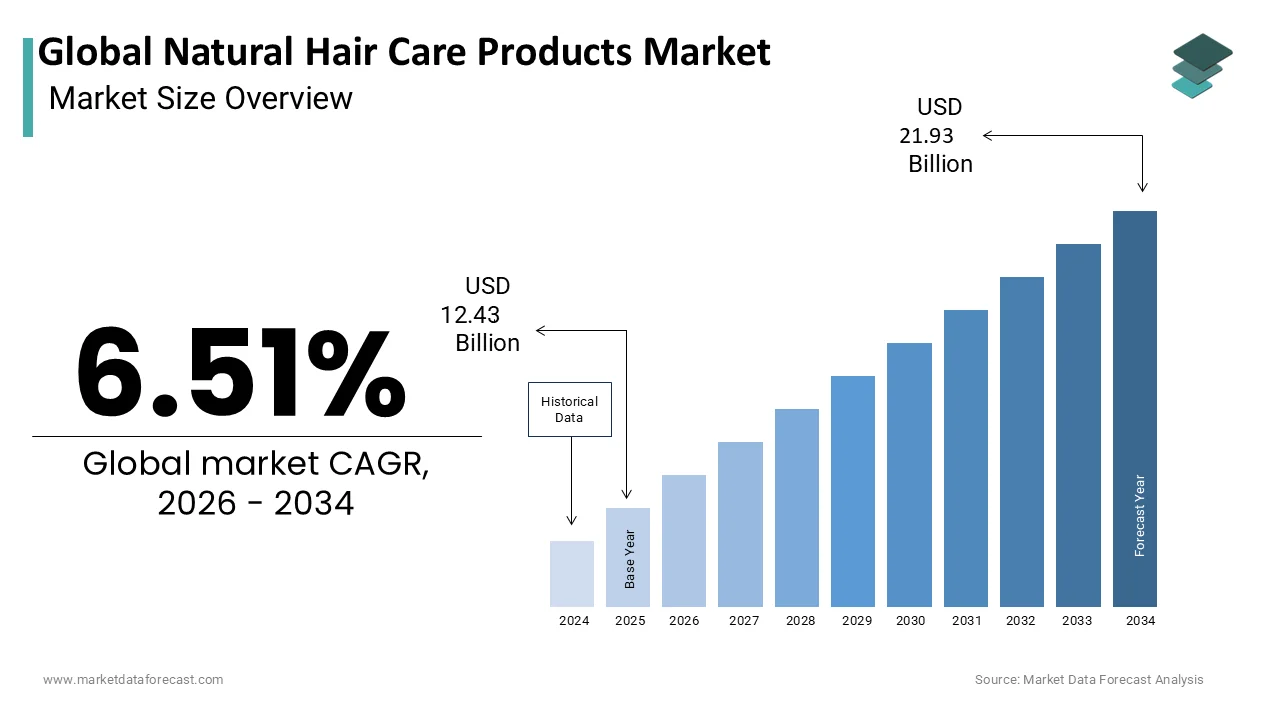
- Market Valuation: Valued at USD 12.43 billion in 2025, growing to USD 13.24 billion in 2026, and projected to expand to USD 21.93 billion by 2034, supported by a compound annual growth rate (CAGR) of 6.51%.
- Primary Growth Drivers: Rising consumer awareness regarding scalp health and microbiome balance, cultural reclamation and identity-driven hair choices (the natural hair movement), and the surge in green chemistry and bioengineered active ingredients.
Key Market Segment Metrics (2026–2034)
| Category | Leading Segment / Core Focus | Fastest-Growing / Key Segments |
|---|---|---|
| By Product Type | Shampoo Segment (commanded an estimated 34.7% share in 2025 due to universal cleansing requirements and sulfate-free surfactant innovations) | Hair Oil Segment (projected to expand at a CAGR of 11.8% driven by pre-wash rituals and traditional oiling practices) |
| By Distribution Channel | Brick and Mortar Stores (captured 58.8% market share in 2025 anchored by tactile shopping, specialty clean beauty sections, and local supply networks) | Online Stores (registering a rapid CAGR of 14.3% fueled by e-commerce expansion, DTC models, and AI-driven personalization) |
| By End-User | Women Segment (retained a dominant share in 2025 driven by textured hair maintenance, specialized styling regimens, and community education) | Men Segment (fastest-growing end-user expanding at a CAGR of 10.6% supported by shifts in male grooming and wellness norms) |
| By Region | North America (led the global market with a 36.8% share in 2025 anchored by strong texture advocacy, the CROWN Act, and regulatory scrutiny) | Asia-Pacific & Africa (accelerating through traditional herbal wellness routines, rising urban affluence, and expanding e-commerce) |
Major Market Players & Industry Landscape
Competitive Structure: Highly fragmented and dynamic environment balancing multinational beauty conglomerates with agile indie brands, focusing on transparency, clinical validation, sustainability, and cultural inclusivity.
Key Companies Profiled: Procter & Gamble, SheaMoisture, L’Oréal Paris, Hask, Mama Earth, Nature Lab Tokyo, Estee Lauder, Phyto Botanical Power, St. Botanica, Bollati, Amazon Beauty Inc., John Master Organics, and Organic Harvest.
Global Natural Hair Care Products Market Size
The Global natural hair care products market was valued at USD 12.43 billion in 2025. The global market size is expected to grow at a CAGR of 6.51% from 2026 to 2034 and be worth USD 21.93 billion by 2034 from USD 13.24 billion in 2026.
Natural Hair Care Products are formulations derived predominantly from plant-based, organic, and non-synthetic ingredients designed to nourish, strengthen, and enhance hair health without the inclusion of sulfates, parabens, silicones, or synthetic fragrances. These products cater to diverse hair types, with a pronounced emphasis on textured, curly, and coily hair profiles that require specialized moisture retention and scalp-friendly solutions. As consumer consciousness around personal well-being and ingredient transparency intensifies, the demand for clean-label hair care has surged.
MARKET DRIVERS
Rising Awareness of Scalp Health and Its Biological Impact on Hair Integrity has emerged as a pivotal driver in the natural hair care sector. Scientific research increasingly underscores the correlation between scalp microbiome balance and hair follicle vitality. A disrupted scalp environment, often exacerbated by harsh chemical-laden products, can lead to inflammation, dandruff, and hair thinning. This has catalyzed a shift toward botanical alternatives such as tea tree oil, aloe vera, and apple cider vinegar, which exhibit antimicrobial and anti-inflammatory properties. Brands incorporating clinically tested natural actives have reported improvement in scalp barrier function within eight weeks, as demonstrated in independent dermatological trials. Consequently, consumers are prioritizing biocompatible formulations that support long-term scalp homeostasis.
Cultural Reclamation and Identity-Driven Hair Choices are significantly amplifying demand for natural hair care, particularly among Black and Afro-Caribbean communities. The global "natural hair movement," which gained momentum in the early 2010s, continues to influence grooming behaviors by promoting the acceptance of unaltered hair textures. This cultural shift is supported by legislative actions such as the CROWN Act, now adopted in several U.S. states, which protects individuals from discrimination based on hair texture and style. The societal validation of natural hair has prompted targeted product development, with companies like SheaMoisture and Mielle Organics reporting growth in sales.
MARKET RESTRAINTS
Limited Standardization and Regulatory Ambiguity in Ingredient Claims pose a critical restraint on market credibility. While terms like “natural,” “organic,” and “clean” are widely used in marketing, there is no universally enforced definition governing their application in cosmetics. The U.S. Department of Agriculture certifies organic food products under strict guidelines, but personal care items fall under the jurisdiction of the FDA, which lacks equivalent mandatory standards. This inconsistency erodes consumer trust and complicates informed decision-making. Furthermore, the absence of third-party verification for many brands enables greenwashing, where companies exaggerate the natural composition of their products. Such practices hinder market differentiation and reduce the competitive advantage of genuinely sustainable brands.
Supply Chain Vulnerability of Botanical Raw Materials due to climate volatility and geopolitical instability restricts consistent production and scalability. Many key ingredients in natural hair care, such as shea butter, argan oil, and baobab extract, are sourced from ecologically sensitive regions in West and East Africa. These instabilities not only increase formulation costs but also compromise batch consistency, challenging brands’ ability to maintain quality and meet rising demand.
MARKET OPPORTUNITIES
Advancements in Green Chemistry and Bioengineered Actives present a transformative opportunity for innovation in natural hair care. Emerging biotechnological processes enable the sustainable synthesis of high-efficacy compounds without compromising ecological integrity. For instance, fermentation-derived keratin and plant-based hyaluronic acid offer moisture retention and structural reinforcement comparable to synthetic polymers. Companies like Amyris and Solabia are pioneering scalable biosynthesis platforms that reduce reliance on agricultural extraction. These technologies not only enhance performance but also ensure traceability and purity, addressing consumer concerns about contamination and deforestation. By integrating bio-factored ingredients, brands can achieve superior results while aligning with environmental stewardship goals.
Expansion into Emerging Markets with High Textured-Hair Prevalence offers substantial growth potential, particularly in Sub-Saharan Africa and South Asia. With over 1.4 billion people in Sub-Saharan Africa, where the majority possess tightly coiled or curly hair types, there is a deeply rooted tradition of using natural oils and herbal remedies for hair maintenance. As per the World Bank, urbanization rates in the region reached 43% in 2023, coinciding with increased disposable income and access to retail infrastructure. Local entrepreneurs are leveraging indigenous knowledge to develop region-specific formulations using moringa, black seed oil, and hibiscus. International brands entering these markets through partnerships with local cooperatives are witnessing accelerated adoption, indicating a shift from imported chemical-laden products to culturally resonant, naturally derived alternatives.
MARKET CHALLENGES
Formulation Stability and Performance Parity with Conventional Products remain a persistent challenge in the natural hair care domain. Consumers expect natural products to deliver equivalent or superior results in terms of moisture retention, frizz control, and styling hold, benchmarks traditionally dominated by silicones and synthetic polymers. However, plant-based alternatives often face shorter shelf lives and sensitivity to temperature and pH fluctuations. Also, natural formulations often face stability issues such as phase separation or microbial growth within months of storage. Additionally, achieving consistent curl definition without synthetic film-formers remains technically complex. These performance gaps necessitate extensive R&D investment in emulsification techniques and natural preservative systems, creating a barrier for smaller brands lacking technical expertise.
Consumer Skepticism Due to Inconsistent Product Efficacy and Overpriced Offerings impedes broader market penetration. Despite the premium pricing of many natural hair care lines—often higher than conventional counterparts, clinical validation of claims remains limited. This perception of underperformance is exacerbated by anecdotal reviews on social media platforms, where user experiences vary widely due to differences in hair porosity, density, and regimen compatibility. Furthermore, the concentration of high-cost botanical extracts, such as cold-pressed oils and rare herbal infusions, inflates retail prices without always delivering proportional benefits. As a result, price-sensitive consumers, particularly in developing economies, remain hesitant to transition fully to natural alternatives, limiting mass-market scalability.
REPORT COVERAGE
| REPORT METRIC | DETAILS |
| Market Size Available | 2025 to 2034 |
| Base Year | 2025 |
| Forecast Period | 2026 to 2034 |
| Segments Covered | By Product Type, Distribution Channel, End-User, and Region |
| Various Analyses Covered | Global, Regional & Country Level Analysis, Segment-Level Analysis, DROC, PESTLE Analysis, Porter’s Five Forces Analysis, Competitive Landscape, Analyst Overview on Investment Opportunities |
| Regions Covered | North America, Europe, Asia Pacific, Latin America, Middle East and Africa |
| Key Market Players | Procter & Gamble, Mama Earth, Nature Lab Tokyo, Estee Lauder, Phyto Botanical Power, St. Botanica, Bollati, Amazon Beauty Inc., John Master Organics and Organic Harvest |
SEGMENTAL ANALYSIS
By Product Type Insights
The shampoo segment constituted the largest type in the natural hair care market by commanding an estimated 34.7% share in 2025. This dominance is primarily fueled by the universal necessity of cleansing as a foundational step in hair care regimens. Consumers increasingly prioritize sulfate-free, pH-balanced shampoos that preserve the scalp’s natural sebum while eliminating buildup. Furthermore, innovations in mild surfactants derived from coconut and sugar esters have enhanced lathering efficacy without compromising skin compatibility. Brands such as Acure and Desert Essence have leveraged these advancements, launching clinically tested formulations that combine cleansing power with moisturizing benefits, thereby reinforcing shampoo’s central role in daily routines and sustaining its market leadership.
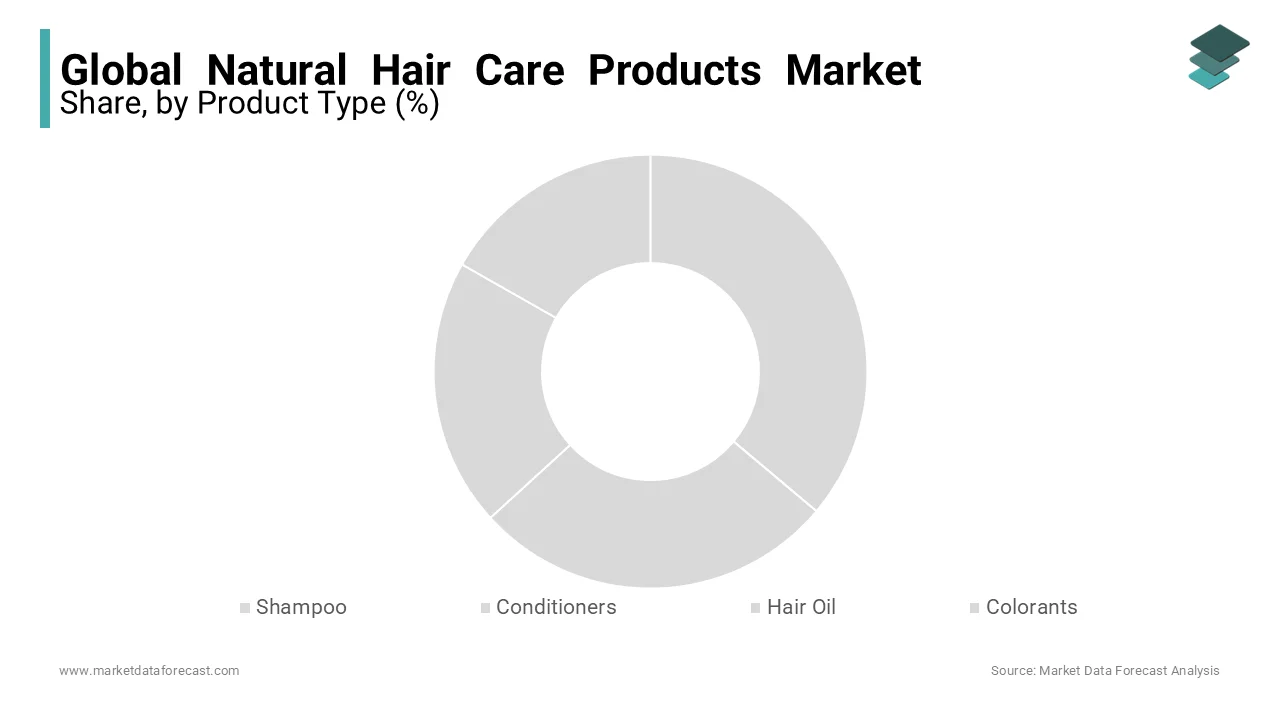
The hair oil segment is the fastest-growing segment within the natural hair care market and is projected to expand at a CAGR of 11.8% from 2025 to 2033. This accelerated growth is driven by deep-rooted cultural practices in regions like South Asia and Sub-Saharan Africa, where pre-wash oiling and overnight scalp treatments are integral to hair maintenance. Besides, clinical validation has bolstered consumer confidence: research from the National Center for Biotechnology Information demonstrated that daily application of cold-pressed coconut oil reduced protein loss in both damaged and undamaged hair by up to 50%. As global consumers adopt holistic, preventive approaches to hair health, the fusion of tradition and science has elevated hair oils from ancillary treatments to essential, high-performance products.
By Distribution Channel Insights
The brick and mortar stores segment remained the dominant distribution channel by capturing a 58.8% of the global natural hair care market in 2025. This lead position is sustained by the tactile nature of personal care shopping, where consumers rely on sensory evaluation, touch, scent, and texture, before purchasing. Specialty retailers such as Sephora, Ulta Beauty, and Whole Foods Market have expanded their clean beauty sections, offering curated selections of certified natural brands, which enhances consumer trust. Additionally, in regions like Africa and South Asia, informal retail networks, including local beauty supply shops and pharmacies, serve as primary access points for natural hair care, especially in areas with limited digital connectivity. These physical touchpoints not only facilitate immediate product access but also enable personalized recommendations from stylists and store associates, reinforcing their continued relevance.
The online stores segment is emerging as the fastest-growing distribution channel and is registering a CAGR of 14.3% between 2025 and 2033. The surge is propelled by rising e-commerce penetration, enhanced digital literacy, and the proliferation of direct-to-consumer (DTC) brand models. Subscription services and AI-driven personalization tools, such as hair quizzes and virtual consultations, have significantly improved customer engagement and retention. Brands like Briogeo and Pattern Beauty have capitalized on social media-driven discovery, leveraging Instagram and TikTok to funnel traffic to their e-commerce platforms. Moreover, global logistics improvements, including faster shipping and hassle-free returns, have mitigated earlier concerns about accessibility. As internet users in Southeast Asia and Latin America surpass 500 million collectively, according to the International Telecommunication Union, the digital expansion of natural hair care is poised for sustained acceleration.
By End-User Insights
The women segment represented the prominent end-user segment by accounting for a substantial share of the natural hair care market in 2025. This dominance is due to historically higher investment in personal grooming and the complexity of textured hair maintenance, particularly among Black, South Asian, and mixed-heritage women. The global natural hair movement has empowered women to embrace their curls and coils, driving demand for specialized products such as leave-in conditioners, curl creams, and protective styling oils. Besides, hormonal factors such as pregnancy, menopause, and postpartum shedding have heightened awareness of scalp and hair health, prompting increased use of botanical treatments. The rise of female-centric beauty communities on platforms like YouTube and Reddit has further amplified product education and peer validation, solidifying women’s central role in shaping market dynamics and innovation trajectories.
The men segment is the fastest-growing end-user, with the natural hair care market for men expanding at a CAGR of 10.6% from 2025 to 2033. This growth is fueled by a cultural shift in male grooming norms, where self-care is increasingly viewed as an extension of wellness rather than vanity. The rise of textured hair acceptance among Black and biracial men has also contributed. Brands like Ouidad Men and Camille Rose’s Apothecary Collection have introduced gender-inclusive lines tailored to coarser hair types and active lifestyles. Concurrently, male influencers on platforms such as TikTok and Instagram are normalizing hair oiling, scalp exfoliation, and regimen-based care, accelerating mainstream adoption.
REGIONAL ANALYSIS
North America Natural Hair Care Products Market Insights
North America led the global natural hair care market by securing a 36.8% share in 2025. The region’s dominance is anchored in high consumer awareness, robust regulatory scrutiny, and a vibrant culture of hair texture advocacy. The U.S., in particular, has been a pioneer in the natural hair movement, with the Black population, numbering over 47 million, driving demand for sulfate-free, moisturizing formulations. As per the U.S. Equal Employment Opportunity Commission, the passage of the CROWN Act in several states has legally protected natural hairstyles in workplaces and schools, reinforcing social acceptance. Additionally, the FDA’s increased focus on cosmetic labeling transparency has prompted brands to disclose ingredient origins and eliminate harmful additives. Retail giants like Target and Walmart have dedicated shelf space to Black-owned natural hair brands, improving accessibility.
Europe Natural Hair Care Products Market Insights
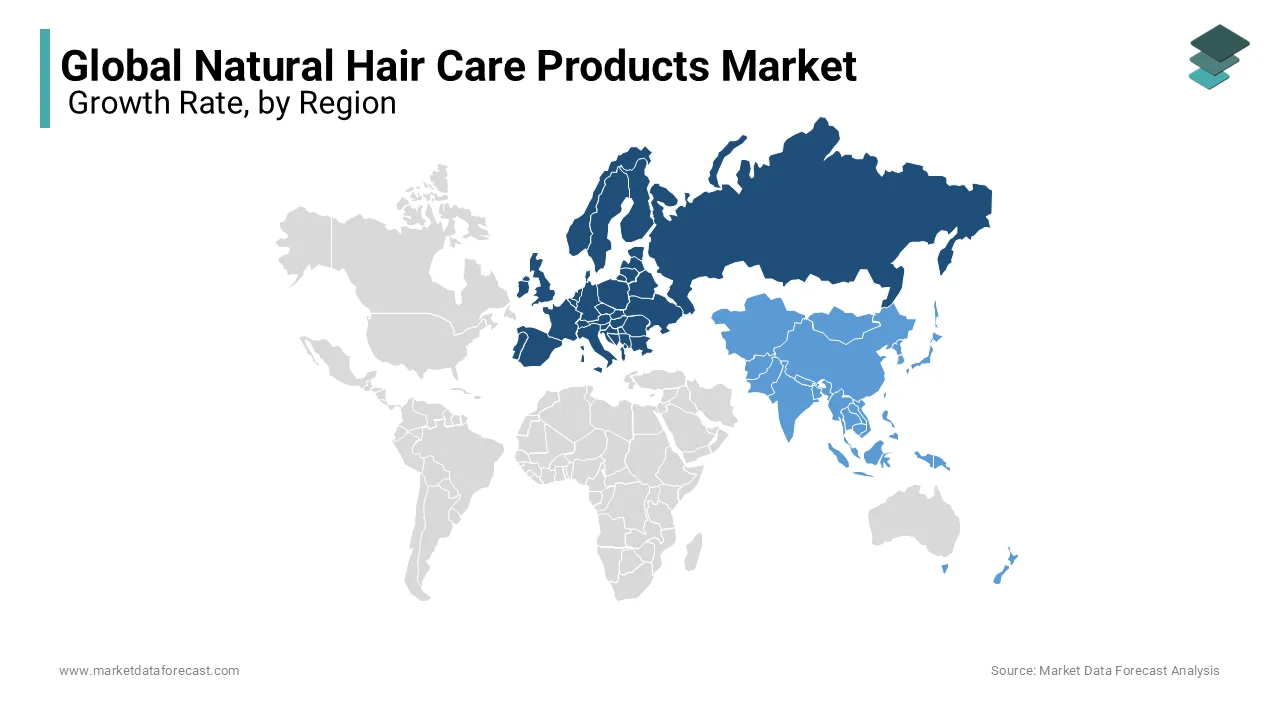
Europe holds a significant market share, with Germany, the UK, and France serving as primary growth engines. The region’s market is characterized by stringent environmental regulations and a strong affinity for clean, dermatologically tested formulations. The European Commission’s REACH regulation has restricted over 1,500 substances in cosmetics, pushing brands to adopt safer, plant-based alternatives. The growing Afro-European population, estimated at 15 million by the European Network Against Racism, has further stimulated demand for products catering to curly and coily hair. Retailers such as Boots and Douglas have responded by expanding their inclusive beauty ranges. Moreover, Nordic countries are leading in sustainable packaging innovation.
Asia Pacific Natural Hair Care Products Market Insights
Asia Pacific holds a notable market share which is propelled by traditional wellness practices and rising urban affluence. Countries like India, Indonesia, and Japan have long-standing rituals involving herbal oils, hibiscus, and amla, which are now being commercialized in modern, scientifically backed formats. The region’s burgeoning middle class is increasingly adopting premium natural brands. South Korea’s K-beauty influence has also extended to hair care, with fermentation-derived actives and lightweight botanical serums gaining popularity. E-commerce platforms like Lazada and Flipkart have enabled regional brands to scale rapidly, while multinational players adapt formulations to local hair types, driving both innovation and accessibility.
Latin America Natural Hair Care Products Market Insights
Latin America accounts for a moderate share of the market, with Brazil and Mexico emerging as key contributors due to high prevalence of curly and wavy hair types. The “Crespo Movement” in Brazil, which celebrates afros and natural textures, has gained traction on social media, influencing product demand. Additionally, local biodiversity offers abundant raw materials. However, economic volatility and import restrictions have limited foreign brand penetration, allowing domestic players like Lola Cosmetics and Salon Line to dominate. Despite challenges, rising beauty consciousness and digital engagement are fostering a dynamic, locally rooted natural hair care ecosystem.
Africa Natural Hair Care Products Market Insights
Africa holds small share of the global market but exhibits immense long-term potential, particularly in Sub-Saharan nations where traditional plant-based hair care remains deeply embedded. Nigeria, South Africa, and Kenya are leading markets. Urbanization and rising female workforce participation are increasing disposable income and brand awareness. Local entrepreneurs are capitalizing on indigenous knowledge, formulating products with baobab, hibiscus, and neem. International brands like SheaMoisture have established sourcing partnerships with women’s cooperatives in Ghana, promoting ethical trade. With internet penetration in Africa reaching 47% in 2023, as per the International Telecommunication Union, e-commerce is unlocking new distribution avenues, positioning the continent as a future growth frontier.
KEY MARKET PLAYERS AND COMPETITIVE LANDSCAPE
Procter & Gamble, Mama Earth, Nature Lab Tokyo, Estee Lauder, Phyto Botanical Power, St. Botanica, Bollati, Amazon Beauty Inc., John Master Organics and Organic Harvest are some of the major companies in the global natural hair care products market.
The competition in the Natural Hair Care Products Market is intensifying as both multinational corporations and agile indie brands vie for consumer loyalty. The market is characterized by rapid innovation, strong brand storytelling, and increasing demand for transparency. Established players leverage R&D capabilities and global distribution, while niche brands capitalize on authenticity, community engagement, and hyper-targeted formulations. Price sensitivity, varying regional preferences, and the proliferation of e-commerce platforms have fragmented the competitive landscape. Differentiation through sustainable packaging, clinically proven natural ingredients, and cultural inclusivity has become critical. As consumers grow more discerning, companies must balance performance, ethics, and accessibility to maintain relevance, resulting in a dynamic, highly responsive competitive environment across geographies.
TOP PLAYERS IN THE MARKET
SheaMoisture
SheaMoisture has established a prominent presence in the Asia Pacific natural hair care landscape by leveraging its heritage in ethically sourced African botanicals. The brand has expanded its footprint through strategic partnerships with regional distributors and e-commerce platforms such as Nykaa and Amazon India. The company also initiated community outreach programs in Indonesia and the Philippines, collaborating with local stylists to educate consumers on natural hair regimens. By aligning with cultural movements promoting hair texture acceptance, SheaMoisture has strengthened brand loyalty and visibility across urban and semi-urban markets, positioning itself as a trusted name in clean, inclusive hair care.
L’Oréal Paris
L’Oréal Paris has significantly influenced the natural hair care segment in Asia Pacific by integrating green science into mainstream formulations. The brand introduced its “Botanicals” line across India, Thailand, and Vietnam, featuring plant-derived actives such as amla, hibiscus, and argan oil, backed by dermatological testing. The company also invested in AI-driven virtual try-on tools on e-commerce sites to enhance consumer engagement. By combining scientific credibility with natural positioning, L’Oréal Paris has successfully bridged the gap between mass-market accessibility and clean beauty expectations. Its omnichannel distribution and high-impact advertising campaigns have further solidified its relevance among younger, eco-conscious consumers.
Hask
Hask has intensified its focus on the Asia Pacific region by introducing lightweight, silicone-free treatments designed for fine to medium hair textures common in East and Southeast Asia. Known for its salon-quality natural oils and keratin-free conditioners, Hask expanded its retail presence in Japan and South Korea through alliances with beauty retailers like LOFT and Watsons. Hask also launched targeted digital campaigns featuring K-beauty influencers to drive trial and awareness. By emphasizing transparency in ingredient sourcing and performance efficacy, Hask has cultivated a niche among consumers seeking affordable, naturally derived solutions without compromising on sensory experience or results.
TOP STRATEGIES USED BY KEY MARKET PLAYERS
Key players in the Natural Hair Care Products Market are deploying a combination of product innovation, sustainable sourcing, digital engagement, strategic partnerships, and regional customization to consolidate their positions. Companies are investing heavily in bio-based actives and green chemistry to enhance product efficacy while maintaining clean labels. Vertical integration through direct sourcing from cooperatives ensures ingredient authenticity and supports ethical branding. E-commerce acceleration, influencer collaborations, and AI-powered personalization are central to customer acquisition. Additionally, brands are reformulating portfolios to meet regional climatic and textural needs, particularly in humid or pollution-prone areas. Mergers and acquisitions are also prevalent, enabling rapid market entry and technology integration, all aimed at building trust, loyalty, and long-term differentiation in a crowded, fast-evolving landscape.
RECENT HAPPENINGS IN THE MARKET
- In March 2023, SheaMoisture launched a climate-resilient shea nut sourcing initiative in Ghana, partnering with women-led cooperatives to ensure sustainable harvests and improve supply chain transparency in the Natural Hair Care Products Market.
- In June 2023, L’Oréal Paris introduced its Botanicals Redensifying range in India and Thailand, featuring Ayurvedic ingredients like amla and shikakai, backed by clinical studies on hair strength and thickness in the Natural Hair Care Products Market.
- In September 2023, Hask reformulated 15 core products to eliminate microplastics and introduced 100% post-consumer recycled packaging across its Asia Pacific distribution network in the Natural Hair Care Products Market.
- In January 2025, Briogeo partnered with Sephora Asia to launch an exclusive humid-climate-resistant curl collection, featuring mold-resistant natural polymers derived from cassava in the Natural Hair Care Products Market.
- In April 2025, Unilever acquired the Indian clean beauty brand Plum, integrating its plant-based R&D expertise to expand its natural personal care portfolio in the Asia Pacific region in the Natural Hair Care Products Market.
MARKET SEGMENTATION
This research report on the global natural hair care products market has been segmented and sub-segmented into the following categories.
By Product Type
- Shampoo
- Conditioners
- Hair Oil
- Colorants
By Distribution Channel
- Brick and Mortar Stores
- Online Stores
By End-User
- Women
- Men
By Region
- North America
- Europe
- Asia Pacific
- Latin America
- The Middle East and Africa