- Product Description Description
- Table of Contents TOC
- List of Table & Figure LOT
- Get Free Sample PDF Sample PDF
Market Size, 2025
$181.28 BnMarket Estimate, 2026
$191.84 BnMarket Forecast, 2034
$301.8 BnCAGR, 2026–2034
5.83%Executive Summary: Global Hair and Beauty Salons Market
- Market Scope: Comprehensive global assessment covering product types (hair care, skin care, nail care, feet care), end-users (male, female), distribution channels (salon, direct-to-consumer, specialty store), and regional breakdowns across North America, Europe, Asia Pacific, Latin America, and MEA.
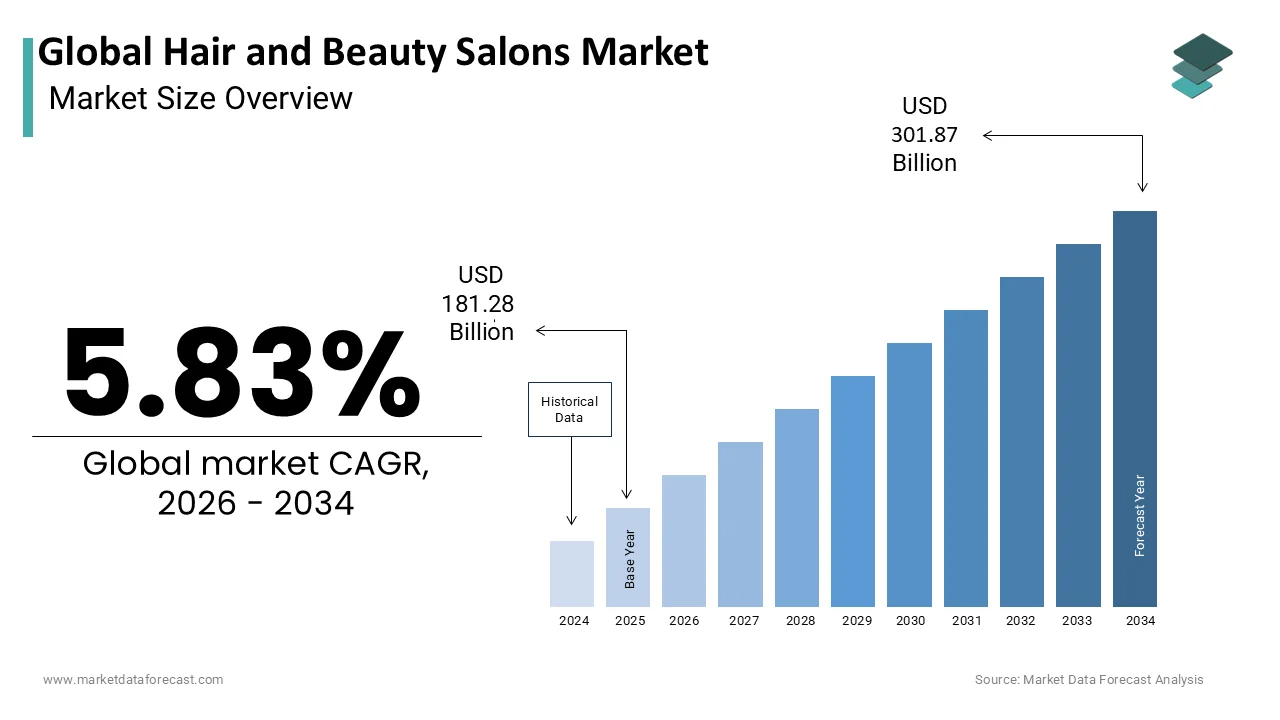
- Market Valuation: Valued at USD 181.28 billion in 2025, estimated at USD 191.84 billion in 2026, and projected to reach USD 301.87 billion by 2034, registering a compound annual growth rate (CAGR) of 5.83% during the forecast period from 2026 to 2034.
- Primary Growth Drivers: Growing consumer desire to maintain youthfulness and aesthetics, rapid adoption of cutting-edge treatments (such as laser hair removal, anti-dandruff, and acne therapies), and effective digital marketing and celebrity endorsements by major salon brands.
Key Market Segment Metrics (2026–2034)
| Category | Leading Segment Focus | Fastest-Growing / Key Structural Trends |
|---|---|---|
| By Product/Service Type | Hair Care (held the leading share in 2025, closely followed by skin care due to rising personal grooming and aesthetic awareness) | Nail & Foot Care (emerging rapidly alongside specialized laser treatments and face spa services boosting consumer confidence) |
| By End-User | Female (ruled the market in 2025, backed by extensive, diverse service portfolios tailored to women's beauty needs) | Male (expanding at a strong CAGR as men increasingly adopt dedicated hair and skin maintenance salon regimens) |
| By Distribution Channel | Salon (predicted to account for the largest market share driven by expanding salon networks and professional branding) | Direct-to-Consumer & Specialty Stores (experiencing healthy CAGRs due to at-home on-demand platforms like Urban Company and niche nail/beauty bars) |
Major Market Players & Market Structure
Market Structure: A competitive, lifestyle-driven global market where established salon chains, cosmetic giants, and on-demand tech platforms compete through innovative service delivery, strategic partnerships, and customer loyalty programs.
Key Companies: Neville Hair and Beauty Salon, Fantastic Sams, Salon You, StyleSeat, AB Klipp AS, L'Oreal Professional Hair and Beauty Salon, Naturals Professional, and Muse Salon & Spa.
Global Hair and Beauty Salons Market Size
The global hair and beauty salons market was valued at USD 181.28 billion in 2025. The global market size is expected to grow at a CAGR of 5.83% from 2026 to 2034 and be worth USD 301.87 billion by 2034, up from USD 191.84 billion in 2026.
The hair and beauty salons are professional commercial establishments providing specialized hair care, aesthetic treatments, skin rejuvenation, and personal grooming services to individual consumers. As per the study, global household final consumption expenditure dedicated to personal care and discretionary services registers an average annual growth rate of 3.5%, reflecting a steady upward trajectory in consumer lifestyle investments. Furthermore, International Labour Organization labor statistics indicate that employment opportunities for licensed cosmetologists and personal appearance workers expand annually, driven by ongoing workforce development and high consumer service demand. Within this commercial landscape, urban patrons increasingly prioritize multi-service establishments that combine advanced aesthetic technology with traditional styling.
MARKET DRIVERS
Proliferation of Digital Booking Platforms and Automated Management Systems
The widespread adoption of mobile scheduling applications and artificial intelligence tools dramatically transforms operational efficiency and client retention, amplifying the growth of the hair and beauty salons market. According to the study, 72% of modern hair and beauty salons utilize advanced digital booking systems, and 80% of clients who book online successfully complete repeat appointments, which significantly boosts customer loyalty. This technological integration directly drives the hair and beauty salons market by eliminating administrative friction, minimizing scheduling conflicts, and enabling salon owners to maximize daily chair utilization rates. Furthermore, artificial intelligence-enabled scheduling and marketing tools contribute an estimated 0.9% incremental impact to overall sector compound annual growth rates by converting missed calls into confirmed bookings, as per the study.
Escalating Urban Disposable Income and Premium Grooming Awareness
The rising individual affluence and lifestyle-driven grooming habits encourage higher consumer spending on specialized professional treatments, which is another factor promoting the growth of the hair and beauty salons market. This economic driver heavily accelerates the hair and beauty salons market because consumers increasingly view professional grooming as an essential component of personal maintenance rather than an occasional luxury. Additionally, rising disposable incomes and a premium wellness focus contribute a 2.1% direct positive impact on sector growth metrics, particularly within metropolitan areas. This trend is further amplified by social media influence, prompting patrons to invest heavily in premium hair treatments, skin rejuvenation, and bespoke spa services.
MARKET RESTRAINTS
Severe Licensed Stylist Shortages and High Workforce Turnover
The persistent labor scarcity and high employee attrition rates impose strict operational hurdles on salon capacity expansion, which is restraining the growth of the hair and beauty salons market. According to the study, the beauty sector experiences high workforce volatility, with approximately 20% to 25% of styling professionals leaving their positions annually due to wage dissatisfaction or burnout. This labor constraint directly restrains the hair and beauty salons market growth by forcing independent establishments to operate below maximum capacity, leading to extended customer waiting lists and unrealized revenue potential. Consequently, salon owners face escalating recruitment and retention expenses, which compress net profit margins across both boutique and franchise operations.
Rapid Expansion of Sophisticated At-Home Beauty Alternatives
The proliferation of advanced consumer-grade aesthetic devices encourages clients to substitute professional salon visits with home maintenance routines that is additionally declining the growth of the hair and beauty salons market. As per the report, sales of at-home laser hair removal tools, LED anti-aging masks, and smart styling appliances have expanded by 24% annually among urban households. This product evolution directly impacts the hair and beauty salons market by empowering consumers to perform routine maintenance treatments independently, thereby lengthening the duration between formal salon appointments. Moreover, the rise of sophisticated at-home alternatives exerts a negative 1.8% restraint on overall salon service frequency, particularly affecting standard coloring and basic skincare sectors.
MARKET OPPORTUNITIES
Integration of Artificial Intelligence and Augmented Reality Consultations
Advanced digital visualization tools create lucrative avenues for hyper-personalized styling and precision aesthetic treatments, which serve to elevate new opportunities for the growth of the hair and beauty salons market. This technological shift creates a major opportunity for the hair and beauty salons market by bridging the communication gap between stylists and clients, ensuring high customer satisfaction and reducing service correction rates. Furthermore, the tech-enabled personalization strategies increase average retail product attachment rates by nearly 18% during initial consultations. Consequently, forward-thinking salon enterprises that integrate artificial intelligence diagnostic tools successfully command higher service fees and secure stronger brand loyalty among tech-savvy demographic cohorts.
Expansion of Specialized Men Grooming and Wellness Portfolios
The cultural normalization of male self-care unlocks an entirely untapped consumer demographic for comprehensive salon services, which is additionally to leveraging the growth of the hair and beauty salons market. As per survey, male consumer spending on professional grooming, beard styling, and specialized scalp treatments has increased by 15% year-over-year. This demographic shift presents a major opportunity for the hair and beauty salons market by transforming traditionally female-centric spaces into unisex wellness destinations capable of capturing dual-gender revenue streams. Additionally, growing male participation contributes a 1.3% direct uplift to overall sector growth forecasts, with emerging urban centers recording the highest adoption velocity. This structural change encourages salon operators to redesign service menus and introduce targeted male-oriented packages, broadening their total addressable base.
MARKET CHALLENGES
Stringent Hygiene Regulations and Chemical Compliance Cost Burdens
The rigorous health sanitation mandates and environmental safety standards impose heavy administrative and financial obligations on salon operators, which is a major challenge for the growth of the hair and beauty salons market. According to the study, regulatory inspections regarding chemical ventilation and sterilization protocols have intensified by 20%, requiring substantial facility upgrades. This compliance burden directly challenges the hair and beauty salons market by forcing small independent business owners to allocate significant capital toward specialized air filtration systems and certified disposal procedures. Consequently, smaller salons struggle to absorb these mandatory overhead costs, driving industry consolidation as well-funded corporate franchises absorb independent competitors.
Vulnerability to Discretionary Spending Fluctuations During Economic Downturns
Economic uncertainty and inflationary pressures trigger immediate consumer cutbacks on non-essential personal care and beauty services that is also expected to slow the growth of the hair and beauty salons market in the coming years. This economic sensitivity directly challenges the hair and beauty salons market by causing sharp fluctuations in customer booking volumes and reducing the uptake of high-margin add-on treatments. Moreover, risk assessments indicate that demand volatility in lower-frequency discretionary services exerts a continuous negative pressure on independent salon revenue stability. The salon managers must implement aggressive membership models and loyalty discount schemes to retain price-sensitive clients during unpredictable economic cycles.
REPORT COVERAGE
| REPORT METRIC | DETAILS |
| Market Size Available | 2025 to 2034 |
| Base Year | 2025 |
| Forecast Period | 2026 to 2034 |
| Segments Covered | By Product Type, Distribution Channel, End-User, and Region |
| Various Analyses Covered | Global, Regional & Country-Level Analysis, Segment-Level Analysis, DROC, PESTLE Analysis, Porter’s Five Forces Analysis, Competitive Landscape, Analyst Overview on Investment Opportunities |
| Regions Covered | North America, Europe, Asia Pacific, Latin America, Middle East and Africa |
| Key Market Players | Neville Hair and Beauty Salon, Fantastic Sams, Salon You, StyleSeat, AB Klipp AS, L'Oreal Professional Hair and Beauty Salon, Naturals Professional and Muse Salon & Spa |
SEGMENTAL ANALYSIS
By Product Type Insights
The hair care category segment was the largest, holding 23.1% of the hair and beauty salons market share in 2025, with routine maintenance visits for cutting, styling, and chemical treatments. The heavy propelled by the rising frequency of routine salon appointments dedicated to specialized hair coloring and conditioning. Furthermore, World Health Organization lifestyle surveys highlight that urban consumers allocate over 5.00% of their disposable budgets to personal appearance upkeep, ensuring sustained demand for professional hair care solutions.
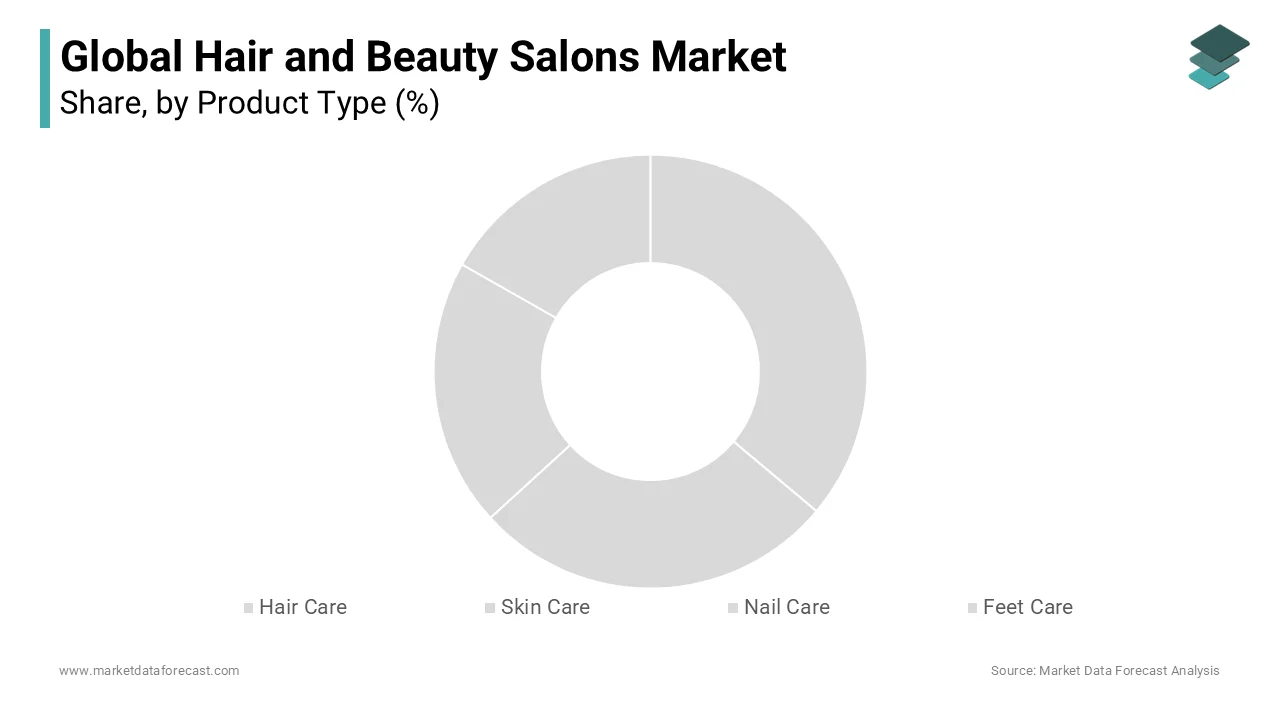
The skin care category segment is likely to witness the fastest CAGR of 12.2% during the forecast period, with the rising consumer focus on anti-aging treatments and acne solutions. This influence of social media dermatology trends that encourage regular professional facial regimens. Additionally, urban populations prioritize professional skin rejuvenation to combat environmental pollution damage, locking in high-margin service growth across metropolitan salon networks.
By End User Insights
The women segment held a significant share of the hair and beauty salons market in 2025 that encompasses multi-service styling, coloring, and aesthetic treatments. The rising female workforce participation and growing disposable incomes are escalating the growth of the hair and beauty salons market. The female disposable income in urban centers has risen by 4.5% annually, which is expanding budgets allocated to luxury salon packages. Furthermore, consumer tracking notes that female clients maintain an average salon visitation frequency of once every 4 weeks, creating a reliable and high-volume revenue baseline for salon operators globally.
The men segment is expected to grow at the fastest CAGR of 19.2% during the forecast period, with the cultural shift toward male self-care and modern grooming trends as key catalysts for this expansion. This rapid growth is driven by the proliferation of specialized men-centric urban grooming lounges offering beard styling, scalp treatments, and facials. Male spending on professional grooming services is boosting the growth of the market. Additionally, targeted male marketing campaigns contribute a 1.3% direct uplift to overall sector growth forecasts, as contemporary male consumers increasingly embrace comprehensive wellness routines.
COUNTRY LEVEL ANALYSIS
North America Hair And Beauty Salons Market Analysis
North America was the largest contributor in the hair and beauty salons market,a ccounting for a 36.4% share in 2025, with high per capita consumer spending and early technological adoption. National Institutes of Health wellness studies reveal that regional household spending on personal care exceeds 600 dollars annually per capita, providing a massive financial foundation for the industry. Furthermore, major metropolitan salon chains in the United States and Canada aggressively integrate automated booking software and virtual styling applications by ensuring sustained high-value revenue generation across the territory.
Europe Hair And Beauty Salons Market Analysis
Europe hair and beauty salon market was ranked second, holding a 19.8% share in 2025, with strict cosmetic safety regulations, a high density of premium boutique salons, and a strong cultural emphasis on aesthetic wellness. European Medicines Agency and local health authority compliance audits report a 12% annual rise in consumer demand for organic and cruelty-free salon treatments across member states. Additionally, comprehensive lifestyle surveys published by Eurostat indicate that European consumers prioritize regular hair and skin maintenance as an essential component of personal well-being, reinforcing steady regional market stability.
Asia Pacific Hair And Beauty Salons Market Analysis
Asia Pacific hair and beauty salons market growth is propelled by surging urban disposable incomes, massive population demographics, and evolving lifestyle standards. As per the study, the region hosts over 50% of the global consumer base, creating an immense local demand for modern grooming services. Moreover, government-backed retail infrastructure developments in China, India, and Japan attract substantial foreign investment, accelerating the proliferation of luxury multi-service salons across developing commercial hubs.
Latin America Hair And Beauty Salons Market Analysis
Latin America hair and beauty salons market growth is driven by growing beauty consciousness, economic stabilization, and progressive modernization of urban shopping centers. Pan American Health Organization statistical bulletins report an 8% annual expansion in urban small-business enterprise openings dedicated to personal care services. This entrepreneurial growth steadily enhances consumer access to professional styling facilities, elevating regional consumption levels across major metropolitan districts.
The Middle East and Africa Hair And Beauty Salons Market Analysis
The Middle East and Africa hair and beauty salons market is likely to grow with the ambitious national economic diversification strategies and the rapid expansion of luxury retail developments. The growth of the market in this region is also driven primarily by high-income Gulf Cooperation Council economies. AAccording to theWorld Health Organization, annual increase in premium wellness and grooming center openings across the United Arab Emirates and Saudi Arabia. This high-value institutional investment accelerates the local adoption of high-end international salon franchises, establishing a robust foundation for long-term commercial penetration across developing regional economic corridors.
COMPETITIVE LANDSCAPE
Competition within the global hair and beauty salons market is exceptionally intense, characterized by a highly fragmented landscape of independent boutique operators competing directly against large-scale multinational franchise networks. Industry participants constantly strive to differentiate their service offerings by introducing specialized organic treatments, advanced skin rejuvenation technologies, and personalized wellness packages that appeal to evolving consumer preferences. Pricing pressures and rising commercial real estate rental costs demand that market players continuously optimize operational efficiency and leverage digital marketing tools to secure steady client foot traffic. Key competitors frequently engage in aggressive talent acquisition strategies, proprietary mobile application development, and strategic studio leasing models to attract top-tier licensed professionals. Furthermore, the rapid growth of premium at-home beauty devices and e-commerce retail platforms forces traditional salon operators to elevate the experiential value of in-person services, creating high operational standards that separate dominant industry leaders from smaller local establishments.
KEY MARKET PLAYERS
Some of the companies that are playing a dominant role in the Global Hair and Beauty Salons Market include:
- Neville Hair and Beauty Salon
- Fantastic Sams
- Salon You
- StyleSeat
- AB Klipp AS
- L'Oréal Professional Hair and Beauty Salon
- Naturals Professional
- Muse Salon & Spa
TOP LEADING PLAYERS IN THE MARKET
- Regis Corporation operates as a premier global hair salon enterprise, contributing extensive franchise management and corporate salon operations to the international beauty services sector. The corporation delivers standardized haircare treatments and styling solutions through well-known brand portfolios across thousands of commercial locations worldwide. To strengthen its commercial footprint, the enterprise focuses heavily on optimizing digital scheduling applications and streamlining franchise support structures. Furthermore, the firm routinely refines its operational efficiency to enhance same-store sales growth and maximize cash flow generation across its North American network.
- Ulta Beauty functions as a leading beauty retail and salon service enterprise contributing integrated salon experiences alongside extensive cosmetic and haircare product offerings. The company delivers professional skin treatments, hair styling, and beauty services directly inside its expansive retail locations globally. Additionally, the firm strategically expands its physical retail footprint and pursues targeted international retail acquisitions to capture broader consumer demographics.
- Sola Salons operates as a prominent salon studio enterpris,e contributing innovative salon space rentals and independent business infrastructure to beauty professionals worldwide. The corporation provides fully equipped individual studio spaces that empower licensed stylists, estheticians, and independent beauty practitioners to run private businesses without traditional salon overhead. To strengthen its market position, the enterprise continuously invests in property expansion across major metropolitan areas and upgrades its tenant management digital portal. Moreover, the firm deploys targeted educational resources and marketing toolkits to support independent operators in growing their client base and retaining high-end consumer loyalty.
TOP STRATEGIES USED BY KEY MARKET PARTICIPANTS
Key market participants deploy aggressive digital transformation initiatives to integrate mobile booking applications and artificial intelligence scheduling tools that streamline appointment coordination and maximize daily chair utilization. Leading salon corporations focus heavily on expanding franchise networks and securing strategic retail partnerships to increase brand visibility across urban commercial centers. Industry leaders pursue targeted mergers and corporate acquisitions of specialized beauty brands and international retail chains to diversify service portfolios and capture new consumer demographics. Corporations also establish robust loyalty programs and experiential in-store marketing campaigns to drive customer retention and boost retail product attachment rates during salon visits.
GLOBAL HAIR AND BEAUTY CLINIC MARKET NEWS
- In August 2025, the renowned companies Aveda and Nykaa collaborated to create Aveda x Nykaa Salon in Delhi, which aims to set new standards with plush services and vegan products.
- In July 2025, the biggest company, L'Oreal Professionals, created a campaign subsidizing the price for salon color services- A Bit Like Eat Out To Help Out,-which refunds 10 pounds to drive and support local salons to bounce back this summer.
- In February 2025, a leading company, Green Trends, a salonandf consumer goods firm CavinKare Ltd committed to donating 100 wigs to underprivileged cancer patients under its Corporate Social Responsibility initiative 'Shai'," commemorating World Cancer Day.
MARKET SEGMENTATION
This research report on the global hair and beauty clinic market has been segmented and sub-segmented into the following categories.
By Product Type
- Hair Care
- Skin Care
- Nail Care
- Feet Care
- Others
By End-User
- Male
- Female
By Distribution Channel
- Salon
- Direct-to-consumer
- Specialty Store
By Region:
- North America
- Europe
- Asia Pacific
- Latin America
- Middle East and Africa