- Product Description Description
- Table of Contents TOC
- List of Table & Figure LOT
- Get Free Sample PDF Sample PDF
Market Size, 2025
$3.17 BnMarket Estimate, 2026
$3.27 BnMarket Forecast, 2034
$4.19 BnCAGR, 2026–2034
3.15%Executive Summary: Global Hand Sanitizer Market
- Market Scope: Comprehensive global hand sanitizer market analysis covering product forms, distribution channels, end-user settings, regional leadership frameworks, and personal hygiene adoption metrics.
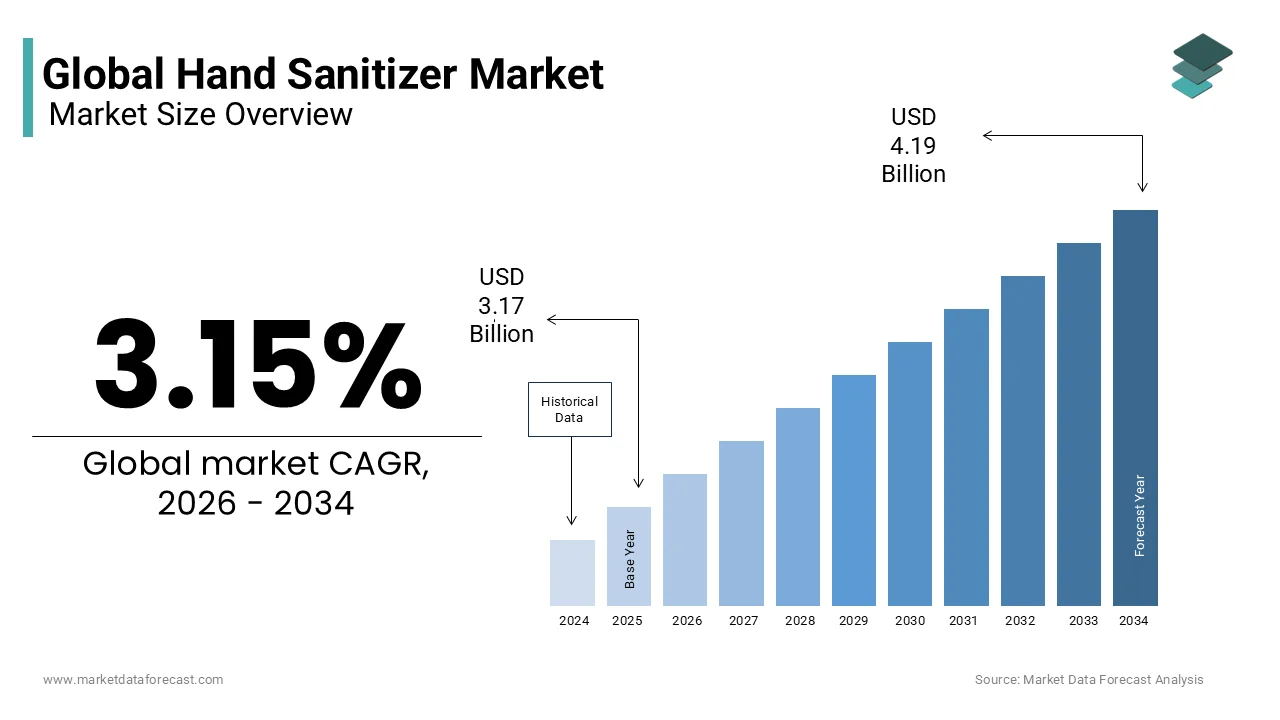
- Market Valuation: Valued at USD 3.17 billion (2025), estimated at USD 3.27 billion (2026), and projected to reach USD 4.19 billion by 2034, registering a steady CAGR of 3.15% (2026–2034).
- Primary Growth Drivers: Consumer preference for health and wellness, product innovations such as soothing scents and skin-protecting emollients/humectants, rising living standards, and institutional support from organizations like the WHO and FDA. Key operational catalysts include government-backed licenses for new manufacturers and brewers to scale production, alongside rising awareness of personal hygiene and infection control.
Key Market Segment Metrics (2026–2034)
| Category | Leading Segment (2025 Position) | Fastest-Growing Segment |
|---|---|---|
| By Product | Gel-Based (held the biggest market share due to high spreadability and rapid germ destruction) | Gel and Foam Sanitizer Formulations |
| By Distribution Channel | Hypermarkets & Supermarkets (occupy a vital place due to wide brand choices and bulk-purchase offers) | Online Retail Channels and E-Commerce Platforms |
| By End User | Hospitals (dominated the market due to the critical need for sanitized clinical environments) | Schools and Educational Institutions (driven by hygiene promotion campaigns) |
| By Region | North America (led by the United States due to high purchasing power and health awareness) | Asia-Pacific (projected to experience significant growth driven by government hygiene initiatives in countries like India) |
Major Market Players & Market Structure
Market Structure: Highly competitive personal care and hygiene landscape featuring major multinational corporations competing intensely on product differentiation, organic formulations, skin-friendly humectants, promotional campaigns, and extensive retail distribution.
Key Companies: Reckitt Benckiser Group, The Himalaya Drug Company, Procter & Gamble, GOJO Industries Inc., Henkel Corporation, Unilever Plc, Vi-Jon Laboratories Inc., Chattem Inc., Best Sanitizers Inc., and Kutol Products Company.
Global Hand Sanitizer Market Size
The global hand sanitizer market size was valued at USD 3.17 billion in 2025 and is expected to reach USD 4.19 billion by 2034 from USD 3.27 billion in 2026. The market is projected to grow at a CAGR of 3.15%.
Hand sanitizer is a disinfectant that can be used instead of soap and water. It is used to prevent the spread of infection, which is primarily transmitted by hand and can lead to a variety of disorders such as nosocomial food-borne illness and others. It's made up of alcohol, water, emollients, polyacrylates, artificial and natural colours, and perfumes, and comes in foam, gel, and liquid forms. Hand sanitizers containing ethanol and isopropanol denature proteins and remove the lipid-based coats of bacteria and viruses quickly. The ingredients are carried by the water, which bonds with the hydrogel. Emollients and other substances are added in small amounts to protect the skin from alcohol-induced dryness, mitigate the acidic effects of polyacrylate, and improve the product's scent and look.
MARKET DRIVERS
Consumer preference for health and wellness, as well as product innovation such as the use of scents in sanitizer formulations, are expected to drive the worldwide hand sanitizer market forward. Furthermore, rising living standards, increased health expenditures, and support from organisations such as the World Health Organization, the Food and Drug Administration, and others for the need for sanitation all contribute to increased demand for hand sanitizers. Various governments throughout the world have issued licences to new manufacturers, sugar producers, and brewers in order to enhance hand sanitizer manufacturing in order to satisfy rising worldwide demand. As a result of the current demand, an increasing number of companies are including alcohol in their products, which is becoming increasingly vital for them to compete in a highly competitive market.
MARKET RESTRAINTS
During the forecast period, however, health risks connected with chemical compounds are expected to hamper the market growth.
MARKET OPPORTUNITIES
Increased focus on healthcare, rising hygiene awareness, the rising popularity of personal hygiene products, rising demand for organic and chemical-free hand sanitizers, appealing marketing strategies, are some of the major factors driving hand sanitizer. Hand sanitizers also contain humectants, which attract and hold moisture in the hands and do not remove natural oils from the skin, even when used repeatedly. These sanitizers are more effective and kinder on the skin than regular soap. The key players in the market are boosting their market share through various techniques such as promotional campaigns and media coverage.
MARKET CHALLENGES
Because alternative products such as soaps, shampoos, and oils are widely available, sales revenues from the many products related to hand cleansing, such as sanitizer and washers, decline, putting downward pressure on product demand. Furthermore, the market is projected to be hampered by an increase in the number of cases of skin cleansers with synthetic ingredients causing side effects.
REPORT COVERAGE
| REPORT METRIC | DETAILS |
| Market Size Available | 2025 to 2034 |
| Base Year | 2025 |
| Forecast Period | 2026 to 2034 |
| CAGR | 3.15% |
| Segments Covered | By Product, Distribution Channel, End User, and Region. |
| Various Analyses Covered | Global, Regional & Country Level Analysis, Segment-Level Analysis, DROC, PESTLE Analysis, Porter’s Five Forces Analysis, Competitive Landscape, Analyst Overview of Investment Opportunities |
| Regions Covered | North America, Europe, APAC, Latin America, Middle East & Africa |
| Market Leaders Profiled | Reckitt Benckiser Group, The Himalaya Drug Company, Procter & Gamble, GOJO Industries Inc., Henkel Corporation, Unilever Plc, Vi-Jon Laboratories Inc., Chattem Inc., Best Sanitizers Inc., and Kutol Products Company |
SEGMENTAL ANALYSIS
By Product Insights
In 2025, the gel-based hand sanitizer segment had the biggest market share of, which is likely to continue during the forecast period. Because gel sanitizers are often light and watery in formulation, they have a high spreadability, allowing them to quickly enter the skin and destroy most bacteria. In the approaching years, the simplicity of product availability and increased access to these types of antiseptic solutions will fuel demand. As the coronavirus disease (COVID-19) spreads over the world, the need for hand sanitizers in schools, hospitals, residential and business complexes, and other public spaces has skyrocketed. Hand sanitizers are gaining popularity due to their mobility and simplicity over handwashes, which is boosting sales of gel-type sanitizers.
By Distribution Channel Insights
Due to the availability of a vast choice of hand washing goods from multiple brands in a single location, as well as the discounts and offers made by these retailers on bulk purchases, the hypermarkets & supermarkets segment occupies a vital place in the global market.
By End User Insights
The hospital segment dominates the market due to the growing need for sanitizers to maintain a sanitary environment in hospitals and clinics. Furthermore, the increased health concerns among doctors and other hospital and clinic workers create a steady need for various personal care products.
REGIONAL ANALYSIS
The United States is one of the world's most important consumer marketplaces, and it's especially lucrative for personal care and hygiene products because the population is well-informed and willing to spend. Consumers' strong purchasing potential in the United States is projected to be a major driver of hand sanitizer product use.Other factors that will favourably influence hand sanitizer shipments in the United States include increased demand for organic hand sanitizers and rising awareness about personal care and cleanliness.
Europe was the second greatest contributor. There are a lot of market players in this region, and numerous types of hand antiseptics, such as gel-based, foam-based, sprays, and wipes, are widely used. Consumers in countries like the United Kingdom and Germany are more prepared to spend on personal care and hygiene items, thus they dominate the market.Hand sanitizer has long been a popular product in Germany. The most recent COVID-19 epidemic has wreaked havoc across the country, causing the government to take drastic anti-pandemic measures.An unanticipated spike in demand for health and safety items, particularly hand sanitizers, has occurred in the region.
Hand sanitizer use in Asia Pacific is predicted to grow significantly over the projection period. Over the period, government activities to raise awareness about personal care and hygiene are likely to have a significant impact on hand sanitizer shipments in these regions. India has seen a significant surge in demand for personal care goods as a result of government measures aimed at raising hygiene awareness. Over the projected period, rising consumer awareness of natural products will additionally fuel demand for organic hand sanitizers in the country.
KEY MARKET PLAYERS
- Reckitt Benckiser Group
- The Himalaya Drug Company
- Procter and Gamble
- Gojo Industry Inc.
- Henkel Corporation
- Unilever Plc.
- Vi-Jon Laboratories Inc.
- Chattem Inc
- Best Sanitizers Inc.
- Kutol Products Company
MARKET SEGMENTATION
This research report on the global hand sanitizer market is segmented and sub-segmented into the following categories.
By Product
- Gel
- Foam
- Spray
By Distribution Channel
- Hypermarket & Supermarket
- Drugstore
- Online
By End User
- Restaurants
- Schools
- Hospitals
- Household Purpose
By Region
- North America
- Europe
- Asia-Pacific
- Latin America
- Middle East and Africa