- Product Description Description
- Table of Contents TOC
- List of Table & Figure LOT
- Get Free Sample PDF Sample PDF
Market Size, 2025
$12.42 BnMarket Estimate, 2026
$12.97 BnMarket Forecast, 2034
$18.30 BnCAGR, 2026–2034
4.4%Executive Summary: Global Helicopter Ice-Protection Systems Market
- Market Scope: Comprehensive global market analysis of helicopter ice-protection technologies designed to prevent ice accumulation on rotorcraft components across commercial, military, and general aviation sectors.
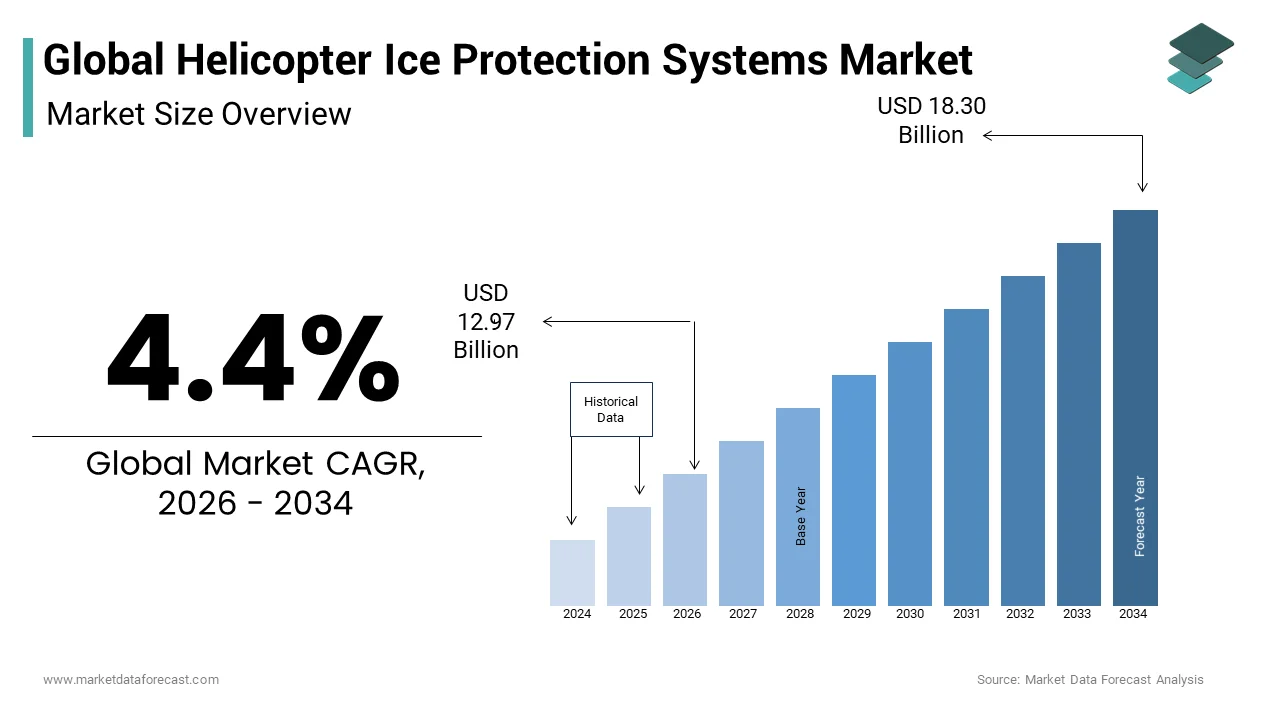
- Market Valuation: Valued at USD 12.42 billion (2025), estimated at USD 12.97 billion (2026), and projected to reach USD 18.30 billion by 2034, registering a steady CAGR of 4.4% (2026–2034).
- Primary Growth Drivers: Expansion of offshore energy operations in harsh climates, heightened military procurement for all-weather Arctic readiness, and regulatory mandates for flight into known icing conditions.
Key Market Segment Metrics (2026–2034)
| Category | Leading Segment (2025 Position) | Fastest-Growing Segment |
|---|---|---|
| By Technology | Electrical systems (dominant due to precise heating and adaptability for rotor blades) | Electro-thermal and smart detection-integrated systems |
| By Platform | Military rotorcraft (holding major share due to defense modernization and all-weather Arctic mission requirements) | Commercial and offshore support platforms |
| By Region / Country | North America (outperformer holding 32.1% global share backed by offshore operations and military presence) | Asia-Pacific (growing rapidly through defense expansions and offshore energy activities) |
Major Market Players & Market Structure
Market Structure: Consolidated market landscape featuring major aerospace primes and specialized suppliers competing on system weight efficiency, reliability, and stringent regulatory certification expertise.
Key Companies: Raytheon Technologies Corporation (Collins Aerospace), Safran S.A., GKN Aerospace Services Limited, Honeywell International, DOW Chemical Company, Meggitt PLC, JBT Corporation, Clariant, and CAV Ice Protection Inc.
Global Helicopter Ice-Protection Systems Market Size
The global helicopter ice-protection systems market size was valued at USD 12.42 billion in 2025 and is anticipated to reach USD 12.97 billion in 2025 to reach USD 18.30 billion by 2034, growing at a CAGR of 4.4% during the forecast period from 2026 to 2034.
Helicopter Ice Protection Systems Market Comprehensive Analysis
The helicopter ice potection systems are specialized aerospace technologies designed to prevent ice accumulation on rotorcraft components. These systems are essential for maintaining aerodynamic efficiency structural integrity and operational safety in freezing atmospheric conditions. According to the study, icing conditions contribute to approximately 12% of weather related aviation accidents highlighting the critical nature of these protective measures. In Europe, the European Union Aviation Safety Agency mandates strict certification standards for flight into known icing conditions which drives the integration of advanced protection systems in new aircraft designs. The growing deployment of helicopters in high latitude regions such as Scandinavia and Canada where icing seasons can last up to six months further necessitates robust protection mechanisms. As per the National Transportation Safety Board effective ice protection is vital for search and rescue operations which often occur in adverse weather. The transition toward electric vertical takeoff and landing aircraft also introduces new requirements for lightweight and energy efficient ice protection solutions. This technological evolution reflects the industry's commitment to enhancing flight safety and expanding operational envelopes in increasingly challenging environmental conditions.
MARKET DRIVERS
Expansion of Offshore Energy Operations in Harsh Climates
The rapid expansion of offshore wind energy and oil and gas exploration is majorly fuelling the growth of the helicopter ice protection systems market. Helicopters are the preferred mode of transport for personnel and equipment to remote offshore platforms due to their speed and versatility. Ice accumulation on rotor blades can lead to severe vibration loss of lift and potential catastrophic failure making reliable protection systems mandatory for safe operations. Operators prioritize aircraft equipped with advanced electro thermal or pneumatic de-icing systems to minimize downtime and ensure schedule reliability. Regulatory bodies, such as the UK Civil Aviation Authority enforce stringent requirements for offshore flights in icing conditions compelling operators to upgrade fleets with certified protection technologies. The economic imperative to maintain continuous energy production drives investment in capable rotorcraft. As offshore projects move further into Arctic waters, the demand for helicopters with enhanced ice protection capabilities will continue to grow supporting market expansion.
Increased Military Procurement for All Weather Capability
The heightened geopolitical tensions and the modernization of armed forces globally for military helicopters equipped, which is additionally fuelling the helicopter ice protection systems market. NATO countries, particularly those in Northern Europe and North America prioritize all weather operational readiness to deter aggression and conduct surveillance in Arctic regions. Ice accumulation compromises mission effectiveness by reducing payload capacity range and maneuverability, which is for combat and logistics operations. The Canadian Armed Forces have invested heavily in upgrading their CH 148 Cyclone and CH 146 Griffon fleets with improved ice protection to support sovereignty patrols in the Arctic. Similarly, the Russian Ministry of Defence continues to deploy Ka 32 and Mi 8 helicopters with robust de-icing systems for polar operations. Modern warfare doctrines emphasize year-round readiness necessitating aircraft that can operate safely in icing conditions without performance degradation. Defense contractors are integrating smart ice detection systems that automatically activate protection measures enhancing pilot situational awareness. This strategic focus on Arctic and high-altitude capabilities ensures sustained procurement of advanced ice protection technologies for military rotorcraft fleets worldwide.
MARKET RESTRAINTS
High Installation and Maintenance Costs Limit Adoption
The substantial financial burden associated with installing and maintaining for small commercial operators and older fleet segments is hindering the growth of the helicopter ice protection systems market. According to the research, the cost of retrofitting an existing helicopter with a certified ice protection system can range from 100000 to 300000 dollars depending on the aircraft type and technology complexity. This initial investment is often prohibitive for small tour operators or agricultural users, who operate on thin margins and rarely encounter severe icing conditions. Maintenance expenses further exacerbate this issue as ice protection components, such as heating elements and pneumatic boots require regular inspection and replacement. For older aircraft, the structural modifications required to accommodate these systems may not be economically viable leading operators to restrict flights during icing seasons instead. This limitation reduces asset utilization and revenue potential but is often the only feasible option for budget constrained businesses. The lack of standardized pricing for spare parts and specialized labor further increases total cost of ownership.
Weight and Power Consumption Penalties on Performance
The additional weight and power consumption imposed by ice protection systems negatively impact helicopter performance metrics, serving as a technical restraint for widespread adoption. The weight and power consumption penalties on performance is also impeding the growth of the helicopter ice protection systems market. This weight penalty is particularly crucial for light single engine helicopters where payload margins are already narrow. This power draw may require upgrades to the electrical system further increasing weight and complexity. In hot and high-altitude, environments the combination of reduced engine performance and added system weight can severely limit operational ceiling and range. The performance degradation due to ice protection activation must be carefully calculated during certification to ensure safety margins are maintained. Operators often face trade-offs between carrying fuel cargo or protection equipment limiting mission flexibility. For emergency medical services, every kilogram counts and the added weight of ice protection may reduce the number of medical staff or equipment that can be carried. These performance compromises discourage some operators from installing comprehensive systems opting instead for limited protection or operational restrictions. The engineering challenge of minimizing weight and power while maintaining effectiveness remains a barrier to broader market acceptance.
MARKET OPPORTUNITIES
Integration with Electric Vertical Takeoff and Landing Aircraft
The emergence of electric vertical takeoff and landing aircraft is setting up new opportunities for the growth of the helicopter ice protection systems market. These aircraft rely on distributed electric propulsion, which offers unique opportunities for integrating electro thermal heating elements directly into rotor blades and motor housings. Data from NASA research indicates that distributed electric systems can provide precise localized heating with minimal energy waste compared to traditional pneumatic systems. This technological synergy allows for smarter more responsive ice protection that activates only when and where needed preserving battery life. The Federal Aviation Administration is working on certification frameworks for eVTOL operations in icing conditions creating a clear pathway for entry. Companies, uch as Joby Aviation and Archer Aviation are actively testing ice protection prototypes to ensure all weather capability for commercial launch. Developing specialized ice protection solutions for eVTOLs allows suppliers to establish early partnerships with emerging manufacturers. This first mover advantage positions companies to become standard suppliers as the industry scales. The focus on sustainability also drives innovation in low power consumption materials aligning with the environmental goals of electric aviation.
Retrofitting Aging Civilian and Military Fleets
The extensive global inventory of aging helicopters for retrofitting modern ice protection systems to extend operational life and enhance safety compliance is another factor to boost the growth of the helicopter ice protection systems market. Regulatory pressures and insurance requirements are increasingly mandating upgraded safety features for older aircraft operating in varied weather conditions. Data from the European Union Aviation Safety Agency shows that retrofitted ice protection systems can extend the operational envelope of legacy aircraft by allowing flight into known icing conditions. This capability increases asset utilization and resale value making retrofitting an attractive investment for operators. Military fleets also present opportunities as nations seek to upgrade older models rather than purchase new aircraft due to budget constraints. The US Army has initiated programs to upgrade UH 60 Black Hawk and AH 64 Apache helicopters with improved ice protection to maintain readiness. Commercial retrofit providers offer modular solutions that minimize installation time and disruption to operations. The availability of advanced materials such as carbon nanotube-based heaters allows for lighter and more efficient retrofits compared to older technologies. As aviation authorities tighten safety regulations, the demand for compliant retrofit solutions will grow.
MARKET CHALLENGES
Complexity of Certification and Regulatory Compliance
The complex and rigorous certification processes for manufacturers and operators alike is to pose as a major challenge for the growth of the helicopter ice protection systems market. The certification for flight into known icing conditions requires extensive flight testing in natural and simulated icing environments, which can take several years and cost millions of dollars. This lengthy process delays market entry and increases development costs, particularly for small and medium sized enterprises. Changes in regulatory standards further complicate compliance as authorities update requirements based on new safety data and technological advancements. The International Civil Aviation Organization periodically revises annexes related to aircraft icing which manufacturers must continuously monitor and address. Testing facilities capable of simulating realistic icing conditions are limited globally creating bottlenecks in the validation process. The National Research Council Canada operates one of the few major icing wind tunnels but scheduling conflicts often delay testing programs. Manufacturers must also ensure compatibility with various helicopter models each requiring separate certification efforts. This fragmentation increases the administrative and technical burden on suppliers.
Technological Limitations in Detecting Clear Ice
The difficulty in detecting and mitigating clear ice formation is affecting safety and operational reliability, which is another factor likely to decline the growth of the helicopter occe protection systems market. The clear ice is particularly dangerous because it is transparent and adheres strongly to surfaces making it difficult for pilots to detect visually until significant accumulation occurs. Current ice detection systems often struggle to distinguish between clear ice and other contaminants such as rain or dirt leading to false alarms or delayed activation of protection systems. This limitation forces pilots to rely on conservative operational guidelines which may restrict flight unnecessarily or expose aircraft to risk if ice forms rapidly. Electro thermal systems may require higher energy levels to shed clear ice compared to rime ice increasing power consumption and wear on components. Pneumatic boots may fail to crack clear ice effectively if it bonds too strongly to the surface. Research into advanced optical and ultrasonic sensors is ongoing but commercial viability remains limited. The industry faces the challenge of developing more sensitive and reliable detection technologies that can operate in real time.
REPORT COVERAGE
| REPORT METRIC | DETAILS |
| Market Size Available | 2025 to 2034 |
| Base Year | 2025 |
| Forecast Period | 2026 to 2034 |
| CAGR | 4.4% |
| Segments Covered | By Application, Platform, Technology, Type, and Region |
| Various Analyses Covered | Global, Regional & Country Level Analysis, Segment-Level Analysis, DROC, PESTLE Analysis, Porter’s Five Forces Analysis, Competitive Landscape, Analyst Overview on Investment Opportunities |
| Regions Covered | North America, Europe, APAC, Latin America, Middle East & Africa |
| Market Leaders Profiled | DOW Chemical Company, Meggit PLC, JBT Corporation, Clariant, BE Aerospace, Inc., Zodiac Aerospace, Honeywell International, United Technologies Corporation, Curtiss Wright, CAV Ice Protection Inc., and others |
REGIONAL ANALYSIS
North America Market Analysis
North America helicopter ice protection systems market was the outperformer in the 32.1% of share in 2025 with the extensive offshore energy operations and a large military presence in Arctic regions. The United States helicopter ice protection systems market growth is having prominent growth opportunities in this region North American demand, according to the study. The US Department of Defense continues to invest heavily in upgrading its helicopter fleet with advanced ice protection to maintain readiness in Alaska and other cold weather theaters. The offshore wind projects along the East Coast are driving demand for civil helicopters with ice protection capabilities. The presence of major manufacturers supports local innovation and supply chain integration. Regulatory frameworks in both countries emphasize safety and environmental standards which drive the adoption of efficient and reliable ice protection technologies. The region benefits from well established testing facilities such as the NASA Glenn Research Center, which facilitates certification and development.
Europe Market Analysis
Europe helicopter ice protection systems market was ranked second by holding 19.2% of share in 2025 with the stringent regulatory standards and a strong focus on offshore renewable energy. Norway and the United Kingdom are key contributor with the extensive offshore oil and gas and wind energy operations in the North Sea. The European Green Deal promotes the transition to clean energy which indirectly boosts demand for reliable transport solutions in harsh marine environments. Airbus Helicopters based in France is a major player developing integrated ice protection solutions for its civilian and military models. Regulatory harmonization across the EU facilitates the certification and deployment of new technologies. The region's focus on sustainability drives innovation in energy efficient ice protection systems. High labor costs and strict safety regulations encourage the adoption of automated and reliable protection mechanisms. The dense population and extensive healthcare networks also support the growth of emergency medical services using ice protected helicopters.
Asia Pacific Market Analysis
Asia Pacific helicopter ice protection systems market growth is expected to grow with the increasing military expenditures and expanding offshore energy activities. China is the largest contributor in the region with its People's Liberation Army Navy expanding its helicopter fleet for maritime operations in the South China Sea. Data from the Chinese Ministry of National Defense indicates significant investments in all weather capable rotorcraft for island defense and logistics. India is also emerging as a key player with its coast guard and navy procuring helicopters for surveillance in the Indian Ocean. The Indian Ministry of Defence has outlined plans to acquire new multi role helicopters with ice protection capabilities for high altitude operations in the Himalayas. Japan and South Korea contribute through their advanced manufacturing sectors and participation in regional security initiatives. The region faces challenges related to diverse regulatory frameworks and varying levels of infrastructure development. However, the increasing focus on disaster relief and emergency response in countries prone to natural disasters drives demand for versatile helicopters.
Latin America Market Analysis
Latin America helicopter ice protection systems market growth is propelling with the mining and energy operations in high altitude and southern regions. Chile and Argentina are the key contributor due to their extensive mining activities in the Andes mountains, where high altitude icing is a common hazard. The helicopters are essential for transporting personnel and equipment to remote mines requiring reliable ice protection. The Brazilian National Agency of Petroleum Natural Gas and Biofuels regulates safety standards for offshore flights influencing equipment choices. However, the nature of mining and energy operations ensures a baseline demand for safety equipment. Local operators often rely on imported technology from North America and Europe. Government initiatives to improve infrastructure and safety standards are gradually boosting market activity.
The Middle East and Africa Market Analysis
The Middle East and Africa helicopter ice protection systems market growth is likely to grow with the specific military and offshore energy needs. Saudi Arabia and the United Arab Emirates are the primary markets in the Middle East with their armed forces procuring advanced helicopters for desert and mountain operations. South Africa is the leading market in Africa with its mining industry and coastal patrol requirements driving demand. The South African Civil Aviation Authority enforces safety standards that encourage the adoption of ice protection for high altitude flights in the Drakensberg mountains. The focus is largely on military modernization and specialized industrial applications.
COMPETITIVE LANDSCAPE
The competitive landscape of the helicopter ice protection systems market is characterized by a few dominant aerospace giants and specialized niche suppliers who compete on technology reliability and certification expertise. High barriers to entry due to stringent regulatory requirements and complex certification processes limit the number of active participants. Major players leverage their established relationships with helicopter manufacturers to secure contracts for new aircraft programs. Innovation in lightweight materials and smart detection technologies serves as a key differentiator among competitors. Companies compete on the ability to provide integrated solutions that minimize weight and power consumption while maximizing safety. Aftermarket support and maintenance services are competitive factors, as operators seek long term reliability and reduced downtime. Price competition is moderate because safety critical components prioritize performance over cost. Intellectual property protection plays a significant role with firms holding patents for specific heating element designs and control algorithms.
KEY MARKET PLAYERS
The major players in the helicopter ice protection systems market include
- DOW Chemical Company
- Meggit PLC
- JBT Corporation
- Raytheon Technologies Corporation
- Safran S.A.
- GKN Aerospace Services Limited
- Clariant
- BE Aerospace, Inc.
- Zodiac Aerospace,
- Honeywell International
- United Technologies Corporation
- Curtiss-Wright
- CAV Ice Protection, Inc.
Top Players In The Market
- Raytheon Technologies Corporation is a leading provider of advanced aerospace and defense systems including comprehensive ice protection solutions for rotary wing aircraft. The company leverages its expertise in thermal management and sensor technologies to deliver high reliability de icing systems for military and civil helicopters. Raytheon recently enhanced its product portfolio by integrating smart ice detection sensors with electro thermal heating elements to improve response times and energy efficiency. Their collaboration with major helicopter manufacturers ensures seamless integration of protection systems into new platform designs. The company focuses on developing lightweight materials that reduce the overall weight penalty while maintaining robust performance in extreme conditions. Raytheon actively participates in government funded research programs to advance next generation ice protection technologies for Arctic operations. Their global service network provides timely maintenance and support ensuring operational readiness for customers worldwide.
- Safran S.A. is a prominent international player in the aerospace industry offering specialized ice protection systems through its electrical equipment division. The company designs and manufactures electro thermal and pneumatic de icing solutions tailored for various helicopter models used in offshore and emergency services. Safran recently launched a new generation of flexible heating mats that offer improved durability and easier installation for retrofit applications. Their focus on sustainability drives the development of energy efficient systems that minimize power consumption from helicopter generators. Safran collaborates closely with regulatory bodies to ensure all products meet stringent certification standards for flight into known icing conditions. The company expands its manufacturing capabilities in Europe and North America to meet growing demand from commercial operators. Their investment in digital twin technology allows for precise simulation of ice accumulation patterns enhancing system design accuracy. Safran’s strong engineering heritage and continuous innovation enable it to deliver reliable safety solutions that protect lives and assets in challenging environments.
- GKN Aerospace Services Limited is a key supplier of aerospace components, including advanced ice protection systems for rotorcraft applications. The company specializes in producing high quality heating elements and control units that ensure effective ice removal from rotor blades and engine inlets. GKN recently invested in automated manufacturing processes to improve production consistency and reduce lead times for custom orders. Their partnership with leading helicopter OEMs facilitates the integration of proprietary ice protection technologies into new aircraft platforms. The company emphasizes rigorous testing protocols to validate system performance under diverse atmospheric conditions. GKN expands its service offerings to include lifecycle support and maintenance contracts which enhance customer retention and long term value. Their focus on lightweight composite materials helps reduce the structural burden on helicopters while maintaining thermal efficiency. GKN’s commitment to quality and operational excellence supports the global aviation industry’s need for safe and reliable all weather flight capabilities.
Top Strategies Used By Key Market Participants
Key players in the helicopter ice protection systems market primarily focus on technological innovation to develop lighter and more energy efficient de icing solutions. Companies invest heavily in research and development to create advanced materials such as carbon nanotubes that offer superior thermal conductivity with minimal weight addition. Strategic partnerships with original equipment manufacturers are essential for integrating protection systems into new helicopter designs during the early development stages. Expanding aftermarket services including maintenance repair and overhaul contracts helps firms secure recurring revenue streams and strengthen customer relationships. Geographic expansion into emerging countries with growing aviation sectors allows companies to tap into new demand sources. Compliance with evolving regulatory standards drives continuous improvement in system reliability and safety features. Mergers and acquisitions enable larger firms to acquire specialized technologies and broaden their product portfolios.
MARKET SEGMENTATION
This research report on the global helicopter ice-protection market has been segmented and sub-segmented based on the application, platform, technology, and region.
By Application
- Engine Inlets
- Nacelle
- Wings
- Windshields
- Propellers
- Tail
- Sensors
- Air Data Probes
By Platform
- Commercial
- Military Jets
- General Aviation
By Technology
- Chemical
- Electrical
By Type
- Anti-icing
- Deicing
By Region
- North America
- Europe
- Asia-Pacific
- Latin America
- The Middle East and Africa