- Product Description Description
- Table of Contents TOC
- List of Table & Figure LOT
- Get Free Sample PDF Sample PDF
Market Size, 2025
$59.06 BnMarket Estimate, 2026
$63.19 BnMarket Forecast, 2034
$108.58 BnCAGR, 2026–2034
7%Executive Summary: High Performance Computing Market
- Market Scope: Comprehensive global high-performance computing market analysis covering component structures (servers, storage, network devices), application segments (technical and business computing), deployment modes (local and cloud), and regional leadership frameworks.
- Market Valuation: Valued at USD 59.06 billion (2025), estimated at USD 63.19 billion (2026), and projected to reach USD 108.58 billion by 2034, registering a robust CAGR of 7% (2026–2034).
- Primary Growth Drivers: Escalating demand for high-speed data analysis in genomics, precision medicine, and aerospace simulations, government funding for national supercomputing initiatives, rapid adoption of cloud-based HPC solutions, and integration of AI/ML workloads into traditional clusters.
Key Market Segment Metrics (2026–2034)
| Category | Leading Segment (2025 Position) | Fastest-Growing Segment |
|---|---|---|
| By Component | Hardware (constitutes the most essential part, encompassing servers, storage, and network devices) | Supercomputers and departmental units noted as the fastest-selling items |
| By Application / Vertical | Technical computing and business computing | Life sciences sector (emerging as a significant growth vertical due to exponential medical data generation) |
| By Deployment Mode | Local environments | Hybrid and cloud-based HPC deployments gaining traction for flexible computational resources |
| By Region | North America (identified as the largest regional market due to technological advancements and early adoption, followed by Europe) | Regions scaling up national supercomputing initiatives and quantum computing research |
Major Market Players & Market Structure
Market Structure: Highly competitive global computing and data center infrastructure landscape featuring major hardware and cloud technology providers competing on next-generation processors, graphics virtualization, and power-efficient high-end architectures.
Key Companies: AMD (US), Atos (France), AWS (US), Cisco Systems (US), and Cray (US).
 Download Free Sample Report
Global High Performance Computing Market Size
The global high-performance computing (HPC) market was worth USD 59.06 billion in 2025. The global market is predicted to reach USD 63.19 billion in 2026 and USD 108.58 billion by 2034, growing at an annual growth rate (CAGR) of 7.0% from 2026 to 2034.
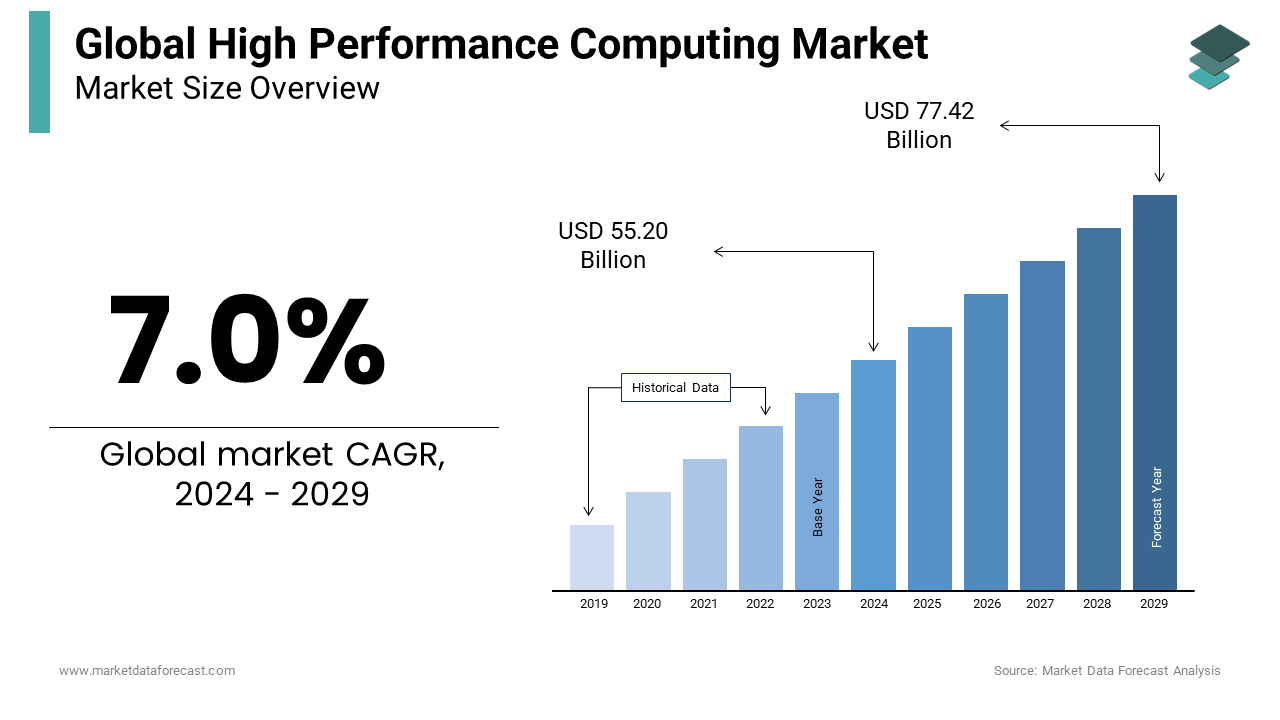
High Performance Computing (HPC) is the procedure that mainly includes parallel processing to execute advanced applications in an efficient, swift and dependable way. New workloads like genomic sequencing, machine learning, deep learning, facial and speech recognition, and pattern recognition are running on HPC systems. High-performance computers greatly contribute to industrial competitiveness, national security, scientific progress and quality of life.
Using the computational capabilities of HPC, scientists, and researchers can make better decisions and analyses and use a simulation support system to determine how the scanned object can behave in a real situation influenced by different physical predictor variables. This saves R&D time and expense and helps create a more qualitative and precise product. It would be a very difficult task without model simulation, which usually consists of larger systems, lots of geometric details, and complex physics.
Physical simulation, optimization, and machine learning (ML) in several applications, including financial modeling and life science simulations, which are a few examples that need HPC to solve complex problems in reality. In addition, regulatory requirements for energy consumption, sustainability, and safety, as well as cost pressure, are dominant worldwide, increasing rapidly, resulting in increased complexity for engineers in the field of engineering. development. In the aerospace and defense sector, companies attach great importance to lowering production costs with higher production rate. HPC software solutions allow companies to provide accurate multi-physics and multi-scale simulation solutions by using simulation in the designs, eliminating manual testing.
MARKET TRENDS
Life Sciences and Healthcare Expected to See Significant Growth in the future in this market
According to HPC Wire, advancements in end-user verticals like genomics, precision medicine, electronic health records (EHR), and digital imaging, along with the rise of medical IoT and mobile devices, have resulted in an exponential growth in data health services. For example, by 2020, the amount of medical data generated globally is projected to double every 73 days, when a typical healthcare consumer in developed countries is expected to contribute 1,200 terabytes of data. In the life.
With the growing need for rapid data analysis in the healthcare system, healthcare has been at the forefront of technology adoption for the past two decades. Additionally, the need to accelerate drug discovery and genomics-related studies has been one of the other factors that have complemented the adoption of high-throughput solutions. The demand for a software solution that accurately meets the needs of healthcare and life sciences is capable of exploring existing EHR and other electronic data sets to provide an overview of healthcare industry services.
MARKET DRIVERS
The rising need for high-performance computing, developments in the IT industry, progressions in virtualization, and the augmenting preference for hybrid HPC solutions are a few factors likely to promote this business growth.
HPC systems’ ability to analyze huge volumes of data at accurate speeds is promoting adoption by government and defense agencies, educational institutions, and energy and utility organizations. This should also bode well for the growth of the HPC market in the coming years.
MARKET RESTRAINTS
In addition to this, software hurdles continue to grow, hampering the growth of the HPC market.
REPORT COVERAGE
| REPORT METRIC | DETAILS |
| Market Size Available | 2025 to 2034 |
| Base Year | 2025 |
| Forecast Period | 2026 to 2034 |
| CAGR | 7% |
| Segments Covered | By Component, Application, Deployment Mode, and Region |
|
Various Analyses Covered | Global, Regional & Country Level Analysis, Segment-Level Analysis, DROC, PESTLE Analysis, Porter’s Five Forces Analysis, Competitive Landscape, Analyst Overview on Investment Opportunities |
| Regions Covered | North America, Europe, APAC, Latin America, Middle East & Africa |
|
Market Leaders Profiled | AMD (US), Atos (France), AWS (US), Cisco Systems (US), and Cray (US) are some of the key players in the global HPC market and Others. |
SEGMENTAL ANALYSIS
By Component Insights
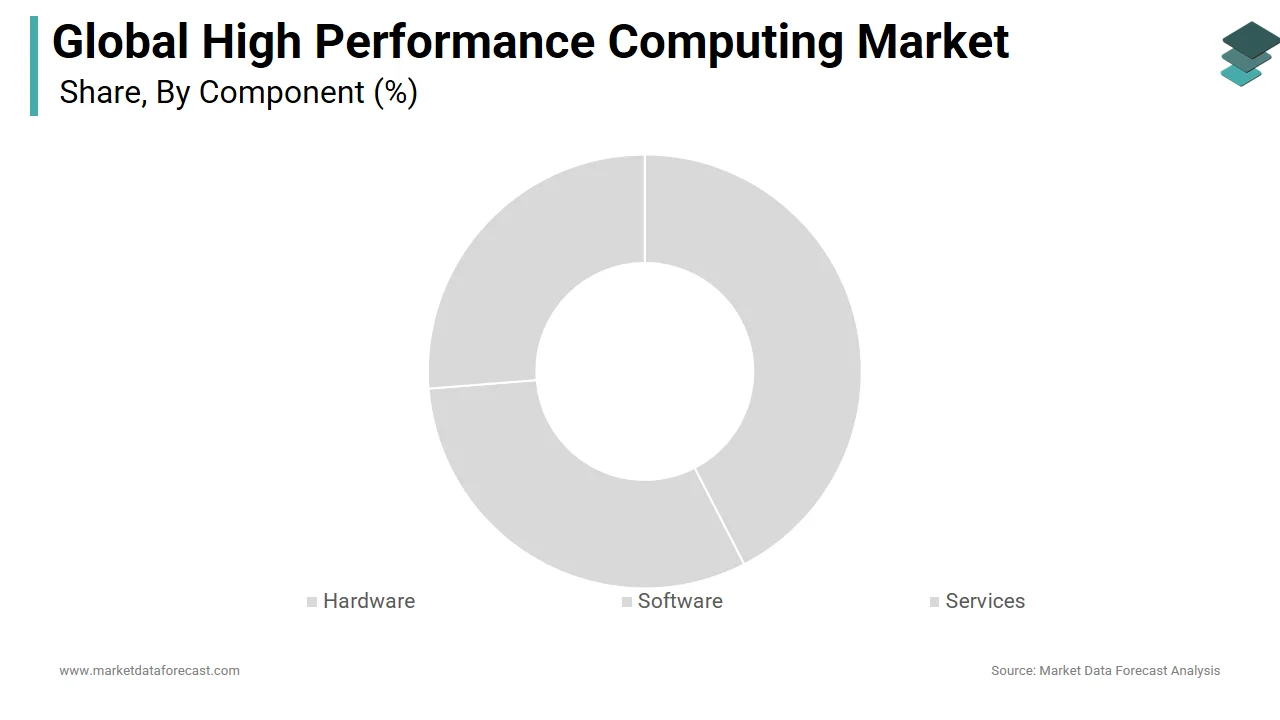
The hardware components are the most essential parts of any HPC system. The efficiency of the system is totally dependent on the hardware entities of the HPC. HPC's hardware segment includes memory (storage) capacity, power management, servers, and network devices. The servers consist of a supercomputer, a division, a department, and a workgroup. Supercomputers and departmental units are the fastest selling items in the hardware and architecture section. Another essential component of HPC is the software and the management system. It consists of middleware, programming tools, performance optimization tools, cluster management, and fabric management. Finally, the services provided are design and consulting, integration and implementation, training, and outsourcing.
REGIONAL ANALYSIS
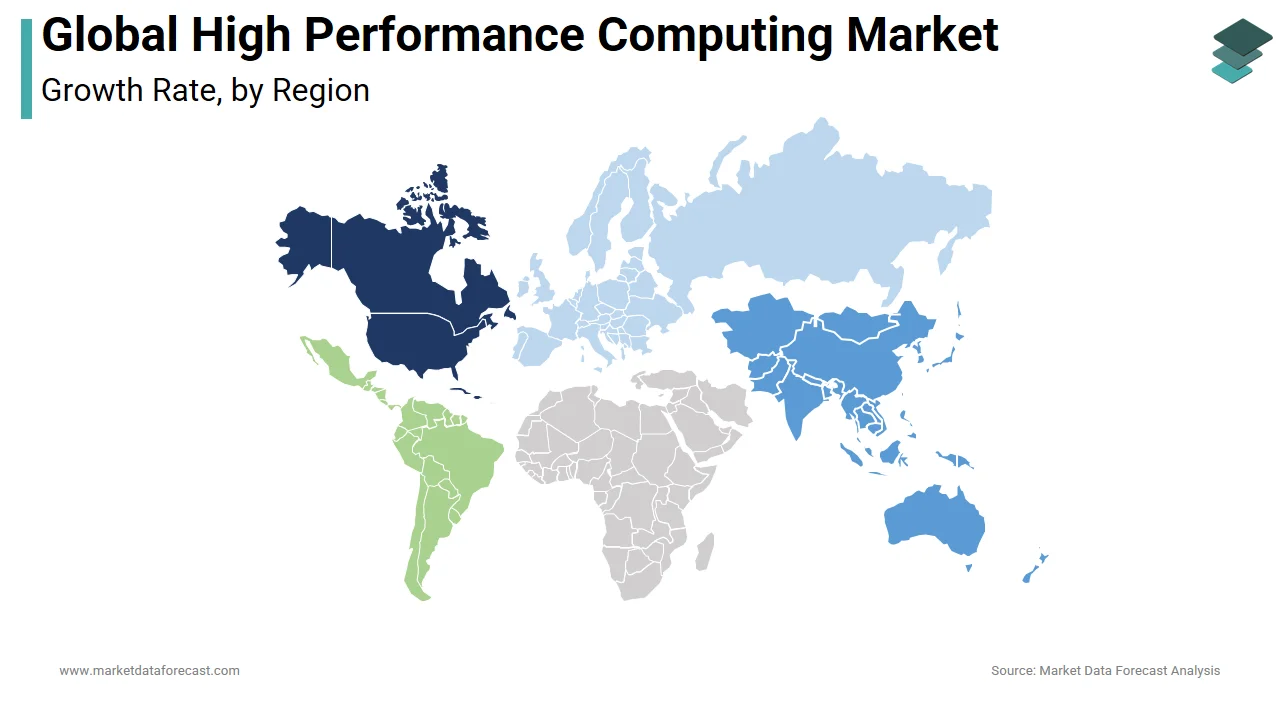
The global high-performance computing market is being analyzed in different geographies such as North America, Europe, Asia-Pacific, and LAMEA. North America is the largest market for HPC technology due to technological advancements and early adoption of the technology in the region, followed by Europe.
KEY MARKET PLAYERS
AMD (US), Atos (France), AWS (US), Cisco Systems (US), and Cray (US) are some of the key players in the global HPC market.
RECENT MARKET HAPPENINGS
- In October 2017, AMD announced the release of the AMD Embedded Radeon E9170 GPU. The GPU is ideal for devices that requires high-end graphics and extended display capabilities and that meet demands for power and thermal efficiency.
- In June 2017, AMD announced the launch of the high-performance AMD EPYC 7000 data center processors. AMD EPYC is equipped with up to 32 high-performance “Zen” cores for better performance.
- In May 2016, AMD announced the release of the AMD FirePro S7100X GPU. The AMD FirePro S7100X GPU assists over 16 users per GPU in various virtualization solutions, which include VMware, SOLIDWORKS, Siemens NX, and Solid Edge
MARKET SEGMENTATION
This research report on the global high-performance computing market has been segmented and sub-segmented based on the deployment mode, application, component, and region.
By Component
- Hardware
- Software
- Services
By Application
- Technical Computing
- Business Computing
By Deployment Mode
- Local
- Cloud
By Region
- North America
- Europe
- Asia-Pacific
- Latin America
- The Middle East and Africa