- Product Description Description
- Table of Contents TOC
- List of Table & Figure LOT
- Get Free Sample PDF Sample PDF
Market Size, 2025
$0.36 BnMarket Estimate, 2026
$0.48 BnMarket Forecast, 2034
$4.69 BnCAGR, 2026–2034
33%Executive Summary: Global Quantum Computing Market
- Market Scope: Comprehensive global quantum computing market analysis covering deployment architectures, application verticals, end-use industrial sectors, regional leadership frameworks, and quantum processing metrics.
- Market Valuation: Valued at USD 0.36 billion (2025), estimated at USD 0.48 billion (2026), and projected to reach USD 4.69 billion by 2034, registering an exceptional CAGR of 33% (2026–2034).
- Primary Growth Drivers: Substantial institutional and private investments in quantum technologies, rising demand for high-performance computing (HPC) to handle complex calculations, and expanding computational needs in medical research, financial markets, and secure defense communications.
Key Market Segment Metrics (2026–2034)
| Category | Leading Segment (2025 Position) | Fastest-Growing Segment |
|---|---|---|
| By Deployment | Cloud Segment (holds the majority of the market share with over 70% driven by secure communication and remote access needs) | Cloud-Based Quantum Services (expanding rapidly due to lower infrastructure entry barriers for enterprises) |
| By Application | Material Simulation Segment (held 40% of the market share for handling complex molecules and industrial modeling) | Machine Learning (expected to be the fastest-growing segment, accelerated by automated optimization and faster algorithm training) |
| By End-Use | Aerospace & Defense (held the majority market share at 37% due to demands for heavy encryption and secure communication) | Automotive Industry (projected to grow at a CAGR of 33.2% driven by parallel processing and molecular modeling for materials) |
| By Region | North America (market leader owing to the high concentration of leading quantum computing technology corporations and research hubs) | Asia-Pacific (fastest-growing regional market driven by strategic technological contributions from key players in China and surrounding hubs) |
Major Market Players & Market Structure
Market Structure: Highly specialized and competitive global quantum technology landscape featuring tech giants and pioneering hardware developers competing intensely on qubit scaling, error-correction mechanisms, QPU performance, and cloud accessibility.
Key Companies: Alibaba Group Holding Limited, Google LLC, D-Wave Systems Inc., International Business Machines Corporation (IBM), Huawei Technologies Co. Ltd., Intel Corporation, ID Quantique, Rigetti & Co Inc., and Microsoft.
Global Quantum Computing Market Size
The global quantum computing market was valued at USD 0.36 billion in 2025. The market is estimated at USD 0.48 billion in 2026 and is projected to reach USD 4.69 billion by 2034, growing at a CAGR of 33% from 2026 to 2034.
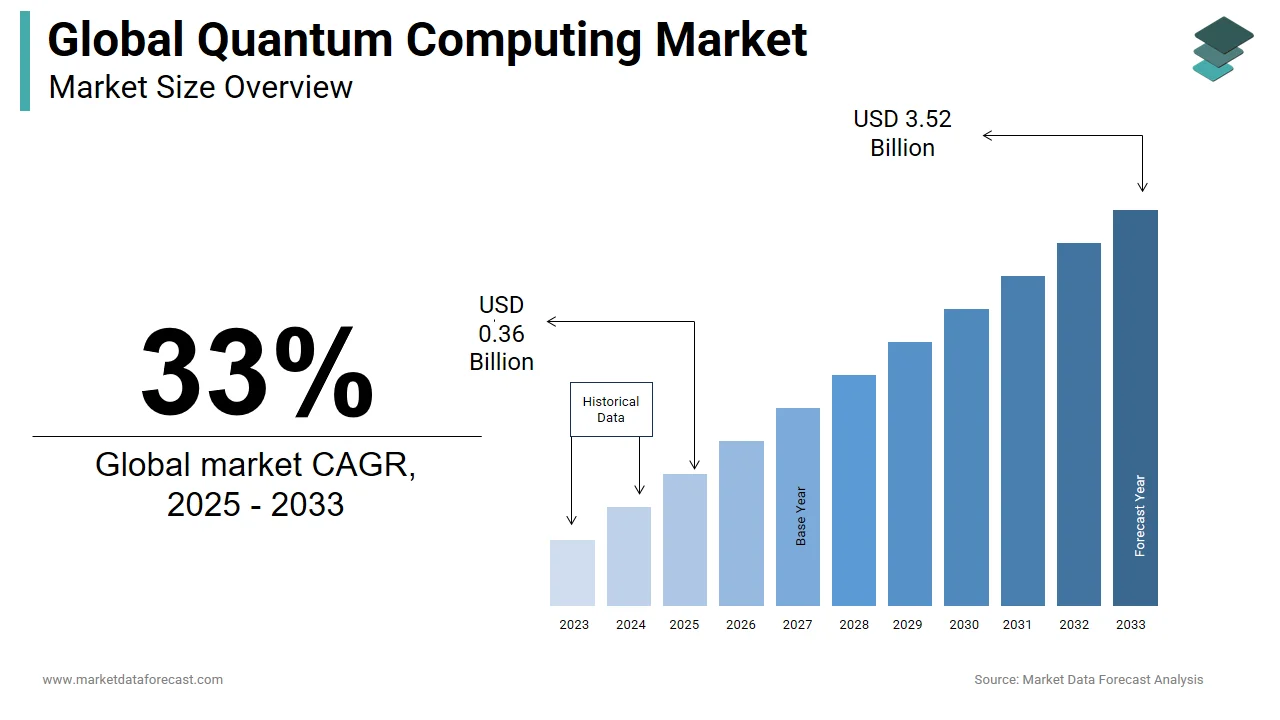
Quantum computers are fundamentally different from traditional supercomputers and use quantum effects. Unlike conventional machines, quantum bits (qubits) are used to analyze data. Moreover, they perform complicated tasks more efficiently than traditional computers, which mainly stimulates the growth of the global market.
MARKET DRIVERS
Factors such as more excellent investment in quantum computing technologies, increased demand for heavy-performance computing, and increased demand from medical research and financial markets are projected to fuel the market.
Traditional computers can solve typical problems at medium speeds with reasonable accuracy. Quantum computers, on the other hand, can handle complex problems faster than conventional and supercomputers. Available machines have certain drawbacks, as they are restricted by their processors, storage capacity, and latency issues, which pose a high-performance computing market. Quantum computing uses Quantum Processing Units (QPUs) to process information in a matter of seconds and also has limitless storage, which allows large corporations to implement and improve computing technology. This is a massive driver of the Market.
MARKET RESTRAINTS
Operational problems, reliability issues, and error correction issues related to quantum computing are likely to impede market growth during the forecast period.
REPORT COVERAGE
| REPORT METRIC | DETAILS |
| Market Size Available | 2025 to 2034 |
| Base Year | 2025 |
| Forecast Period | 2026 to 2034 |
| CAGR | 33% |
| Segments Covered | By Deployment, Application, End-use & Region |
|
Various Analyses Covered | Global, Regional & Country Level Analysis, Segment-Level Analysis, DROC, PESTLE Analysis, Porter’s Five Forces Analysis, Competitive Landscape, Analyst Overview on Investment Opportunities |
| Regions Covered | North America, Europe, APAC, Latin America, Middle East & Africa |
|
Market Leaders Profiled | Stanley Black & Decker Inc., Robert Bosch GmbH, Atlas Copco AB, Actuant Corporation, Techtronic Industries Co. Limited, Danaher Corporation, Makita Corporation, Hitachi Koki Co. Ltd., Emerson Electric Co & Hilti Corporation, and others |
SEGMENTAL ANALYSIS
By End-Use Insights

The aerospace and Defense segment held the majority of the market share in 2025, with 37%. This market share is attributed to the need for secure and reliable communication systems for data transfer in the defense sector.
Quantum computing offers heavy encryption, which takes decades for traditional computers to decode the information, so this information processing is beneficial for the defense sector. Also, the automotive industry is expected to be the fastest-growing segment, with a CAGR of 33.2%. The reason for the growth is attributed to the need to handle complex problems with parallel activities and model molecules, and materials with reliable performance allow such systems to pursue openings in end-user sectors such as automobile, energy and power, pharmaceutical, and healthcare.
By Deployment Insights
Out of these, the Cloud segment holds the majority of the market share in 2025, with over 70%. The reason for such market share is attributed to the need for secure and reliable communication systems for data transfer in various industries.
By Application Insights
Based on the Application, the Material Simulation segment holds the majority of the market share in 2025, with 40%. The reason for such market share is attributed to the need to handle complex problems in end-user sectors such as automobiles, energy and power, pharmaceutical, and healthcare.
Also, Machine Learning is expected to be the fastest-growing segment, which can be associated with increased automation in various fields, as quantum computers can help machine learning algorithms learn quicker and more efficiently.
REGIONAL ANALYSIS

Geographically, North America is expected to have the largest market share. This is purely due to the increased number of leading competitors located in this region. The Asia Pacific market is also expected to grow due to China’s contribution to the Alibaba Group.
KEY MARKET PLAYERS
Some key players in the Quantum Computing market include Alibaba Group Holding Limited, Google LLC, D-Wave Systems Inc., International Business Management Corporation (IBM), Huawei Technologies Co. Ltd., Intel Corporation, ID Quantique, Rigatti & Co, Inc., and Microsoft.
RECENT MARKET HAPPENINGS
- In October 2019, Google officially announced the accomplishment of quantum supremacy in an article published in Nature's science journal. The announcement comes precisely one month after it first leaked, after Google's report was mistakenly published earlier. But now, though, it's official, ensuring that the full details of the work are available and that the entire scientific community will thoroughly scrutinize what Google claims it has done.
- Google announced that its 54-qubit Sycamore system was capable of performing a 200-second calculation that would require the world's strongest supercomputer a time of 10,000 years. That would mean that the computation, which required the creation of random numbers, was virtually impossible on a conventional, non-quantum device.
MARKET SEGMENTATION
This research report on the global quantum computing market has been segmented and sub-segmented based on the end-use, deployment, application, and region.
By End-Use
- Aerospace and Defense
- Automotive Industry
- Health Care & Lifesciences
- IT and Telecom
By Deployment
- Cloud
- On-Premise
By Application
- Machine Learning
- Material Simulation
- Optimization
By Region
- North America
- Europe
- Asia Pacific
- Latin America
- Middle East Africa