- Product Description Description
- Table of Contents TOC
- List of Table & Figure LOT
- Get Free Sample PDF Sample PDF
Market Size, 2025
$9.51 BnMarket Estimate, 2026
$10.29 BnMarket Forecast, 2034
$19.33 BnCAGR, 2026–2034
8.20%Executive Summary: Global Hospital Air Purifiers Market
- Market Scope: Global market analysis covering product types, technology segments, infection metrics, and regional landscapes.
- Market Valuation: Valued at USD 9.51 billion (2025), estimated at USD 10.29 billion (2026), and projected to reach USD 19.33 billion by 2034, growing at a CAGR of 8.20% (2026–2034).
- Primary Growth Drivers: Significant reduction in clinical transmission (air purification linked to a 45% decline in infections), severe health burdens from pollution (~2.4 million annual deaths), and high baseline healthcare-associated infection (HAI) rates (affecting 7% of acute-care patients in high-income countries and 15% in low- and middle-income regions).
Key Market Segment Metrics (2026–2034)
| Category | Leading Segment (2025 Position) | Fastest-Growing Segment |
|---|---|---|
| By Type | Portable Air Purifiers (favored for flexibility, mobility, and infection control) | — |
| By Technology | HEPA Purifiers (driven by high cleanliness and filtration standards) | — |
| By Region | North America (represents >20% of global HEPA filter manufacturing) | Asia-Pacific (led by rapidly expanding markets in China and India) |
Major Market Players & Market Structure
Market Structure: Competitive landscape shaped by advanced HEPA filtration, UVGI, activated carbon, nanofiber filtration, smart systems, and AI-powered air purification. Manufacturers focus on lowering power consumption, real-time tracking, and adaptive filtration. Recent innovations include regulatory milestones like the Kronos Model 8 receiving FDA 510(k) Class II Medical Device clearance in July 2024.
Key Companies: Rabbit Air, Honeywell International Inc., Eureka Forbes, Xiaomi, IQAir, LG Electronics, Daikin Airconditioning India Pvt. Ltd., Unilever, Camfil, COWAY CO. LTD, AustinAir, Koninklijke Philips N.V., Whirlpool of India, Sunbeam Products Inc., Alen Corporation, and Sharp Electronics Corporation.
 Download Free Sample Report
Global Hospital Air Purifiers Market Size
The global hospital air purifiers market was valued at USD 9.51 billion in 2025. The global market is anticipated to grow at a CAGR of 8.20% from 2026 to 2034, reaching USD 19.33 billion by 2034, up from USD 10.29 billion in 2026.
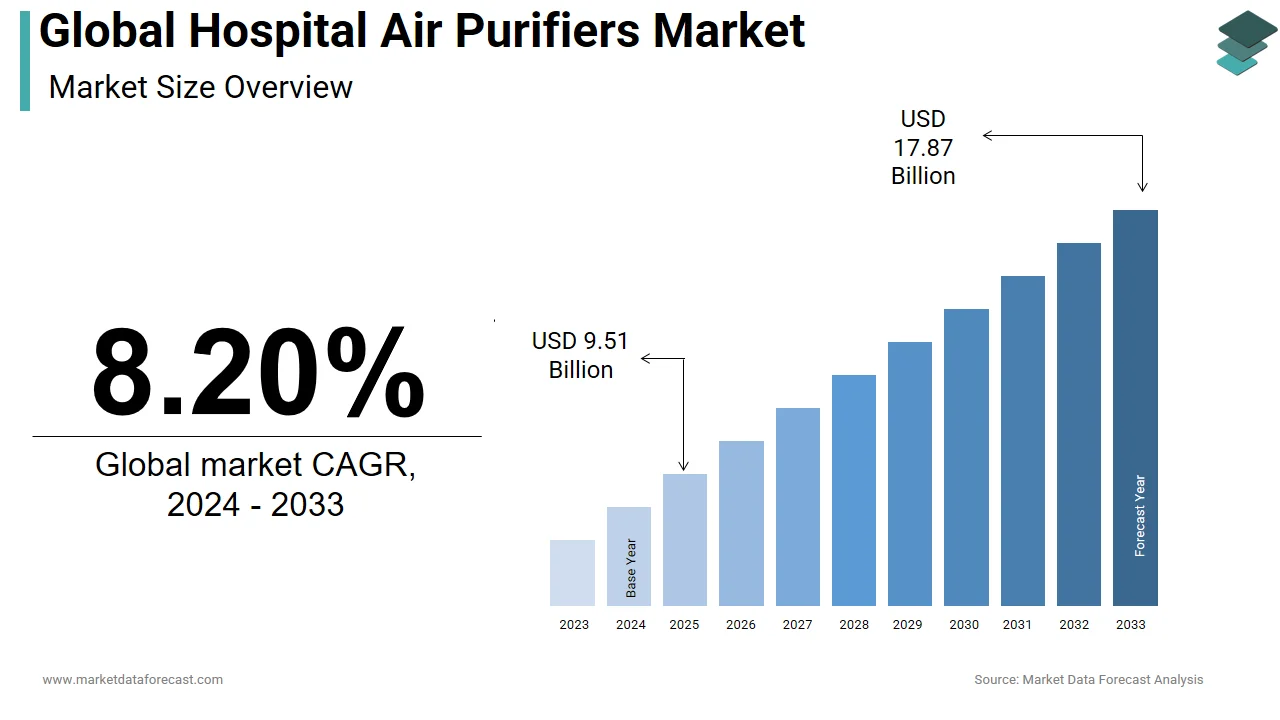
Presently, the market is witnessing a higher growth rate, which is due to frequent incidences of climate change, increased respiratory incidences and the shortcomings exposed during the multiple waves of COVID-19. Hospitals utilise molecular air cleaners like activated charcoal filters since they are particularly designed to eliminate harmful and painful gases, such as volatile organic compounds (VOCs) and steam from the atmosphere. As per a study, there was a 45 per cent decline in infections due to air purification. This is caused by patients getting in contact with healthcare facilities
MARKET DRIVERS
The hospital air purifiers market growth is driven by the notable share of healthcare-associated infections (HAIs).
According to the World Health Organization (WHO), about 70 per cent of infections, including those of COVID-19 and other big diseases, can be avoided or stopped if sufficient hand hygiene and other affordable practices are ensured. These situations benefit the sale of healthcare air purifiers.
The market is predicted to be propelled by increasing aerial diseases and rising pollution levels in urban cities. Moreover, growing health awareness, coupled with an enhanced living standard and surging spending power, is believed to push forward the market growth. Heightened sales of domestic appliances like water filtration devices, kitchen appliances, cleaning appliances and air purifiers were caused by several government lockdown actions in provision for the outbreak of COVID-19 in 2020. Enhanced health awareness has accelerated demand for air purifiers all around the world.
The declining air quality and growing incidence of respiratory infections also contribute to the market expansion. The high concentration of air pollution results from rapid urbanisation and industrialisation, which is a major element influencing the hospital air purifier market. As per the World Health Organization, air pollution takes the lives of about 2.4 million individuals every year. In addition, air pollution is the foremost reason for mortality in low- and middle-income nations. The necessity for effective air cleaners in hospitals in tire-2 and tire-3 cities is likely to augment the market growth rate throughout the estimation period because of the contaminated air which can cause severe health conditions like greater risk of cardiac, COPD, asthma and lung cancer.
The expansion of the hospital air purifiers market is expected to accelerate significantly owing to the developments in filter media, the incorporation of nanotechnology, improved air cleaning technologies and smart and adaptive filtration systems.
The use of Nanofiber-based filters and other nanotechnology can provide enhanced air filtration efficiency and longevity as well as lower power consumption. Moreover, the industry is also expected to move forward with AI-powered solutions. These systems can maximize air purification output based on live quality monitoring, adapting their filter capability and airflow speed as required.
MARKET RESTRAINTS
The requirement of substantial initial investment and consistent servicing is restricting the growth of the hospital air purifiers market.
These products, especially the extremely state-of-the-art technology similar to that based on UVGI, are costly to procure and install afterwards. The price can differ according to alluring characteristics, dimensions, capacity, and technology used in them. For instance, HEPA surgical room air purifiers that also utilize UVGI are costlier than those of some simple general-use air cleaners. Besides this, the change of filters and regular servicing surge the function expenses. Thus, this makes it a big hurdle to the adoption of technologies such as these under their limited budgets in hospitals, especially in developing economies where financial issues may reduce the influx of investment in new healthcare technologies.
The insufficiency of supplies or substances for infection prevention and control impedes effective deployment. It is one of the most frequently occurring issues in the hospital air purifiers market. The situation gets even worse with the lack of proper waste management considerably adding to inferior infection control. Moreover, substandard infrastructure is a main obstruction to productive infection prevention and control which ultimately hampers the market growth. Additionally, the patient’s non-compliance with poor prohibition and control rules augments the healthcare-related infections.
REPORT COVERAGE
| REPORT METRIC | DETAILS |
| Market Size Available | 2025 to 2034 |
| Base Year | 2025 |
| Forecast Period | 2026 to 2034 |
| Segments Covered | By type, technology & Region |
| Various Analyses Covered | Global, Regional & Country Level Analysis, Segment-Level Analysis, Drivers, Restraints, Opportunities, Challenges; PESTLE Analysis; Porter's Five Forces Analysis, Competitive Landscape; Analyst Overview of Investment Opportunities |
| Regions Covered | North America, Europe, APAC, Latin America, Middle East & Africa |
| Market Leaders Profiled | Rabbit Air (U.S.), Honeywell International Inc. (U.S.), Eureka Forbes (India). |
SEGMENTAL ANALYSIS
By Type Insights
Portable air purifiers are gaining traction due to flexibility and mobility, high filtration efficiency, infection control, cost-effectiveness and high cost of standard alternatives. After the outbreak of COVID-19, the focus on air quality drastically increased which led to a surge in the prices of popular healthcare air purifiers. Consequently, the majority of small and medium-sized hospitals and medical centers shifted to the portable option, elevating its market share. Moreover, the portable air purifiers segment is deeply consolidated due to the existence of various established companies, which places the market in a tough spot for small-scale producers to stand against world-class players.
By Technology Insights
High-efficiency particulate Air (HEPA) prevails above all others. This can be attributed to the need for a greater degree of cleanliness to provide improved health and recovery of patients, which results in higher demand for these air filters and drives the segment’s market share. Apart from this, the pharmaceutical sector discharges a high quantity of harmful chemicals that contaminate the atmosphere and surroundings, surging the demand for a filtered environment. According to a study, presently, seven out of every hundred patients admitted to acute-care hospitals in high-income nations and also 15 patients in medium and low-income economies will procure a minimum of one medical care-related infection throughout their time in hospital.
REGIONAL ANALYSIS
North America hospital air purifiers market is in a commanding position because of the higher health awareness among the general public coupled with the widespread presence of several market companies in the area. Moreover, developed nations have already well-settled production factories that discharge pollutants, causing the deployment of air filters in medical facilities in both residential and commercial areas. The region represents over 20 per cent of the manufacturing of HEPA filters, allowing the elevated usage rate of air filters over the region.
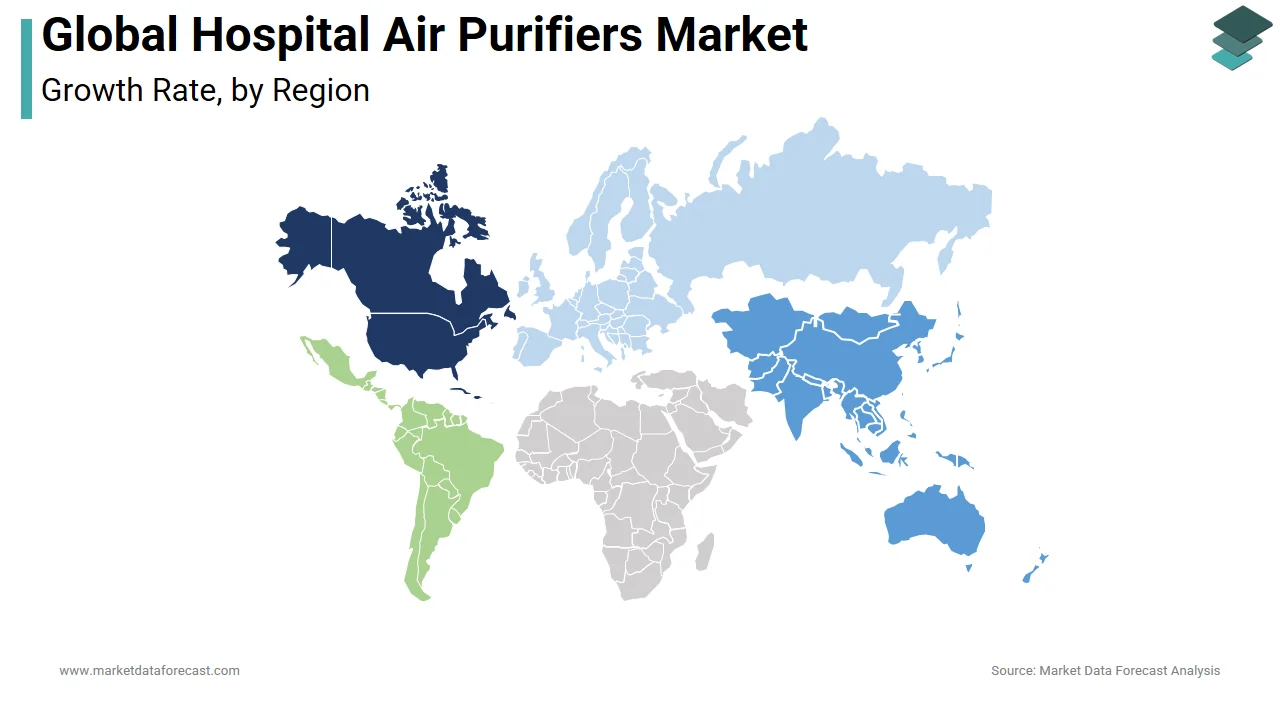
Asia-Pacific is predicted to propel at the fastest growth rate in the estimation period of 2024 to 2029 owing to the swift pace of industrialization and mounting pollution density in the industry. The APAC region is led by China, and India which are believed to expand at the fastest growth rate. In addition, the growing intensity of investments in the medical industry, the rise in government attention toward enhancing air quality, increasing knowledge and understanding amidst the numerous advantages of air filtration in combating respiratory conditions and the growing middle class with greater spending power on medical. This has raised restoration and new hospital construction projects, therefore influencing the need for the same with extremely effective air cleaning systems in the domain to provide improved security for patients and better outputs.
KEY MARKET PLAYERS
Companies playing a prominent role in the global hospital air purifiers market profiled in this report are Rabbit Air (U.S.), Honeywell International Inc. (U.S.), Eureka Forbes (India),Xiaomi (China), IQAir (Switzerland),LG Electronics (South Korea), Daikin Airconditioning India Pvt. Ltd. (India),Unilever (U.K.),Camfil (Sweden),COWAY CO., LTD (South Korea), AustinAir (U.S.),Koninklijke Philips N.V. (Netherlands), Whirlpool of India (India),Sunbeam Products, Inc. (U.S.), Alen Corporation (U.S.),Sharp Electronics Corporation (Japan)
RECENT HAPPENINGS IN THE MARKET
In July 2024, KRONOS ADVANCED TECHNOLOGIES, INC., an innovation-oriented product advancement company and maker of the patented air disinfection technology for Kronos CORE under its modern intelligent air purification systems, press released that the United States Food and Drug Administration (FDA) has lately approved an extra 510(k) permission to a market-leading product, Kronos Model 8 which it categorizing it as a Class II Medical Device.
MARKET SEGMENTATION
This research report on the global medical cannabis market has been segmented and sub-segmented based on type, technology & region.
By Type
- Fixed Air Purifier
- Portable Air Purifier
- Smart Air Purifier
- Whole-House Air Purifiers
- Electrostatic Precipitators
- Others
By Technology
- Photo Plasma
- High-Efficiency Particulate Air (HEPA)
- Ultraviolet Germicidal Irradiation
- Thermodynamic Sterilization (TSS)
- Polarized-Media Electronic
- Activated Carbon
- UV Technology
- Negative Ion
- Ionizer Purifiers
- Photocatalytic Oxidation (PCO)
- Titanium Dioxide
- Ozone Generators
- Others
By Region
- North America
- Europe
- Asia Pacific
- Latin America
- Middle East and Africa