- Product Description Description
- Table of Contents TOC
- List of Table & Figure LOT
- Get Free Sample PDF Sample PDF
Market Size, 2025
$4.81 BnMarket Estimate, 2026
$7.22 BnMarket Forecast, 2034
$187.2 BnCAGR, 2026–2034
50.2%Global Humanoid Robot Market Size, Growth, Trends & Forecast (2026–2034)
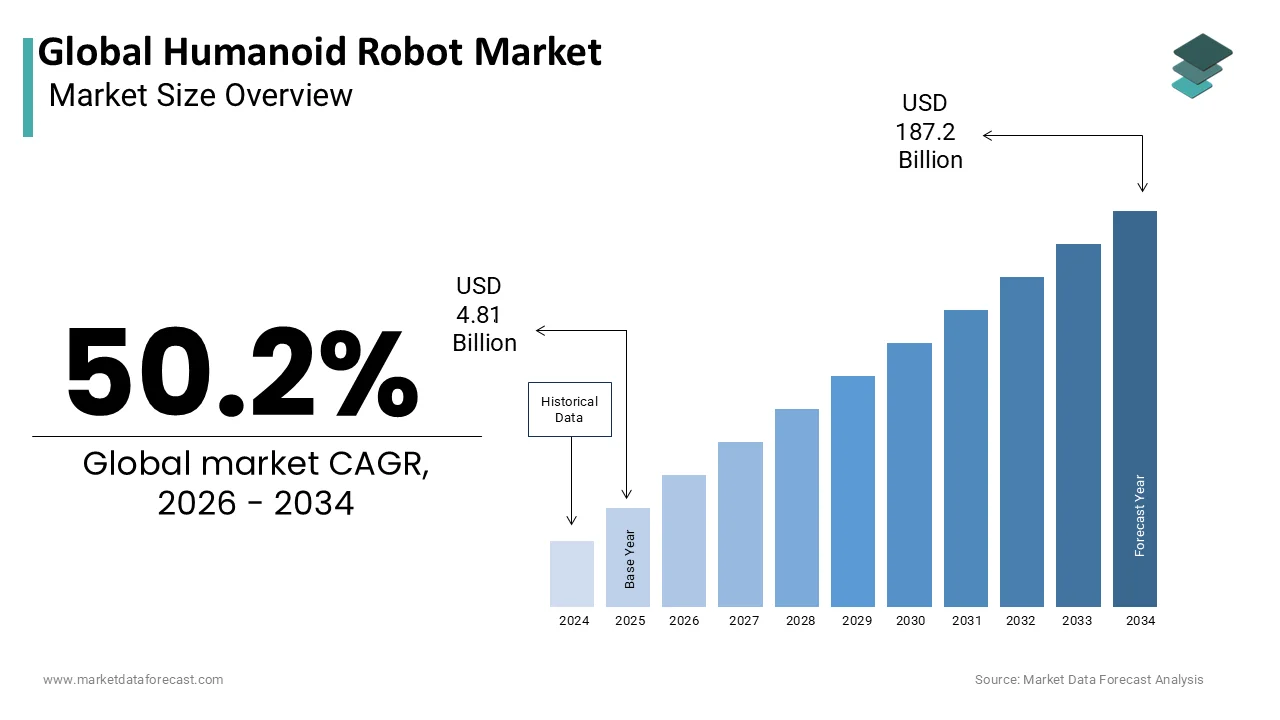
The global humanoid robot market size was valued at USD 4.81 billion in 2025, is anticipated to reach USD 7.22 billion in 2026, and is projected to expand up to USD 187.2 billion by 2034, registering an exceptional compound annual growth rate (CAGR) of 50.2% during the forecast period from 2026 to 2034. Growth is driven by expanding applications across retail, healthcare, research, and rising investor funding in cognitive robotics.
Key Executive Metrics (At-a-Glance)
- 2025 Base Valuation: USD 4.81 Billion
- 2026 Current Valuation: USD 7.22 Billion
- 2034 Forecast Valuation: USD 187.2 Billion
- Compound Annual Growth Rate (CAGR): 50.2% (2026–2034)
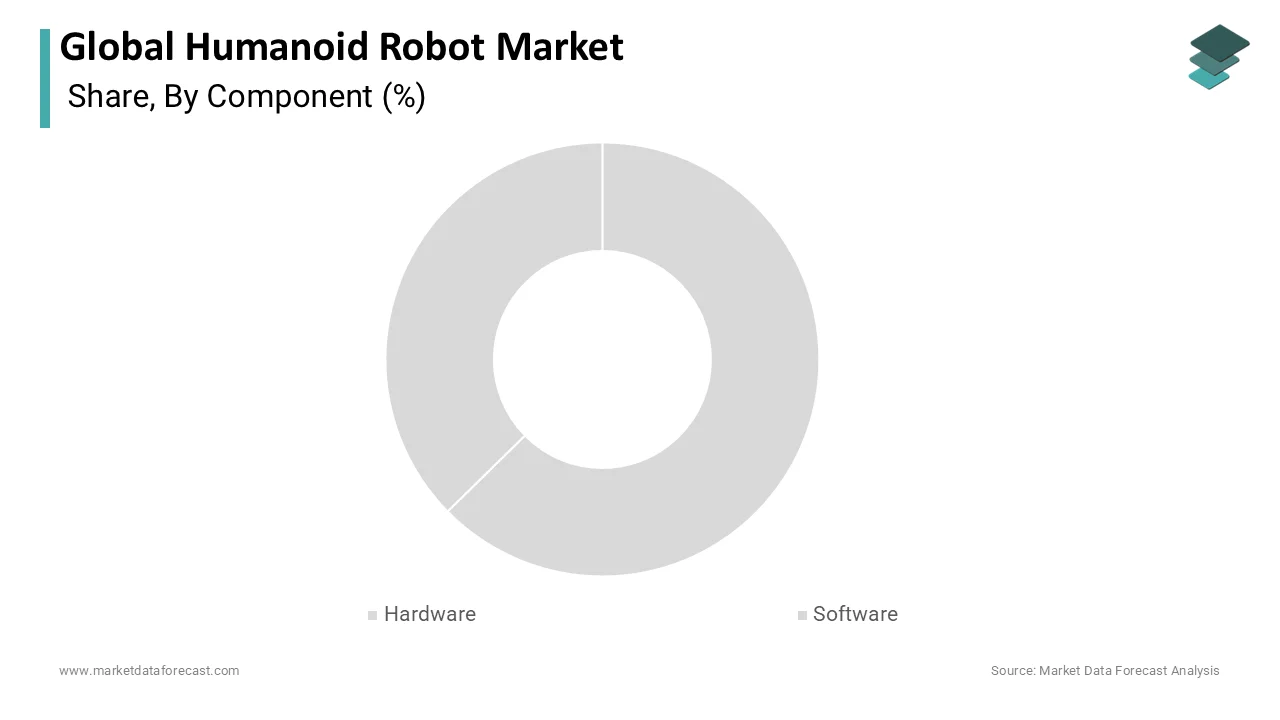
- Dominant Component Segment: Hardware (Comprising intricate sensors, actuators, and structural mechanics)
- Fastest-Growing Component Segment: Software (Driven by AI, machine learning, and cognitive processing capabilities)
- Key Application Segments: Research & Space Exploration, Education & Entertainment, Personal Assistance & Caregiving, Hospitality, and Search & Rescue
- Key Motion Types: Biped and Wheel Drive
- Key Regions: North America, Europe, Asia-Pacific, Latin America, and Middle East & Africa
Core Market Drivers
- Diverse Sector Integration: Expanding adoption in retail, healthcare, and scientific research fields creating wide usage avenues.
- Investment Inflows: Growing venture capital and government backing accelerating robotic R&D and commercial scale-up.
Primary Market Restraints & Challenges
- High Cost & Maintenance: Complex hardware/software components and high R&D expenses resulting in steep initial price tags.
- Talent & Ethical Hurdles: Shortage of skilled technicians to troubleshoot complex machinery, alongside consumer acceptance and ethical concerns.
Global Humanoid Robot Market Segmentation Breakdown
| Segment Category | Key Sub-Segments / Details |
|---|---|
| By Component | Hardware, Software |
| By Application | Research & Space Exploration, Education & Entertainment, Personal Assistance & Caregiving, Hospitality, Search & Rescue |
| By Motion | Biped, Wheel Drive |
| By Region | North America, Europe, Asia Pacific, Latin America, Middle East & Africa |
Major Industry Players Profiled
Key innovators driving market growth include HYULIM Robot Co., Ltd, HANSON ROBOTICS LTD, Engineered Arts Limited, Honda, KAWADA Robotics Corporation, SoftBank Robotics, Sanbot Co, ROBOTIS, Willow Garage, Toshiba Corporation, PAL Robotics, and Toyota Motor Corporation.
Global Humanoid Robot Market Size
The Global Humanoid Robot Market was worth US$ 4.81 billion in 2025 and is anticipated to reach a valuation of US$ 187.2 billion by 2034 from US$ 7.22 billion in 2026. It is predicted to register a CAGR of 50.2% during the forecast period 2026 to 2034.
MARKET SCENARIO
A humanoid robot is a robot resembling the human body in shape. The design may be for functional purposes, usually given a code and programmed to do certain tasks such as interacting with human tools and environments, for experimental purposes, or for studies, such as the study of bipedal locomotion, or for other purposes. In general, humanoid robots have a torso, a head, two arms, and two legs, though some humanoid robots may replicate only part of the body, for example, from the waist up. Some humanoid robots also have heads designed to replicate human facial features,s such as eyes and mouth, hs for aesthetics or functionality with sensors, diodes, and scanners. Androids are humanoid robots built to aesthetically resemble humans.
MARKET DRIVERS
The humanoid robot market is driven by several factors, and humanoid robots have potential opportunities in many fields and sectors.
The use of Humanoid Robots in retail, health care, and research has opened new gates for the humanoid robot market and is a primary market driver. This increased the demand for the humanoid robot market due to its wide areas of use. Growing investors in robotics are also accelerating the growth rate of the market.
MARKET RESTRAINTS
The High Cost and Maintenance of These Humanoid Robots:
The Humanoid Robot Market is still relatively new and growing, which is why it is so expensive. A humanoid robot is a very complex machine, and finding a bug is a huge deal for the technician. Hence, the lack of skilled technicians is hindering the growth rate of the market. The components that go into making these robots are very complicated and intricate,e and the software parts also cost a lot of money. The cost of Research and development is also very high despite the funding by the investors and the government, which is directly degrading the market shares. Another restraint is consumer acceptance and willingness to cooperate with a robot over human interaction. There are ethical concerns with humanoid robotics that are also limiting the growth rate of the market.
MARKET OPPORTUNITIES
The growing use of the humanoid robot market in the healthcare segment has created a plethora of opportunities. Countries like Japan and China are leading in humanoid robot research and have used it in the medical supply and healthcare sector. This can be further taken to the next step, which is the use of AI to monitor the health of the patients and aid the elderly with basic tasks using the sensors, cameras, and other intricate systems integrated into the humanoid robots.
REPORT COVERAGE
| REPORT METRIC | DETAILS |
| Market Size Available | 2025 to 2034 |
| Base Year | 2025 |
| Forecast Period | 2026 to 2034 |
| Segments Covered | By Component, Application, Motion, and Region. |
| Various Analyses Covered | Global, Regional, and country-level analysis; Segment-Level Analysis, DROC, PESTLE Analysis, Porter’s Five Forces Analysis, Competitive Landscape, Analyst Overview of Investment Opportunities |
| Regions Covered | North America, Europe, APAC, Latin America, Middle East & Africa |
| Market Leaders Profiled | HYULIM Robot Co., Ltd, HANSON ROBOTICS LTD, Engineered Arts Limited, Honda, KAWADA Robotics Corporation, SoftBank Robotics, Sanbot Co, ROBOTIS, Willow Garage, Toshiba Corporation, PAL Robotics, Toyota Motor Corporation, and Others. |
SEGMENTAL ANALYSIS
MARKET KEY PLAYERS
- HYULIM Robot Co., Ltd
- HANSON ROBOTICS LTD
- Engineered Arts Limited
- Honda
- KAWADA Robotics Corporation
- SoftBank Robotics
- Sanbot Co
- ROBOTIS
- Willow Garage
- Toshiba Corporation
- PAL Robotics
- Toyota Motor Corporation
RECENT HAPPENINGS IN THE MARKET
- In 2021, Ameca is the world’s most advanced human-shaped robot representing the forefront of human-robotics technology, developed at Engineered Arts headquarters in Falmouth, Cornwall, UK. The robot uses microphones, cameras, and facial recognition software. It is GP3-enabled World's most advanced humanoid robot, Ameca, has now expressed its ability to draw figures. The robot, which has previously demonstrated the ability to represent many different kinds of human emotions and their ability to speak in multiple languages, drew a cat in a video uploaded by its manufacturing firm, Engineered Arts.
- In 2019, NASA unveiled its most advanced space exploratory Humanoid Robot, Valkyrie,e to, the world with a video demonstration. This Humanoid Robocanto performs complex tasks and can even go on solo missions to space. Several other countries are also trying to launch their very own humanoid robots for space exploration in the future.
MARKET SEGMENTATION
By Component
- Hardware
- Software
By Application
- Research & Space Exploration
- Education & Entertainment
- Personal Assistance & Caregiving
- Hospitality
- Search & Rescue
By Motion
- Biped
- Wheel Drive
REGIONAL ANALYSIS
- North America
- Europe
- Asia Pacific
- Latin America
- Middle East & Africa