- Product Description Description
- Table of Contents TOC
- List of Table & Figure LOT
- Get Free Sample PDF Sample PDF
Market Size, 2025
$1.31 BnMarket Estimate, 2026
$1.72 BnMarket Forecast, 2034
$15.10 BnCAGR, 2026–2034
31.2%Executive Summary: Global Hydrogen Fueling Station Market
- Market Scope: Comprehensive assessment of the global hydrogen fueling station market, outlining system technologies, station types, product architectures, delivery mechanisms, and regional landscapes.
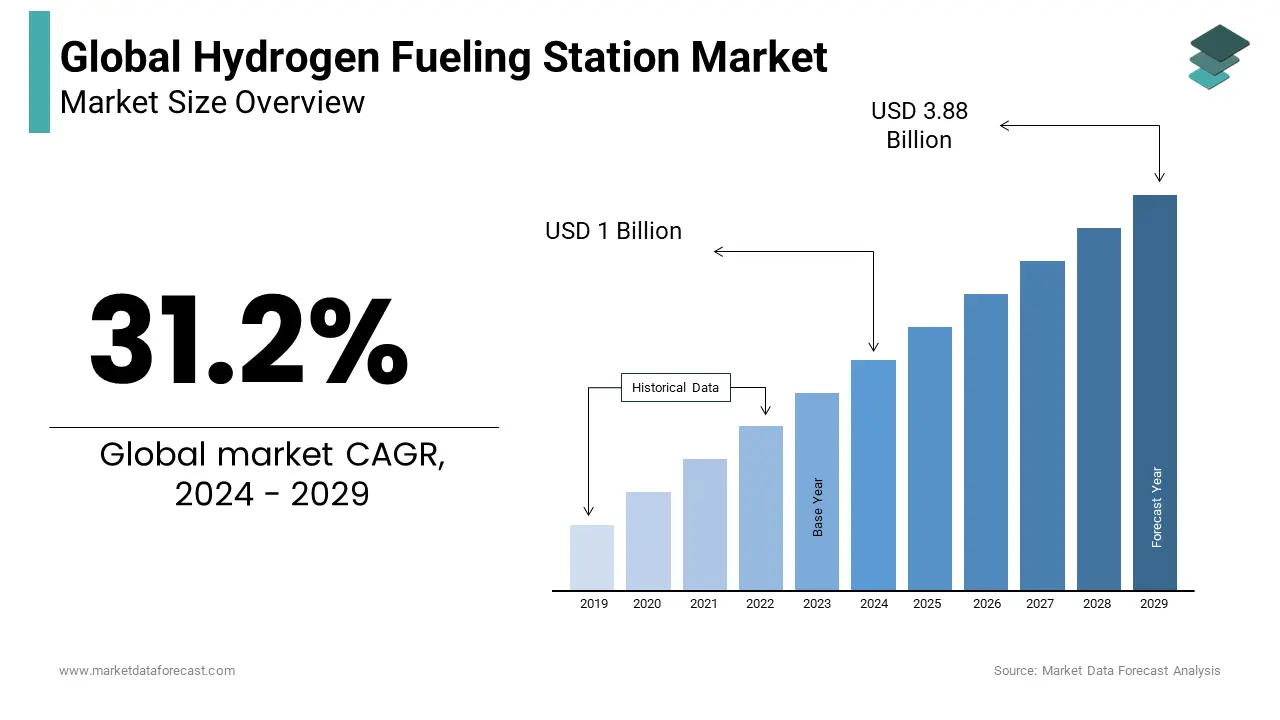
- Market Valuation: Valued at USD 1.31 billion in 2025, reaching USD 1.72 billion in 2026, and projected to expand to USD 15.10 billion by 2034, growing at a robust CAGR of 31.2% from 2026 to 2034.
- Primary Growth Drivers: Escalating demand for zero-emission fuel cell electric vehicles (FCEVs), declining costs of hydrogen fuel, and proactive government funding toward clean energy corridors.
Key Market Segment Metrics
| Category | Leading Segment (Base Position) | Fastest-Growing / High-Growth Segment |
|---|---|---|
| By Type | Small Station (held dominant share in 2025, supported by early-stage hydrogen passenger vehicle deployment and localized hubs) | Medium Station (projected at a high growth rate driven by balanced capital investments and rising commercial fleet requirements) |
| By Product | Retail Stations (accounted for major permanent public fueling infrastructure baseline usage) | Mobile Hydrogen Stations (growing steadily due to unmatched operational flexibility, quick deployment, and scalability) |
| By End-User | Pipeline Delivery (occupies the largest share for cost-effective, large-scale industrial transport of hydrogen) | Tanker Trucks & Tube Trailers (surging to service distributed network hubs and non-piped fueling stations) |
| By Region | Asia-Pacific (market leader backed by aggressive zero-emission policies and state funding in China, Japan, and South Korea) | North America & Europe (expanding rapidly via clean-corridor infrastructure bills and heavy-duty truck network rollouts) |
Major Market Players & Industry Landscape
Market Structure: Highly collaborative and expanding market environment driven by specialized industrial gas corporations, energy leaders, and tech providers building robust hydrogen transport ecosystems.
Key Companies: FuelCell Energy Inc., Air Products, Cummins Inc., Ballard, ITM Power, Air Liquide, Hydrogenics, Linde Group, and Black & Veatch Holding Company.
 Download Free Sample Report
Global Hydrogen Fueling Station Market Size
The global hydrogen fueling station market was valued at USD 1.31 billion in 2025 and is projected to reach a valuation of USD 15.10 billion by 2034 from USD 1.72 billion in 2026 and is predicted to register a CAGR of 31.2% between 2026 and 2034.
A hydrogen fuelling station is a storage and filling station for hydrogen gas or liquid. The components are liquid storage tanks, compressors, super compressors, and dispensers. Firstly, hydrogen is brought to the filling station in a truck. It can also be supplied with the help of pipelines to the station, as it exists in many countries. The next component is compressors, where the liquid form of hydrogen is converted into gas form by passing it through vaporizer towers, where the hydrogen liquid is heated at high temperatures until the gas form is achieved. Then it is passed to the next component, super compressors, where the hydrogen gas is compressed at high pressure. This can be done according to the two standards, H35 half pressure and H70 full pressure.
After that, it is stored in storage tanks at the fueling stations. The storage tanks are above the ground as compared to the gasoline tanks, which are below the ground. The last component is the dispenser, where before passing through the pumps, the gas should be cooled down through heat exchangers to prevent the cars from overheating and maintain the energy density of the hydrogen gas.
MARKET DRIVERS
Over the forecast period, the hydrogen fueling station market is expanding rapidly as a result of the rising demand for hydrogen-powered vehicles.
Hydrogen is considered a clean and flexible energy source to support zero-carbon energy emissions. The vehicles are more powerful and energy efficient than gasoline-driven ones, and the declining cost of hydrogen fuel is driving the hydrogen fueling station market. Different automobile manufacturers are planning to launch new FCEVs and support the government's zero-emission strategies. The use of green hydrogen in many sectors, like automobiles, aerospace, and manufacturing industries, is also expanding the market.
MARKET RESTRAINTS
The construction cost of a hydrogen fuelling station is very high as it requires building various components of inflammable hydrogen fuel, which is a significant barrier to the market's expansion. If hydrogen gas escapes from its containment, it can affect safety issues, which is also a factor limiting growth.
REPORT COVERAGE
| REPORT METRIC | DETAILS |
| Market Size Available | 2025 to 2034 |
| Base Year | 2025 |
| Forecast Period | 2026 to 2034 |
| Segments Covered | By Type, Product, End-User, and Region. |
| Various Analyses Covered | Global, Regional, & Country Level Analysis; Segment-Level Analysis, Drivers, Restraints, Opportunities, Challenges, PESTLE Analysis, Porter’s Five Forces Analysis, Competitive Landscape, Analyst Overview of Investment Opportunities |
| Regions Covered | North America, Europe, Asia Pacific, Latin America, Middle East, and Africa |
| Key Market Players | Fuel Cell Energy Inc., Air Products, Cummins Inc., Ballard, ITM Power, Air Liquide, Hydrogenics, Linde Group, Black and Veatch Holding Company, Praxair, and Others. |
SEGMENTAL ANALYSIS
By Type Insights
The small station segment is predicted to grow at a high rate because of the increase in the number of hydrogen-powered passenger vehicles. Many customers are adapting to zero-emission vehicles, and various countries' governments are supporting the move.
By Product Insights
The mobile hydrogen refueling station is growing during the forecasted period because of its various benefits, such as a high level of flexibility and the ability to be modified according to customer needs. These can also be moved from one place to another in comparison to the retail and non-retail hydrogen fueling stations, which are fixed structures.
By End-User Insights
At present, the Pipeline Delivery segment occupies the largest share of the market and is projected to grow. The most energy-efficient and cost-effective method of delivering hydrogen is through a pipeline. The pipeline is expected to witness the highest adoption rate for large-scale hydrogen transportation in the future as the hydrogen energy industry develops.
REGIONAL ANALYSIS
The Asia-Pacific region is estimated to hold the highest position in the hydrogen fueling station market. China, Japan, and Korea are among the leading countries that are moving towards zero emissions and introducing various policies. The government is providing funding for the hydrogen-based fuelling station facilities, which is a key factor in this region's growth.
KEY MARKET PLAYERS
Companies playing a prominent role in the global hydrogen fueling station market include
- FuelCell Energy Inc.
- Air Products
- Cummins Inc.
- Ballard
- ITM Power
- Air Liquide
- Hydrogenics
- Linde Group
- Black & Veatch Holding Company
- Praxair
- Others
RECENT MARKET HAPPENINGS
- In December 2021, Air Products announced the opening of its first hydrogen fuelling station in Shandong Province in a joint effort with the local government to support China's "Hydrogen into Ten Thousand Homes" initiative to fuel buses and trucks for environmentally friendly transportation.
- In July 2020, Linde announced that work on the world's first hydrogen refueling station for passenger trains will begin in Bremervorde, Germany.
- In March 2021, Air Products and Baker Hughes announced a collaboration for Global Hydrogen Projects in which they will develop next-generation hydrogen compression to lower production costs and increase the use of hydrogen fuel to achieve zero carbon emissions.
MARKET SEGMENTATION
This research report on the global hydrogen fueling station market has been segmented and sub-segmented based on type, product, end-user, and region.
By Type
- Small Station
- Medium Station
- Large Station
By Product
- Retail
- Non-Retail
- Mobile hydrogen Stations
By End-User
- Hydrogen Tube Trailers
- Tanker Trucks
- Pipeline Delivery
- Railcars and Barges
By Region
- North America
- Europe
- Asia Pacific
- Latin America
- Middle East & Africa