- Product Description Description
- Table of Contents TOC
- List of Table & Figure LOT
- Get Free Sample PDF Sample PDF
Executive Summary: Global Industrial Dust Collector Market
- Market Scope: Comprehensive global industrial dust collector market analysis covering product types, operational mechanisms, mobility configurations, end-use verticals, and regional growth patterns.
- Market Valuation: Valued at USD 9.55 billion in 2025, anticipated to reach USD 9.98 billion in 2026, and projected to expand to USD 14.19 billion by 2034, growing at a steady CAGR of 4.5% during the forecast period from 2026 to 2034.
- Primary Growth Drivers: Rising demand for food safety and workplace air quality, strict government environmental and worker safety regulations, rapid industrialization, and the need to protect manufacturing equipment and reduce exposure to hazardous fumes. Key operational hurdles include high maintenance and frequent filter cleaning requirements for fabric filters under heavy dust loads.
Key Market Segment Metrics (2026–2034)
| Category | Leading Segment (Base Position) | Fastest-Growing Segment |
|---|---|---|
| By Product Type | Baghouse Dust Collectors (highly adaptable, very efficient, and capable of managing harsh industrial applications by varying bag sizes) | Baghouse and Cartridge systems |
| By Mechanism | Dry Mechanism (dominant segment driven by dry particle filtration requirements in food processing, cement, and metal industries) | Dry dust collection mechanism |
| By Mobility | Fixed Segment (holds the largest market share as large-scale industrial plants require permanent, heavy-duty centralized duct networks) | Portable / Mobile dust collectors |
| By Application | Food & Beverage and Cement (leading segments driven by strict hygiene guidelines, combustible dust control, and large-scale particulate output) | Food & Beverage and Mining sectors |
| By Region / Country | North America (holds a significant market share due to advanced technological adoption and early infrastructure automation) | Asia-Pacific (fastest-growing regional market led by rapid industrialization and manufacturing expansion in China and India) |
Major Market Players & Market Structure
Market Structure: Highly competitive global environmental control and industrial filtration ecosystem featuring major engineering companies competing on pleated baghouse designs, high-temperature resistance, and low-maintenance solutions.
Key Companies: Parker Hannifin Corp, Oneida Air Systems, FLSmidth, Donaldson Company Inc., American Air Filter Company Inc., 3M, Nederman, Camfil APC, CLARCOR Industrial Air, and Industrial Vacuum Equipment Corporation.
Global Industrial Dust Collector Market Size
The global industrial dust collector market size was valued at USD 9.55 billion in 2025 and is anticipated to reach a valuation of USD 9.98 billion in 2026 and USD 14.19 billion by 2034, growing at a CAGR of 4.5% from 2026 to 2034.
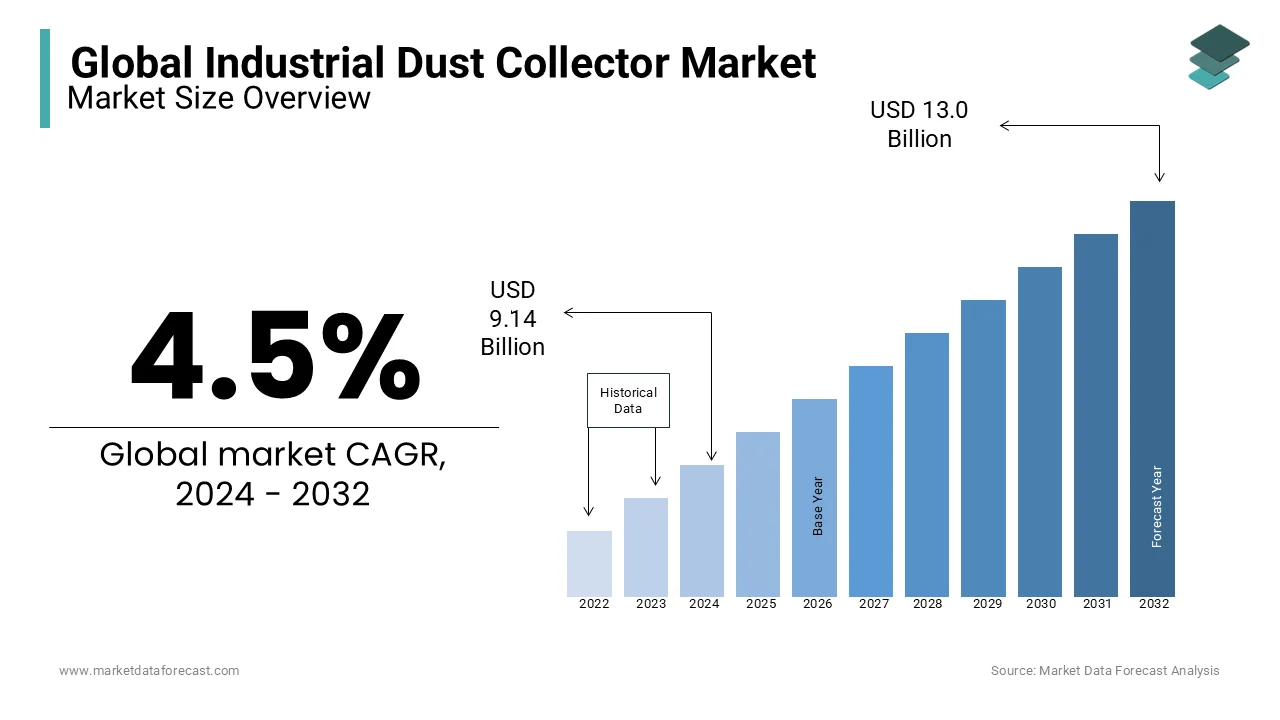
An industrial dust collector is equipment that is used in plants, factories, warehouses, and other industries. This equipment is used to collect dust from the industrial environment and also controls the air quality by removing any harmful matter and fumes from gases that may arise during a manufacturing process, resulting in a safer environment for workers and employees.
A dust collection system's basic components include a blower, dust filter, cleaning system, receptacle, ductwork, and a means of collecting pollutants. An industrial dust collector works by moving particles through a fan system to remove air pollutants from the workplace. The movement of an air stream is accelerated by the force generated by a fan to construct a setup that collects dust and harmful gases from the environment. The forces of centrifugal force, inertial force, and gravity are used to separate harmful gases and dust particles. The blower draws air from the location into the filter, which filters out particulates. The air-cleaning component is the dust filter. When air pollutants and dust particles pass through the system and are separated from the filter, they fall into a container known as a hopper for collection.
MARKET DRIVERS
The growing demand for food safety in the food and beverage industries, as well as the use of dust collectors to remove air pollutants that are harmful to workers and employees, are driving the market for industrial dust collectors.
Rapid industrialization and investments are also contributing to the growth of the market. The various advantages of industrial dust collectors and strict government safety regulations have made industries adopt them, making them a popular choice in the market. Advantages include increased manufacturing efficiencies, reduced worker exposure to harmful substances, adaptability in a variety of industries, and the ability to change the filter quickly and easily.
MARKET RESTRAINTS
Since most dust collectors use fabric filters, they require frequent filter cleaning, which can cause high maintenance costs since heavy dust loads require frequent filter cleaning. Most filters are cleaned by injecting high-pressure air into the filter, which causes the filter to expand as a result of the air pressure. Due to this, it becomes necessary to clean the filter on a more regular basis. As a result, the growth of the market is constrained by this key factor.
REPORT COVERAGE
| REPORT METRIC | DETAILS |
| Market Size Available | 2025 to 2034 |
| Base Year | 2025 |
| Forecast Period | 2026 to 2034 |
| CAGR | 4.5% |
| Segments Covered | By Product Type, Mechanism, Mobility, Application, and Region |
| Various Analyses Covered | Global, Regional & Country Level Analysis, Segment-Level Analysis, DROC, PESTLE Analysis, Porter’s Five Forces Analysis, Competitive Landscape, Analyst Overview on Investment Opportunities |
| Regions Covered | North America, Europe, APAC, Latin America, Middle East & Africa |
| Market Leaders Profiled | PARKER HANNIFIN CORP, Oneida Air Systems, FLSmidth, Donaldson Company, Inc., American Air Filter Company, Inc., 3M, Nederman, Camfil APC, CLARCOR Industrial Air, Industrial Vacuum Equipment Corporation, and Others. |
SEGMENTAL ANALYSIS
By Product Insights
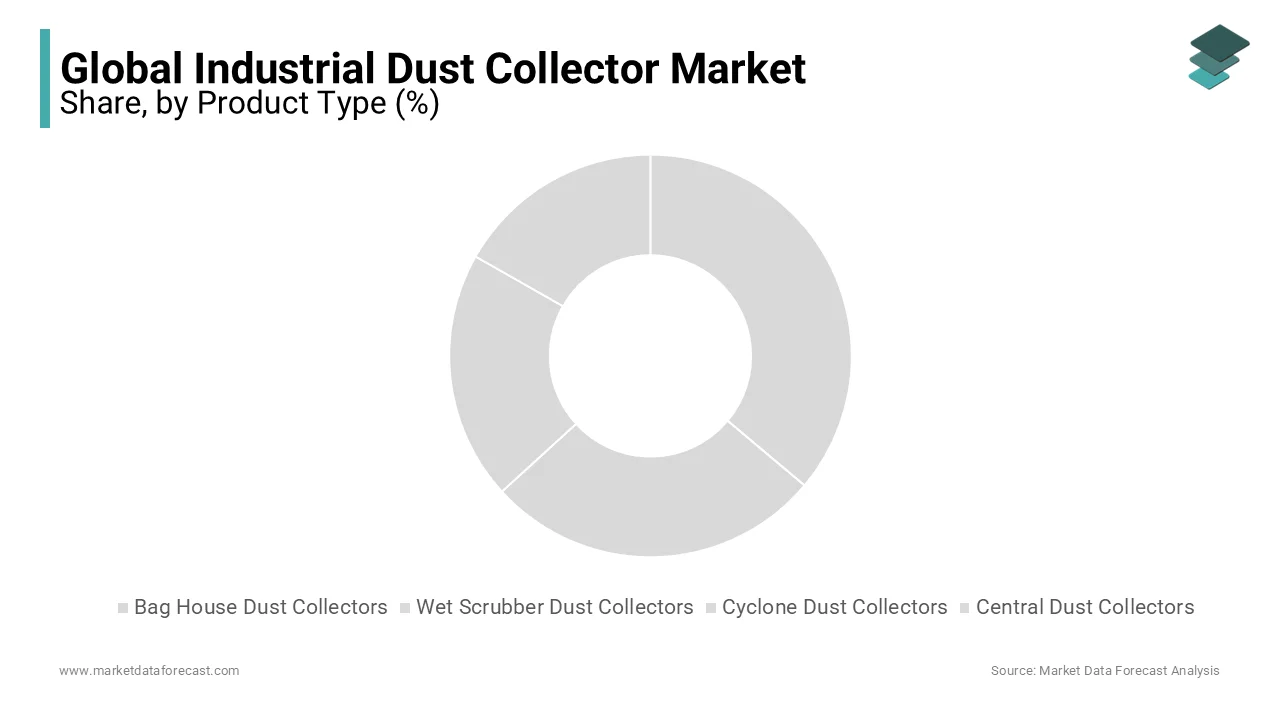
In this product type segment, Baghouse dust collectors are leading and are also expected to grow at a higher CAGR during the forecasted period. Baghouse dust collectors are extremely adaptable and can be designed for almost any dust-producing application by varying bag size and type. When compared to other types of dust collectors, these are very efficient and can handle any harsh applications in the industry.
By Mechanism Insights
Dry is leading the mechanism segment and is expected to grow at a high rate during the forecasted period. The market is driven due to dry dust particle issues in the food and beverage and cement industries. Combustible dust causes explosions and fires in the food and beverage industry. As a result, installing industrial dust collectors in the food and beverage industry not only improves air quality but also protects workers from getting lung diseases.
By Mobility Insights
Fixed segment holds the largest market share in 2025, as many industries require large dust collectors. The portable segment is expected to grow at a high rate during the forecasted period. Portable dust collectors are economical compared to fixed dust collectors. When in an industry, the dust generation is not fixed in one place and many machines are working on a shop floor that are being operated for a very short period of time, a portable dust collector with a flexible arm arrangement will be a cost-effective way compared to a fixed or centralized dust collection system. Also, the filters require no installation or setup cost and very low maintenance cost. These benefits are driving the portable segment.
By Application Insights
Food & Beverage is leading the application segment and is expected to grow at a high rate during the forecasted period. The market is driven by the strict safety policies and regulations of the government globally. In the food industry, dust particles are a major issue that settles on contaminated products before the packaging process, and thus, the use of dust collectors plays a major role.
REGIONAL ANALYSIS

North America holds the largest market share in 2025, as it is a developed country and has adopted various advanced technologies and equipment. The Asia Pacific is expected to grow at the highest rate during the forecasted period. This growth will be driven by the rapid investment and industrialization in this region. Strict government policies and an increase in safety, mainly in food and beverage companies, are driving the region forward. China is the world's largest producer of cement, followed by India, and these government policies will have an impact on these industries, which will drive the industrial dust collection market.
KEY MARKET PLAYERS
Major Key Players in the Global Industrial Dust Collector Market are
- PARKER HANNIFIN CORP
- Oneida Air Systems
- FLSmidth
- Donaldson Company, Inc.
- American Air Filter Company, Inc.
- 3M
- Nederman,
- Camfil APC
- CLARCOR Industrial Air
- Industrial Vacuum Equipment Corporation
- others.
RECENT MARKET NEWS
- In April 2022, Parker Hannifin Corp. launched a pleated baghouse filter for customers that collects dust in high-temperature applications. It is designed to remove bags and cages, significantly decreasing installation and removal costs.
- In October 2020, Donaldson Company, Inc. announced to launch of a Donaldson Torit Rugged Pleat baghouse industrial dust collector. It is intended to collect heavy, abrasive dust generated by woodworking, mining, grain processing, and other industries.
- In May 2022, Eitrium announced the acquisition of Ilmeg Products AB, a Swedish manufacturer of dust collectors, primarily for the mining industry, to increase its product offerings and strengthen its position in the market.
MARKET SEGMENTATION
This research report on the global industrial dust collector market has been segmented and sub-segmented based on product type, mechanism, mobility application, and region.
By Product Type
- Bag House Dust Collectors
- Wet Scrubber Dust Collectors
- Cyclone Dust Collectors
- Central Dust Collectors
- Others
By Mechanism
- Dry
- Wet
By Mobility
- Portable
- Fixed
By Application
- Food & Beverage
- Pharmaceutical
- Energy & Power
- Steel
- Cement
- Mining
- Others
By Region
- North America
- Europe
- Asia-Pacific
- Latin America
- The Middle East and Africa