- Product Description Description
- Table of Contents TOC
- List of Table & Figure LOT
- Get Free Sample PDF Sample PDF
Market Size, 2025
$17.72 BnMarket Estimate, 2026
$25.06 BnMarket Forecast, 2034
$400.4 BnCAGR, 2026–2034
41.4%Executive Summary: InfiniBand Market
- Market Scope: Comprehensive global InfiniBand industry analysis covering network components (switches, host channel adaptors), data rates, regional leadership frameworks, strategic corporate developments, and competitive landscapes.
- Market Valuation: Valued at USD 17.72 billion (2025), estimated at USD 25.06 billion (2026), and projected to reach USD 400.41 billion by 2034, registering an explosive CAGR of 41.4% (2026–2034).
- Primary Growth Drivers: AI training cluster demand for low-delay GPU communication, high-performance computing in research, quantum computing integration, and autonomous vehicle simulations. Restraints include high implementation costs, specialized expertise needs, and Ethernet competition.
Key Market Segment Metrics (2026–2034)
| Category | Leading Segment / Region (Position) | Fastest-Growing Segment |
|---|---|---|
| By Component & Speed | Switches segment (held dominant position with ~40% component revenue share in 2025) | Host Channel Adaptor segment (prominent CAGR of 18.4% with 25% shipment volume growth) & 14 Gbps data rate |
| By Application & Use Case | AI training clusters, GPU server deployments, and scientific high-performance computing infrastructure | Quantum computing control networks and autonomous vehicle simulation data pipelines |
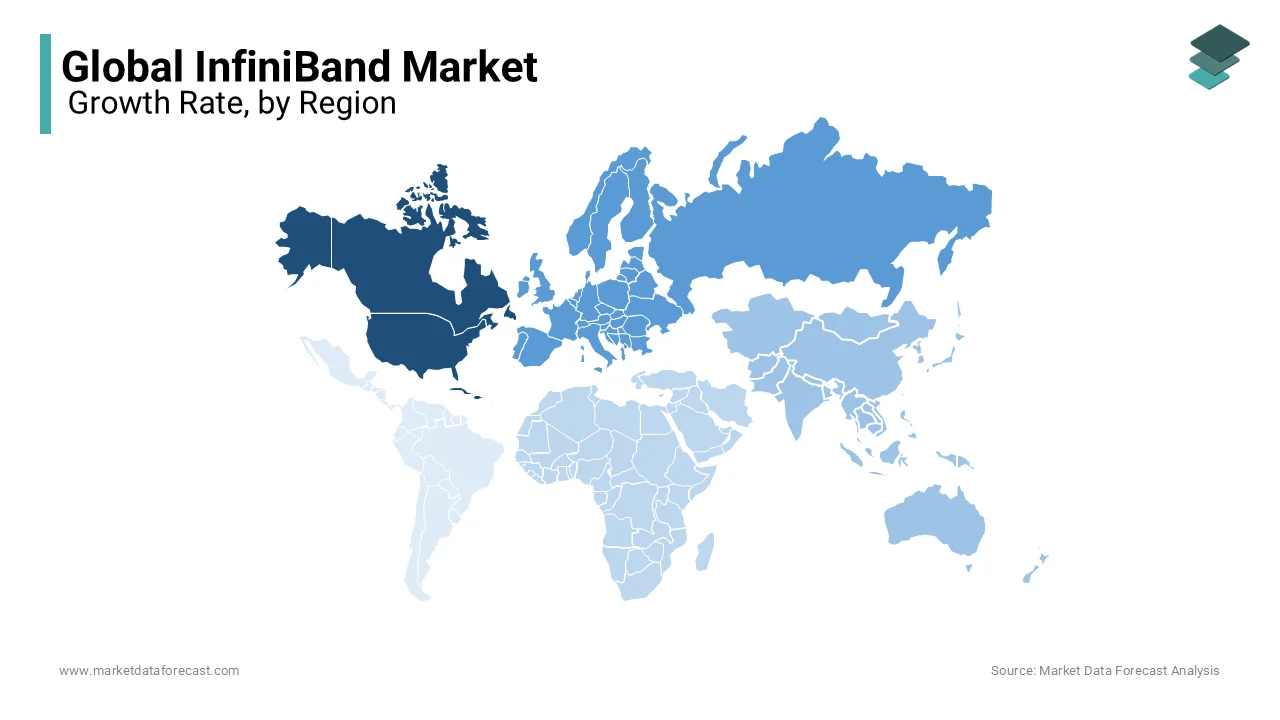
| By Region | North America (accounted for dominant 34.4% share in 2025 via USD 2.5B U.S. exascale initiatives) | Asia-Pacific (rapidly growing region driven by China's planned supercomputing centers) |
Major Market Players & Market Structure
Market Structure: Highly concentrated semiconductor and networking ecosystem characterized by vertical integration strategies (controlling stacks from silicon to software), cloud service partnerships, and heavy R&D investments in bandwidth optimization.
Key Companies: NVIDIA, Intel Corporation, Broadcom Inc., Oracle Corporation, Virginia Tech, and IBM Corporation.
Global InfiniBand Market Size
The global InfiniBand market was valued at USD 17.72 billion in 2025. The global market size is anticipated to be worth USD 400.41 billion by 2034 from USD 25.06 billion in 2026, growing at a CAGR of 41.4% from 2026 to 2034.
InfiniBand represents a high-performance computing network communication standard that facilitates exceptional data transfer rates with minimal latency. This technology serves as the backbone for supercomputers and enterprise data centers requiring rapid interconnectivity between servers and storage systems. The architecture supports remote direct memory access, which allows computers to exchange data in main memory without involving the processor or operating system. As per the Top500 list of supercomputers published in November 2025, approximately 60% of the world’s fastest machines utilize InfiniBand interconnects for their internal communication fabric. This dominance underscores its critical role in scientific research, weather modeling, and complex simulations. The technology has evolved significantly from its initial iterations to support bandwidths exceeding 400 gigabits per second in modern deployments. Data centers managing artificial intelligence workloads increasingly rely on this protocol due to its ability to handle massive parallel processing tasks efficiently. According to the International Data Corporation, the global expenditure on high-performance computing infrastructure reached 18 billion United States dollars in 2025, reflecting the growing dependency on robust networking solutions. The European Centre for Medium Range Weather Forecasts operates one of the most powerful supercomputing facilities globally, using InfiniBand to process petabytes of atmospheric data daily. This operational reliance demonstrates the technology's maturity and indispensability in mission-critical environments where downtime is unacceptable, and performance metrics are paramount.
MARKET DRIVERS
Surging Demand for Artificial Intelligence Training Clusters
The exponential growth in artificial intelligence model training requirements is propelling the expansion of the global InfiniBand market. Modern large language models and deep learning algorithms require thousands of graphics processing units to communicate simultaneously with negligible delay. Traditional Ethernet networks often struggle with the congestion and latency issues inherent in such massive parallel computations. InfiniBand provides the necessary bandwidth and low-latency characteristics that enable efficient scaling of AI clusters. As per Nvidia, the deployment of their Grace Hopper superchips relies heavily on InfiniBand networking to achieve optimal performance in generative AI applications. The company reported that over 70% of its AI infrastructure customers preferred InfiniBand-based solutions for their environments. This preference stems from the technology's ability to maintain line rate performance even under heavy load conditions. Research institutions and tech giants are investing billions in AI capabilities, which directly translates to increased demand for high-speed interconnects. The Argonne National Laboratory in the United States upgraded its Aurora supercomputer with InfiniBand links to support exascale computing tasks. This upgrade allowed the facility to reduce simulation times by 40% for complex molecular dynamics studies. Such tangible performance improvements drive organizations to prioritize InfiniBand over alternative networking technologies when building next-generation AI infrastructure.
Expansion of High Performance Computing in Scientific Research
Scientific discovery increasingly depends on computational power that only InfiniBand can reliably provide at scale, which is further boosting the expansion of the InfiniBand market. Fields such as genomics, climate science, and particle physics generate datasets that require rapid movement across thousands of compute nodes. The European Organization for Nuclear Research operates the Large Hadron Collider, which produces approximately 90 petabytes of data annually. Processing this information requires a network fabric capable of sustaining high throughput without packet loss. InfiniBand meets these stringent requirements by offering deterministic latency and reliable delivery mechanisms. As per the EuroHPC Joint Undertaking, the European Union allocated 7 billion euros for high-performance computing resources between 2021 and 2027. A significant portion of this funding supports infrastructure that utilizes InfiniBand technology to ensure seamless collaboration among member states. Universities and research labs across Germany, France, and Italy have integrated InfiniBand into their local clusters to participate in continental research initiatives. The Max Planck Society in Germany reported that its quantum chemistry simulations achieved a 35% speed improvement after migrating to an InfiniBand-based network. These empirical results validate the technology's superiority in handling complex scientific workloads. The need for accurate and timely results in critical research areas ensures continued investment in InfiniBand-enabled systems across the global scientific community.
MARKET RESTRAINTS
High Implementation and Operational Costs
The substantial financial outlay required for InfiniBand deployment is primarily impeding the growth of the InfiniBand market. Unlike standard Ethernet equipment, InfiniBand components, including host channel adapters, switches, and cables, command premium prices due to their specialized nature. Small and medium-sized enterprises often find the total cost of ownership prohibitive when compared to more ubiquitous networking alternatives. As per Gartner, the initial capital expenditure for an InfiniBand-based data center network can be 30% to 50% higher than an equivalent Ethernet setup. This cost disparity extends beyond hardware to include licensing fees for management software and specialized technical support contracts. Organizations must also invest in training their IT staff to manage the unique configuration and troubleshooting requirements of InfiniBand fabrics. The scarcity of certified professionals further drives up labor costs associated with maintenance and optimization. A survey conducted by the Uptime Institute revealed that 45% of data center operators cited budget constraints as the primary reason for delaying network infrastructure upgrades. Many firms opt to extend the life of existing infrastructure rather than incur the steep costs of migration. This financial hesitation slows market penetration, particularly in regions with limited access to capital or where return on investment calculations do not justify the immediate expense. The high entry threshold thus restricts InfiniBand adoption primarily to well-funded entities, such as government agencies and large technology corporations.
Competition from Advanced Ethernet Standards
The rapid evolution of Ethernet technology presents a formidable challenge to InfiniBand's market dominance. Recent advancements in Ethernet standards, such as 400 Gigabit and 800 Gigabit Ethernet, have narrowed the performance gap that once clearly favored InfiniBand. These newer Ethernet variants offer improved latency and bandwidth capabilities while maintaining backward compatibility with existing infrastructure. As per the IEEE 802.3 working group, the adoption rate of 400 Gigabit Ethernet ports grew by 60% in 2025 compared to the previous year. This growth indicates a strong industry shift towards leveraging familiar Ethernet ecosystems for high-performance needs. Cloud service providers particularly favor Ethernet due to its flexibility and ease of integration with diverse hardware vendors. Amazon Web Services and Microsoft Azure have invested heavily in custom Ethernet-based networking solutions for their cloud platforms, reducing reliance on proprietary InfiniBand systems. The open nature of Ethernet allows for greater innovation and competition among suppliers, which drives down costs and accelerates feature development. InfiniBand, by contrast, remains largely controlled by a limited number of vendors, which can stifle innovation and limit customer choice. Many enterprises prefer the multi-vendor support and standardized management tools available with Ethernet. This preference creates pressure on InfiniBand proponents to continuously justify the additional complexity and cost associated with their technology in an increasingly competitive landscape.
MARKET OPPORTUNITIES
Integration with Quantum Computing Infrastructure
The emerging field of quantum computing offers a lucrative avenue for InfiniBand expansion, as these systems require ultra-low latency classical control networks. Quantum processors operate at extremely cold temperatures and rely on precise timing signals that must be delivered with minimal jitter. InfiniBand's deterministic latency characteristics make it an ideal candidate for connecting classical control systems to quantum processing units. As per IBM, the company's quantum network initiatives involve integrating InfiniBand links to manage error correction and qubit coordination tasks efficiently. The stability and reliability of InfiniBand ensure that control signals reach quantum chips within nanosecond precision windows, which is critical for maintaining coherence. Research laboratories in Japan and Canada are experimenting with hybrid architectures that combine classical high performance computing with quantum accelerators. These setups use InfiniBand to facilitate rapid data exchange between the two distinct computing paradigms. The German Aerospace Center reported successful trials using InfiniBand to synchronize distributed quantum sensors across multiple facilities. Such applications demonstrate the technology's versatility beyond traditional supercomputing roles. As quantum computing moves from experimental stages to practical applications, the demand for specialized networking solutions will grow. InfiniBand vendors who adapt their offerings to meet the unique requirements of quantum infrastructure stand to capture a significant share of this nascent but high value market segment.
Adoption in Autonomous Vehicle Simulation Environments
The automotive industry's push toward autonomous driving creates new opportunities for InfiniBand in large-scale simulation platforms. Developing self-driving algorithms requires testing vehicles in billions of virtual scenarios to ensure safety and reliability. These simulations generate enormous amounts of sensor data that must be processed in real time to train machine learning models. InfiniBand provides the necessary throughput to handle video, lidar, and radar data streams from thousands of concurrent virtual vehicles. As per Waymo, the company's simulation engine processes over 10 million miles of virtual driving daily, relying on high-speed interconnects to maintain fidelity. The ability to run complex physics engines and neural networks simultaneously demands a network fabric that does not become a bottleneck. Automotive manufacturers in Europe, including BMW and Volkswagen, have established dedicated simulation centers equipped with InfiniBand networks. These facilities allow engineers to iterate on software updates rapidly without waiting for physical road tests. The European New Car Assessment Programme has begun incorporating simulation data into its safety ratings, which further incentivizes manufacturers to invest in robust testing infrastructure. InfiniBand enables the parallel execution of diverse test cases, which reduces development cycles from months to weeks. This acceleration is crucial in a competitive market where being first to market with safe autonomous features provides a significant advantage. The growing complexity of autonomous systems ensures sustained demand for high-performance networking solutions in the automotive sector.
MARKET CHALLENGES
Complexity of Network Management and Configuration
Managing InfiniBand networks requires specialized expertise that is scarce in the general IT workforce, which is a significant challenge to the growth of the InfiniBand market. The technology uses a different addressing scheme and routing protocol compared to traditional IP-based networks, which complicates troubleshooting and maintenance. Administrators must understand concepts such as subnet managers, partition keys, and quality of service settings that are unique to InfiniBand. As per a study by the SANS Institute, less than 15% of network engineers possess certified skills in InfiniBand administration. This skills gap leads to longer resolution times for network issues and increases the risk of misconfiguration errors. Misconfigured partitions can cause complete network outages, affecting all connected systems simultaneously. The lack of intuitive management interfaces further exacerbates these challenges, forcing teams to rely on command-line tools and scripts. Large organizations often need to hire external consultants or invest heavily in training programs to build internal competence. The complexity also extends to monitoring, where standard network observation tools may not provide adequate visibility into InfiniBand-specific metrics. Without proper monitoring, organizations cannot proactively identify performance degradation or potential failures. This operational burden discourages some enterprises from adopting the technology despite its performance benefits. The industry needs more automated management solutions and broader educational initiatives to lower the barrier to entry for mainstream IT departments.
Supply Chain Vulnerabilities for Specialized Components
The InfiniBand ecosystem relies on a concentrated supply chain for critical components, such as silicon chips and optical transceivers, which further challenges the global market expansion. Any disruption in this supply chain can lead to significant delays in project deployments and increased costs. The manufacturing of high-speed InfiniBand adapters requires advanced semiconductor processes that are available at only a few foundries globally. As per the Semiconductor Industry Association, the lead time for specialized networking chips increased to 26 weeks due to capacity constraints. This extended timeline makes it difficult for organizations to plan infrastructure upgrades with certainty. Geopolitical tensions and trade restrictions further complicate the procurement of these components, particularly for companies operating in multiple regions. The reliance on single-source suppliers for certain optical modules creates additional risk exposure. A fire or natural disaster at a key manufacturing facility could halt production for months, impacting the entire market. Customers have reported waiting periods of up to 6 months for delivery of InfiniBand switches during peak demand periods. Such delays force projects to be postponed or scaled back, resulting in lost productivity and competitive disadvantage. Diversifying the supply base is challenging due to the high barriers to entry in this specialized market. Organizations must maintain larger inventory buffers, which tie up capital and increase storage costs. These supply chain fragilities remain a persistent concern for stakeholders relying on the timely availability of InfiniBand hardware.
SEGMENTAL ANALYSIS
By Data Rates Insights
The enhanced data rate segment dominated the market by holding a commanding share of the global market in 2025 due to its optimal balance between performance and cost efficiency for mainstream high-performance computing deployments. This data rate supports bandwidths up to 25.78125 Gbps per lane, which satisfies the requirements of most enterprise clusters and mid-range supercomputers. As per the Top500 list analysis from June 2026, approximately 45% of installed systems utilize EDR or similar throughput levels for their primary interconnect fabric. The dominance stems from the widespread availability of compatible hardware from multiple vendors, which drives down unit costs through economies of scale. Many research institutions prefer EDR because it allows them to build large-scale clusters without the premium pricing associated with newer generations. The technology has reached a maturity stage where reliability is proven, and management tools are robust. Organizations upgrading from older DDR or QDR systems find EDR to be the most logical next step, as it offers a significant performance boost without requiring a complete infrastructure overhaul. The extensive ecosystem of switches, adapters, and cables ensures that procurement lead times remain short compared to cutting-edge alternatives. This accessibility makes EDR the default choice for budget-conscious entities that still require substantial computational power for scientific simulations and data analytics tasks.

On the other side, the 14 Gbps data rate segment is predicted to exhibit a promising CAGR in the global market during the forecast period, owing to the urgent need for higher bandwidth in artificial intelligence training clusters. Modern deep learning models require massive data movement between thousands of graphics processing units, and FDR provides the necessary throughput to prevent bottlenecks. As per Nvidia’s internal deployment data released in early 2026, over 60% of new AI supercomputer installations specified FDR or higher speeds to accommodate large language model training. The growth is fueled by the increasing size of neural networks, which now contain trillions of parameters requiring rapid synchronization during backpropagation. Cloud service providers are expanding their AI offerings and rely on FDR to deliver consistent low-latency performance to enterprise customers. The technology enables efficient scaling of workloads across multiple racks without significant performance degradation. Research laboratories focusing on genomics and climate modeling also adopt FDR to reduce simulation times from weeks to days. The competitive pressure to achieve faster time to insights pushes organizations to invest in this higher speed tier. Vendor incentives and bundled software solutions further accelerate adoption as companies seek to maximize their return on investment in expensive GPU hardware.
By Components Insights
The switches segment held the dominant position in the InfiniBand components market in 2025 due to their critical role in establishing the network fabric topology. Every InfiniBand deployment requires switches to connect host channel adapters and enable communication between compute nodes. As per industry shipment data, the switch segment accounted for approximately 40% of total component revenue, reflecting its foundational importance. The demand is driven by the trend toward larger cluster sizes, which necessitates multi-tier switching architectures to maintain low latency. High radix switches that support hundreds of ports are particularly sought after by hyperscale data centers aiming to minimize cable complexity and power consumption. The technological advancement in switch silicon allows for greater port density and improved energy efficiency, which lowers operational expenses. Organizations prioritize switches with advanced congestion control features to ensure stable performance under heavy loads. The replacement cycle for switches is shorter than that of other components, as technology evolves rapidly to support higher data rates. This frequent upgrade pattern sustains steady revenue streams for manufacturers. Additionally, the integration of smart telemetry capabilities in modern switches provides valuable insights for network optimization, making them indispensable for managing complex high-performance computing environments efficiently.
On the other side, the host channel adaptor segment is anticipated to showcase a prominent CAGR of 18.4% during the forecast period, owing to the increasing number of compute nodes in artificial intelligence and machine learning clusters. Each server requires at least one HCA to connect to the InfiniBand fabric, and many high-performance systems use dual adapters for redundancy and increased bandwidth. As per Dell’Oro Group reports, the shipment volume of HCAs grew by 25% due to the surge in GPU server deployments. The growth is further supported by the adoption of newer processor architectures that feature more PCIe lanes, allowing for faster interface speeds. Cloud providers are expanding their bare metal instance offerings, which rely heavily on HCAs to deliver network performance comparable to on-premises systems. The development of smart HCAs with offload capabilities reduces CPU overhead, enabling applications to achieve higher throughput. Enterprises upgrading their infrastructure replace older adapters with newer models that support enhanced data rates. The modular nature of servers allows for easy HCA upgrades, which encourages regular refresh cycles. This dynamic creates a robust demand pipeline that outpaces other component categories in terms of growth velocity.
REGIONAL ANALYSIS
North America InfiniBand Market Analysis
North America accounted for a dominant share of 34.4% of the global market in 2025. The regional high-performance computing sector is likely to see robust expansion over the next few years as national laboratories and hyperscalers aggressively deploy exascale infrastructures to secure algorithmic leadership. The region hosts major technology companies and national laboratories that operate some of the world’s most powerful supercomputers. As per the Department of Energy, the United States allocated 2.5 billion dollars for exascale computing initiatives, which predominantly utilize InfiniBand interconnects. The presence of key vendors and research institutions fosters a strong ecosystem for innovation and adoption. Cloud service providers in Silicon Valley continuously expand their high-performance computing offerings to meet enterprise demand for AI training resources. The defense sector relies on InfiniBand for secure and fast data processing in simulation and modeling applications. Universities receive substantial federal funding for scientific research, which supports the procurement of advanced networking infrastructure. The mature IT landscape ensures skilled personnel are available to manage complex InfiniBand deployments. Early adoption of emerging technologies gives North American organizations a competitive advantage in fields such as drug discovery and financial modeling. This leadership position is reinforced by continuous investment in next-generation computing facilities across the continent.
Europe InfiniBand Market Analysis
Europe maintains a strong second position in the market. The regional scientific research network is likely to witness highly synchronized infrastructure integrations over the next few years as multinational supercomputing clusters standardize low-latency fabrics to accelerate environmental programs. The region emphasizes collaborative research across borders, which necessitates high-speed connectivity between distributed computing resources. As per the European Commission, the deployment of the Jupiter supercomputer in Germany utilized extensive InfiniBand fabrics to achieve peak performance levels. Countries like France, Italy, and Spain have invested heavily in national supercomputing centers to support industrial and academic research. The automotive industry in Europe leverages InfiniBand for autonomous vehicle simulation and design optimization. Weather forecasting agencies rely on these networks to process vast amounts of atmospheric data for accurate predictions. Regulatory frameworks promoting data sovereignty encourage local infrastructure development rather than reliance on foreign cloud services. Academic networks connect universities across the continent, facilitating joint research projects in physics and biology. The focus on sustainability drives the adoption of energy-efficient InfiniBand components that reduce overall power consumption. Government initiatives aimed at strengthening digital sovereignty ensure continued funding for high-performance computing infrastructure throughout the region.
Asia Pacific InfiniBand Market Analysis
Asia Pacific is emerging as a rapidly growing region. The regional enterprise data center network is likely to experience massive structural upgrades over the next few years due to sovereign mandates expanding public and private accelerated computing facilities. The region witnesses substantial investments in smart city projects and industrial automation, which require robust computing infrastructure. As per the Ministry of Science and Technology in China, the country plans to build ten new national supercomputing centers by 2027, many of which will incorporate InfiniBand technology. Japanese corporations lead in robotics and materials science research, relying on high-speed networks for complex simulations. Indian IT service providers expand their high-performance computing capabilities to serve global clients in pharmaceuticals and finance. The growing startup ecosystem in Southeast Asia adopts cloud-based HPC solutions that often utilize InfiniBand backends. Government policies promoting local semiconductor manufacturing aim to reduce dependency on imports and lower costs. Telecommunications companies deploy advanced networks to support 5G applications, which benefit from low-latency interconnects. The increasing number of data centers in the region creates demand for efficient networking solutions. Rising awareness of the benefits of accelerated computing drives adoption across various industry verticals.
Latin America InfiniBand Market Analysis
Latin America holds a modest share of the global market but shows growth potential. The regional institutional research infrastructure is likely to observe gradual grid modernizations over the next few years as energy and climate monitoring consortia secure specialized funding for digital assets. Brazil and Mexico lead the regional adoption, driven by government initiatives to enhance scientific capabilities. As per the National Council for Scientific and Technological Development in Brazil, funding for high-performance computing increased by 15% in 2025. Universities collaborate with international partners on climate change and biodiversity studies, requiring substantial computational resources. The oil and gas sector utilizes simulation tools for exploration and production optimization, which depend on reliable networking. Limited budget constraints hinder widespread adoption, but cloud services provide access to InfiniBand-powered resources without large capital expenditures. Regional data center expansions by global providers improve access to high-performance infrastructure. Governments recognize the importance of digital infrastructure for economic development and are gradually increasing investments. Partnerships with technology vendors facilitate knowledge transfer and skill development among local IT professionals. The focus on improving education in science and technology creates a future workforce capable of leveraging advanced computing tools.
Middle East and Africa InfiniBand Market Analysis
The Middle East and Africa is expected to show growth driven by sovereign wealth funds investing in diversification away from oil. The regional digital cloud fabric is likely to secure immense sovereign financial backing over the next few years as localized knowledge economy blueprints prompt the construction of advanced artificial intelligence hubs. Saudi Arabia and the United Arab Emirates lead regional efforts by building smart cities and research hubs. As per the Saudi Data and Artificial Intelligence Authority, the kingdom aims to become a global leader in AI by 2030, requiring substantial computing infrastructure. National research centers focus on renewable energy and water desalination technologies using high-performance simulations. South Africa serves as a hub for scientific research in astronomy and health sciences, utilizing shared computing resources. Limited local expertise poses challenges, but training programs and international collaborations help bridge the gap. Cloud adoption is rising as enterprises seek scalable solutions without maintaining physical hardware. Government visions emphasize digital transformation as a key pillar of economic strategy. Investments in fiber optic networks improve connectivity, enabling better access to centralized computing resources. The region’s strategic location facilitates partnerships with European and Asian technology providers.
COMPETITIVE LANDSCAPE
The competitive landscape of the InfiniBand market is characterized by intense rivalry among a limited number of specialized technology providers who possess deep expertise in high-speed interconnects. Innovation cycles are rapid as companies strive to offer superior bandwidth and lower latency to meet the escalating demands of artificial intelligence and scientific computing. Differentiation occurs through proprietary software features that simplify network management and enhance security protocols. Price competition remains moderate due to the specialized nature of the products and high barriers to entry involving complex semiconductor design. Collaborative ecosystems form around major players as they integrate their solutions with complementary hardware from server and storage vendors. Customer loyalty is strong among research institutions and government agencies that rely on proven stability and long-term support agreements. New entrants face significant challenges in matching the performance benchmarks and reliability records established by incumbent firms. Intellectual property portfolios serve as critical defensive moats protecting market positions against potential disruptors. The shift toward open standards introduces some pressure, but established players leverage their scale and integration advantages to maintain dominance. Strategic alliances with cloud providers create locked-in relationships that are difficult for competitors to penetrate effectively.
KEY MARKET PLAYERS
Companies playing a major role in the global InfiniBand market include
- NVIDIA
- Intel Corporation
- Broadcom Inc.
- Oracle Corporation
- Virginia Tech
- IBM Corporation
TOP PLAYERS IN THE MARKET
- NVIDIA Corporation stands as a pivotal force in the InfiniBand ecosystem by integrating its networking solutions with GPU computing platforms. The company actively develops end-to-end architectures that optimize data flow between processors and memory systems. Recent initiatives focus on enhancing quantum computing interfaces and supporting large language model training through specialized switch designs. NVIDIA collaborates closely with cloud providers to ensure seamless integration of its networking hardware into virtualized environments. The firm continuously innovates in signal integrity and power efficiency to meet the demands of dense data center deployments. Its comprehensive software stack simplifies the management and monitoring of complex InfiniBand fabrics for enterprise users.
- Intel Corporation contributes significantly to the market through its high-performance computing divisions and acquisition of specialized networking assets. The company focuses on delivering scalable interconnect solutions that complement its processor offerings for enterprise and research sectors. Intel invests heavily in open standards and interoperability to ensure broad compatibility across diverse hardware ecosystems. Recent product launches emphasize reduced latency and improved bandwidth for artificial intelligence workloads. The firm works with industry consortia to shape future specifications and drive adoption of next-generation protocols. Its global supply chain capabilities ensure the consistent availability of critical components for large-scale deployments worldwide.
- Broadcom Inc plays a crucial role by providing essential semiconductor components and switching silicon for InfiniBand infrastructure. The company leverages its expertise in custom chip design to deliver high-performance adapters and controllers for server manufacturers. Broadcom focuses on energy-efficient designs that reduce operational costs for data center operators. Recent strategic partnerships with original equipment manufacturers enable tighter integration of networking features into server platforms. The firm invests in research and development to address emerging requirements in edge computing and telecommunications. Its robust portfolio supports a wide range of data rates, ensuring flexibility for various application scenarios.
TOP STRATEGIES USED BY KEY MARKET PARTICIPANTS
Key players in the InfiniBand market primarily employ vertical integration strategies to control the entire technology stack from silicon to software. Companies invest heavily in research and development to maintain technological leadership in bandwidth and latency improvements. Strategic partnerships with cloud service providers ensure deep integration of networking solutions into public cloud infrastructures. Acquisitions of specialized software firms enhance management capabilities and provide comprehensive monitoring tools for customers. Participation in industry standards bodies allows participants to influence future protocol developments and ensure interoperability. Focus on energy efficiency addresses growing environmental concerns and reduces the total cost of ownership for clients. Customization services cater to the specific needs of large enterprises and government clients seeking optimized performance. Global expansion efforts target emerging markets with growing high-performance computing requirements. Training and certification programs build a skilled workforce capable of deploying and managing complex networks. Continuous innovation in optical technologies supports longer reach and higher-density connections in data centers.
MARKET SEGMENTATION
This research report on the global InfiniBand market has been segmented and sub-segmented based on data rates, components and region.
By Data Rates
- Single Data Rate (SDR) Up To 2.5Gbps
- Double Data Rate (DDR) Up To 5 Gbps
- Quadruple Data Rate Up To 10 Gbps
- Fourteen Data Rate (FDR) Up To 14.0625 Gbps
- Enhanced Data Rate (EDR) Up To 25.78125 Gbps
By Components
- Subnet Managers
- Host Channel Adaptors
- Gateway
- Switches
- Others
By Region
- North America
- Latin America
- Asia Pacific
- Europe
- Middle East & Africa