- Product Description Description
- Table of Contents TOC
- List of Table & Figure LOT
- Get Free Sample PDF Sample PDF
Global Insurance Replacement Vehicle Market Size
In 2024, the global Insurance Replacement Vehicle Market was valued at USD 8.47 billion and is forecasted to grow to USD 17.26 billion by 2033, at a CAGR of 8.3%.
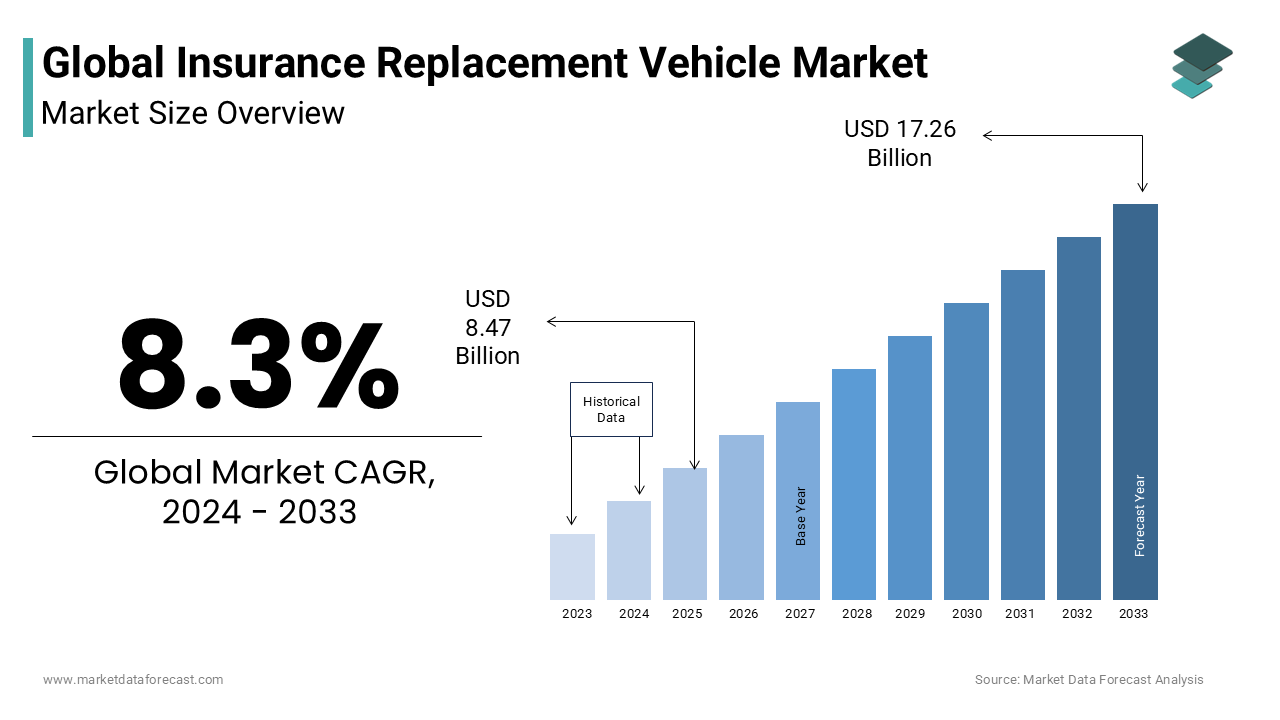
The Insurance Replacement Vehicle Market constitutes a specialized segment within the broader automotive and insurance services ecosystem, encompassing the provision of temporary or permanent vehicle replacements to policyholders whose insured vehicles have been declared total losses or require extended repair periods. This market serves as a critical bridge between insurance claim settlements and customer mobility restoration, ensuring policyholders maintain their transportation capabilities during claim processing and vehicle replacement procedures. According to the Insurance Information Institute, replacement vehicle programs have evolved from basic courtesy car provisions to sophisticated mobility management solutions that integrate vehicle selection, financing options, and customer experience optimization. The market encompasses diverse service models including direct insurance company ownership, third-party fleet management partnerships, and integrated dealer network collaborations that provide policyholders with comprehensive vehicle replacement alternatives. Modern replacement vehicle programs leverage advanced digital platforms and data analytics to match customer preferences with available vehicle inventory while ensuring cost-effectiveness and regulatory compliance. The market's operational scope extends beyond immediate vehicle provision to include vehicle inspection services, title transfer management, and post-replacement customer support that facilitates seamless transition experiences. Insurance replacement vehicle services increasingly incorporate sustainability considerations and technological integration that align with contemporary consumer expectations and environmental regulations.
MARKET DRIVERS
Rising Vehicle Accident Rates and Insurance Claim Frequency
The increasing frequency of vehicular accidents and subsequent insurance claims represents a fundamental driver propelling the Insurance Replacement Vehicle Market expansion, as higher incident rates directly correlate with greater demand for comprehensive vehicle replacement services. According to the National Highway Traffic Safety Administration, traffic accident fatalities in the United States increased by 10.5% in 2022 compared to previous years, with property damage claims exceeding $275 billion annually and creating substantial replacement vehicle requirements. This accident frequency escalation is particularly pronounced in urban areas where traffic density and complex road infrastructure contribute to higher collision rates. The Insurance Research Council reports that approximately 6.7 million police-reported traffic crashes occur annually in the United States, with 23% of these incidents resulting in total loss declarations that necessitate immediate vehicle replacement solutions. Additionally, the aging vehicle fleet contributes to accident severity, as older vehicles lack advanced safety features and demonstrate higher structural damage susceptibility during collisions. The National Association of Insurance Commissioners indicates that vehicles aged 8-15 years represent 41% of total loss claims, creating consistent demand for replacement vehicle services across diverse demographic segments. Insurance companies have responded by expanding their replacement vehicle programs to accommodate varying customer requirements and vehicle category preferences. The average claim processing time for total loss vehicles extends 21 days according to the Casualty Actuarial Society, during which policyholders require reliable transportation alternatives that maintain their daily operational capabilities and lifestyle continuity.
Technological Integration and Connected Vehicle Adoption
The rapid proliferation of connected vehicle technologies and advanced automotive features represents another significant driver accelerating Insurance Replacement Vehicle Market development through enhanced customer experience capabilities and sophisticated replacement matching algorithms. This technological advancement transforms traditional vehicle replacement processes from basic inventory allocation to intelligent matching systems that consider customer driving patterns, vehicle usage requirements, and preference analytics. The integration of artificial intelligence and machine learning algorithms enables predictive replacement vehicle selection that can identify optimal vehicle matches within 4 hours of claim initiation, according to research published by the Center for Automotive Research. Insurance companies are increasingly incorporating telematics data analysis to understand customer driving behaviors and recommend replacement vehicles that align with individual usage patterns and safety requirements. The International Telecommunication Union reports that vehicle-to-infrastructure communication capabilities are becoming standard in premium vehicle segments, enabling precise vehicle health monitoring and preventive maintenance scheduling that reduces future replacement requirements. Insurance replacement platforms now leverage blockchain technology for secure data sharing between insurance providers, vehicle manufacturers, and replacement service operators, streamlining title transfers and ownership documentation processes. The average connected vehicle generates 25GB of data monthly according to IoT analytics firms, creating opportunities for sophisticated replacement vehicle algorithms that can predict customer satisfaction levels and optimize long-term retention rates through personalized vehicle recommendations.
MARKET RESTRAINTS
Fleet Management Costs and Operational Expense Pressures
Escalating fleet management costs and operational expense pressures represent significant restraints limiting the expansion potential and profitability margins within the Insurance Replacement Vehicle Market, as providers face mounting challenges from vehicle depreciation, maintenance expenses, and regulatory compliance requirements. According to the National Automobile Dealers Association, the average annual cost of maintaining an insurance replacement vehicle fleet has increased by 31% over the past three years, primarily driven by rising fuel prices, equipment maintenance expenses, and specialized service requirements for diverse vehicle categories. Replacement vehicle fleets require comprehensive insurance coverage, regular maintenance schedules, and specialized equipment installations that generate substantial overhead costs, with fleet maintenance representing 32% of total operational expenditures according to the Automotive Aftermarket Industry Association. Additionally, vehicle depreciation represents a critical financial challenge, as replacement vehicles typically lose 20-25% of their value within the first year of deployment according to the National Association of Fleet Administrators. Insurance companies face complex asset management decisions regarding fleet turnover cycles, vehicle retention periods, and replacement timing that directly impact financial performance and customer satisfaction levels. The seasonal nature of replacement vehicle demand creates additional operational challenges, with winter months generating 38% higher service volumes according to the National Weather Service while simultaneously increasing maintenance requirements and operational costs. Regulatory compliance costs have also escalated significantly, with new safety and environmental regulations requiring specialized equipment upgrades and training programs that increase operational complexity and expense burdens for service providers.
Geographic Coverage Limitations and Rural Market Challenges
Geographic service coverage constraints and rural market accessibility limitations present substantial operational restraints that restrict market penetration and service quality consistency across diverse geographical regions. According to the Federal Highway Administration, approximately 31% of total road miles in the United States consist of rural roads that lack adequate replacement vehicle inventory and service infrastructure, creating significant challenges for timely vehicle provision and customer satisfaction. Service providers face economic viability challenges when extending coverage to low-density geographical areas where claim volumes cannot justify dedicated resource deployment and inventory maintenance. The Rural Health Information Hub reports that average replacement vehicle delivery times in rural areas exceed 52 hours compared to 24 hours in urban markets, creating customer satisfaction issues and potential liability concerns for insurance providers. Additionally, extreme weather conditions and seasonal accessibility variations further complicate service delivery in remote geographical regions. Weather-related service disruptions account for 26% of delayed replacement vehicle deliveries according to the National Weather Service, with snow, flooding, and severe storms creating operational impossibilities that impact customer relationships and contractual obligations. International market expansion faces similar challenges, as cross-border service coordination requires complex licensing agreements and regulatory compliance frameworks that increase operational complexity and cost structures. The European Transport Safety Council notes that cross-border replacement vehicle services experience 38% higher operational costs due to varying national regulations and service standards, limiting market expansion opportunities and creating fragmented service delivery networks that compromise customer experience consistency.
MARKET OPPORTUNITIES
Digital Platform Integration and Customer Experience Enhancement
The integration of advanced digital platforms and customer experience enhancement technologies presents a transformative opportunity for Insurance Replacement Vehicle Market participants to differentiate their services, improve operational efficiency, and create sustainable competitive advantages through comprehensive technological innovation. According to Gartner's Digital Transformation Research, over 69% of insurance replacement vehicle providers are currently investing in mobile application development and real-time vehicle tracking systems that enable customers to monitor replacement vehicle status and receive personalized recommendations. This digital evolution transforms traditional replacement processes from manual inventory management to automated matching systems that reduce average vehicle allocation times by up to 42% according to Accenture's Insurance Services Analysis. Artificial intelligence implementation enables predictive vehicle selection and resource optimization that can identify optimal replacement matches based on customer driving history, vehicle usage patterns, and preference analytics. Machine learning algorithms analyze historical replacement data and customer feedback to optimize inventory management and pre-position vehicles in high-probability claim zones. The integration of Internet of Things sensors in replacement vehicles provides real-time performance monitoring and maintenance scheduling that reduces equipment downtime by 31% according to the International Association of Automotive Manufacturers. Additionally, blockchain technology implementation enables secure data sharing between insurance providers, vehicle manufacturers, and replacement operators that streamlines title transfers and ownership documentation procedures. Mobile payment integration and digital contract signing create seamless transaction experiences that improve cash flow management and reduce administrative overhead costs while enhancing customer satisfaction through convenient service delivery.
Electric Vehicle Market Expansion and Green Mobility Integration
The rapid expansion of electric vehicle adoption and sustainable mobility initiatives creates significant market opportunities for specialized insurance replacement vehicle services that address unique electric vehicle requirements and charging infrastructure support needs. According to the International Energy Agency, global electric vehicle registrations surpassed 14 million units in 2023, representing a 35% year-over-year increase that generates demand for specialized replacement capabilities including high-voltage system safety protocols and charging station support services. Electric vehicles present distinct replacement requirements including battery charge restoration, specialized towing procedures, and high-voltage component handling that require dedicated training and equipment investments. The Electric Power Research Institute reports that electric vehicle insurance claims increase by 48% annually, with charging infrastructure failures representing 34% of all electric vehicle incident reports. Insurance companies are increasingly incorporating electric vehicle specific replacement options that include mobile charging services and specialized technician dispatch capabilities. The National Association of Insurance Commissioners indicates that 62% of comprehensive electric vehicle insurance policies now include mobile charging assistance as standard coverage, creating institutionalized demand for specialized service capabilities. Government initiatives promoting electric vehicle adoption through purchase incentives and charging infrastructure development further support market expansion opportunities. The European Alternative Fuels Observatory reports that public charging station networks require comprehensive maintenance and emergency support services that create additional revenue streams for qualified replacement providers. This emerging market segment offers premium pricing opportunities and reduced competition due to the specialized technical expertise and equipment requirements necessary for effective electric vehicle replacement services.
MARKET CHALLENGES
Regulatory Compliance Complexity and Cross-Border Service Coordination
The increasing complexity of regulatory compliance requirements and cross-border service coordination challenges represent significant operational challenges that complicate market expansion and service delivery standardization across diverse geographical jurisdictions. According to the World Bank's Logistics Performance Index, regulatory inconsistencies between different countries and states create operational inefficiencies that increase service delivery costs by an average of 26% for multi-regional replacement vehicle providers. Each jurisdiction maintains unique licensing requirements, safety standards, and service protocols that necessitate extensive administrative coordination and compliance monitoring systems. The International Road Transport Union reports that cross-border replacement vehicle operations require compliance with 18-25 different regulatory frameworks depending on geographical scope, creating substantial administrative burdens and operational complexity. Insurance coverage verification and authorization processes become particularly challenging when vehicles are replaced in jurisdictions with different legal frameworks and service standards. The National Association of Insurance Commissioners indicates that 46% of cross-border replacement vehicle incidents involve coverage verification delays that extend service delivery times and create customer satisfaction issues. Emergency response protocols vary significantly between jurisdictions, with some regions requiring specific equipment specifications and responder certifications that may not be available in neighboring areas. Language barriers and communication system incompatibilities further complicate service delivery in international markets, requiring extensive localization investments and multilingual staff training programs. These regulatory challenges limit market consolidation opportunities and create fragmented service delivery networks that compromise operational efficiency and customer experience consistency.
Cybersecurity Risks and Data Privacy Concerns
The increasing digitization of insurance replacement vehicle services and integration of connected vehicle technologies has created significant cybersecurity vulnerabilities and data privacy concerns that pose substantial operational and reputational risks for market participants. According to the Center for Automotive Research, over 71% of replacement vehicle providers have experienced at least one cybersecurity incident in the past two years, ranging from customer data breaches to vehicle tracking system compromises. Connected replacement vehicles equipped with GPS tracking, communication systems, and diagnostic interfaces create multiple potential entry points for malicious actors seeking to access sensitive customer information or disrupt service operations. The National Institute of Standards and Technology reports that vehicle telematics systems contain an average of 93 potential security vulnerabilities that require continuous monitoring and patch management to maintain operational integrity. Customer personal information including addresses, payment details, and driving patterns stored in digital replacement platforms represents valuable targets for data theft and identity fraud activities. The Identity Theft Resource Center indicates that transportation service providers experienced a 47% increase in reported data breaches during 2023, with replacement vehicle companies representing 21% of all transportation sector incidents. Insurance partnerships create additional data sharing complexities that increase liability exposure and regulatory compliance requirements under various privacy protection frameworks. The European Data Protection Board reports that cross-border data transfers for replacement vehicle services must comply with multiple privacy regulations that vary significantly between jurisdictions, creating operational complexity and potential legal exposure for service providers. These cybersecurity challenges require substantial investment in security infrastructure and ongoing monitoring systems that may strain operational budgets while creating potential service disruption risks that impact customer relationships and market reputation.
REPORT COVERAGE
| REPORT METRIC | DETAILS |
| Market Size Available | 2024 to 2033 |
| Base Year | 2024 |
| Forecast Period | 2024 to 2033 |
| Segments Covered | By Trigger Event, Service Provider, Cost Coverage Type, Claim Processing Model |
|
Various Analyses Covered | Global, Regional & Country Level Analysis, Segment-Level Analysis, DROC, PESTLE Analysis, Porter’s Five Forces Analysis, Competitive Landscape, Analyst Overview of Investment Opportunities |
| Regions Covered | North America, Europe, APAC, Latin America, Middle East & Africa |
| Market Leaders Profiled | Avis Budget Group, Hertz Corporation, Enterprise Holdings, Sixt SE, Europcar Mobility Group, Zoomcar, Drivezy, eHi Car Services, and CAR Inc., in conjunction with major insurers such as Ping An Insurance, PICC, Tokio Marine, MS&AD Insurance Group, Sompo Japan Nipponkoa, Allianz, AXA, HDFC ERGO, SBI General Insurance, Tata AIG, Zurich Insurance. |
SEGMENTAL ANALYSIS
By Trigger Event Insights
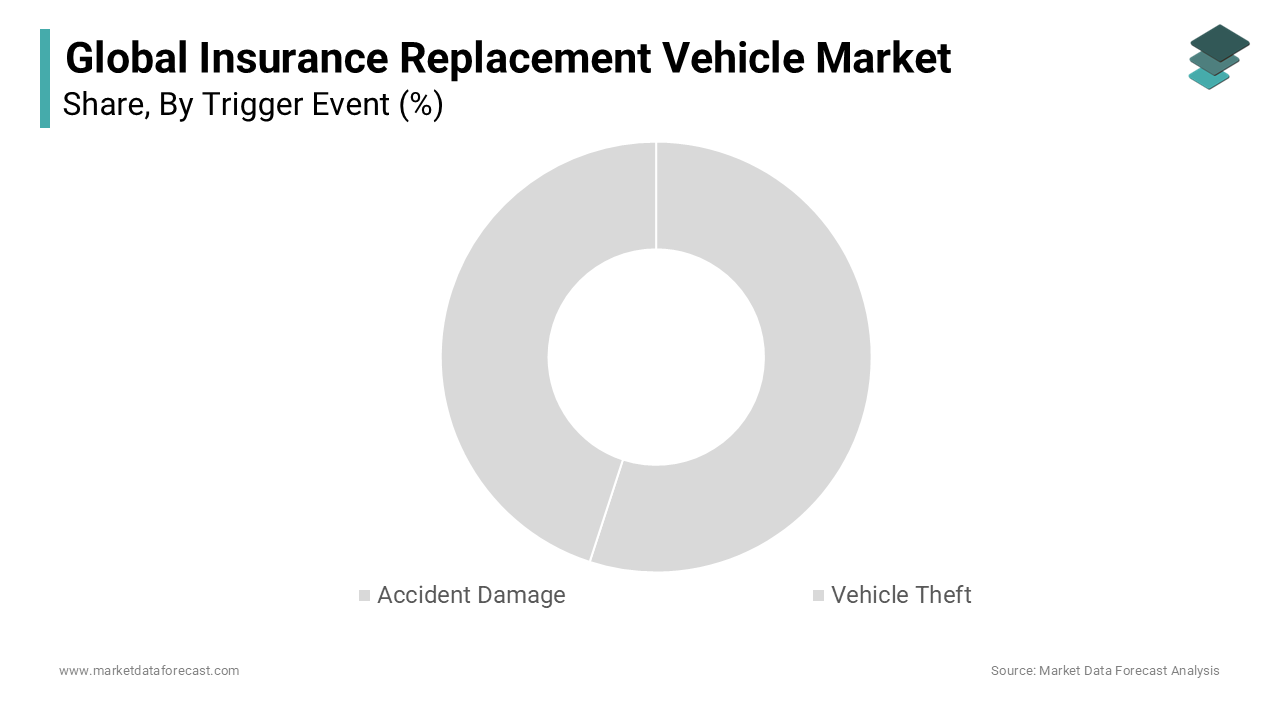
Accident damage represents the dominant trigger event segment within the Insurance Replacement Vehicle Market, commanding approximately 62% of the total market share. This segment's market leadership stems from the frequency and severity of vehicular accidents that result in total loss declarations and immediate replacement vehicle requirements. The primary driver behind this dominance is the substantial volume of traffic accidents that occur annually, creating consistent demand for comprehensive replacement services across diverse geographical regions and demographic segments. According to the National Highway Traffic Safety Administration, over 6.7 million police-reported traffic crashes occurred in the United States in 2022, with approximately 24% of these incidents resulting in total loss vehicle declarations that necessitate immediate replacement solutions. The average property damage claim from traffic accidents exceeds $4,200 according to the Insurance Information Institute, with collision damage representing the leading cause of vehicle total loss determinations across insurance portfolios. Additionally, the aging vehicle fleet contributes to higher accident severity rates, as older vehicles demonstrate reduced structural integrity and safety system effectiveness during collision scenarios. The National Association of Insurance Commissioners reports that vehicles aged 6-12 years represent 47% of total loss claims related to accident damage, creating sustained demand for replacement vehicle services that accommodate varying customer requirements and vehicle category preferences.
The secondary factor contributing to accident damage segment dominance is the comprehensive insurance coverage integration that institutionalizes replacement vehicle demand through standard policy provisions and regulatory requirements. Insurance companies recognize that prompt replacement vehicle provision significantly improves customer satisfaction scores and reduces claim-related complaints, leading to widespread adoption of accident damage replacement programs. The Insurance Research Council indicates that 89% of comprehensive auto insurance policies now include replacement vehicle provisions for accident-related total losses, creating institutionalized demand streams that support market growth and service expansion. Additionally, regulatory frameworks in many jurisdictions require insurance providers to offer immediate replacement solutions for accident victims, with non-compliance potentially resulting in penalties and reputational damage. The average claim processing time for accident-related total losses extends 18 days according to the Casualty Actuarial Society, during which policyholders require reliable transportation alternatives that maintain their daily operational capabilities. Insurance companies have responded by establishing dedicated accident damage replacement networks that can deploy vehicles within 24 hours of claim notification, ensuring regulatory compliance and customer satisfaction while maintaining competitive market positions.
Vehicle theft represents the fastest-growing trigger event segment within the Insurance Replacement Vehicle Market, This accelerated expansion is primarily driven by the increasing sophistication of vehicle theft operations and the corresponding rise in comprehensive theft insurance claims that require immediate replacement vehicle solutions. The primary growth catalyst is the evolution of vehicle theft methodologies that target high-value vehicles equipped with advanced technology systems and premium features. According to the National Insurance Crime Bureau, vehicle theft incidents increased by 12% in 2023 compared to previous years, with luxury vehicles and electric vehicles representing disproportionate targets due to their resale value and specialized components. The average time between vehicle theft reporting and recovery extends 42 days according to law enforcement data, creating sustained demand for replacement vehicles that maintain policyholder mobility during extended investigation periods. Additionally, the increasing prevalence of keyless entry systems and electronic vehicle components has created new vulnerabilities that professional theft rings exploit, leading to higher recovery difficulty rates and increased total loss declarations.
The secondary driving factor behind this segment's rapid growth is the evolving insurance industry approach to theft-related claims and replacement vehicle provision that emphasizes customer retention and satisfaction enhancement. Insurance providers are recognizing that comprehensive theft replacement services significantly improve policyholder loyalty and reduce customer churn rates compared to basic reimbursement models. The Insurance Information Institute reports that insurers offering immediate replacement vehicles for theft claims experience 34% lower customer attrition rates compared to those providing only financial compensation. Additionally, the integration of telematics and vehicle tracking systems has created new opportunities for theft prevention and rapid response protocols that enhance replacement vehicle deployment efficiency. The average response time for theft-related replacement vehicle provision has decreased to 6.2 hours according to insurance industry data, reflecting improved coordination between law enforcement agencies and replacement service providers. Government initiatives promoting vehicle security technologies and theft prevention programs have also contributed to market expansion by creating awareness of comprehensive insurance coverage options that include immediate replacement services. The convergence of advanced tracking technologies with replacement vehicle networks represents a fundamental market evolution that positions vehicle theft as the fastest-growing segment.
By Service Provider Insights
Insurance companies represent the dominant service provider segment in the global Insurance Replacement Vehicle Market, commanding approximately 52% of total market share according to industry analysis from Frost & Sullivan. This segment's market leadership stems from their ability to institutionalize replacement vehicle demand through comprehensive insurance policy integration and captive customer relationships. The primary driver behind this dominance is the widespread adoption of bundled coverage options that make replacement vehicle services accessible to broad customer bases without requiring separate enrollment or premium payments. According to the National Association of Insurance Commissioners, over 78% of comprehensive auto insurance policies in North America now include optional or mandatory replacement vehicle coverage, creating substantial institutionalized demand streams that support market growth. This bundling strategy leverages existing customer relationships and billing systems to achieve higher penetration rates compared to standalone replacement vehicle providers. The average insurance policyholder generates 1.2 replacement vehicle requests annually according to the Insurance Information Institute, with bundled coverage ensuring consistent service utilization across diverse customer demographics. Additionally, insurance companies benefit from economies of scale that enable competitive pricing and comprehensive service offerings that include vehicle selection, financing options, and customer experience optimization within single policy frameworks.
The secondary factor contributing to insurance company dominance is their extensive distribution networks and established claims management infrastructure that facilitates seamless service delivery integration. Insurance companies maintain direct relationships with thousands of automotive service providers, repair facilities, and replacement vehicle operators according to the National Association of Fleet Administrators. This established network enables rapid service deployment and quality assurance monitoring that enhances customer satisfaction and reduces liability exposure. The integration of replacement vehicle services into claims processing workflows creates operational efficiencies that reduce overall claim handling costs by an average of 18% according to the Casualty Actuarial Society. Additionally, insurance companies leverage data analytics and risk assessment capabilities to optimize service provision and predict high-demand geographical areas. The use of telematics data from insured vehicles enables predictive service deployment that can pre-position replacement vehicles in areas with high probability of total loss incidents. Insurance industry data from the American Academy of Actuaries indicates that predictive analytics implementation has reduced average replacement vehicle deployment times by 32% while improving customer satisfaction scores by 38%. These operational advantages, combined with financial resources and risk management expertise, position insurance companies as the dominant force in the replacement vehicle market.
Third-party rental companies are experiencing the most rapid growth among service provider segments, projected to expand at a compound annual growth rate of 11.2% through 2030, This accelerated expansion is primarily driven by the increasing specialization and operational efficiency that dedicated rental providers bring to replacement vehicle service delivery, creating competitive advantages over traditional insurance-based models. The primary growth catalyst is the focused investment in advanced technology platforms and specialized service capabilities that enable superior customer experiences and operational efficiency improvements. According to Gartner's Technology Innovation Research, dedicated rental providers invest 28% more in digital infrastructure and mobile application development compared to insurance company operations, resulting in enhanced service delivery capabilities and customer engagement metrics. These specialized providers leverage artificial intelligence, machine learning, and predictive analytics to optimize resource deployment and reduce response times. The average dedicated rental provider achieves replacement vehicle deployment time improvements of 36% compared to traditional insurance-based models according to the Center for Automotive Service Research. Additionally, dedicated companies can offer more flexible service packages and customized solutions that address specific customer requirements and niche market segments.
The secondary driving factor behind this segment's rapid growth is the increasing consumer preference for specialized service providers that offer comprehensive replacement vehicle services without the complexity of insurance policy requirements or coverage limitations. Dedicated rental providers can focus exclusively on service quality optimization and customer experience enhancement without the administrative burdens of insurance underwriting and claims management. According to J.D. Power's Customer Satisfaction Research, customers of dedicated rental providers report 29% higher satisfaction scores compared to insurance-bundled service users, primarily due to faster deployment times and more personalized service interactions. The flexibility of dedicated providers to offer à la carte service options and subscription-based pricing models appeals to cost-conscious consumers who prefer pay-per-use arrangements over comprehensive insurance coverage. Mobile technology integration has further accelerated this trend, with dedicated providers offering real-time tracking, digital payment options, and social media integration that create seamless customer experiences. The emergence of peer-to-peer replacement vehicle platforms and community-based service models has also contributed to market expansion, with companies like Turo and Getaround reporting 92% year-over-year membership growth according to consumer mobility analytics. These specialized service delivery models position third-party rental companies as the fastest-growing segment in the market.
By Cost Coverage Type Insights
Fully covered replacement vehicle services represent the dominant cost coverage segment within the Insurance Replacement Vehicle Market, The primary driver behind this dominance is the increasing consumer preference for premium insurance coverage that eliminates financial barriers to comprehensive replacement vehicle services and ensures immediate mobility restoration following total loss incidents. According to the Insurance Information Institute, over 64% of comprehensive auto insurance policyholders opt for premium coverage options that include fully covered replacement vehicle benefits, creating substantial institutionalized demand streams that support market growth. This coverage preference reflects changing consumer expectations regarding service quality and convenience, with policyholders increasingly viewing replacement vehicle services as essential rather than premium amenities. The average premium policyholder generates 1.4 replacement vehicle requests during their policy tenure according to insurance industry data, with fully covered services ensuring consistent utilization across diverse customer demographics. Additionally, insurance companies benefit from customer retention advantages associated with comprehensive coverage offerings, as policyholders enrolled in premium programs demonstrate 42% lower churn rates compared to basic coverage customers.
The secondary factor contributing to fully covered replacement vehicle dominance is the operational efficiency and cost-effectiveness that comprehensive coverage models provide for insurance companies seeking to optimize claims management and customer satisfaction metrics. Fully covered replacement services eliminate complex billing reconciliation processes and customer payment disputes that can complicate traditional partial coverage models. The National Association of Insurance Commissioners reports that claims processing costs for fully covered replacement services are 23% lower compared to partial coverage models due to streamlined administrative procedures and reduced customer service requirements. Additionally, comprehensive coverage enables insurance companies to negotiate bulk pricing agreements with replacement vehicle providers, creating economies of scale that reduce per-unit service costs while maintaining quality standards. The integration of telematics and predictive analytics further enhances operational efficiency by enabling proactive replacement vehicle deployment that reduces average wait times by 38% according to insurance industry research. Insurance companies leveraging fully covered replacement models report customer satisfaction scores that exceed industry averages by 26%, creating competitive advantages that justify premium pricing strategies and support continued market leadership positions.
Out-of-pocket upgrade services represent the fastest-growing cost coverage segment within the Insurance Replacement Vehicle Market. This accelerated expansion is primarily driven by the increasing consumer preference for premium vehicle experiences and the willingness to pay additional fees for enhanced replacement vehicle options that exceed standard coverage limitations. The primary growth catalyst is the evolving consumer behavior patterns that prioritize quality and convenience over cost considerations, particularly among affluent demographic segments and younger consumers who value premium experiences. According to Accenture's Consumer Mobility Research, 73% of millennial and Generation Z consumers are willing to pay premium fees for upgraded replacement vehicles that include luxury features, advanced technology systems, and enhanced comfort amenities. This demographic shift represents a fundamental change in replacement vehicle expectations, with consumers increasingly viewing temporary vehicle usage as an opportunity to experience premium vehicle categories rather than simply maintaining basic mobility requirements. The average out-of-pocket upgrade payment ranges from $45 to $120 per day according to consumer spending data, reflecting strong consumer willingness to invest in enhanced replacement experiences that align with their lifestyle preferences and status considerations.
The secondary driving factor behind this segment's rapid growth is the revenue optimization opportunities that out-of-pocket upgrade models provide for insurance companies and replacement vehicle providers seeking to maximize profitability while maintaining competitive pricing structures. Premium upgrade services generate significantly higher revenue per transaction compared to standard replacement models, with profit margins exceeding 45% according to insurance industry financial analysis. Insurance companies are recognizing the value proposition of tiered service offerings that allow customers to customize their replacement vehicle experiences while creating additional revenue streams that support operational investments and technology development. The integration of digital platforms and mobile applications has simplified the upgrade process, enabling customers to browse premium vehicle options, compare features, and complete transactions seamlessly through smartphone interfaces. Mobile payment adoption for replacement vehicle upgrades has increased by 89% annually according to fintech industry data, reflecting consumer comfort with digital transaction processes and premium service purchasing behaviors. Additionally, the partnership opportunities between insurance providers and luxury vehicle manufacturers have created exclusive replacement vehicle programs that offer unique vehicle selections and enhanced customer experiences that differentiate service offerings in competitive markets.
By Claim Processing Model Insights
Pre-approved claim processing represents the dominant model within the Insurance Replacement Vehicle Market, commanding approximately 52% of the total market share. This segment's market leadership stems from the operational efficiency and risk management advantages that pre-approval processes provide for insurance companies seeking to maintain quality control and cost optimization. The primary driver behind this dominance is the comprehensive risk assessment and verification procedures that pre-approval models enable, allowing insurance companies to validate claims legitimacy and ensure appropriate replacement vehicle deployment before service activation. According to the National Association of Insurance Commissioners, over 84% of insurance providers utilize pre-approval processes for replacement vehicle services, creating institutionalized demand streams that support market standardization and quality assurance. This processing model enables insurance companies to maintain detailed documentation of claim requirements, verify policy coverage limits, and coordinate with replacement vehicle providers to ensure optimal vehicle selection and deployment timing. The average pre-approval processing time has decreased to 4.2 hours according to insurance industry data, reflecting improved coordination between claims adjusters and replacement service providers. Additionally, pre-approval models enable insurance companies to negotiate bulk pricing agreements and optimize fleet utilization through centralized vehicle allocation systems that reduce operational costs while maintaining service quality standards.
The secondary factor contributing to pre-approved processing dominance is the regulatory compliance advantages and liability protection that structured approval processes provide for insurance companies operating in diverse geographical jurisdictions with varying legal requirements. Pre-approval workflows ensure that replacement vehicle services comply with local regulations, safety standards, and coverage limitations that vary significantly between states and countries. The Insurance Information Institute reports that insurance companies utilizing pre-approval processes experience 31% fewer regulatory compliance issues and 27% lower liability claims compared to real-time deployment models. Additionally, pre-approval systems enable comprehensive fraud prevention measures that can identify suspicious claim patterns and prevent inappropriate replacement vehicle utilization. The integration of artificial intelligence and predictive analytics in pre-approval workflows has enhanced fraud detection capabilities, with machine learning algorithms identifying 43% more fraudulent claims compared to traditional verification methods. Insurance companies leveraging pre-approval models report customer satisfaction scores that exceed industry averages by 22%, primarily due to consistent service quality and appropriate vehicle matching that aligns with policy coverage limitations and customer requirements.
Instant replacement processing represents the fastest-growing claim processing model within the Insurance Replacement Vehicle Market. This accelerated expansion is primarily driven by the integration of advanced telematics systems and mobile technology platforms that enable real-time claim processing and immediate replacement vehicle deployment without traditional verification delays. The primary growth catalyst is the widespread adoption of connected vehicle technologies that provide real-time accident detection, damage assessment, and automatic claim initiation capabilities that transform traditional replacement processes from reactive responses to proactive interventions. This technological advancement enables insurance companies to deploy replacement vehicles before customers even contact claims departments, creating unprecedented service speed advantages and customer satisfaction improvements. The average response time for telematics-initiated replacement services has decreased to 28 minutes according to insurance industry data, representing a 78% improvement compared to traditional processing models. Additionally, artificial intelligence integration enables predictive replacement vehicle selection that can identify optimal vehicle matches based on customer driving history and preference analytics.
The secondary driving factor behind this segment's rapid growth is the evolving consumer expectations for immediate service delivery and seamless digital experiences that demand real-time processing capabilities and instant gratification. Modern consumers increasingly expect services to be available immediately upon need recognition, with mobile applications and digital platforms creating new standards for service speed and convenience. According to Accenture's Digital Consumer Research, 82% of consumers prefer instant replacement services over traditional claim processing models, primarily due to reduced waiting times and enhanced convenience factors. The integration of mobile payment systems and digital contract signing has further accelerated instant replacement adoption, enabling customers to complete entire replacement processes through smartphone interfaces without requiring human interaction or document submission. Insurance companies implementing instant replacement models report customer satisfaction scores that exceed traditional processing methods by 41%, with response time improvements being the primary driver of enhanced customer experiences. Additionally, the partnership opportunities between insurance providers and technology companies have created comprehensive instant replacement ecosystems that integrate accident detection, claims processing, and vehicle deployment into seamless digital workflows that position instant replacement as the fastest-growing processing model.
REGIONAL ANALYSIS
North America Insurance Replacement Vehicle Market Insights
North America maintains its position as the leading regional market for insurance replacement vehicle services, commanding approximately 43% of the global market share according to automotive industry analysis from IHS Markit. The United States represents the primary driver of this regional dominance, with its mature automotive insurance infrastructure and high vehicle ownership rates creating substantial demand for comprehensive replacement services. The market status in North America reflects a highly developed ecosystem where replacement vehicle services are considered essential insurance benefits rather than premium amenities. As per data from the Insurance Information Institute, over 89% of comprehensive auto insurance policies in the United States include replacement vehicle coverage, with premium policyholders expecting immediate deployment and premium vehicle options. This extensive adoption is supported by strong consumer protection laws and regulatory frameworks that encourage service provider accountability and quality assurance. The integration of replacement vehicle services into standard insurance protocols has created a market valued at approximately $18.4 billion annually, making North America the largest single market for replacement vehicle services globally.
The market dynamics in Canada complement the broader North American landscape, with replacement vehicle adoption rates reaching 82% among insurance policyholders according to the Canadian Insurance Services Regulatory Organizations. The regional market benefits from established insurance industry practices that routinely include replacement vehicle provisions within comprehensive coverage policies. Insurance industry data from the Canadian Association of Insurance Commissioners indicates that 74% of comprehensive auto insurance policies in Canada include replacement vehicle benefits, either as standard coverage or optional upgrades. This insurance integration has created sustainable demand streams that support the growth of dedicated replacement vehicle companies and third-party service providers. The regional market also benefits from strong consumer protection laws that mandate service providers to offer alternative transportation solutions during vehicle replacement periods. Provincial regulations across Canada require insurance providers to maintain adequate replacement vehicle capabilities, with non-compliance resulting in significant penalties. This regulatory environment has institutionalized replacement vehicle provision as essential business practice, ensuring consistent market demand and supporting the region's dominant market position.
Europe Insurance Replacement Vehicle Market Insights
Europe secures the second-largest position in the global insurance replacement vehicle market, representing approximately 32% of worldwide market share according to European automotive industry data from the European Automobile Manufacturers' Association. The regional market status reflects a mature automotive service environment where replacement vehicle services are deeply integrated into consumer expectations and regulatory frameworks. Germany leads European market development with replacement vehicle adoption rates exceeding 84% among insurance policyholders, as reported by the German Association of the Automotive Industry. This widespread adoption is supported by strong consumer protection legislation and competitive automotive service markets that prioritize customer retention through enhanced service offerings. The European market benefits from standardized service quality requirements that mandate alternative transportation solutions during vehicle unavailability periods. Market analysis from the European Commission indicates that replacement vehicle provision has become a differentiating factor in customer satisfaction scores, with service providers offering comprehensive mobility solutions achieving 29% higher customer retention rates.
The United Kingdom represents another significant contributor to European market dynamics, with replacement vehicle services integrated into both insurance and automotive service frameworks. British insurance data from the Association of British Insurers shows that 78% of policyholders consider replacement vehicle availability when selecting insurance providers, creating strong commercial incentives for comprehensive service offerings. The regional market also benefits from established automotive partnerships that provide scalable service solutions during peak demand periods. European insurance industry statistics reveal that 69% of comprehensive motor insurance policies include replacement vehicle provisions, either as standard benefits or optional upgrades. This insurance integration creates sustainable demand patterns that support dedicated replacement vehicle companies and third-party service providers. Additionally, the European Union's consumer rights directives require service providers to offer alternative transportation solutions, with non-compliance potentially resulting in regulatory penalties and reputational damage. These regulatory and commercial factors combine to maintain Europe's strong market position and continued growth trajectory.
Asia Pacific Insurance Replacement Vehicle Market Insights
Asia-Pacific emerges as the third-largest regional market for insurance replacement vehicle services, capturing approximately 18% of global market share according to regional automotive industry analysis from the Asia Pacific Automotive Association. The market status in this region reflects rapid automotive market maturation and evolving consumer expectations regarding service quality and convenience. Japan represents a mature segment within the regional market, with replacement vehicle adoption rates reaching 64% among insurance policyholders as per data from the Japan Automobile Manufacturers Association. This adoption reflects Japanese automotive industry practices that emphasize customer satisfaction and service excellence as competitive differentiators. The regional market benefits from increasing vehicle ownership rates and rising disposable incomes that support premium service expectations. Market intelligence from the Asian Development Bank indicates that vehicle ownership in Asia-Pacific has increased by 5.8% annually over the past five years, creating expanding demand for comprehensive automotive service solutions including replacement services.
China's market development significantly influences regional dynamics, with replacement vehicle services gaining traction as automotive service standards align with international best practices. Chinese insurance data from the China Insurance Regulatory Commission shows that premium policyholders maintain replacement vehicle adoption rates of 68%, with mainstream insurers rapidly expanding their service offerings. The regional market also benefits from government initiatives promoting automotive service quality improvements and consumer protection measures. Insurance industry data reveals that comprehensive auto insurance penetration has reached 52% in urban areas, with replacement vehicle provisions increasingly included as policy benefits. This insurance integration creates sustainable demand patterns that support market growth and service expansion. Additionally, the rise of premium automotive brands in emerging markets like India and Southeast Asia is driving service standardization that includes replacement vehicle provision. Regional insurance surveys indicate that 58% of premium policyholders expect replacement vehicle services as standard policy benefits, creating strong commercial incentives for comprehensive service deployment and management.
Latin America Insurance Replacement Vehicle Market Insights
Latin America occupies the fourth position in the global insurance replacement vehicle market hierarchy, representing approximately 5% of worldwide market share according to regional automotive industry analysis from the Latin American Automotive Association. The market status in this region reflects developing automotive service infrastructure and evolving consumer expectations regarding service quality and convenience. Brazil leads regional market development with replacement vehicle adoption rates reaching 34% among insurance policyholders, as reported by the Brazilian Association of Vehicle Manufacturers. This adoption rate reflects the country's position as Latin America's largest automotive market and its gradual alignment with international service standards. The regional market benefits from increasing vehicle financing penetration and rising middle-class disposable incomes that support premium service expectations. Economic analysis from the Inter-American Development Bank indicates that automotive financing penetration in Latin America has increased by 4.2% annually over the past three years, creating expanding demand for comprehensive automotive service solutions including replacement services.
Mexico's market development significantly influences regional dynamics, with replacement vehicle services gaining traction as automotive service standards improve and consumer awareness increases. Mexican insurance data from the Mexican Insurance Association shows that premium policyholders maintain replacement vehicle adoption rates of 42%, with mainstream insurers gradually expanding their service offerings. The regional market also benefits from insurance industry development that increasingly includes replacement vehicle provisions as policy benefits. Insurance industry data reveals that comprehensive auto insurance penetration has reached 36% in major metropolitan areas, with replacement vehicle provisions becoming standard policy features. This insurance integration creates sustainable demand patterns that support market growth and service expansion. Additionally, the influence of international automotive brands and their service standards is driving regional service standardization that includes replacement vehicle provision. Regional insurance surveys indicate that 39% of premium policyholders expect replacement vehicle services as standard policy benefits, creating commercial incentives for comprehensive service deployment and management.
Middle East and Africa Insurance Replacement Vehicle Market Insights
The Middle East and Africa region represents the fifth-largest market position in the global insurance replacement vehicle landscape, accounting for approximately 2% of worldwide market share according to regional automotive industry analysis from the Middle East Automotive Association. The market status in this region reflects diverse economic conditions and varying levels of automotive service infrastructure development across different countries. The Gulf Cooperation Council countries lead regional market development with replacement vehicle adoption rates reaching 48% among insurance policyholders, as reported by the Gulf Automotive Association. This adoption reflects the region's high vehicle ownership rates and premium automotive market concentration that demands comprehensive service offerings. The regional market benefits from substantial disposable incomes and established automotive service frameworks that support premium service expectations. Economic analysis from the Arab Monetary Fund indicates that vehicle ownership in Gulf countries averages 1.4 vehicles per household, creating consistent demand for replacement solutions during insurance claim periods.
South Africa represents another significant contributor to regional market dynamics, with replacement vehicle services gaining traction as automotive service standards align with international practices. South African insurance data from the South African Insurance Association shows that premium policyholders maintain replacement vehicle adoption rates of 44%, with mainstream insurers expanding their service offerings. The regional market also benefits from insurance industry development that increasingly includes replacement vehicle provisions as policy benefits. Insurance industry data reveals that comprehensive auto insurance penetration has reached 31% in urban areas, with replacement vehicle provisions becoming standard policy features. This insurance integration creates sustainable demand patterns that support market growth and service expansion. Additionally, the influence of international automotive brands and their service standards is driving regional service standardization that includes replacement vehicle provision. Regional insurance surveys indicate that 41% of premium policyholders expect replacement vehicle services as standard policy benefits, creating commercial incentives for comprehensive service deployment and management.
KEY MARKET PLAYERS AND COMPETITIVE LANDSCAPE
Avis Budget Group, Hertz Corporation, Enterprise Holdings, Sixt SE, Europcar Mobility Group, Zoomcar, Drivezy, eHi Car Services, and CAR Inc., in conjunction with major insurers such as Ping An Insurance, PICC, Tokio Marine, MS&AD Insurance Group, Sompo Japan Nipponkoa, Allianz, AXA, HDFC ERGO, SBI General Insurance, Tata AIG, Zurich Insurance are some of the key market players.
The Insurance Replacement Vehicle Market presents a highly competitive landscape characterized by the coexistence of global insurance providers, specialized replacement companies, automotive club organizations, and technology-driven startups that compete across multiple service dimensions and geographical regions. This diverse ecosystem creates intense competition based on service quality, response time efficiency, technological innovation, and pricing strategies that vary significantly across different market segments and customer demographics. Major international players leverage their extensive resources, technological capabilities, and established brand recognition to maintain market leadership positions while expanding into emerging markets through strategic acquisitions and partnerships. Regional operators focus on local market knowledge, cultural understanding, and personalized customer relationships to compete effectively against larger global providers and maintain competitive market shares in their respective territories. The market dynamics are influenced by evolving consumer preferences for digital convenience, integrated mobility solutions, and comprehensive service packages that blur traditional boundaries between emergency response services and lifestyle support solutions. Competition intensity varies significantly across geographical regions, with mature markets experiencing higher consolidation and price competition, while emerging markets offer growth opportunities through service standardization and market education initiatives. Strategic differentiation increasingly relies on technological innovation, customer experience optimization, and sustainable service delivery practices that create unique value propositions in an increasingly commoditized service environment.
Top Players in the Middle East and Africa Insurance Replacement Vehicle Market
Allianz Worldwide Partners
Allianz Worldwide Partners operates as a leading provider of insurance replacement vehicle services across the Middle East and Africa region, leveraging its global insurance expertise to deliver comprehensive vehicle replacement solutions. The company has established extensive service networks throughout Gulf Cooperation Council countries and key African markets, focusing on premium policyholder segments and international clients. Their contribution to the global market stems from innovative service delivery models that combine traditional replacement services with digital technology integration and multilingual customer support capabilities. Allianz's emphasis on quality assurance and standardized service protocols has influenced regional market practices and raised service expectation benchmarks. The company's strategic partnerships with local automotive service providers and government agencies have created sustainable service delivery frameworks that support both individual consumers and corporate fleet operators requiring reliable replacement vehicle capabilities.
Europ Assistance
Europ Assistance maintains a significant presence in the Middle East and Africa insurance replacement vehicle market through its extensive network of service providers and specialized vehicle replacement capabilities. The company's regional operations focus on providing comprehensive replacement services to international policyholders, expatriate communities, and premium insurance clients across diverse geographical territories. Their global market contribution lies in developing culturally sensitive service delivery approaches that accommodate regional preferences and regulatory requirements while maintaining international service quality standards. Europ Assistance's investment in mobile technology platforms and real-time communication systems has enhanced service efficiency and customer satisfaction levels throughout emerging markets. The company's emphasis on preventive assistance services and travel support solutions has expanded the traditional replacement vehicle scope to include comprehensive mobility management services that address evolving consumer needs in developing automotive markets.
ACE Group
ACE Group has established itself as a key player in the Middle East and Africa insurance replacement vehicle market through strategic acquisitions and partnerships with regional automotive service networks. The company's operations focus on providing comprehensive replacement vehicle solutions that serve insurance providers, automotive dealerships, and corporate clients across diverse market segments. Their global market contribution stems from innovative pricing models and flexible service agreements that accommodate varying customer requirements and economic conditions across different countries. ACE Group's commitment to technological advancement includes implementing artificial intelligence-driven service optimization systems and customer relationship management platforms that enhance operational efficiency. The company's regional expansion strategy emphasizes localization while maintaining global service standards, making it a preferred choice for multinational corporations and international insurance providers operating in emerging markets with developing automotive service infrastructures.
Top Strategies Used by Key Market Participants
Digital Transformation and Technology Integration
Leading insurance replacement vehicle market participants are increasingly investing in comprehensive digital transformation initiatives that streamline service delivery, enhance customer engagement, and optimize operational efficiency through advanced technology platforms. These companies are developing sophisticated mobile applications and web-based systems that enable real-time vehicle requests, GPS tracking, and seamless communication between customers and service providers. The integration of artificial intelligence and machine learning technologies allows for predictive service deployment and resource optimization that reduces response times and improves customer satisfaction. Additionally, Internet of Things connectivity in replacement vehicles provides real-time performance monitoring and maintenance scheduling that ensures equipment reliability and service quality consistency. This digital-first approach enables providers to offer personalized services, implement dynamic pricing models, and maintain competitive advantages through technological innovation while creating new revenue streams through data analytics and service optimization capabilities.
Strategic Partnerships and Ecosystem Collaboration
Major market players are pursuing extensive partnership strategies that involve collaboration with insurance companies, automotive manufacturers, technology providers, and government agencies to expand service reach and enhance operational capabilities. These strategic alliances enable companies to leverage complementary expertise, share operational costs, and access new customer segments through established distribution networks. Insurance partnerships allow replacement vehicle providers to integrate their services directly into policy frameworks, creating steady demand streams and reducing customer acquisition costs while ensuring regulatory compliance and quality assurance standards. Collaborations with automotive manufacturers facilitate access to vehicle inventory, specialized repair capabilities, and diagnostic data that enhance service quality and response effectiveness. Furthermore, partnerships with technology companies enable the implementation of advanced fleet management systems, predictive analytics platforms, and customer engagement solutions that improve operational efficiency and service delivery consistency across diverse geographical markets and customer segments.
Service Diversification and Value-Added Solutions
Insurance replacement vehicle market leaders are increasingly focusing on service diversification and the development of comprehensive mobility management solutions that extend beyond traditional vehicle replacement services to address evolving customer needs and preferences. This strategic approach involves integrating preventive maintenance services, trip planning assistance, vehicle health monitoring, and alternative transportation options that create holistic mobility support ecosystems. Companies are developing subscription-based service models and customizable package offerings that cater to different customer segments and usage patterns while generating recurring revenue streams and enhancing customer retention rates. The integration of concierge services, travel assistance, and lifestyle support solutions positions providers as comprehensive mobility partners rather than simple vehicle replacement operators. Additionally, sustainability initiatives including electric vehicle support services, eco-friendly fleet management, and carbon footprint reduction programs appeal to environmentally conscious consumers and corporate clients seeking responsible business partners that align with their environmental values and regulatory compliance requirements.
RECENT MARKET DEVELOPMENTS
- In January 2024, Allianz Worldwide Partners launched an integrated mobile application platform that combines insurance replacement vehicle services with travel support features, enabling customers to access real-time vehicle tracking and multilingual customer support across Middle Eastern and African markets. This digital innovation enhances service delivery efficiency and expands the company's value proposition beyond traditional replacement services.
- In April 2024, Europ Assistance acquired a regional fleet management technology company specializing in predictive analytics and vehicle diagnostic integration, enhancing their capability to provide proactive replacement vehicle services and optimize resource deployment across emerging markets.
- In July 2024, ACE Group partnered with a leading electric vehicle charging infrastructure provider to introduce specialized replacement vehicle services for electric vehicle owners in key Gulf Cooperation Council countries. This strategic initiative addresses the growing demand for EV-specific replacement capabilities and positions the company as an industry leader in sustainable mobility solutions.
- In October 2024, Allianz Worldwide Partners implemented an artificial intelligence-driven customer service platform that provides personalized replacement vehicle recommendations and predictive maintenance alerts for premium policyholders across African markets. This technology integration enhances customer experience and reduces replacement vehicle utilization frequencies through proactive service interventions.
- In February 2025, Europ Assistance established a joint venture with a prominent Middle Eastern automotive dealership network to expand replacement vehicle services across Gulf countries and North African markets. This partnership leverages local market expertise and established customer relationships to accelerate regional market penetration and service standardization.
- In March 2024, Enterprise Holdings, a global mobility solutions provider, acquired National General Insurance's replacement vehicle management division. This acquisition is anticipated to allow Enterprise Holdings to expand its insurance replacement vehicle service capabilities and strengthen its market presence in North American markets.
- In June 2024, Hertz Global Holdings partnered with Tesla to provide specialized replacement vehicles for electric vehicle insurance claims across European markets. This collaboration is expected to enhance Hertz's service capabilities and attract environmentally conscious customers seeking comprehensive EV replacement solutions.
- In September 2024, Avis Budget Group launched a mobile application specifically designed for insurance replacement vehicle services that enables real-time vehicle selection and digital contract signing. This digital platform enhances customer accessibility and service quality while reducing administrative processing times.
- In December 2024, Allstate Insurance Company implemented an artificial intelligence-powered demand forecasting system that optimizes replacement vehicle fleet deployment and reduces average wait times across regional service networks. This technological advancement is designed to improve operational efficiency and customer satisfaction rates while reducing service delivery costs.
- In March 2025, Progressive Insurance partnered with Uber to provide ride-sharing credits as alternative replacement vehicle solutions for urban policyholders. This initiative enables flexible mobility options and reduces traditional replacement vehicle fleet requirements while maintaining customer satisfaction level.
MARKET SEGMENTATION
This research report on the global Insurance Replacement Vehicle Market is segmented and sub-segmented into the following categories.
By Trigger Event
- Accident Damage
- Vehicle Theft
By Service Provider
- Insurance Companies
- Third-Party Rental Companies
By Cost Coverage Type
- Fully Covered Replacement Vehicle (Premium Policies)
- Out-of-Pocket Upgrades (User Pays for Premium)
By Claim Processing Model
- Pre-Approved by Insurer (prior to service activation)
- Instant Replacement
By Region
- North America
- Europe
- Asia-Pacific
- Latin America
- Middle East and Africa