- Product Description Description
- Table of Contents TOC
- List of Table & Figure LOT
- Get Free Sample PDF Sample PDF
Market Size, 2025
$11.23 BnMarket Estimate, 2026
$12.52 BnMarket Forecast, 2034
$29.91 BnCAGR, 2026–2034
11.5%Executive Summary: Global Intelligent Process Automation Market
- Market Scope: Global intelligent process automation market analysis covering components, technologies, industry verticals, and regional leadership frameworks.
- Market Valuation: Valued at USD 11.23 billion (2025), estimated at USD 12.52 billion (2026), and projected to reach USD 29.91 billion by 2034, registering a robust CAGR of 11.5% (2026–2034).
- Primary Growth Drivers: Increased adoption of automation to transform work environments, rising investments in digital transformation by large firms, and the development of unified intelligent automation tools. Current trends highlight AI-RPA integration to enhance productivity without human intervention and expanding adoption within BFSI and utility sectors.
Key Market Segment Metrics (2026–2034)
| Category | Leading Segment (2025 Position) | Fastest-Growing Segment |
|---|---|---|
| By Component & Technology | Solution segment (dominated) & Machine learning (accounted for over 32% of overall industry share) | Solution segment (expected to grow at a CAGR of 16.0%) |
| By Industry Vertical | BFSI segment (represented the most significant market share by automating compliance and data tasks) | Utility and healthcare automation sectors |
| By Deployment / Service | Enterprise-grade integrated cloud and on-premise platforms | Cloud-native intelligent automation services |
| By Region | North America (largest region with 32.84% share in 2025 due to higher automation adoption and mobile penetration) | Europe (expected to represent 27.17% of the worldwide market with expanding enterprise integration) |
Major Market Players & Market Structure
Market Structure: Highly competitive automation and software ecosystem featuring major global technology leaders competing intensely on machine learning portfolios, natural language generation, RPA integration, and scalable enterprise workflow solutions.
Key Companies: UiPath, Inc. (US), SAP SE (Germany), Dell EMC Corp. (US), Blue Prism Group (UK), IBM Corporation (US), Salesforce.com, Inc. (US), WorkFusion (US), Accolade/Accelirate, Inc. (US), Kofax Inc. (US), Pegasystems Inc. (US), and Open Text Corp. (Canada).
Global Intelligent Process Automation Market Size
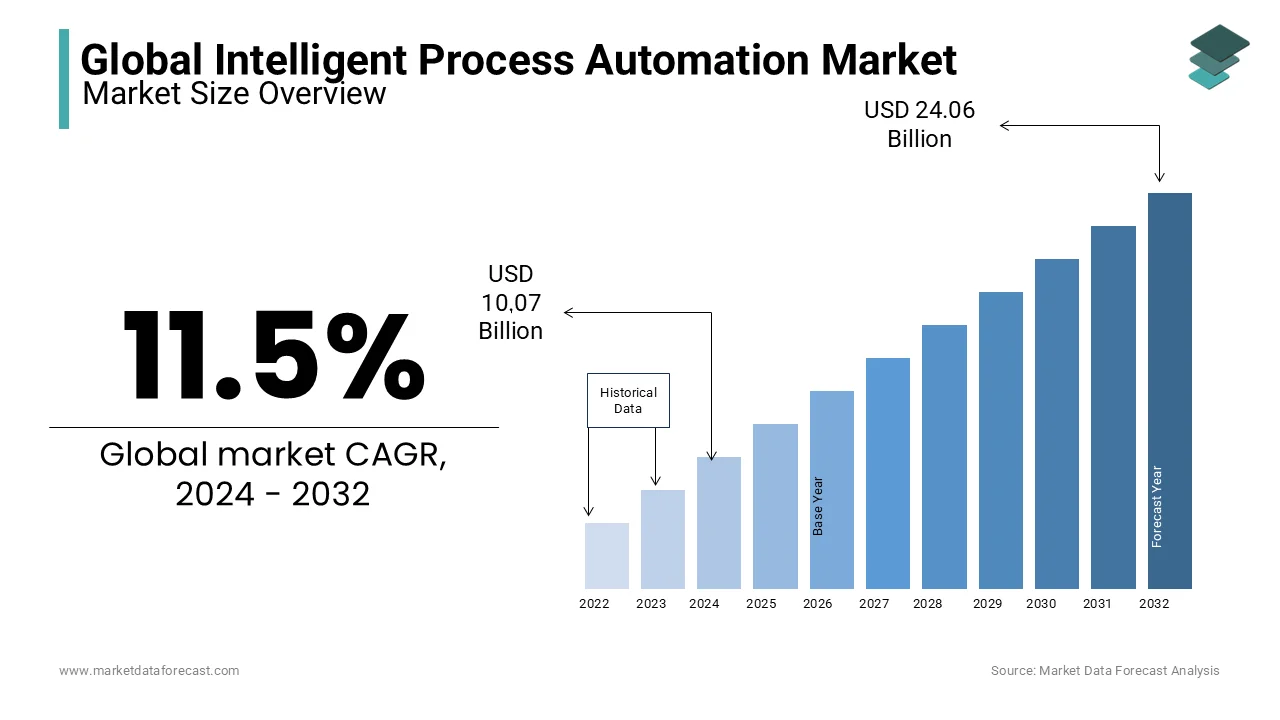
The global Intelligent process automation market was valued at USD 11.23 billion in 2025 and is anticipated to reach a valuation of USD 12.52 billion in 2026 and USD 29.91 billion by 2034, growing at a compound annual growth rate (CAGR) of 11.5 % during the forecast period from 2026 to 2034.
Current Introduction and Definition of the Intelligent Process Automation Market
The intelligent process automation is the strategic convergence of robotic process automation with artificial intelligence technologies, including machine learning, natural language processing, and computer vision to automate complex end to end business workflows that require cognitive judgment rather than simple rule based execution. According to the World Economic Forum Future of Jobs Report 2025, approximately 39% of core workplace skills are expected to change within the next 5 years creating urgent organizational pressure to augment human capabilities through intelligent automation platforms. The global spending on AI centric business process services in 2024 reflects enterprise prioritization of cognitive automation over legacy system modernization. As per the study, generative AI and related intelligent automation technologies could add between 2.6 trillion and 4.4 trillion dollars annually to global economic output through productivity enhancements across knowledge work functions.
MARKET DRIVERS
Generative AI Integration Expanding Cognitive Automation Boundaries
The incorporation of large language models and generative AI into automation platforms is substantially fuelling the growth of the intelligent process automation market. According to Deloitte’s State of Generative AI in Enterprise Q3 2024 survey, 78% of organizations have deployed or piloted generative AI integrated automation solutions with document processing and customer service representing top use cases due to immediate ROI visibility. As per Accenture research, combining generative AI with traditional RPA increases process automation coverage from 30% to 65% for insurance claims handling reducing manual intervention requirements substantially. AI Center platform experienced 340% year over year growth in 2024, as enterprises upgraded existing bot fleets with language model capabilities enabling handling of email correspondence contract analysis and code generation without custom development. Unlike previous automation waves limited to structured inputs generative AI enables processing of unstructured text images and audio at near human comprehension levels unlocking back office functions long considered automation resistant. This technological inflection point transforms intelligent process automation from efficiency tool to capability multiplier allowing organizations to scale knowledge work output without proportional headcount increases addressing structural labor shortages, while maintaining service quality standards during peak demand periods.
Operational Resilience Imperatives Accelerating Digital Workforce Adoption
Enterprises increasingly view intelligent process automation as crucial infrastructure for maintaining business continuity amid workforce volatility supply chain disruptions and regulatory complexity rather than discretionary cost optimization initiative. The operational resilience imperative is accelerating the growth of the intelligent process automation market. As per the Everest Group, companies deploying intelligent process automation achieved 40% faster recovery times during disruption events compared to peers relying solely on manual contingency plans validating resilience value proposition beyond efficiency metrics. Financial services firms subject to evolving compliance requirements utilize intelligent automation for real time transaction monitoring and regulatory reporting adapting to rule changes through configuration updates rather than retraining programs taking weeks or months. This risk mitigation dimension creates budget justification independent of ROI calculations positioning intelligent process automation as insurance policy against operational fragility in uncertain macroeconomic environments where traditional workforce planning assumptions no longer hold reliably.
MARKET RESTRAINTS
Legacy System Integration Complexity Hindering Scalability
Despite advanced AI capabilities, intelligent process automation deployments frequently stall when connecting to outdated enterprise applications lacking modern APIs creating technical debt that undermines scalability and maintenance sustainability. The legacy system integration complexity is impeding the growth of the intelligent process automation market. According to Forrester Wave Intelligent Automation Platforms Q4 2024 assessment, implementation failures trace to integration challenges with mainframe ERP and proprietary databases rather than AI model performance deficiencies. The organizations spend average total intelligent automation project budgets on legacy system connectors and middleware development diverting resources from value adding cognitive capabilities. Screen scraping and UI automation techniques used as workarounds create fragile dependencies breaking with application updates requiring constant maintenance overhead that erodes productivity gains. Many enterprises operate hybrid IT environments where critical data resides across disconnected systems making end to end process automation architecturally impossible without costly core system modernization.
Data Governance Deficiencies Undermining AI Reliability
The intelligent process automation effectiveness depends fundamentally on data quality accessibility and governance frameworks that most organizations lack creating reliability gaps preventing production deployment at scale. The data governance deficiencies undermining AI reliability is additionally degrading the growth of the intelligent process automation market. According to the research, poor data quality costs organizations average 12.9 million dollars annually with automated processes amplifying errors exponentially compared to manual review checkpoints catching anomalies. The financial institutions delayed intelligent automation rollouts due to inability to validate training data lineage and bias detection meeting regulatory examination standards. Unstructured data sources like emails documents and call transcripts contain inconsistencies formatting variations and missing context that degrade AI model accuracy requiring extensive preprocessing pipelines adding complexity and latency. Privacy regulation including GDPR CCPA and sector specific mandates restrict data access for model training creating compliance overhead that slows development cycles. Organizations lacking mature data cataloging metadata management and stewardship practices discover that intelligent automation exposes rather than solves underlying information governance weaknesses forcing remediation investments before automation benefits materialize effectively delaying time to value significantly beyond initial projections.
MARKET OPPORTUNITIES
Autonomous Agent Architectures Enabling End to End Orchestration
The emerging autonomous agent frameworks moving beyond task level automation toward goal oriented multi step workflow orchestration with minimal human supervision, which is augmented in fostering new opportunities for the growth of the intelligent process automation market. According to Microsoft Work Trend Index 2025, business leaders plan to deploy AI agents for complex cross functional processes within 18 months citing ability to handle exceptions and coordinate multiple systems autonomously as key differentiator. As per the study, autonomous agent implementations in IT service management achieved 70% first contact resolution rates compared to 35% for traditional chatbot approaches validating superior reasoning capabilities. Unlike scripted workflows failing at unexpected decision points autonomous agents leverage reinforcement learning and tool use patterns adapting dynamically to novel scenarios while maintaining audit trails for compliance. This architectural evolution expands addressable market from repetitive back office tasks to professional services sales operations and strategic planning functions previously considered too variable for automation. Early adopters gain competitive advantages through faster cycle times reduced coordination overhead and enhanced employee experience as humans focus on exception handling and relationship building rather than routine process execution creating sustainable differentiation in talent constrained markets.
Industry Specific Vertical Solutions Capturing Domain Expertise
Specialized intelligent process automation solutions embedding industry knowledge regulatory frameworks and pre trained models present significant opportunity to reduce implementation risk and accelerate time to value for sector specific use cases. The industry specific vertical solutions capturing domain expertise is additionally to fuel the growth of the intelligent process automation makret. The vertical specific solutions grew 48% year over year outpacing horizontal platform growth by 2.3 times as buyers prioritize domain relevance over generic capabilities, according to the study. Research from Guidewire indicates insurance carriers deploying claims specific intelligent automation realized faster settlement versus customized general purpose implementations due to pre built damage assessment models and policy interpretation logic. Healthcare revenue cycle management solutions integrating coding guidelines payer rules and denial prediction models demonstrate similar advantages reducing implementation timelines from 12 months to 4 months, according to data. This specialization trend creates defensible market positions for vendors developing deep domain expertise while enabling customers to bypass lengthy discovery and model training phases. As regulatory complexity increases across sectors, demand for compliant by design automation solutions grows, creating premium pricing opportunities and recurring revenue streams through continuous regulatory update subscriptions tied to evolving industry standards.
MARKET CHALLENGES
Algorithmic Transparency Requirements Conflicting with Model Complexity
The regulatory demands for explainable AI decisions conflict fundamentally with deep learning model architectures powering advanced intelligent process automation is to act as a barrier for the growth of the intelligent process automation market. According to European Union AI Act enforcement guidelines effective 2025, high risk automated decision systems must provide meaningful explanations of outputs yet state of art language models operate as statistical black boxes resisting post hoc interpretation methods satisfying legal standards. As per the research, financial institutions suspended credit underwriting automation projects due to inability to satisfy fair lending examination requirements demanding causal reasoning rather than correlation based predictions. Healthcare diagnostic automation faces similar constraints where clinicians require understandable rationale for treatment recommendations not just probability scores. Legal liability frameworks remain undefined for erroneous autonomous decisions creating uninsurable exposure deterring enterprise adoption despite demonstrated accuracy advantages over human baselines. This transparency paradox constrains intelligent process automation to low-stakes applications, while highest value regulated processes remain manual awaiting breakthroughs in interpretable AI architectures or regulatory acceptance of performance-based validation replacing explanation requirements entirely.
Change Management Resistance Undermining User Adoption
The employee awareness fear of displacement and workflow disruption frequently undermine intelligent process automation success, despite technical readiness creating adoption gaps that prevent realization of projected benefits. The change management resistance undermining user adoption is also to decline the growth of the intelligent process automation market. According to Harvard Business Review Analytic Services 2024 survey, 67% of intelligent automation initiatives failed to achieve target adoption rates due to inadequate change management and user engagement strategies rather than technology shortcomings. The employees distrust AI generated outputs without human validation creating shadow review processes that negate efficiency gains and introduce new error sources through inconsistent override behaviors. Middle managers often resist automation threatening perceived team value and budget allocations creating passive sabotage through delayed approvals and negative framing to subordinates. Successful deployments require reframing automation as augmentation rather than replacement involving users in design co creation and establishing clear career pathways leveraging new skills.
REPORT COVERAGE
| REPORT METRIC | DETAILS |
| Market Size Available | 2025 to 2034 |
| Base Year | 2025 |
| Forecast Period | 2026 to 2034 |
| CAGR | 11.5%. |
| Segments Covered | By Component, Technology, Deployment Mode, Organization Size, Application, Industry Verticals, and Region |
| Various Analyses Covered | Global, Regional & Country Level Analysis, Segment-Level Analysis, DROC, PESTLE Analysis, Porter’s Five Forces Analysis, Competitive Landscape, Analyst Overview on Investment Opportunities |
| Regions Covered | North America, Europe, APAC, Latin America, Middle East & Africa |
| Market Leaders Profiled | UiPath, Inc. (US), SAP SE (Germany), Dell EMC Corp. (US), Blue Prism Group (UK), IBM Corporation (US), Salesforce.com, Inc. (US), WorkFusion (US), Accelirate, Inc. (US), Kofax Inc. (US), Pegasystems Inc. (US), Open Text Corp. (Canada), among others |
SEGMENTAL ANALYSIS
By Component Insights
The solutions segment was accounted in holding 56.2% of the intelligent process automation market share in 2025 with the strategic shift toward platform based consumption models where organizations seek unified environments combining RPA AI and analytics rather than assembling fragmented point solutions. As per the study, platform license and subscription revenue constituted 68% of total market spend in 2024, reflecting buyer preference for consolidated vendor relationships reducing integration complexity and maintenance overhead. Major vendors like UiPath Microsoft and ServiceNow have successfully bundled cognitive capabilities into core offerings making AI features table stakes rather than premium add ons thereby inflating solution segment values. This consolidation trend accelerates as CIOs mandate standardized enterprise-wide automation platforms to govern security compliance and scalability preventing shadow IT proliferation. Consequently, capital allocation favors comprehensive solution acquisitions enabling immediate deployment across multiple use cases versus incremental service engagements delivering narrower scope with higher long term operational costs and vendor dependency risks.
The process discovery and mining tools represent the fastest growing component segment in the intelligent process automation market with a projected compound annual growth rate of 34.8% through 2030 driven by the critical need to identify high value automation opportunities objectively before implementation. The first key growth factor is the widespread failure of traditional workshop based process assessment methods leading organizations to adopt data driven discovery techniques validating actual workflows versus documented procedures. As per the survey, their platform analyzed over 100 billion transaction records in 2024, uncovering hidden inefficiencies worth average 12 million dollars per enterprise customer annually demonstrating tangible value justification for discovery tool investments.
The solutions segment held a dominant share of the intelligent process automation market in 2025 with the majority of revenue as enterprises prioritize acquiring integrated software platforms over standalone services or tools. The strategic shift toward platform-based consumption models, where organizations seek unified environments combining RPA AI and analytics rather than assembling fragmented point solutions. Major vendors like UiPath Microsoft and ServiceNow have successfully bundled cognitive capabilities into core offerings making AI features table stakes rather than premium add ons thereby inflating solution segment values. This consolidation trend accelerates as CIOs mandate standardized enterprise-wide automation platforms to govern security compliance and scalability preventing shadow IT proliferation. Consequently, capital allocation favors comprehensive solution acquisitions enabling immediate deployment across multiple use cases versus incremental service engagements delivering narrower scope with higher long term operational costs and vendor dependency risks.
The pocess discovery and mining tools segment is deemed to register a fastest CAGR of 34.8% throughout the forecast period with the crucial need to identify high value automation opportunities objectively before implementation. The widespread failure of traditional workshop based process assessment methods leading organizations to adopt data driven discovery techniques validating actual workflows versus documented procedures. According to report, companies using process mining identified 40% more automation candidates and achieved 2.5 times higher ROI on implemented bots compared to those relying solely on stakeholder interviews and manual documentation review. This evidence based approach de risks automation portfolios by prioritizing initiatives with proven frequency volume and standardization levels maximizing return on limited implementation resources.
By Technology Insights
The robotic process automation segment held a significant share of the intelligent process automation market in 2025 with the unparalleled ability to integrate with legacy systems without API modifications enabling automation in brownfield environments where most enterprise data and transactions reside. While AI provides cognitive capabilities, RPA provides hands executing actions across disparate applications bridging integration gaps that would otherwise require costly system modernization. This complementary relationship ensures RPA remains relevant even as AI advances because cognitive insights must ultimately translate into system transactions to create business value. Organizations view RPA as proven low risk entry point establishing automation governance centers of excellence and change management practices before layering advanced AI reducing transformation risk.
The natural language processing segment is likely to grow at a fastest CAGR of 41.2% throughout the forecast period with the generative AI breakthroughs unlocking unstructured text processing at unprecedented scale and accuracy. The explosion of enterprise use cases involving email document and chat processing that previously resisted automation due to linguistic variability now addressed by large language models is also boosting the growth of the intelligent process automation market. Unlike previous NLP generations requiring extensive custom training for narrow domains, modern foundation models demonstrate zero shot generalization across diverse business contexts dramatically reducing implementation effort and specialist dependency. This accessibility democratizes NLP adoption beyond data science teams enabling business users to configure text processing through natural language prompts rather than coding expanding addressable user base exponentially.
By Application Insights
The business process automation segment was the largest by accounting for 34.2% of the intelligent process automation market share in 2025. Unlike vertical specific applications requiring domain expertise and custom development, BPA leverages horizontal processes common across organizations enabling solution standardization and reuse accelerating deployment velocity. Finance functions serve as typical entry points due to high transaction volumes clear ROI metrics and executive sponsorship from CFOs controlling automation budgets. Success in finance creates internal advocacy and proof points justifying expansion to HR supply chain and other functions creating organic growth momentum within enterprises. This land and expand dynamic ensures BPA maintains leadership as starting point for automation journeys regardless of eventual specialization creating sustained baseline demand independent of emerging application trends.
The customer experience management segment is esteemed to grow at a fastest CAGR of 38.5% throughout the forecast period with the rising consumer expectations and competitive differentiation pressures in digital first economy. The integration of generative AI enabling personalized responsive customer interactions at scale that were previously cost prohibitive with human agents or inadequate with rule based chatbots. AI assisted customer service resolutions increased in 2024 with satisfaction scores matching human agent performance for routine inquiries validating technology readiness for production deployment. Unlike back office automation focused on cost reduction CX automation drives revenue through improved retention conversion and lifetime value creating dual justification appealing to both CFOs and CMOs. Digital native competitors setting new service standards force incumbents to match capabilities or lose share creating competitive urgency independent of ROI calculations. Social media amplification of poor experiences raises reputational stakes making CX automation risk mitigation investment as much as growth enabler.
REGIONAL ANALYSIS
North America Market Analysis
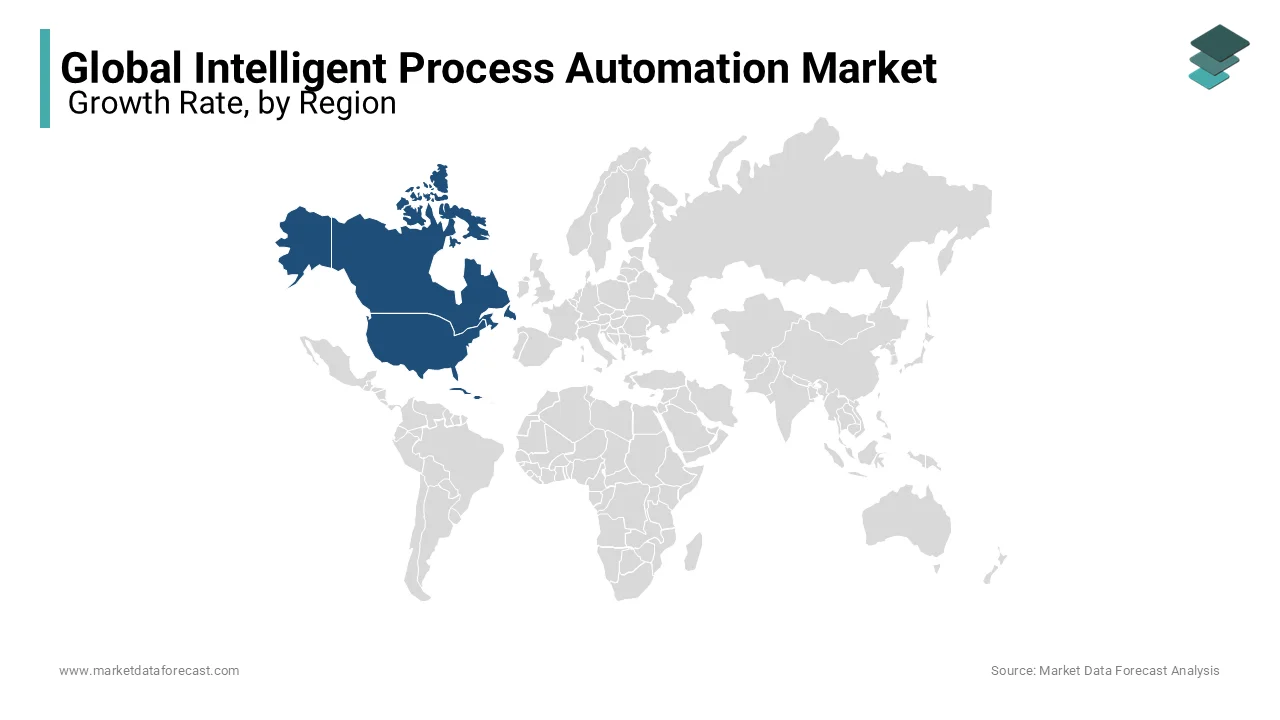
North America was the largest contributor in the global intelligent process automation market by accounting for 42.2% of share in 2025 with the early technology adoption deep capital markets and concentration of major platform vendors. According to the study, North American intelligent automation startups raised 4.2 billion dollars in venture funding during 2024 representing 68% of global investment concentrated in generative AI and vertical specific solutions. Strong intellectual property protections and established legal frameworks for AI liability create favorable environment for commercial deployment reducing regulatory uncertainty hindering adoption elsewhere. However, talent competition for AI and automation specialists remains intense with salary inflation averaging 18% annually, creating cost pressures favoring platform automation over custom development. Nearshoring trends to Latin America create hybrid delivery models combining North American strategy with regional execution optimizing cost and quality.
Europe Market Analysis
Europe intelligent process automation market was ranked second by occupying 28.8% of share in 2025 with the regulatory driven adoption strong data privacy consciousness and manufacturing sector automation leadership. According to the study, 78% of large EU enterprises deployed AI or automation technologies with Germany, France, and Netherlands leading adoption rates driven by Industry 4.0 initiatives and public sector digitization mandates. EU AI Act implementation creates both constraint and opportunity establishing clear rules for high risk automation enabling confident deployment once compliant, while restricting opaque black box systems common elsewhere. Strong works councils and labor unions shape automation strategies emphasizing augmentation over replacement requiring extensive consultation and retraining programs slowing deployment but ensuring social license and sustainability. GDPR compliance requirements drive demand for privacy preserving automation techniques and data minimization creating specialized market segments where European vendors hold competitive advantages.
Asia Pacific Market Analysis
Asia Pacific intelligent process automation market growth is driven by demographic pressures digital transformation initiatives and government smart nation programs. The extreme diversity ranging from Japan’s advanced aging society automation to India’s IT services led adoption and China’s state directed AI industrial policy creating multiple distinct submarkets within single region. As per the study, Indian IT BPM industry generated 28 billion dollars in automation related revenue in 2024, leveraging domestic talent pool and global delivery expertise to serve both local and international clients. Japan’s Society 5.0 initiative addresses super aging demographics through robotics and AI subsidies creating unique demand for eldercare and labor substitution automation absent elsewhere. Southeast Asian nations leverage automation for leapfrog development bypassing traditional industrialization stages moving directly to digital services. Regional trade agreements like RCEP facilitate cross border data flows and technology transfer accelerating adoption though geopolitical tensions create bifurcation risks for multinational vendors navigating competing regulatory spheres.
Latin America Market Analysis
Latin America intelligent process automation market growth is likely to grow with the fintech innovation nearshoring demand and public sector modernization efforts. The region’s market status reflects emerging market dynamics where automation serves dual purposes of efficiency improvement and formalization of informal economic activities creating unique use cases absent in developed markets. Brazilian fintechs like Nubank and Mercado Pago pioneered AI driven credit underwriting and customer service automation serving previously unbanked populations creating indigenous innovation models adapted to local conditions. Public sector digitization initiatives in Colombia and Chile drive government automation adoption reducing bureaucracy and corruption through transparent algorithmic decision making. Currency volatility and economic instability create both challenge and opportunity as automation enables cost flexibility versus fixed labor commitments during uncertain periods. Limited local vendor ecosystem creates dependency on global platforms but also opportunities for regional integrators developing localized solutions addressing specific regulatory and cultural requirements.
Middle East and Africa Market Analysis
Middle East and Africa intelligent process automation market growth is likely to be propelled with the sovereign wealth funded digital transformation visions and leapfrog technology adoption. The region’s market status reflects top-down development models where automation serves national diversification strategies and futuristic branding rather than organic demand creating enclave deployments with limited spillover to broader economies. GCC countries invested 18 billion dollars in digital transformation during 2024 with intelligent automation comprising significant portion of smart city and e government initiatives, according to the study. UAE’s Smart Dubai strategy targets 100% paperless government transactions driving extensive back office automation across public entities. South Africa’s financial services sector leads continental adoption leveraging automation to serve diverse income segments and manage regulatory complexity. Kenyan mobile money ecosystem M Pesa spawned indigenous automation innovations for financial inclusion serving models exported globally.
COMPETITIVE LANDSCAPE
Competition in the intelligent process automation market features intense rivalry between established RPA vendors hyperscale cloud providers and emerging AI native startups each pursuing distinct paths toward market dominance and differentiation. Traditional RPA leaders leverage installed bases and enterprise trust integrating AI capabilities to defend positions against cloud giants offering bundled automation within broader platform subscriptions at aggressive price points. Hyperscalers exploit distribution advantages and infrastructure scale making automation accessible to SMBs and departments previously priced out of enterprise solutions though lacking deep process expertise and governance maturity required for complex deployments. AI native startups challenge incumbents with superior cognitive capabilities and modern architectures but face go to market hurdles and credibility gaps in risk averse enterprise buying cycles favoring proven vendors. Competition increasingly centers on ecosystem strength partner networks and vertical specialization rather than pure technology features as baseline AI capabilities commoditize through open-source models and API access. Consolidation accelerates as standalone players struggle to match integrated platform value propositions forcing mergers and acquisitions to achieve necessary scale and breadth.
KEY MARKET PLAYERS
Major key players in the global intelligent process automation market are
- UiPath, Inc. (US)
- SAP SE (Germany)
- Dell EMC Corp. (US)
- Microsoft Corporation
- Blue Prism Group (UK)
- ServiceNow Inc
- IBM Corporation (US)
- Salesforce.com, Inc. (US)
- WorkFusion (US)
- Accelirate, Inc. (US)
- Kofax Inc. (US)
- Pegasystems Inc. (US)
- Open Text Corp. (Canada).
Top Players In The Market
- UiPath Inc maintains extensive involvement in the intelligent process automation market through its comprehensive Business Automation Platform integrating RPA AI and process mining capabilities for enterprise wide deployment. The company recently launched UiPath Autopilot featuring generative AI powered assistants enabling natural language bot creation and document processing without coding expertise. UiPath strengthened market position by expanding partner ecosystem with over 5000 system integrators and technology alliances ensuring global implementation capacity and vertical specialization. Recent actions include acquiring Reveal to enhance security and compliance monitoring addressing regulated industry requirements. These initiatives demonstrate commitment to platform consolidation and accessibility democratizing intelligent automation beyond technical specialists while maintaining enterprise grade governance standards essential for production deployments across diverse organizational contexts and regulatory environments worldwide.
- Microsoft Corporation contributes significantly to the intelligent process automation market through Power Automate platform deeply integrated with Microsoft 365 Azure AI and Dynamics 365 ecosystems enabling seamless automation within existing enterprise workflows. The company recently introduced Copilot Studio, allowing business users to build custom AI agents using conversational interfaces reducing development barriers substantially. Microsoft strengthened market position by embedding automation capabilities directly into Teams SharePoint and Outlook creating ubiquitous access points that drive organic adoption without separate procurement processes. These strategies leverage massive installed base and trusted vendor relationships positioning Microsoft as default choice for organizations already invested in Microsoft stack, creating network effects that accelerate adoption while reducing integration complexity and total cost of ownership compared to standalone platforms requiring separate infrastructure and identity management systems.
- ServiceNow Inc plays vital role in intelligent process automation market through Now Platform combining workflow orchestration AI and employee experience capabilities focused on IT service management HR and customer service domains. The company recently launched Now Assist generative AI features embedded across platform modules enabling automated case summarization knowledge article generation and code assistance within native workflows. ServiceNow strengthened market position by acquiring Element AI and other specialized firms enhancing machine learning capabilities for predictive intelligence and natural language understanding. Recent actions include expanding industry specific workflows for financial services healthcare and telecommunications accelerating time to value for vertical use cases. These initiatives reflect strategy of embedding automation within broader digital workflow platform rather than competing as standalone RPA tool creating stickiness through integrated data models and cross functional process visibility that isolated automation tools cannot replicate enabling sustained customer expansion and premium valuation multiples.
Top Strategies Used By Key Market Participants
Key players in the intelligent process automation market employ platform consolidation strategies integrating RPA AI analytics and process mining into unified offerings reducing vendor sprawl and simplifying governance for enterprise buyers. Companies pursue strategic acquisitions targeting specialized AI document processing and vertical solution providers filling capability gaps faster than organic development, while acquiring talent and customer bases simultaneously. Ecosystem expansion through partnerships with system integrators cloud providers and industry specialists extends reach and implementation capacity without proportional headcount growth enabling scalable global delivery. Generative AI integration has become table stakes with vendors racing to embed large language model capabilities distinguishing offerings through proprietary fine tuning safety guardrails and domain specific prompt engineering rather than base model access alone. Consumption based pricing models align vendor revenue with customer value realization reducing adoption friction and creating predictable recurring revenue streams attractive to investors. Community building through developer programs certification pathways and marketplace ecosystems creates network effects and switching costs locking in users through skill investments and reusable component libraries.
MARKET SEGMENTATION
This research report on the global intelligent process automation market has been segmented and sub-segmented based on component, deployment mode, organization size, technology, and region.
By Component
- Solution
- Robotic Process Automation (RPA)
- Artificial Intelligence (AI) Platforms
- Analytics & Reporting Tools
- Process Discovery & Mining Tools
- Services
- Consulting
- Design & Implementation
- Training & Support
By Technology
- Machine Learning (ML)
- Natural Language Processing (NLP)
- Robotic Process Automation (RPA)
- Virtual Agents
- Computer Vision
- Mini Bots
- Neural Networks
- Others
By Deployment Mode
- Cloud-Based
- On-Premise
By Organization Size
- Large Enterprises
- Small and Medium-Sized Enterprises (SMEs)
By Application
- Business Process Automation (BPA)
- IT Operations
- Application Management
- Content Management
- Security Management
- Customer Experience Management
- Business Intelligence & Analytics
- Enterprise Mobility
- Others
By Industry Vertical
- Banking, Financial Services, and Insurance (BFSI)
- Healthcare & Life Sciences
- Retail & eCommerce
- Information Technology (IT) & Telecom
- Manufacturing & Logistics
- Media & Entertainment
- Education
- Government & Defense
- Agriculture
- Others
By Region
- North America
- Europe
- Asia Pacific
- Latin America
- Middle East and Africa