- Product Description Description
- Table of Contents TOC
- List of Table & Figure LOT
- Get Free Sample PDF Sample PDF
Market Size, 2025
$114.90 BnMarket Estimate, 2026
$121.79 BnMarket Forecast, 2034
$194.12 BnCAGR, 2026–2034
6%Executive Summary: Global Process Automation Market
- Market Scope: Comprehensive global process automation market analysis covering transmitters, analyzers, software solutions, industry verticals, communication types, and regional growth distribution.
- Market Valuation: Valued at USD 114.90 billion (2025), anticipated to reach USD 121.79 billion in 2026, and projected to hit USD 194.12 billion by 2034, growing at a CAGR of 6.0% from 2026 to 2034.
- Primary Growth Drivers: Aggressive corporate focus on operational cost reduction and efficiency, rising integration of Industry 4.0/IoT paradigms, expanding adoption of cloud-based automation solutions, and stringent regulatory compliance demand across heavy process industries.
Key Market Segment Metrics (2026–2034)
| Category | Leading Segment / Position | Growth Dynamics & Outlook |
|---|---|---|
| By Solution / System | Distributed Control System (DCS) | Dominates the market driven by growing needs for integrated process control, safety, and reliability across continuous production lines. |
| By Communication | Wireless Communication | Holds the largest share due to cost-effective deployment, flexible infrastructure setups, and ease of predictive maintenance routines. |
| By End-User Industry | Chemical and Petrochemical (21.4% share) | Maintains steady growth supported by strict environmental regulations and rapid production efficiency transformations. |
| By Region | North America (35.9% share) | Leads globally backed by advanced R&D capabilities, smart factory transitions, and widespread refinery safety tech. |
Major Market Players & Market Structure
Market Structure: Highly competitive landscape characterized by major automation providers offering end-to-end industrial software, hardware solutions, predictive analytics platforms, and cloud optimization integrations.
Key Companies: ABB Ltd, Eaton Corporation, Dassault Systèmes, Schneider Electric SE, Emerson Electric Co., Honeywell International, Inc., Siemens AG, Rockwell Automation, Inc., General Electric Company, Mitsubishi Corporation, and Robert Bosch GmbH.
Global Process Automation Market Size
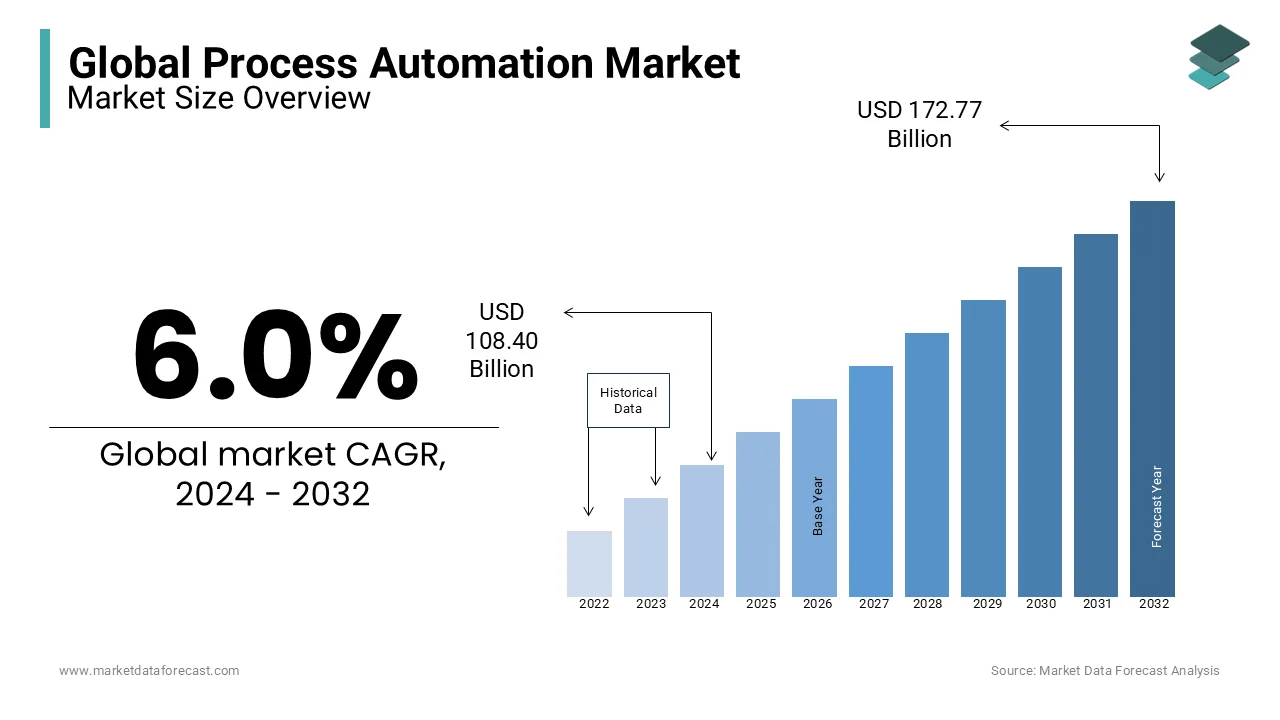
The global process automation market was valued at USD 114.90 billion in 2025 and is anticipated to reach USD 121.79 billion in 2026 to reach USD 194.12 billion by 2034, growing at a CAGR of 6.0% during the forecast period from 2026 to 2034.
Current Scenario of the Global Process Automation Market
Process automation is the use of software and technologies to automate the sequence of activities. It automates data collection, aggregation, and synthesis for large information sets and facilitates informed and faster decision-making. Process automation has a broad range of applications. Several companies start by automating straightforward departmental or support operations, such as data collection and cost approval. Others use cutting-edge technologies to handle event-driven, mission-critical, core business operations by automating increasingly complicated, cross-functional tasks.
MARKET DRIVERS
Cost reduction and operational efficiency have become major goals for companies in many industries, and companies have been adopting process automation to achieve these goals, which is one of the primary factors propelling the process automation market growth. The increasing demand for the end-to-end logistics chain in the digital revolution is majorly propelling the global process automation market growth. The trend of automation for quality and flexible output is likely to accelerate in the coming years and propel the global market growth. The growing popularity of the Internet of Things (IoT) and the rise in support from government policies are further fuelling the growth rate of the global market.
The processing industries, such as oil and gas, chemical, and mining industries, are actively adopting process automation over manufacturing lines to automate repetitive tasks such as extracting, validating, and processing. This provides a huge opportunity for the process automation market. Furthermore, the rise in demand for safety automation systems to address several safety challenges in the oil and gas industry and industrial adoption of robotics and artificial intelligence to achieve a high level of efficiency and precision during production is providing numerous opportunities for the process automation market during the forecast period.
An increase in the adoption of cloud-based automation solutions, improved regulatory compliance, a growing number of digital transformation initiatives, rapid adoption of robotic process automation, and rising efforts from companies to minimize human errors are further promoting the growth of the process automation market.
MARKET RESTRAINTS
Concerns about job displacement are one of the key restraints to the growth of the process automation market. Process automation is no less than automating the whole manufacturing process, resulting in the loss of many jobs, leaving many people working in manufacturing lines unemployed. Compatibility issues with existing systems and security and data privacy concerns are further hindering the global market growth. The deployment of process automation within manufacturing lines requires high-level algorithms and a skilled workforce to monitor the systems; any ambiguity can hinder the process of production. Moreover, process automation needs heavy investments to automate the whole manufacturing plant.
REPORT COVERAGE
| REPORT METRIC | DETAILS |
| Market Size Available | 2025 to 2034 |
| Base Year | 2025 |
| Forecast Period | 2026 to 2034 |
| CAGR | 6.0% |
| Segments Covered | By Transmitter, Analyzer, Solution, Industry, and Region. |
| Various Analyses Covered | Global, Regional & Country Level Analysis, Segment-Level Analysis, DROC, PESTLE Analysis, Porter’s Five Forces Analysis, Competitive Landscape, Analyst Overview of Investment Opportunities |
| Regions Covered | North America, Europe, APAC, Latin America, Middle East & Africa |
| Market Leaders Profiled | Mitsubishi Corporat GmbH,Hert Bosch GmbH, ABB Ltd, EaCorporation, Systèmes Saultault Systèmes d'information et de gestion, Emerson Electric Co., Honeywell International, Inc., Johnson Controls, Inc., Rockwell Automation, InSchneider der Electric SE and Others. |
SEGMENTAL ANALYSIS
By System Insights
Based on the system, the DCS segment dominated the global process automation market in 2024 and is estimated to hold the leading share of the global market during the forecast period.
The domination of the DCS segment in the global market is primarily driven by the rising need for integrated process control, safety, and reliability. DCS is a computerized control system for a process or plant, usually with many control loops, in which autonomous controllers are distributed throughout the system, with central operator supervisory control. Several companies have been using DCS for increased production and improved yields. The growing usage of DCS in industries such as chemical plants, petrochemical (oil) and refineries, pulp and paper mills, food and food processing, agrochemical and fertilizer, metal and mines, automobile manufacturing, metallurgical process plants, and pharmaceutical manufacturing is further boosting the growth rate of the DCS segment in the process automation market.
By Communication Insights
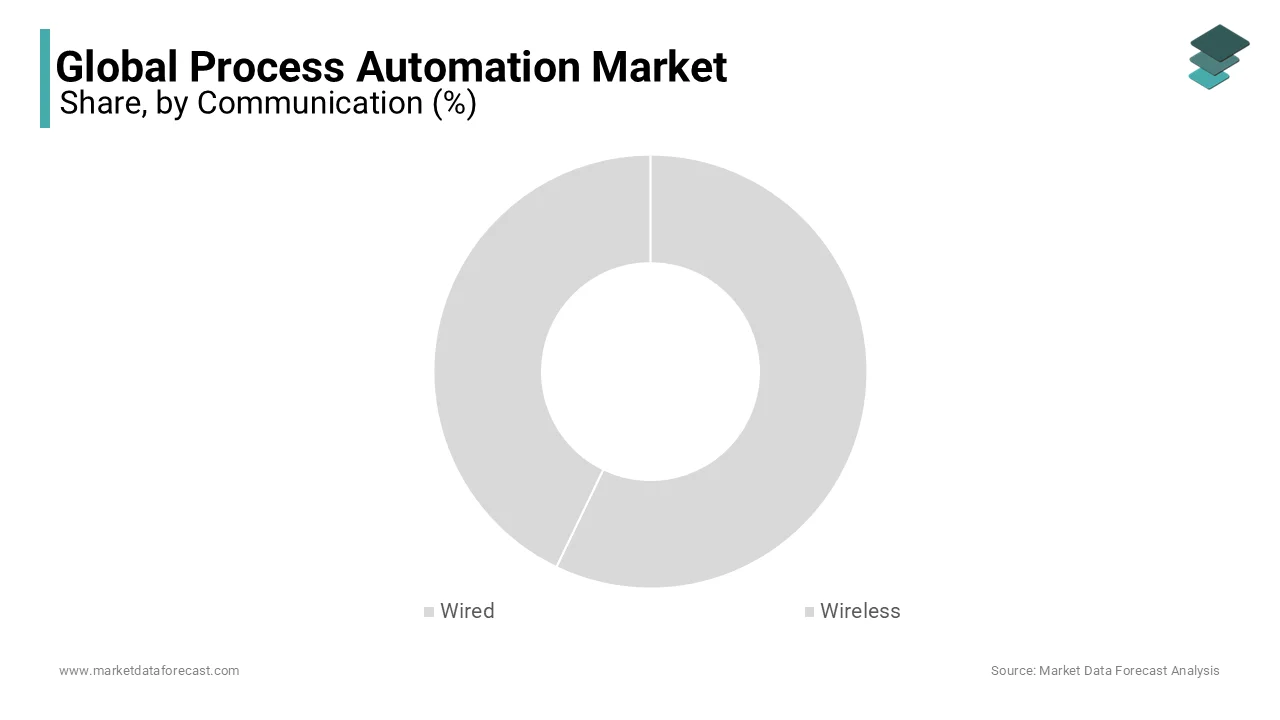
Based on communication, the wireless segment had the largest share of the global process automation market in 2024 and is estimated to hold the dominant position in the global market throughout the forecast period.
Industry 4.0 has given rise to increasingly intelligent machines and flexible, efficient automated facilities. Wireless communications have become more prevalent in industrial settings because of these increasingly complicated systems. The wireless protocol enables secure and adaptable control connectivity, working on the collection and continual adjustment of production-process values. Furthermore, wireless communication monitors machinery condition for predictive maintenance routines remotely. Moreover, wireless technologies are the most economical choice over time. This is because wired communication requires running cable through a production area, which is expensive. Even planning the cable and connector routing requires time and effort. These factors are driving the wireless protocol segment in the process automation market in the period.
By End-User Industry Insights
Based on end-user, the chemical and petrochemical segment occupied 21.4% of the global market share in 2024 and is expected to grow steadily during the forecast period due to the stringent regulations, rapid adoption of Industry 4.0, and growing emphasis on production efficiency.
On the other hand, the paper and pulp segment is expected to register a healthy CAGR during the forecast period. The paper and pulp industry involves numerous processes for producing the final product. Raw materials must go through numerous steps while being closely monitored for temperature and chemical content. Process automation makes it possible to accomplish this from a single location. Even pulp and paper mills are operating under constant pressure to reduce production costs and meet the demand globally. These complex processes in the pulp and paper industry are driving manufacturers to adopt process automation in the plant.
REGIONAL ANALYSIS
North America Market Analysis
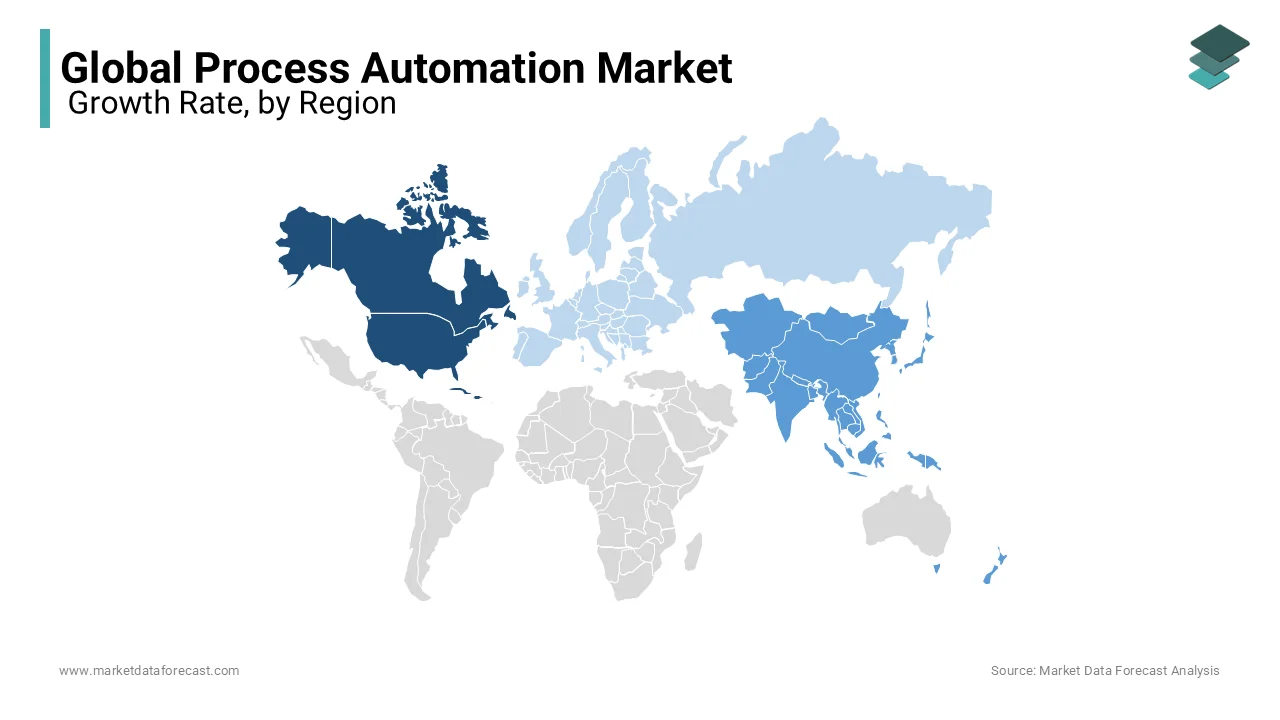
North America accounted for 35.9% of the global market share in 2024 and is expected to grow at a prominent CAGR during the forecast period. The strong R&D capabilities of several companies that are based in North America, widespread adoption of automation in manufacturing, and rising focus on smart technologies are driving the North American process automation market. The U.S. led the process automation market in North America and had the leading share of the regional market in 2024. The U.S. is projected to showcase promising growth during the forecast period due to the increasing implementation of advanced process automation in U.S. refineries for enhanced efficiency and safety. Canada is another noteworthy regional segment in the North American market and is expected to account for a considerable share of the North American market during the forecast period. The growth of smart factories and digitalization in the manufacturing sector of Canada is propelling the Canadian process automation market growth.
Asia Pacific Market Analysis
Asia-Pacific was the second biggest regional segment in the worldwide market in 2024 and held 33.8% of the global market share. The growing industrialization and the presence of developing countries are propelling the growth of the APAC market. China, followed by Japan and India, is expected to hold the leading share of the APAC market during the forecast period.
Europe Market Analysis
Europe is a promising regional market for process automation worldwide and is anticipated to account for a substantial share of the global market during the forecast period. Factors such as growing emphasis on energy efficiency and stringent environmental regulations are propelling the European market growth. Germany, France, and the United Kingdom are the leading players in the European market.
KEY MARKET PLAYERS
Companies playing a key role in the global process automation market include
- ABB Ltd
- Eaton Corporation
- Dassault Systèmes
- Schneider Electric SE
- Emerson Electric Co.
- Honeywell International, Inc.
- Siemens AG
- Rockwell Automation, Inc.
- General Electric Company
- Mitsubishi Corporation
- Robert BosGmbHmBH.
RECENT MARKET NEWS
- In 2023, Dassault Systèmes developed a new data science solution to allow Renault Group to optimize vehicle costs. The Dassault Systèmes cost intelligence solution with artificial intelligence is allowing the Renault group to simulate the impacts of raw material price increases.
- In 2023, Eaton Corporation acquired a 49% stake in Jiangsu Ryan Electrical Co., Ltd, a manufacturer of power distribution and sub-transmission transformers in China. This acquisition enables Eaton to provide better service to customers in the Asia Pacific region.
MARKET SEGMENTATION
This research report on the global process automation market has been segmented and sub-segmented based on the component, business function, organization size, deployment type, industry vertical, and region.
By Transmitter
- Level
- Pressure
- Temperature
By Analyzer
- TOC (Total Organic Carbon)
- pH
- Oxygen
- Conductivity
- Density
- Toxic Gas
- Turbidity
- Hydrogen Sulfide
By Solution
- PLC (Programmable Logic Controller)
- DCS (Distributed Control System)
- SCADA (Supervisory Control and Data Acquisition)
- HMI (Human-Machine Interface)
- MES (Manufacturing Execution System)
By Industry
- Oil & Gas
- Chemicals
- Food & Beverages
- Pharmaceuticals
- Energy & Power
- Water & Wastewater
- Metals & Mining
- Others
By Region
- North America
- The United States
- Canada
- Rest of North America
- Europe
- UK
- France
- Spain
- Germany
- Italy
- Russia
- Sweden
- Denmark
- Switzerland
- Netherlands
- Turkey
- Czech Republic
- Rest of Europe
- The Asia Pacific
- India
- Japan
- China
- Australia
- Singapore
- Malaysia
- South Korea
- New Zealand
- Southeast Asia
- Latin America
- Brazil
- Argentina
- Mexico
- Rest of LATAM
- The Middle East and Africa
- Saudi Arabia
- UAE
- Lebanon
- Jordan
- Cyprus