- Product Description Description
- Table of Contents TOC
- List of Table & Figure LOT
- Get Free Sample PDF Sample PDF
Market Size, 2025
$1010 MnMarket Estimate, 2026
$1187 MnMarket Forecast, 2034
$4321.7 MnCAGR, 2026–2034
17.53%Executive Summary: Global Irrigation Controller Market
- Market Scope: Comprehensive global analysis of the irrigation controller market covering system types, smart product categories, agricultural and non-agricultural applications, and regional market trends.
- Market Valuation: Valued at USD 1,010 million in 2025, reaching USD 1,187.05 million in 2026, and projected to scale up to USD 4,321.75 million by 2034, growing at a rapid CAGR of 17.53% from 2026 to 2034.
- Primary Growth Drivers: Escalating global water scarcity concerns, rising government initiatives and subsidies (such as micro-irrigation funding), and rapid adoption of IoT-driven smart farming practices.
Key Market Segment Metrics (2026–2034)
| Category | Leading Segment (2025 Position) | Fastest-Growing Segment |
|---|---|---|
| By Type | Weather-based controllers (holding a strong baseline share due to automated scheduling based on local meteorological data) | Sensor-based controllers (expanding rapidly through real-time soil moisture tracking and precise water adjustments) |
| By Product | Smart controllers (commanding the major revenue share owing to digitalized interfaces and remote automation capabilities) | IoT-integrated smart controllers (surging as farms and landscape operators demand granular reporting and efficiency) |
| By Application | Agricultural sector (capturing the largest share due to food security needs and controlled environment farming) | Non-agricultural sectors (growing through smart urban landscaping, golf courses, and sports ground projects) |
| By Region / Country | North America (leading market supported by massive landscape water consumption and advanced agricultural tech adoption) | Asia-Pacific (fastest-growing regional market driven by World Bank projects, government irrigation funds in India and China, and water scarcity management) |
Major Market Players & Market Structure
Market Structure: Consolidated and competitive landscape featuring prominent agricultural technology and water management firms focusing on IoT integration, remote diagnostics, and high-efficiency water conservation systems.
Key Companies: Valmont Industries, Lindsay Corporation, Toro, Hunter Industries, Rain Bird, HydroPoint Data Systems, Netafim, Calsense, Glacon, Rachio, Weathermatic, Green IQ, and Nelson Irrigation.
Global Irrigation Controller Market Size
The global irrigation controller market size was valued at USD 1010 million in 2025 and is anticipated to reach USD 1187.05 million in 2026 to reach USD 4321.75 million by 2034, growing at a CAGR of 17.53% during the forecast period from 2026 to 2034.
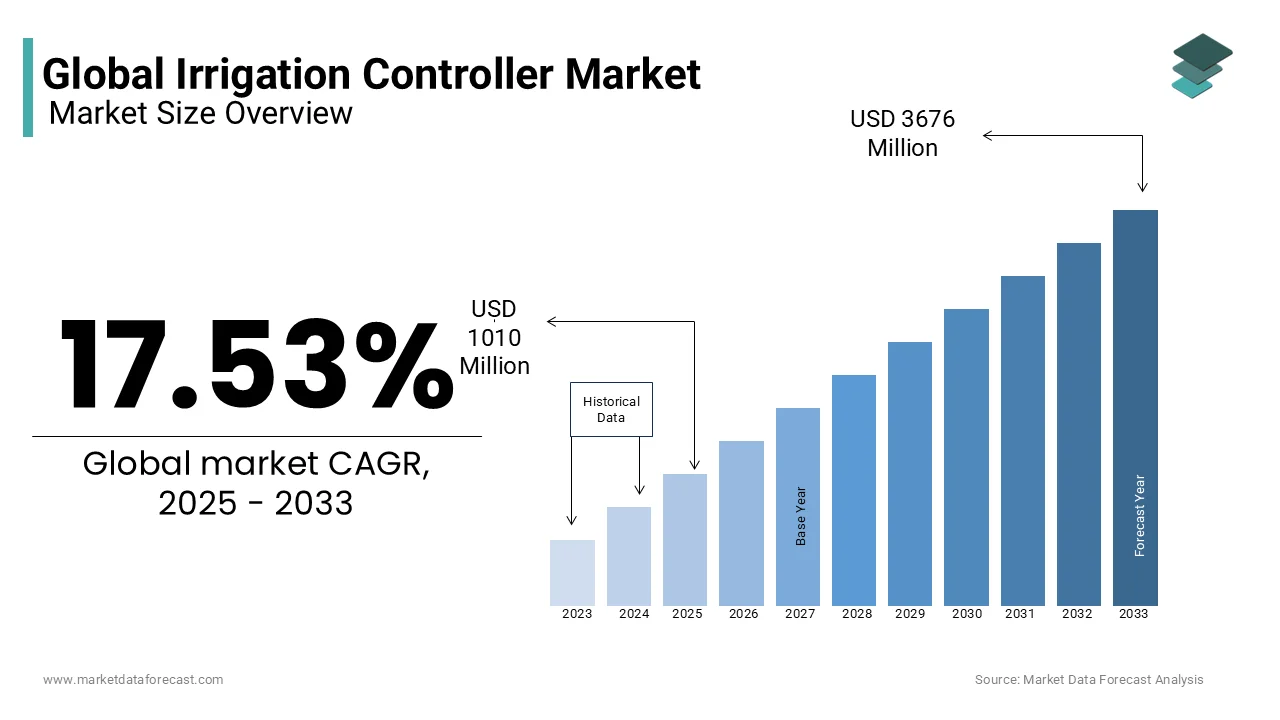
Irrigation controllers are significant in applying a lot of water at the right time to acquire maximum farming production and to accomplish an elevated level of proficiency in the utilization of water and fertilizers.
The market is driven by the expanding requirement for water conservation andthe developing utilization of modern farming practices. Besides, factors, for example, quick development in the lawn and garden equipment market, are required to expand the interest in irrigation controllers. Be that as it may, the high initial venture cost and declining farm earnings restrain the market development. Moreover, design challenges are bringing about low demand from labor-intensive economies and are expected to represent a challenge to the worldwide market.
MARKET DRIVERS
Appeal for Water Conservation
As per water.org, 785 million individuals live without access to safe water, while 144 million rely upon surface water to meet their fundamental needs. Water shortage is one of the significant variables prompting the interest of irrigation controllers. Ever-expanding population, wastage of water assets, extreme utilization of groundwater, urbanization, and industrialization are a portion of the key variables for water shortage.
Government Schemes to Promote Proper Irrigation Systems
Different government plans, for example, the Micro Irrigation Fund (MIF) in the Indian farming area, are another significant driver for the irrigation controllers. The Public Bank for Agriculture and Rural Development affirmed a reserve of USD 420.2 million for MIF to empower open and private interests in micro irrigation. The positive results of Micro-Irrigation have made food security successful because of an expansion in the development and efficiency of various yields. Utilization of an irrigation system expanded region under irrigation from a single wellspring of water results in improved food security for the nation.
MARKET RESTRAINTS
Significant expense of Installation and Repairs
The essential restraint related to an irrigation system is its significant expense, the establishment of which relies upon the size of the property. Parts of the land should be uncovered to introduce pipework and connect it to the pipes arrangement of the home, which is labor-intensive and tedious.
Additionally, wind can destroy sprinklers, along these lines, causing water to be diverted off course. The irrigation system can be harmed by underground bugs, bringing about water pooling or broken parts. The expense of fixing an irrigation system can be significantly more costly than replacing a damaged garden hose. Consequently, significant expenses of establishment and fixes related to the sprinkler system may control market development.
MARKET DYNAMICS
Rising awareness of water preservation,increasingg agriculturatask costsst, and growing significance to increase farm benefits by using smart irrigation systems are the essential elements that drive the development of the global smart irrigation controller market. Developing enthusiasm for automated systems, expanding research investments on developing smart irrigation systems utilizing the Internet of Things (IoT), and persistent advancement in detecting innovations accelerate the development of the worldwide irrigation controller market. Expanding government activities, developing smart towns and urban areas, and developing the need to screen and control the water requirements of the field because of deficient precipitation and water shortages all over the world fill the development of the worldwide smart irrigation controller market. In any case, requirements related to execution cost and the absence of awareness with respect to the expected advantages of smart irrigation controllers are distinguished as the limitations liable to stop the movement of the worldwide irrigation controller market.
REPORT COVERAGE
| REPORT METRIC | DETAILS |
| Market Size Available | 2025 to 2034 |
| Base Year | 2025 |
| Forecast Period | 2026 to 2034 |
| CAGR | 17.53% |
| Segments Covered | By Type, Product, Application, and Region |
| Various Analyses Covered | Global, Regional & Country Level Analysis, Segment-Level Analysis, DROC, PESTLE Analysis, Porter’s Five Forces Analysis, Competitive Landscape, Analyst Overview on Investment Opportunities |
| Regions Covered | North America, Europe, APAC, Latin America, Middle East & Africa |
| Market Leaders Profiled | Valmont Industries (US), Lindsay Corporation (US), Toro (US), Hunter Industries (US), Rain Bird (US), HydroPoint Data Systems (US), Netafim (Israel), Calsense (US), Glacon (Israel), Rachio (US), Weathermatic (US), Green IQ (Israel), Nelson Irrigation (US), and Others. |
SEGMENTAL ANALYSIS
By Type Insights
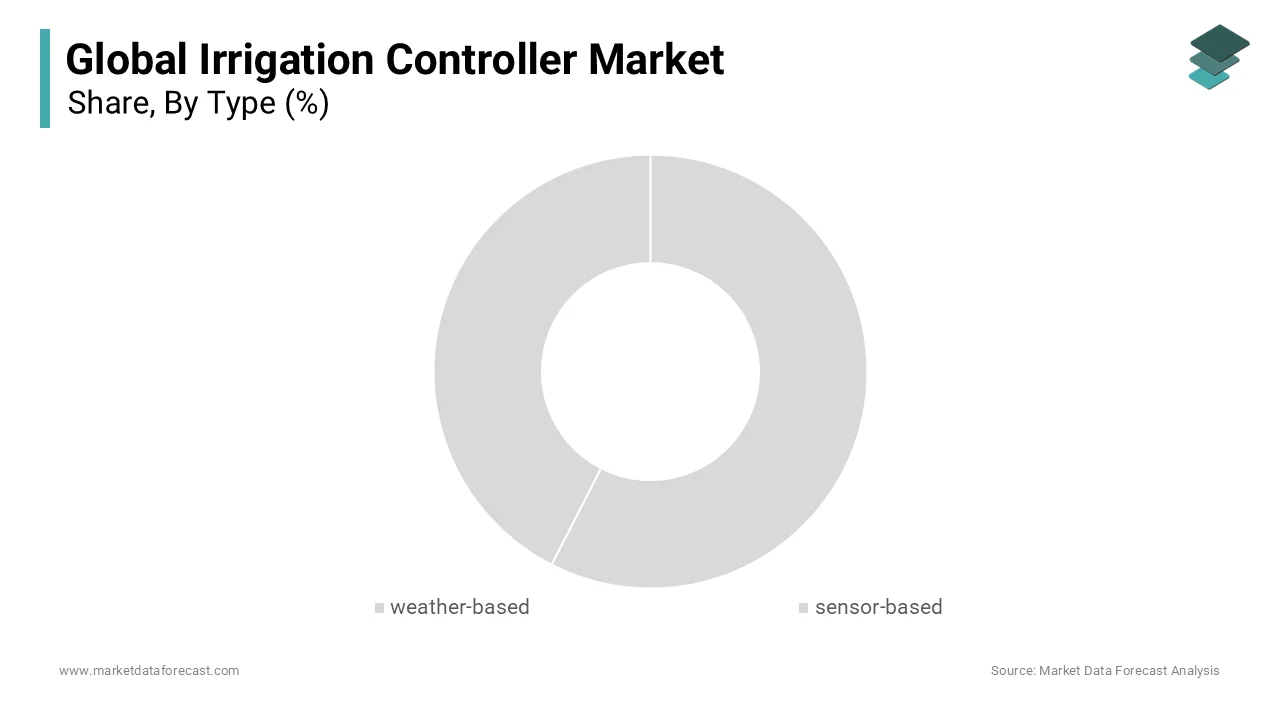
The sensor-based irrigation controller’s fragment is likely to develop at thehighesty CAGR during the conjecture time frame. Sensors help in acquiring continuous soil moisture levels and determining the irrigation prerequisites.
By Product Insights
The multi-usefulness of smart irrigation controllers and the capacity to produce climate and farm reports are required to expand their interest. Smart Controllers remain a significant section, contributing 64.2% of the general market regarding income in 2018, attributable to the rising interest in digitalized, easy-to-understand items, which can alter irrigation designs and automatically run at times to meet explicit farming requirements.
By Application Insights
The agriculture sector secured the biggest piece of the overall industry as irrigation controllers are most broadly utilized in sports grounds, golf courses, and private yards and gardens. The developing pattern of controlled environment agriculture is expected to increase the demand for irrigation controllers in the agricultural sector.
REGIONAL ANALYSIS
North America Market Analysis
In the U.S., more than 34 billion liters of water every day is utilized for landscape irrigation. The greater part of thiwasted squandered due to overwatering in light of the failures brought about by traditional techniques. Rising interest in completely automated systems that can change running times and water schedules, consequently, to meet the landscape needs is foreseen to flood the market with development over the coming years.
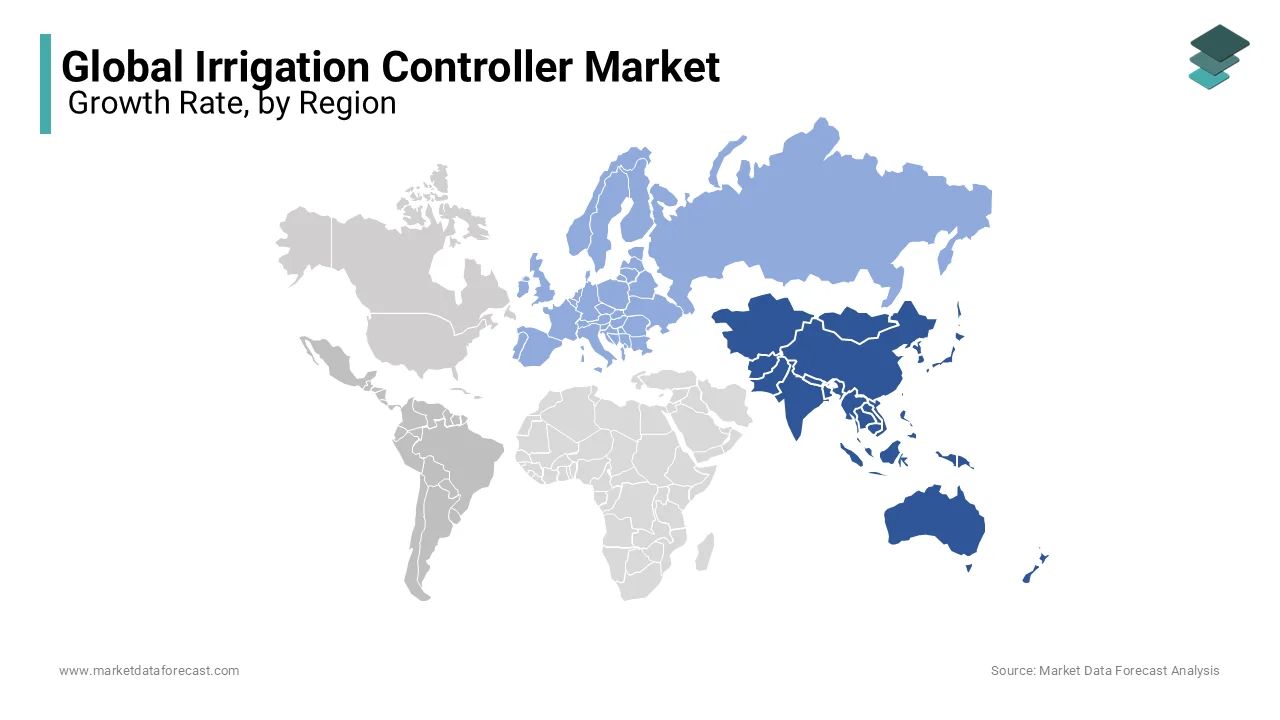
As per "The State of Agricultural Commodity Markets" report, West Africa and India are probably agricultural agriculture production ffallsas they utilize 2-3 times more water than other major agricultural nations, for example, the U.S., Brazil, and China. Rising government activities for creating awareness about drip irrigation and smart solutions are foreseen to build product demand over the estimated time frame.
The Integrated Modern Agriculture Development (IMAD) Project by the World Bank in China is required to create awareness about the environmental change in farming practices, combined with institutional help for improving irrigation systems in China. Additionally, a venture of $313.4 million is made to give a better system and new on-farm advances, bringing about fortifying the item demand throughout the following years.
KEY MARKET PLAYERS
The worldwide market for irrigation controllers is dominated by huge players, for example,
- Valmont Industries (US)
- Lindsay Corporation (US)
- Toro (US)
- Hunter Industries (US)
- Rain Bird (US)
- HydroPoint Data Systems (US)
- Netafim (Israel)
- Calsense (US)
- Glacon (Israel)
- Rachio (US)
- Weathermatic (US)
- Green IQ (Israel)
- Nelson Irrigation (US)
RECENT MARKET NEWS
The worldwide marketers of irrigation and system equipment are
- Lindsay Corporation (NYSE: LNN),
- Net Irrigate
- LLC
- Net Irrigate
- Lindsay's FieldNET
MARKET SEGMENTATION
This research report on the global irrigation controller market is segmented and sub-segmented into the following categories.
By Type
- weather-based
- sensor-based
By Product
- smart controllers
- tap timers
- basic controllers
By Application
- agricultural
- and non-agricultural
By Region
- North America
- Europe
- Asia Pacific
- Latin America
- Middle East and Africa