- Product Description Description
- Table of Contents TOC
- List of Table & Figure LOT
- Get Free Sample PDF Sample PDF
Market Size, 2025
$1819 MnMarket Estimate, 2026
$2149 MnMarket Forecast, 2034
$8133 MnCAGR, 2026–2034
18.1%Executive Summary: Global Smart Irrigation Market
- Market Scope: Comprehensive global smart irrigation industry analysis covering controller types (weather-based, sensor-based), hardware and network components (sensors, smart detection systems), regional leadership frameworks (North America, Asia Pacific), competitive landscapes, and technological integrations.
- Market Valuation: Valued at USD 1,819.72 million (2025), estimated at USD 2,149.09 million (2026), and projected to reach USD 8,133.05 million by 2034, registering a robust CAGR of 18.1% (2026–2034).
- Primary Growth Drivers: Water scarcity, climate-smart agriculture, IoT automation, regulatory conservation pressure, agricultural labor costs, AI predictive irrigation, smart city initiatives, and urban green infrastructure. Restraints include high installation costs, interoperability challenges, cybersecurity risks, and technical expertise gaps.
Key Market Segment Metrics (2026–2034)
| Category | Leading Segment / Region (Position) | Fastest-Growing Segment |
|---|---|---|
| By Controller & Hardware | Weather-based irrigation controllers (largest segment in 2025 optimizing water using real-time data) & Sensors (largest hardware share in 2025) | Sensor-based irrigation controllers (projected at a 15.5% CAGR) & Smart detection systems (forecast to grow at a 16.8% CAGR for leak prevention) |
| By Technology & Innovation | AI integration, IoT connectivity, and cloud-based analytics for enhanced irrigation efficiency and user control | Advanced water-loss prevention solutions and automated predictive agricultural management systems |
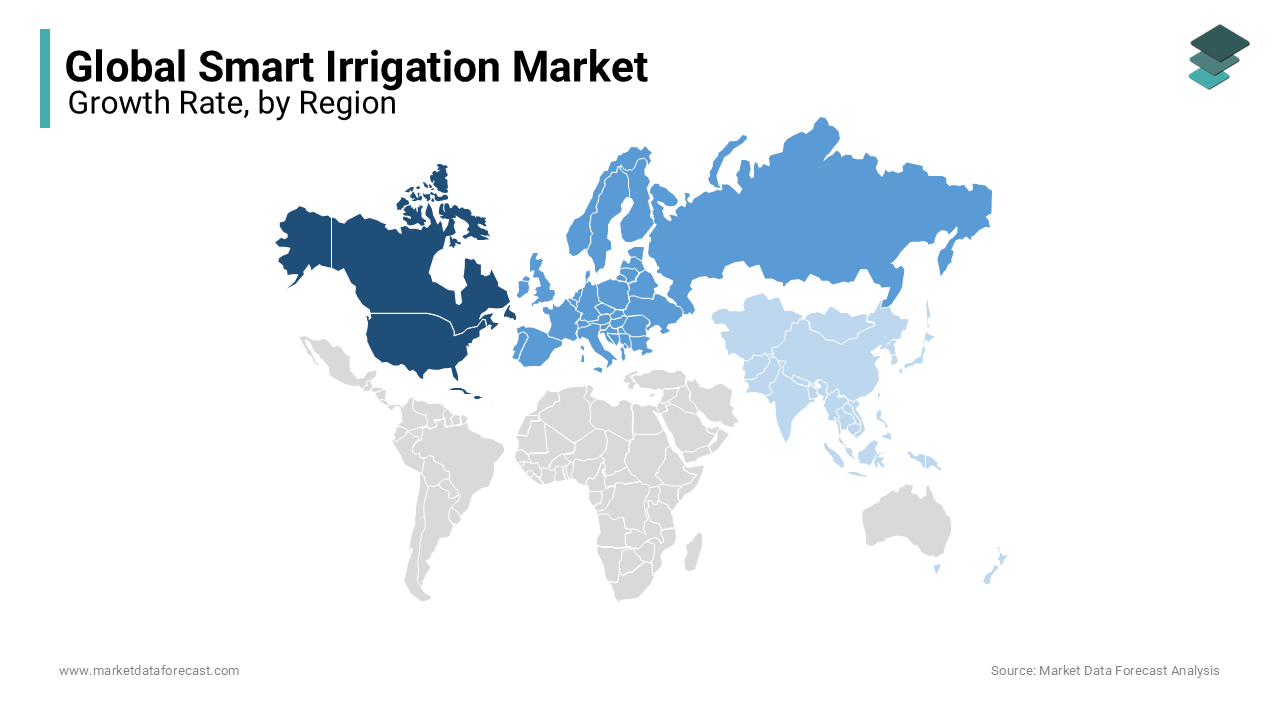
| By Region / Country | North America (dominated global market with 36.3% share in 2025 supported by regulatory frameworks and advanced infrastructure) | Asia Pacific (high-growth region driven by government investments in smart agriculture, irrigation modernization, and water scarcity) |
Major Market Players & Market Structure
Market Structure: Highly competitive global intelligent water management landscape characterized by technological innovation, AI and IoT integration, strategic acquisitions, partnerships, regulatory compliance, and continuous product differentiation.
Key Companies: Hunter Industries, Rain Bird Corporation, Netafim, HydroPoint Data Systems, Inc., Rachio Inc., The Toro Company, Calsense, Galcon, Blossom, and Green Electronics LLC (RainMachine).
Global Smart Irrigation Market Size
The global smart irrigation market was valued at USD 1819.72 million in 2025 and is anticipated to reach USD 2149.09 million in 2026 from USD 8133.05 million by 2034, growing at a CAGR of 18.1% during the forecast period from 2026 to 2034.
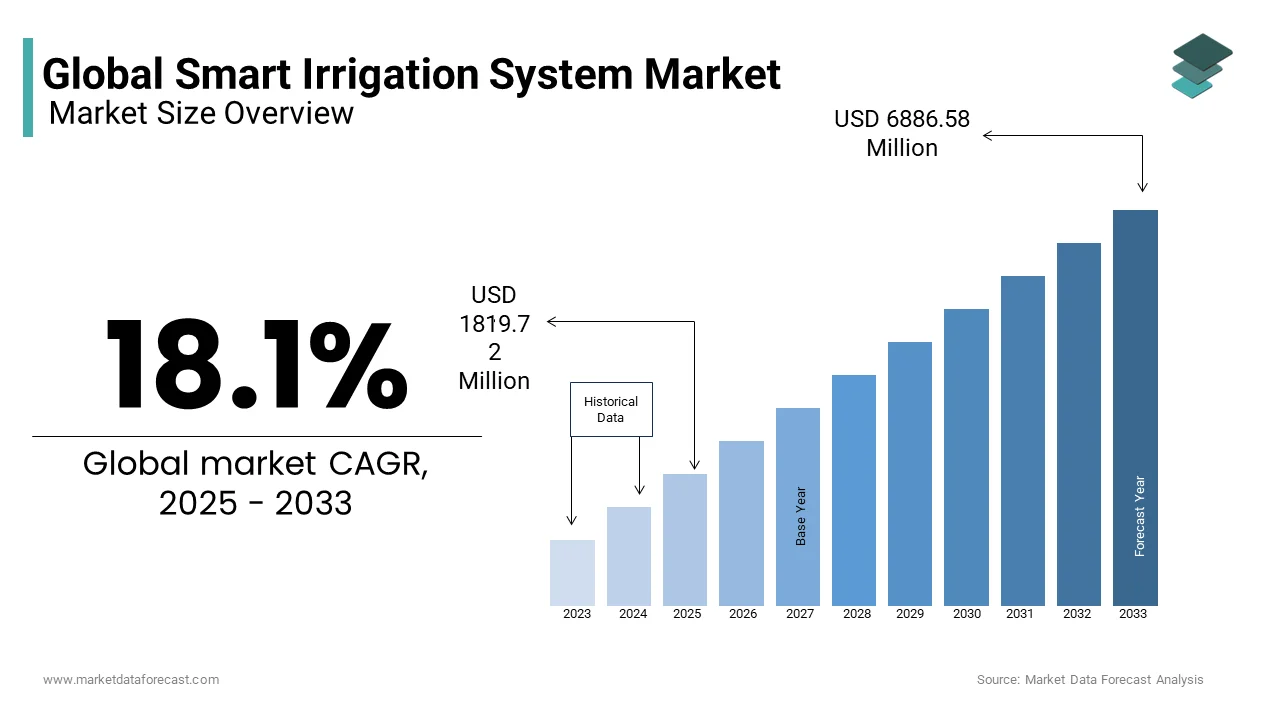
Smart irrigation represents a critical evolution in water resource management, integrating advanced sensors, connectivity protocols, and data analytics to optimize water application in agricultural, residential, and commercial landscapes. This technology shifts irrigation from a reactive practice to a proactive, data driven strategy that responds to real time environmental conditions such as soil moisture levels, weather forecasts, and evapotranspiration rates. According to the Food and Agriculture Organization of the United Nations, agriculture accounts for approximately 70% of all freshwater withdrawals worldwide, which underscores the urgency for such systems. Furthermore, according to the World Resources Institute, 25 countries face extremely high water stress, highlighting the immediate need for efficiency improvements. As per the Environmental Protection Agency, outdoor watering accounts for nearly 30% of total household water use in the United States, much of which is wasted due to inefficiencies. Smart irrigation controllers and weather based systems mitigate this waste by adjusting schedules automatically, which is ensuring plants receive only the necessary amount of water. The integration of Internet of Things devices allows for remote monitoring and control, enhancing user convenience while promoting conservation. As climate change intensifies drought frequencies and alters precipitation patterns, the adoption of smart irrigation technologies becomes not merely an economic choice but an ecological imperative. This market encompasses a diverse range of solutions including drip irrigation systems, sprinkler controllers, and soil moisture sensors, all designed to maximize crop yield and landscape health while minimizing resource depletion.
MARKET DRIVERS
Escalating Water Scarcity and Regulatory Pressure Drive Adoption of Efficient Systems
The accelerating scarcity of freshwater resources coupled with stringent governmental regulations is majorly driving the growth of the global smart irrigation market. As aquifers deplete and surface water sources become unreliable, municipalities and agricultural bodies are enforcing stricter limits on water consumption. According to the United Nations Water Development Report, global water demand is projected to exceed supply by 40% by 2030 if current trends continue, creating an urgent imperative for conservation measures. In response, regions such as California and parts of Australia have implemented tiered pricing structures and mandatory water use restrictions that penalize excessive irrigation. As per water efficiency studies, these regulatory frameworks incentivize the installation of smart controllers that can reduce outdoor water use by 20% to 50% compared to traditional timer based systems. According to the Agricultural Research Service, precision irrigation technologies can achieve water savings ranging from 30% to 65% while maintaining or enhancing crop yields, directly addressing the dual challenges of productivity and conservation. Furthermore, industrial and commercial entities face increasing pressure to demonstrate sustainability credentials, driving the uptake of smart landscape irrigation in corporate campuses and public parks. The financial penalties associated with non-compliance and the rising cost of water utilities makes the return on investment for smart irrigation systems increasingly attractive. Consequently, the convergence of regulatory mandates and physical water scarcity creates a robust demand environment for automated, efficient irrigation solutions across both developed and developing economies.
Rising Labor Costs And Need For Operational Automation In Agriculture
The escalating cost of agricultural labor and the concurrent need for operational automation significantly drive the adoption of smart irrigation systems, particularly in large scale farming operations, which is another significant market driver. Traditional irrigation methods require substantial manual oversight for scheduling, maintenance, and adjustment, tasks that are becoming prohibitively expensive and labor intensive. According to the International Labour Organization, labor costs in the agricultural sector have risen by approximately 15% in major producing nations over the last decade, prompting farmers to seek mechanized alternatives. Smart irrigation systems equipped with remote monitoring capabilities allow farm managers to control vast networks of valves and pumps from a central interface, reducing the need for field personnel. According to the American Farm Bureau Federation, automation technologies can reduce labor requirements for irrigation management by up to 50%, freeing workers for higher value tasks. Additionally, the precision offered by smart systems minimizes the risk of human error, such as overwatering or underwatering, which can lead to crop loss and reduced yields. In regions facing chronic labor shortages, such as parts of Europe and North America, the ability to operate irrigation systems autonomously ensures consistent crop health without relying on transient workforces. The integration of smart irrigation with broader farm management software further enhances operational efficiency by providing data driven insights for decision making. As agricultural margins tighten, the cost savings derived from reduced labor dependency and optimized water usage make smart irrigation an essential component of modern sustainable farming practices.
MARKET RESTRAINTS
High Initial Installation Costs And Complexity Hinder Widespread Adoption
The substantial initial investment required for purchasing and installing smart irrigation infrastructure is a significant restraint for the global market expansion, particularly for small scale farmers and residential users with limited budgets. Unlike traditional timer based controllers, smart systems involve costly components such as soil moisture sensors, weather stations, connectivity modules, and specialized valves. According to the United States Department of Agriculture, the average cost of implementing a precision irrigation system can range from 1,000 to 5,000 USD per hectare depending on complexity, a barrier that many smallholders cannot overcome without financial assistance. Furthermore, the installation process often requires professional expertise to ensure proper sensor placement and system integration, adding to the upfront expenditure. For residential consumers, the price premium of smart controllers compared to basic models remains a deterrent, despite long term water savings. According to the National Association of Home Builders, cost sensitivity among homeowners leads to low penetration of advanced irrigation technologies in new construction projects unless mandated by local codes. Additionally, the perceived complexity of setup and configuration discourages technologically less adept users who fear difficult maintenance requirements. In developing regions, where access to credit is limited, the high capital outlay prevents the widespread deployment of these technologies despite their potential benefits. Without subsidized programs or flexible financing options, the high entry cost continues to restrict market growth to larger commercial entities and affluent residential segments, limiting the overall impact on global water conservation efforts.
Interoperability Issues And Lack Of Standardized Connectivity Protocols
The fragmentation of communication protocols and lack of interoperability among different smart irrigation devices pose a considerable restraint to market expansion, which is also creating technical barriers for seamless integration. The Internet of Things landscape in irrigation features a myriad of proprietary standards including Zigbee, Z Wave, Wi Fi, and LoRaWAN, which often do not communicate effectively with one another. According to the Connectivity Standards Alliance, the absence of a universal protocol forces consumers to commit to specific ecosystems, limiting their choice of compatible sensors and controllers. This vendor lock in reduces flexibility and increases the risk of obsolescence if a manufacturer discontinues support for a particular standard. Furthermore, the complexity of integrating smart irrigation systems with existing home automation platforms or farm management software often requires specialized technical knowledge that average users lack. According to the Consumer Technology Association, compatibility issues are among the top reasons for customer dissatisfaction and product returns in the smart home sector. In agricultural settings, the inability to easily integrate irrigation data with other precision farming tools hinders the realization of fully automated decision making processes. Farmers may find themselves managing multiple disjointed applications rather than a unified dashboard, reducing operational efficiency. Until industry wide standards are established and adopted, the friction caused by interoperability challenges will continue to slow down the adoption rate of comprehensive smart irrigation solutions, particularly among users seeking scalable and flexible technology stacks.
MARKET OPPORTUNITIES
Integration With Artificial Intelligence And Predictive Analytics Offers Growth Potential
The integration of artificial intelligence and predictive analytics into smart irrigation systems is a promising opportunity for market growth by enhancing decision making accuracy and resource optimization. Advanced algorithms can analyze historical weather data, soil characteristics, and plant growth stages to predict future water needs with high precision. According to the International Journal of Agricultural and Biological Engineering, AI driven irrigation models can improve water use efficiency by up to 25% compared to rule based systems by anticipating environmental changes before they occur. This capability allows for proactive adjustments that prevent stress on crops and optimize yield quality. Furthermore, machine learning enables systems to adapt to unique microclimates within a single field or garden, providing hyper localized irrigation schedules. The growing availability of cloud computing resources facilitates the processing of large datasets, making these advanced features accessible to a broader user base. In commercial agriculture, the ability to forecast irrigation requirements helps in planning labor and energy usage more effectively, reducing operational costs. Smart cities are also leveraging AI powered irrigation for public parks and green spaces, aiming to meet sustainability targets through automated conservation. As AI technology becomes more affordable and user friendly, its incorporation into irrigation controllers will differentiate premium products and drive upgrades among existing users. This technological evolution transforms irrigation from a simple utility function into a sophisticated agronomic tool, opening new revenue streams for software developers and hardware manufacturers alike.
Expansion Of Smart City Initiatives And Urban Green Infrastructure Projects
The rapid expansion of smart city initiatives and urban green infrastructure projects globally creates a substantial opportunity for the global smart irrigation market, as municipalities seek sustainable solutions for maintaining public landscapes. Urban areas are increasingly prioritizing green spaces to mitigate heat islands and improve air quality, necessitating efficient water management systems to sustain these assets under budget constraints. According to the United Nations Human Settlements Programme, over 60% of the global population will live in urban areas by 2030, intensifying the demand for smart urban services including automated irrigation for parks, medians, and sports fields. Smart city frameworks often include integrated water management systems that utilize real time data to optimize municipal resource usage. Governments are investing in retrofitting public parks with smart controllers that connect to central monitoring platforms, allowing for remote diagnostics and immediate leak detection. According to the European Commission, the Green Deal initiative encourages member states to adopt nature based solutions that rely on efficient resource use, further driving public sector procurement of smart irrigation technologies. Additionally, the rise of vertical farming and rooftop gardens in dense urban environments requires precise irrigation solutions that maximize space and minimize water waste. These projects often serve as showcases for technology providers, demonstrating the efficacy of smart systems to private developers and homeowners. As urbanization accelerates and sustainability becomes a core pillar of city planning, the public sector will remain a key driver of demand for scalable and reliable smart irrigation infrastructure.
MARKET CHALLENGES
Cybersecurity Vulnerabilities In Connected Irrigation Networks Pose Significant Risks
The increasing connectivity of smart irrigation systems introduces significant cybersecurity vulnerabilities that pose a major challenge to the global smart irrigation market expansion. As these devices become part of the broader Internet of Things ecosystem, they are exposed to potential hacking, data breaches, and malicious control attempts. According to the Cybersecurity and Infrastructure Security Agency, many IoT devices lack robust security features such as encryption and regular firmware updates, making them easy targets for cyberattacks. In agricultural contexts, a compromised irrigation system could lead to catastrophic crop losses if water supply is disrupted or manipulated during critical growth periods. For residential users, breached systems can serve as entry points into home networks, compromising personal data and other connected devices. The lack of standardized security protocols across manufacturers exacerbates this risk, leaving users vulnerable to exploits that target weak passwords or unpatched software flaws. High profile incidents of IoT botnets have raised awareness among consumers and enterprises about the potential dangers of insecure connected devices. This fear of cyber threats can deter potential buyers who prioritize data privacy and operational reliability. Manufacturers face the challenge of balancing ease of use with rigorous security measures, which often increases development costs and complexity. Until comprehensive security standards are enforced and widely adopted, the threat of cyberattacks will remain a persistent concern that hinders the widespread trust and deployment of smart irrigation technologies in critical infrastructure and private settings.
Limited Technical Expertise And User Resistance To Complex Technologies
The limited technical expertise among end users and resistance to adopting complex technologies constitute a significant challenge for the global smart irrigation market, particularly in rural and older demographic segments. Many farmers and homeowners lack the digital literacy required to configure, troubleshoot, and maintain sophisticated irrigation systems that rely on mobile apps and cloud connectivity. According to the Pew Research Center, a significant portion of the rural population in developing and developed nations alike faces barriers to digital adoption due to limited access to training and support. This skills gap leads to improper installation and underutilization of features, resulting in poor performance and user frustration. When systems fail to deliver expected savings due to user error, it reinforces skepticism about the value of smart technology. Additionally, older farmers who rely on traditional methods may view digital solutions as unnecessary complications rather than helpful tools. The agricultural extension services in many regions are not adequately equipped to provide hands on training for these new technologies, leaving users without sufficient guidance. Manufacturers often assume a level of tech savviness that does not exist in the broader market, leading to intuitive design failures. Overcoming this barrier requires significant investment in user education, simplified interfaces, and localized support networks. Without addressing the human element of technology adoption, the potential benefits of smart irrigation will remain inaccessible to a large segment of the market, slowing overall growth and impact.
REPORT COVERAGE
| REPORT METRIC | DETAILS |
| Market Size Available | 2025 to 2034 |
| Base Year | 2026 |
| Forecast Period | 2026 to 2034 |
| CAGR | 18.1% |
| Segments Covered | By Irrigation Controller, Hardware and network, Component, Application, and Region |
| Various Analyses Covered | Global, Regional & Country Level Analysis, Segment-Level Analysis, DROC, PESTLE Analysis, Porter’s Five Forces Analysis, Competitive Landscape, Analyst Overview of Investment Opportunities |
| Regions Covered | North America, Europe, APAC, Latin America, Middle East & Africa |
| Market Leaders Profiled | Hunter Industries, Rain Bird Corporation, Netafim, HydroPoint Data Systems, Inc., Rachio Inc., The Toro Company, Calsense, Galcon, Blossom, Green Electronics LLC (RainMachine), and Others. |
SEGMENTAL ANALYSIS
By Irrigation Controller Insights
The weather based irrigation controllers segment accounted for the major share of the global market in 2025. The growth of this segment in the global market can be credited to their ability to utilize local meteorological data to optimize watering schedules without requiring extensive on site sensor infrastructure. According to the Environmental Protection Agency, weather based controllers can reduce outdoor water use by up to 50% by adjusting irrigation run times based on evapotranspiration rates, temperature, humidity, and wind speed. The ease of installation is a significant factor, as these systems do not require digging trenches for soil moisture wires, making them attractive for retrofitting existing irrigation systems. According to the United States Department of Agriculture, the adoption of evapotranspiration based controllers has increased by 25% in arid regions due to mandatory water conservation ordinances. Furthermore, the integration of Wi Fi connectivity allows these controllers to access real time weather forecasts from online services, ensuring that irrigation is skipped during rainfall events. This predictive capability prevents overwatering and reduces runoff, addressing both economic and environmental concerns. Municipalities often provide rebates for installing weather based controllers, further accelerating their market penetration. The robustness of this technology in diverse climatic conditions ensures its widespread acceptance, as it requires minimal maintenance compared to sensor heavy systems. Consequently, the combination of regulatory support, ease of use, and proven water savings solidifies the dominance of weather based controllers in the global smart irrigation landscape.

On the other side, the sensor based irrigation controllers segment is estimated to showcase a promising CAGR of 15.5% during the forecast period owing to the increasing demand for hyper localized precision in agricultural and high value landscape applications where microclimate variations significantly impact plant health. Unlike weather based systems that rely on regional data, sensor based controllers measure actual soil moisture levels at the root zone, providing immediate feedback for irrigation decisions. According to the International Journal of Agricultural Sustainability, the use of soil moisture sensors can improve water use efficiency by up to 30% in precision agriculture by preventing both under and over irrigation. The advancement of wireless sensor network technology has reduced installation complexity and cost, making these systems more accessible to a broader range of users. In commercial agriculture, the ability to monitor specific field zones allows for variable rate irrigation, which is critical for maximizing crop yield and quality. According to the Food and Agriculture Organization, sensor driven irrigation is essential for sustainable intensification in water scarce regions, driving adoption in countries like India and China. Additionally, the integration of multiple sensor types, including temperature and electrical conductivity sensors, provides comprehensive data for holistic crop management. As farmers and landscapers seek greater control and accuracy, the tangible benefits of real time soil data drive the accelerated adoption of sensor based controllers, outpacing the growth of traditional weather based alternatives.
By Hardware And Network Component Insights
The sensors segment occupied the highest share of the global smart irrigation market in 2025. The dominance of sensors segment in the global market is attributed to their fundamental role in collecting critical data for automated decision making. Soil moisture sensors, in particular, are ubiquitous in both agricultural and residential smart irrigation systems, serving as the primary input for determining when and how much to water. As per market data on precision agriculture, the global deployment of soil moisture sensors in agricultural applications has increased by 20% annually, reflecting their importance in optimizing resource usage. The dominance of this segment is attributed to the versatility of sensor technologies, including capacitive, resistive, and tensiometric types, which cater to different soil types and crop requirements. In residential markets, the integration of rain and freeze sensors with smart controllers is becoming standard practice to prevent unnecessary watering during adverse weather conditions. According to the National Oceanic and Atmospheric Administration, such sensors can prevent up to 15% of water waste associated with weather induced irrigation errors. Furthermore, the decreasing cost of micro electromechanical systems has made high quality sensors affordable for small scale users, expanding the total addressable market. The reliability and accuracy of modern sensors ensure that irrigation systems operate efficiently, reducing the risk of crop stress or landscape damage. As the emphasis on data driven agriculture grows, the demand for precise and durable sensing equipment continues to rise, maintaining the sensors segment as the largest contributor to hardware revenue in the smart irrigation ecosystem.
However, the smart detection systems segment is expected to exhibit a CAGR of 16.8% during the forecast period in the global market owing to the increasing focus on water loss prevention and infrastructure maintenance in both municipal and private irrigation networks. Leaks in irrigation systems can account for significant water waste, with the Environmental Protection Agency estimating that the average household's leaks can account for more than 10,000 gallons of water wasted every year. Smart detection systems utilize acoustic sensors and flow meters to identify anomalies in water pressure and volume, alerting users to potential breaches in real time. In large scale agricultural operations, the ability to detect pipe bursts or valve failures immediately prevents crop loss and reduces repair costs. According to the International Water Association, non-revenue water losses in urban distribution systems can exceed 20% in many parts of the world, prompting utilities to invest in smart detection technologies for public parks and green spaces. Furthermore, insurance companies are beginning to offer discounts for properties equipped with leak detection systems, incentivizing residential adoption. The integration of these systems with mobile applications allows for remote monitoring and instant shutdown capabilities, enhancing user convenience and security. As water scarcity becomes a more pressing global issue, the proactive management of irrigation infrastructure through smart detection technologies is gaining traction, driving robust growth in this specialized hardware segment.
REGIONAL ANALYSIS
North America Market Analysis
North America captured the dominant position in the global market and held 36.3% of the global market share in 2025. holds the dominant position in the global Smart Irrigation Market, accounting for approximately 35% of the total share, driven by high awareness of water conservation and supportive regulatory frameworks. The region benefits from advanced technological infrastructure and a strong presence of key market players who continuously innovate in controller and sensor technologies. According to legislative updates, various states in the United States have implemented water efficiency standards that encourage or mandate the use of smart irrigation technologies in new constructions and renovations. The frequent occurrence of droughts in western states such as California and Arizona has accelerated the adoption of weather based and sensor based controllers among homeowners and agricultural producers. As per agricultural census data, precision irrigation adoption in American agriculture has grown by 15% annually, supported by federal grants and technical assistance programs. Additionally, the widespread availability of high speed internet facilitates the seamless operation of connected irrigation devices, enhancing user experience. Municipal rebate programs further incentivize the replacement of outdated timer based systems with smart alternatives, creating a steady demand stream. The mature market status in North America is characterized by a shift towards integrated smart home and farm ecosystems, where irrigation systems communicate with other devices for holistic resource management. As climate change impacts become more pronounced, the region’s commitment to sustainable water practices ensures continued leadership in the global smart irrigation landscape.
Europe Market Analysis
Europe occupied a promising share of the global market in 2025 and this regional market is majorly driven by stringent environmental regulations and the European Union’s sustainability goals. European countries are likely to see a surge in the implementation of automated irrigation systems for the next few years as they strive to meet new continental sustainability mandates and combat rising water costs. The region’s focus on reducing water footprint in agriculture and urban landscaping is aligned with the EU Green Deal, which mandates efficient resource use across member states. According to the European Environment Agency, about 33% of the European population is affected by water scarcity each year, prompting governments to invest in smart water management solutions. Countries like Spain and Italy, with substantial agricultural sectors facing Mediterranean climate challenges, are leading adopters of precision irrigation systems to maintain crop productivity. According to the Common Agricultural Policy, financial support is provided for farmers who adopt innovative technologies that enhance environmental performance, including smart irrigation controllers. Furthermore, the growing trend of smart cities in nations such as Germany and France includes the implementation of automated irrigation for public green spaces to reduce municipal water bills. The presence of established industrial automation companies in Europe facilitates the development of high quality sensor and control hardware. As water pricing increases and environmental awareness grows among consumers, the demand for smart irrigation solutions is expected to rise steadily. The region’s emphasis on research and development also fosters innovation in AI driven irrigation models, positioning Europe as a key hub for advanced smart water technologies.
Asia Pacific Market Analysis
The Asia Pacific region is emerging as a high growth market for smart irrigation due to the urgent need to address water scarcity in heavily populated agricultural economies. Countries such as China, India, and Australia are investing heavily in modernizing their irrigation infrastructure to support food security amidst declining water resources. According to the Food and Agriculture Organization of the United Nations, Asia accounts for over 60% of the world’s irrigated land, yet suffers from low water use efficiency, creating a vast opportunity for smart technology adoption. In China, government initiatives promoting smart agriculture have led to the deployment of thousands of automated irrigation systems in large scale farming cooperatives. According to the Indian Ministry of Jal Shakti, programs have been launched to promote micro irrigation and smart controls among smallholder farmers, supported by subsidies and training. Australia, facing recurrent droughts, has one of the highest adoption rates of precision irrigation in the world, particularly in the Murray Darling Basin. The increasing penetration of smartphones and affordable internet connectivity in rural areas facilitates the use of mobile controlled irrigation systems. As urbanization accelerates, smart landscaping solutions are gaining traction in major cities like Tokyo and Singapore. The combination of government support, technological accessibility, and critical water constraints drives the rapid expansion of the smart irrigation market in Asia Pacific, making it a key region for future growth.
Latin America Market Analysis
Latin America holds a developing but promising position in the global smart irrigation market owing to the expansion of high value export oriented agriculture and increasing water stress. Brazil, Argentina, and Chile are the primary contributors, leveraging smart irrigation to enhance the productivity of soybean, fruit, and wine production. According to regional reports on agricultural technology, the adoption of precision technologies in Latin American agriculture is growing at a CAGR of 13%, supported by private sector investment and international partnerships. In Chile, the prolonged megadrought has compelled vineyard owners to adopt sensor based irrigation systems to optimize water use and maintain grape quality for export markets. Brazil’s agribusiness sector is increasingly integrating smart controllers with larger farm management platforms to improve operational efficiency and comply with sustainability standards required by European buyers. The lack of widespread rural connectivity remains a challenge, but the expansion of mobile networks is gradually enabling the use of cloud based irrigation solutions. According to the Inter American Institute for Cooperation on Agriculture, government programs in Mexico and Peru are beginning to promote water efficient technologies among smallholders, although adoption rates remain lower than in commercial sectors. As climate variability impacts rainfall patterns, the economic imperative to protect crop yields through precise water management is driving market growth. The region’s potential is significant, particularly as technology costs decrease and local expertise in digital agriculture expands.
Middle East and Africa Market Analysis
The Middle East and Africa region represents a niche but critical segment of the global smart irrigation market due to the extreme aridity and national food security strategies. Saudi Arabia and the United Arab Emirates are likely to accelerate their investment in smart irrigation for the next few years as part of their aggressive national strategies to achieve water and food independence. Countries in the Gulf Cooperation Council, such as Saudi Arabia and the United Arab Emirates, are investing heavily in smart irrigation to support their vision of sustainable agriculture in desert environments. According to the World Bank, the Middle East is the most water scarce region in the world, with per capita water availability well below the poverty line, necessitating maximum efficiency in all water uses. As per Saudi Arabia’s Vision 2030, initiatives have been included to modernize agricultural practices, including the widespread adoption of drip irrigation coupled with smart controllers to reduce groundwater depletion. In Israel, a global leader in water technology, smart irrigation systems are extensively used in both domestic and export agriculture, serving as a model for neighboring countries. African nations like Kenya and South Africa are seeing gradual adoption in commercial flower and fruit farms, where export quality standards require precise resource management.
COMPETITIVE LANDSCAPE
The competitive landscape of the Smart Irrigation Market is characterized by intense rivalry among established industrial giants and innovative technology startups striving to capture market share through differentiation and innovation. Leading companies leverage their extensive distribution networks and brand recognition to maintain dominance while newer entrants focus on niche segments such as high precision agricultural sensors or specialized residential smart home integrations. Competition is driven largely by technological advancements including the integration of artificial intelligence Internet of Things connectivity and cloud based analytics that enhance system accuracy and user experience. Price competitiveness remains a factor particularly in the residential sector where consumers are sensitive to initial installation costs prompting firms to offer flexible financing options and bundled packages. Strategic acquisitions and partnerships are common as companies seek to expand their product portfolios and enter new geographic markets rapidly. Regulatory compliance and alignment with local water conservation mandates also serve as key differentiators influencing purchasing decisions. The market sees continuous innovation in software interfaces making ease of use a critical competitive advantage. As water scarcity concerns grow globally companies that demonstrate proven water savings and reliability gain significant traction among environmentally conscious consumers and commercial entities alike.
KEY MARKET PLAYERS
Some of the major market players dominate the global smart irrigation market.
- Hunter Industries
- Rain Bird Corporation
- Netafim
- HydroPoint Data Systems, Inc
- Rachio Inc.
- The Toro Company
- Calsense
- Galcon
- Blossom
- Green Electronics LLC (RainMachine)
Top Players In the Market
- Rain Bird Corporation remains a pivotal force in the global Smart Irrigation Market through its comprehensive portfolio of weather based and sensor driven controllers. The company actively integrates advanced connectivity features into its products allowing users to manage irrigation systems remotely via mobile applications. Recent initiatives include the expansion of its professional grade smart controller lines which utilize local weather data to optimize watering schedules automatically. Rain Bird also focuses on educational programs for landscape professionals to promote best practices in water conservation. By collaborating with municipal utilities to offer rebate compatible devices the company strengthens its presence in regulated markets. Their commitment to sustainability is evident in continuous product innovations that reduce water waste while maintaining landscape health. This strategic focus on reliability and user friendly technology ensures Rain Bird maintains a strong competitive edge in both residential and commercial sectors globally.
- Hunter Industries significantly contributes to the Smart Irrigation Market by delivering robust and scalable irrigation solutions tailored for diverse agricultural and landscape applications. The company emphasizes the integration of Internet of Things technology into its Hydrawise platform which provides predictive watering adjustments based on real time environmental conditions. Hunter recently enhanced its software capabilities to include advanced diagnostics and leak detection features that help users prevent water loss proactively. The firm also expands its distribution network globally to ensure wider accessibility of its smart controllers and sensors. By focusing on interoperability with third party smart home systems Hunter appeals to tech savvy consumers seeking integrated home automation solutions. Their ongoing investment in research and development leads to innovative products that address specific regional water challenges. This approach reinforces Hunter Industries reputation as a leader in efficient and intelligent water management technologies worldwide.
- The Toro Company plays a crucial role in the Global Smart Irrigation Market by offering a wide array of precision irrigation tools including smart controllers and soil moisture sensors. The company leverages its extensive experience in turf and landscape maintenance to develop user centric smart solutions that simplify water management for homeowners and professionals. Recent actions include the launch of updated smart controller models with enhanced Wi Fi connectivity and intuitive mobile app interfaces for easier setup and monitoring. Toro also partners with local water agencies to promote conservation programs that incentivize the adoption of their smart technologies. The company focuses on integrating artificial intelligence into its systems to provide more accurate watering recommendations based on hyper local weather data. By prioritizing ease of use and measurable water savings Toro strengthens its market position and supports global efforts towards sustainable resource management in residential and commercial landscapes.
Top Strategies Used By Key Market Participants
Key players in the Smart Irrigation Market primarily focus on strategic partnerships and technological integration to enhance their competitive positioning. Companies actively collaborate with utility providers and municipal governments to align their products with local conservation rebates and regulations. This approach drives adoption by reducing cost barriers for end users. Another major strategy involves the continuous improvement of software platforms through artificial intelligence and machine learning algorithms. These advancements enable more precise predictive watering capabilities that adapt to changing weather patterns and soil conditions. Manufacturers also prioritize interoperability by ensuring their devices connect seamlessly with popular smart home ecosystems and agricultural management tools. This compatibility increases user convenience and broadens the appeal of their products. Additionally firms invest heavily in consumer education and professional training programs to bridge the knowledge gap regarding smart technology benefits. By demonstrating tangible water savings and ease of use these strategies effectively stimulate market growth and foster long term customer loyalty across diverse geographic regions.
MARKET SEGMENTATION
This research report on the global smart irrigation system market is segmented and sub-segmented based on the irrigation controller, Hardware and network components, Application, and Region.
By Irrigation Controller
- Weather-based controllers
- Sensor-based controllers
By Hardware and Network Component
- Sensor
- Water/flow meter
- Smart detection system
By Application
- Agriculture
- Non-agriculture
By Region
- North America
- Europe
- Asia-Pacific
- Latin America
- The Middle East and Africa