- Product Description Description
- Table of Contents TOC
- List of Table & Figure LOT
- Get Free Sample PDF Sample PDF
Market Size, 2025
$114.13 MnMarket Estimate, 2026
$133.42 MnMarket Forecast, 2034
$465.30 MnCAGR, 2026–2034
16.9%Middle East and Africa Smart Irrigation Market Size, Growth, Trends & Forecast (2026–2034)
The Middle East and Africa smart irrigation market size was valued at USD 114.13 million in 2025, is anticipated to reach USD 133.42 million in 2026, and is projected to scale up to USD 465.30 million by 2034, registering a compound annual growth rate (CAGR) of 16.9% from 2026 to 2034. Growth is primarily driven by intensifying freshwater scarcity, national agricultural modernization strategies across arid territories, and the integration of renewable energy and data analytics platforms.
Key Executive Metrics (At-a-Glance)
- 2025 Base Valuation: USD 114.13 Million
- 2026 Current Valuation: USD 133.42 Million
- 2034 Forecast Valuation: USD 465.30 Million
- Compound Annual Growth Rate (CAGR): 16.9% (2026–2034)
- Dominant Irrigation Controller Segment: Weather-based controllers (holding 60.6% share in 2025)
- Fastest-Growing Irrigation Controller Segment: Sensor-based controllers (20.2% CAGR)
- Dominant Hardware Segment: Sensors
- Fastest-Growing Hardware Segment: Water and flow meters (19.4% CAGR)
- Dominant Application Segment: Agriculture
- Fastest-Growing Application Segment: Non-agriculture (22.7% CAGR)
- Leading Country Markets: Saudi Arabia (26.7% share in 2025) and the United Arab Emirates
Core Market Drivers & Restraints
- Key Drivers: Escalating water scarcity pressures, strategic government policy frameworks (e.g., Saudi Vision 2030, Morocco's Green Generation), and renewable energy synergies.
- Market Restraints: High initial investment costs limiting smallholder accessibility, limited digital infrastructure in rural areas, and technical capacity/skills gaps.
Middle East and Africa Smart Irrigation Market Segmentation Breakdown
| Segment Category | Largest / Leading Segment | Fastest-Growing Segment |
|---|---|---|
| By Irrigation Controller | Weather-based controllers (60.6% share in 2025) | Sensor-based controllers (20.2% CAGR) |
| By Hardware & Network Component | Sensors | Water and flow meters (19.4% CAGR) |
| By Application | Agriculture | Non-agriculture (22.7% CAGR) |
Major Industry Players Profiled
Key market leaders shaping the Middle East and Africa smart irrigation landscape include Hunter Industries, Rain Bird Corporation, Netafim, HydroPoint Data Systems, Inc., Rachio Inc., The Toro Company, Calsense, Galcon, Blossom, and Green Electronics LLC (RainMachine).
Middle East and Africa Smart Irrigation Market Size
The Middle East and Africa smart irrigation market size was valued at USD 114.13 million in 2025 and is anticipated to reach USD 133.42 million in 2026 and USD 465.30 million by 2034, growing at a CAGR of 16.9% from 2026 to 2034.
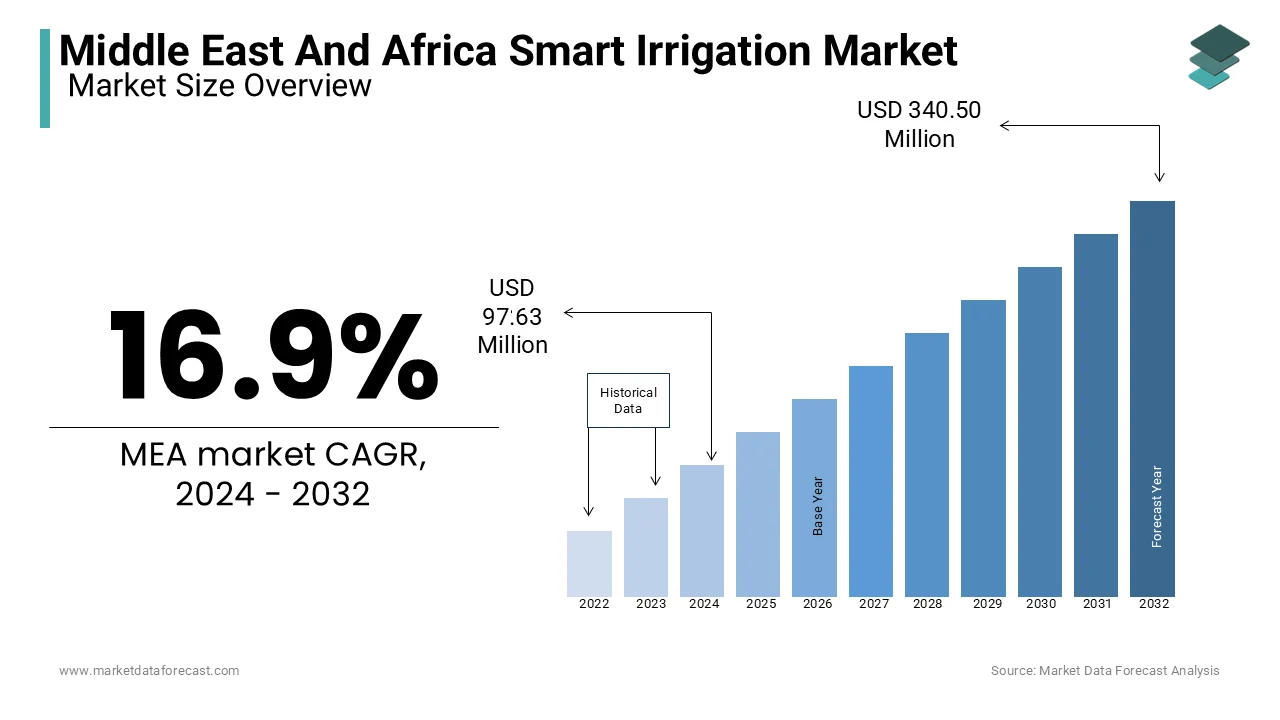
The Middle East and Africa smart irrigation market is projected to grow substantially over the next few years, driven by intensifying freshwater scarcity and national agricultural modernization strategies across arid territories. This market addresses critical resource constraints in territories where renewable freshwater availability remains critically low. According to data published by the World Bank, the Middle East and North Africa region holds only about 1% of global freshwater resources despite hosting substantial agricultural populations. As per World Bank data, the average water availability in the region stands at 1,200 cubic meters per capita annually, which represents approximately six times less than the global average of 7,000 cubic meters. Climate projections indicate that per capita water availability could decline by 50% by 2050 due to population expansion and environmental shifts. Agriculture consumes approximately 85% of regional water resources, yet traditional irrigation methods continue to dominate farming practices across smallholder and commercial operations. The region experiences extreme weather volatility, with increased frequency of droughts and floods that directly impact crop yields and water security. Smart irrigation technologies integrate soil moisture monitoring, weather forecasting, and automated delivery mechanisms to enhance water use efficiency, while supporting sustainable agricultural productivity in water stressed environments.
MARKET DRIVERS
Escalating Water Scarcity Pressures and Agricultural Modernization
Water scarcity represents the foremost catalyst propelling smart irrigation adoption across the Middle East and Africa region. According to the United Nations, more than 60% of the regional population experiences limited or no access to potable water, creating urgent imperatives for efficient agricultural water management. As per World Bank analysis, twelve nations within the Middle East and North Africa qualify among the world's most water scarce countries, including Algeria, Jordan, Saudi Arabia, and Yemen. Agricultural activities consume approximately 85% of available water resources, yet conventional flood irrigation techniques exhibit efficiency rates below 50%, resulting in substantial resource wastage. Climate models project a 20% reduction in regional rainfall patterns, coupled with elevated evaporation rates that will intensify water stress conditions. Groundwater depletion presents another critical concern, with the United Arab Emirates experiencing water table declines of approximately 1 meter annually. Smart irrigation systems employing soil sensors, weather integration, and precision delivery mechanisms can improve water application efficiency by 30% to 50% according to agricultural technology assessments. These technologies enable farmers to apply water only when and where crops require it, reducing waste while maintaining or improving yields. Government initiatives across Gulf Cooperation Council nations increasingly mandate water conservation measures in agriculture, creating regulatory tailwinds for smart irrigation deployment. The convergence of physical water constraints, regulatory pressure, and technological capability establishes a compelling foundation for market expansion.
Government Policy Frameworks Accelerate Technology Adoption
Strategic government interventions across Middle East and Africa nations significantly stimulate smart irrigation market growth through funding programs, regulatory mandates, and capacity building initiatives, which is further contributing to the regional market expansion. According to data published by Morocco's Ministry of Agriculture, the Green Generation 2020 to 2030 strategy prioritizes digitalization of agricultural services and targets installation of more than 100,000 solar powered irrigation pumps. As per Egyptian government announcements, a nationwide mobile based irrigation monitoring pilot was initiated to help farmers optimize water application through real time soil moisture data delivered via handheld devices. Saudi Arabia allocated substantial resources toward agritech development, including a 272 million United States dollar support program targeting water and food security innovations. The United Arab Emirates committed 100 million United States dollars toward precision irrigation and vertical farming solutions. Tunisia supports smart farming startups through innovation hubs that facilitate sensor deployment and data analytics integration for smallholder operations. These policy frameworks typically combine financial incentives, technical assistance, and regulatory standards that lower adoption barriers for farmers. According to regional development assessments, government backed programs have increased smart irrigation awareness among agricultural stakeholders by over 40% in participating countries. Policy driven demand creates predictable market pathways for technology providers, while enabling farmers to access capital for infrastructure upgrades. The alignment of national food security objectives with water conservation goals ensures sustained public sector commitment to smart irrigation expansion.
MARKET RESTRAINTS
High Initial Investment Costs Limit Smallholder Accessibility
Substantial upfront capital requirements present a formidable barrier to smart irrigation adoption, particularly among smallholder farmers who dominate agricultural production across much of Africa, which is a major restraint to the growth of the Middle East and African smart irrigation market. According to market assessments, complete smart irrigation systems including sensors, controllers, connectivity modules, and installation services typically require investments ranging from 2,000 to 10,000 United States dollars per hectare depending on technology sophistication and farm scale. Smallholder operations, which account for approximately 80% of agricultural land in Sub Saharan Africa, often lack access to formal credit facilities necessary for technology procurement. Financing gaps are exacerbated by perceived technology risks and uncertain return on investment timelines that discourage lender participation. According to agricultural development studies, the payback period for smart irrigation systems typically spans 3 to 7 years, which exceeds the planning horizons of many resource constrained farmers. Limited local technical support infrastructure further increases total cost of ownership through maintenance delays and service accessibility challenges. Currency volatility in several African economies introduces additional financial uncertainty for equipment imports and spare parts procurement. These economic constraints disproportionately affect women farmers and youth led agricultural enterprises, who face compounded barriers to capital access. Without targeted financing mechanisms and risk mitigation instruments, smart irrigation technologies remain economically inaccessible to the very producers who could benefit most from water efficiency improvements.
Limited Digital Infrastructure Constrains Technology Deployment
Inadequate digital connectivity and technical support ecosystems significantly impede smart irrigation implementation across rural agricultural landscapes in the Middle East and Africa region, which is further hindering the regional market growth. According to the African Development Bank, around 49% of rural populations have access to 4G networks, which limits the functionality of cloud based irrigation management platforms and real time data transmission capabilities. Middle income countries within the region face pronounced digital inclusion challenges due to large rural populations with limited broadband access and low digital literacy rates. Smart irrigation systems relying on Internet of Things connectivity require stable network coverage for sensor data transmission, remote control functions, and predictive analytics, which remain unavailable in many agricultural zones. According to Internet Society assessments, broadband infrastructure development in the Middle East and North Africa has progressed unevenly, with rural connectivity lagging significantly behind urban centers. Technical support scarcity compounds infrastructure limitations as farmers encounter difficulties troubleshooting system malfunctions or optimizing technology configurations without local expertise. Power supply instability further challenges system reliability, with frequent outages disrupting sensor operations and automated irrigation schedules. According to agricultural technology studies, less than 30% of smallholder farmers in Sub Saharan Africa possess the digital skills necessary to operate advanced irrigation management interfaces. These infrastructure and capability gaps create implementation friction that reduces technology effectiveness and user satisfaction. Until digital ecosystems mature and technical capacity building programs expand, smart irrigation adoption will remain concentrated in well connected commercial farming operations.
MARKET OPPORTUNITIES
Integration With Renewable Energy Systems Creates Synergistic Value
The convergence of smart irrigation technologies with renewable energy infrastructure presents a promising opportunity for the Middle East and African smart irrigation market. According to International Renewable Energy Agency analysis, the Middle East and North Africa region possesses exceptional solar irradiance levels averaging 2,000 to 3,000 kilowatt hours per square meter annually, which enables cost effective solar powered irrigation solutions. As per OECD assessments, renewable energy deployment in agricultural applications can reduce operational costs by 40% to 60% compared to diesel powered alternatives, while eliminating greenhouse gas emissions. Solar powered smart irrigation systems eliminate grid dependency challenges in remote farming areas, while providing predictable energy costs that enhance financial planning for agricultural operations. According to regional energy studies, Egypt has successfully implemented solar irrigation pilots that demonstrate 30% water savings coupled with 25% energy cost reductions. The declining cost trajectory of photovoltaic technology, with module prices falling below 0.20 United States dollars per watt, creates increasingly attractive economics for integrated systems. Government renewable energy targets across Gulf Cooperation Council nations, including Saudi Arabia's 50% green energy goal by 2030, provide policy support for solar irrigation expansion. Financing mechanisms such as pay as you go models and green bonds are emerging to facilitate farmer access to integrated renewable irrigation solutions. According to agricultural innovation assessments, bundled renewable energy and smart irrigation offerings can improve smallholder profitability by 15% to 30% through reduced input costs and enhanced crop yields. This synergistic approach addresses both water and energy security challenges, while supporting climate resilient agricultural development.
Expansion of Data Analytics Platforms Enhances Decision Support
The integration of artificial intelligence and satellite imagery into automated farming systems will likely surge over the next few years, which is creating opportunities for hyper-localized crop management. Advanced data analytics and artificial intelligence applications within smart irrigation ecosystems offer significant opportunities to optimize agricultural productivity and resource efficiency across the Middle East and Africa region. According to telecommunications infrastructure assessments, licensed cellular Internet of Things connections in the region are projected to exceed 70 million, creating robust connectivity foundations for data driven agricultural services. Smartphone connections across the Middle East and Africa will surpass 500 million, enabling widespread access to mobile based irrigation management applications. Advanced analytics platforms can process soil moisture data, weather forecasts, crop growth models, and historical yield information to generate precise irrigation recommendations that improve water use efficiency by 20% to 40% according to agricultural technology studies. Machine learning algorithms enable predictive irrigation scheduling that anticipates crop water requirements based on microclimate conditions and plant phenology stages. Integrated analytics platforms can increase smallholder farmer incomes by 10% to 25% through optimized input application and yield improvements. The growing availability of open source agricultural data and cloud computing infrastructure lowers barriers to advanced analytics adoption. As data literacy improves among agricultural stakeholders, the value derived from intelligent irrigation decision support will continue to expand.
MARKET CHALLENGES
Fragmented Regulatory Landscapes Create Implementation Complexity
Diverse and often inconsistent regulatory frameworks across Middle East and Africa nations present significant challenges for smart irrigation technology standardization and market scaling. According to regional policy assessments, water management regulations vary substantially between countries, with some jurisdictions requiring extensive permitting processes for sensor deployment and data collection activities. As per World Bank analysis, transboundary water governance complexities affect approximately 80% of surface water resources and 66% of total water resources in the region, creating jurisdictional uncertainties for irrigation technology implementation. Data privacy and sovereignty regulations remain underdeveloped in many markets, raising questions about agricultural data ownership, cross border information flows, and farmer rights protections. According to technology deployment studies, inconsistent certification requirements for irrigation equipment increase compliance costs and delay market entry for innovative solutions. Subsidy programs and incentive structures differ markedly between nations, creating uneven competitive landscapes that complicate regional business strategies. According to agricultural policy research, limited harmonization of technical standards for sensor accuracy, data formats, and communication protocols impedes interoperability between systems from different manufacturers. Regulatory uncertainty regarding water rights and allocation priorities affects the economic viability of efficiency improvements, since saved water may not translate into usable benefits for farmers. According to governance assessments, capacity gaps within regulatory agencies slow approval processes for new technologies and limit effective monitoring of implementation outcomes. These fragmented regulatory environments increase transaction costs and create market entry barriers that disproportionately affect small and medium sized technology providers.
Technical Capacity Gaps Hinder Effective System Utilization
The full operational potential of high-tech water management grids will likely be restricted over the next few years by an acute shortage of localized technical expertise, which is further challenging the regional market expansion. Insufficient technical expertise and training infrastructure across agricultural value chains significantly constrain the effective deployment and operation of smart irrigation technologies in the Middle East and Africa region. According to agricultural development research, only 46% of smallholder farmers in arid areas of South Africa have adopted climate smart irrigation technologies, with limited technical knowledge cited as a primary barrier. Digital literacy levels among rural agricultural populations remain low, with many farmers lacking the skills necessary to configure, operate, and maintain advanced irrigation management systems. Technical support ecosystems are underdeveloped, with limited availability of certified technicians who can troubleshoot sensor malfunctions, calibrate equipment, or optimize system configurations. According to innovation studies, less than 30% of agricultural extension services in Sub Saharan Africa possess the expertise required to advise farmers on smart irrigation implementation and best practices. Language barriers and limited localization of user interfaces further complicate technology adoption among non English speaking farming communities. According to capacity building assessments, training programs for smart irrigation operation typically reach fewer than 15% of target farmer populations due to resource constraints and logistical challenges. Equipment maintenance challenges are exacerbated by limited spare parts availability and extended supply chains that increase downtime and reduce system reliability. According to agricultural technology research, inadequate post installation support contributes to technology abandonment rates exceeding 40% in some smallholder contexts. These capacity constraints limit the realization of smart irrigation benefits and undermine farmer confidence in technology investments. Without comprehensive technical training programs and localized support networks, the full potential of smart irrigation technologies will remain unrealized across the region.
REPORT COVERAGE
| REPORT METRIC | DETAILS |
| Market Size Available | 2025 to 2034 |
| Base Year | 2025 |
| Forecast Period | 2026 to 2034 |
| CAGR | 16.9% |
| Segments Covered | By Irrigation Controller, Hardware and Network Component, Application, and Region. |
| Various Analyses Covered | Global, Regional & Country Level Analysis, Segment-Level Analysis, DROC, PESTLE Analysis, Porter’s Five Forces Analysis, Competitive Landscape, Analyst Overview of Investment Opportunities |
| Regions Covered | KSA, UAE, Israel, rest of GCC countries, South Africa, Ethiopia, Kenya, Egypt, Sudan, rest of MEA |
| Market Leaders Profiled | Hunter Industries, Rain Bird Corporation, Netafim, HydroPoint Data Systems, Inc., Rachio Inc., The Toro Company, Calsense, Galcon, Blossom, and Green Electronics LLC (RainMachine). |
SEGMENT ANALYSIS
By Irrigation Controller Insights
The weather based controllers segment accounted for the highest share of 60.6% of the regional market share in 2025 This segment dominance stems from the technology's ability to integrate real time meteorological data with irrigation scheduling algorithms that optimize water application without requiring extensive on site sensor infrastructure. Weather Based Controllers leverage hyperlocal weather forecasting data to dynamically adjust irrigation cycles based on evapotranspiration rates, precipitation forecasts, and temperature variations. According to the Irrigation Association, these controllers access data from on site weather sensors, local meteorological stations, or internet based weather services to calculate precise water requirements for specific crop types. As per United States Environmental Protection Agency assessments, Weather Based Irrigation Controllers can reduce outdoor water consumption by 20% to 40% compared to conventional timer based systems, while maintaining optimal soil moisture levels. In the Middle East And Africa context, where weather volatility intensifies due to climate change, these controllers provide critical adaptability for farmers managing unpredictable rainfall patterns. Regional meteorological agencies have expanded digital weather data accessibility, with Saudi Arabia's National Center for Meteorology now providing hourly forecasts across 95% of agricultural zones. This enhanced data availability enables Weather Based Controllers to deliver more accurate irrigation recommendations that align with actual field conditions. The technology's scalability allows deployment across diverse farm sizes, from smallholder plots to commercial estates, without requiring complex sensor networks that increase maintenance burdens.

The sensor based controllers segment is estimated to showcase the fastest CAGR of 20.2% during the forecast period in the Middle East and African market owing to the increasing farmer recognition of the precision advantages offered by direct soil moisture monitoring and plant stress detection capabilities. Sensor Based Controllers deliver superior irrigation accuracy by measuring actual soil moisture content, root zone conditions, and plant physiological indicators, rather than relying on predictive weather models. Sensor based systems capture a major portion of smart irrigation revenue due to their ability to eliminate irrigation errors caused by microclimate variations that weather forecasts cannot detect. As per agricultural technology assessments, these controllers utilize capacitance probes, tensiometers, and dielectric sensors to provide continuous soil moisture readings at multiple depths, enabling farmers to apply water only when crops experience actual water stress. In the Middle East And Africa context, where soil types vary dramatically from sandy desert terrains to clay rich agricultural valleys, this granular monitoring capability prevents both under irrigation that reduces yields and over irrigation that wastes scarce water resources. Regional field trials in Egypt demonstrated that Sensor Based Controllers reduced water application by 35% while increasing crop yields by 18% compared to weather dependent systems. The technology's adaptability to diverse cropping systems, from date palms in Gulf states to maize in Sub Saharan Africa, further expands its applicability across the region's heterogeneous agricultural landscape.
By Hardware And Network Component Insights
The sensors segment held the largest share of the Middle East and African smart irrigation market in 2025 due to the foundational role sensors play in enabling data driven irrigation decisions across diverse agricultural and non agricultural applications. Sensors serve as the primary data collection interface for smart irrigation ecosystems, capturing essential parameters including soil moisture levels, temperature fluctuations, rainfall intensity, and plant water stress indicators. The sensors segment holds significant market share because sensor based automated farming systems combine real time data on humidity, rain, moisture, nutrient capacity, and optimal temperature requirements to increase farm productivity. As per agricultural technology research, modern smart irrigation deployments utilize multiple sensor types, including capacitance probes for volumetric water content, tensiometers for soil water potential, and infrared thermometers for canopy temperature assessment. This multi parameter monitoring capability enables precise irrigation scheduling that aligns water application with actual crop needs rather than estimated requirements. In the Middle East And Africa region, where water scarcity intensifies agricultural production challenges, sensors provide the granular visibility necessary to optimize every drop of applied water. Regional field studies in Saudi Arabia demonstrated that sensor enabled irrigation systems reduced water consumption by 40% while maintaining crop yields compared to conventional methods. The scalability of sensor networks allows deployment across diverse farm sizes, from smallholder plots to commercial estates, creating broad market applicability.
On the other side, the water and flow meters segment is anticipated to register a CAGR of 19.4% during the forecast period in the Middle East and African smart irrigation market owing to the increasing regulatory requirements and farmer recognition of the value derived from precise water measurement and accountability. Water And Flow Meters enable precise quantification of irrigation water application, supporting compliance with increasingly stringent water conservation regulations across the Middle East And Africa region. According to World Bank analysis, twelve nations within the Middle East and North Africa qualify among the world's most water scarce countries, creating regulatory imperatives for accurate water usage monitoring. As per regional policy assessments, governments in Saudi Arabia and the United Arab Emirates now mandate flow metering for agricultural operations exceeding 5 hectares to ensure adherence to allocated water quotas and conservation targets. These regulatory frameworks create predictable demand for flow measurement infrastructure, as farmers seek to avoid penalties and maintain operational licenses. The meters' ability to detect leaks, pipe failures, and unauthorized water diversions further enhances their value proposition for agricultural operators managing scarce water resources. According to agricultural technology studies, flow meter deployment can reduce water losses from distribution systems by 15% to 25% through early leak detection and pressure optimization. In regions where water pricing mechanisms are evolving toward volumetric billing, flow meters provide the measurement foundation for transparent cost allocation and conservation incentives.
By Application Insights
The agriculture segment held the largest share of the Middle East and African smart irrigation market in 2025. This overwhelming dominance reflects the sector's critical dependence on efficient water management to ensure food security amid intensifying resource constraints. Agricultural water management represents a strategic priority across the Middle East And Africa region, where population growth and climate variability intensify food production challenges. According to World Bank data, agriculture consumes approximately 85% of available water resources in the region, yet conventional irrigation methods exhibit efficiency rates below 50%, resulting in substantial resource wastage. As per regional development assessments, smart irrigation technologies can improve water application efficiency by 30% to 50%, enabling farmers to maintain or increase crop yields while reducing water consumption. This productivity enhancement is particularly valuable in water scarce environments, where every drop of applied water must deliver maximum agricultural output. Government food security initiatives across Gulf Cooperation Council nations increasingly mandate water conservation measures in agriculture, creating regulatory tailwinds for smart irrigation deployment. The technology's ability to support diverse cropping systems, from date palms in desert environments to cereals in Sub Saharan savannas, further expands its applicability across the region's heterogeneous agricultural landscape. Regional field trials in Morocco demonstrated that smart irrigation adoption increased smallholder farmer incomes by 25% through optimized input application and yield improvements.
On the other side, the non-agriculture segment is projected to grow at the fastest CAGR of 22.7% during the forecast period in the regional market owing to the increasing urbanization, landscape development, and recreational infrastructure investment across the region. Rapid urbanization across the Middle East and Africa region creates expanding demand for smart irrigation solutions in residential communities, commercial properties, and public green spaces. According to United Nations assessments, the region's urban population is projected to increase by 180 million people by 2050, driving substantial investment in landscaped environments that require efficient water management. As per municipal planning reports, cities in Gulf Cooperation Council nations allocate significant budgets for urban greening initiatives that incorporate smart irrigation to conserve water while maintaining aesthetic standards. These projects frequently utilize weather responsive controllers, soil moisture sensors, and flow meters to optimize water application across parks, golf courses, and residential developments. The technology's ability to integrate with building management systems and municipal water infrastructure creates additional value for property developers and facility managers. Regional case studies in Dubai demonstrated that smart irrigation deployment in urban landscapes reduced water consumption by 45% compared to conventional timer based systems while maintaining vegetation health. Government sustainability mandates across the region increasingly require water efficient landscaping for new developments, creating regulatory tailwinds for non-agricultural smart irrigation adoption.
COUNTRY ANALYSIS
Saudi Arabia Smart Irrigation Market Analysis
The Saudi Arabia commanded for 26.7% of the regional market share in 2025. This leadership position reflects the kingdom's strategic prioritization of agricultural water conservation amid extreme aridity and ambitious food security objectives. The kingdom's National Water Strategy 2030 allocates substantial resources toward irrigation modernization, with targets to improve agricultural water use efficiency by 40% through technology adoption. According to Saudi Ministry of Environment, Water and Agriculture data, over 120000 hectares of agricultural land now utilize smart irrigation systems, supported by government subsidy programs that cover up to 70% of installation costs. As per regional development assessments, the kingdom's Vision 2030 initiative includes 272 million United States dollar in agritech investments targeting water and food security innovations that accelerate smart irrigation deployment. The technology's alignment with Saudi Arabia's renewable energy expansion creates synergistic opportunities for solar powered irrigation systems that eliminate grid dependency in remote agricultural zones. According to agricultural technology studies, smart irrigation adoption in Saudi date palm cultivation has reduced water consumption by 35% while maintaining fruit quality and yield. The kingdom's regulatory framework increasingly mandates water conservation measures for agricultural operations exceeding 5 hectares, creating predictable demand for smart irrigation infrastructure. These combined policy, financial, and technological drivers establish Saudi Arabia as the regional market leader with sustained growth potential through 2034.
The United Arab Emirates is projected to exhibit top-tier growth in agritech adoption over the next few years, establishing standard-setting smart farming zones across municipal borders. This position reflects the emirate's leadership in agricultural technology innovation and commitment to sustainable water management. The United Arab Emirates National Food Security Strategy 2051 prioritizes precision agriculture technologies, including smart irrigation, to enhance domestic food production amid limited arable land and water resources. According to Dubai Municipality data, over 85% of new agricultural projects in the emirate now incorporate smart irrigation systems as part of sustainability certification requirements. As per government announcements, the United Arab Emirates committed 100 million United States dollars toward agritech companies developing precision irrigation and vertical farming solutions that accelerate technology adoption. The emirate's advanced digital infrastructure enables seamless integration of smart irrigation systems with cloud based analytics platforms and mobile management applications. According to agricultural technology assessments, smart irrigation deployment in United Arab Emirates greenhouse operations has reduced water consumption by 50% while increasing crop yields through precise environmental control. The technology's compatibility with the emirate's renewable energy initiatives creates opportunities for solar powered irrigation systems that align with national decarbonization objectives. Government innovation hubs in Abu Dhabi and Dubai provide technical support and demonstration facilities that accelerate farmer adoption of smart irrigation technologies.
COMPETITIVE LANDSCAPE
The Middle East And Africa Smart Irrigation Market features a competitive landscape characterized by global technology leaders regional specialists and emerging local innovators. Established multinational corporations leverage extensive research and development capabilities global supply chains and brand recognition to maintain market leadership positions. These companies compete through continuous product innovation strategic partnerships and comprehensive customer support infrastructure that address diverse regional requirements. Regional players differentiate through localized product configurations deep understanding of agricultural practices and agile response to emerging market needs. The competitive environment encourages technology advancement with companies investing in artificial intelligence integration wireless connectivity and solar power compatibility to enhance product value propositions. Market participants increasingly focus on total solution offerings that combine hardware software and services to create comprehensive irrigation management ecosystems. Pricing strategies balance premium technology positioning with affordability considerations for resource constrained farmers across the region. The competitive dynamics foster collaboration alongside competition with companies forming strategic alliances to expand market reach and accelerate technology adoption. This evolving competitive landscape drives innovation and value creation that benefits agricultural stakeholders across the Middle East And Africa region.
KEY MARKET PLAYERS
Some of the prominent vendors in the Middle East and Africa smart irrigation market include
- Hunter Industries
- Rain Bird Corporation
- Netafim
- HydroPoint Data Systems, Inc.
- Rachio Inc
- The Toro Company
- Calsense
- Galcon
- Blo
- Green Electronics (RainMachine).
Top Players In The Market
- Netafim maintains a prominent position in the Middle East And Africa Smart Irrigation Market through its comprehensive portfolio of precision irrigation solutions and deep regional expertise. The company's drip irrigation technologies integrated with smart controllers and sensors enable precise water application that aligns with crop requirements across diverse agricultural environments. Netafim has strengthened its regional presence through strategic partnerships with local distributors and government agencies that facilitate technology deployment across smallholder and commercial farming operations. Recent initiatives include the launch of cloud based irrigation management platforms that leverage artificial intelligence to optimize water scheduling based on real time field conditions and weather forecasts. The company's commitment to farmer training programs and technical support infrastructure enhances adoption success and long term customer relationships. Netafim's alignment with regional water conservation policies and food security objectives positions the company for sustained growth across the Middle East And Africa region.
- Rain Bird Corporation contributes significantly to the Middle East And Africa Smart Irrigation Market through its innovative irrigation controllers sensors and software solutions designed for water constrained environments. The company's weather responsive irrigation technologies integrate local meteorological data with soil moisture monitoring to deliver precise water application that optimizes crop productivity while conserving scarce resources. Rain Bird has expanded its regional footprint through collaborations with agricultural extension services and technology partners that enhance product accessibility and farmer support. Recent advancements include the development of solar powered smart irrigation systems that eliminate grid dependency challenges in remote agricultural zones. The company's investment in localized product configurations and multilingual user interfaces improves usability for diverse farming communities across the region. Rain Bird's alignment with government water conservation initiatives and sustainability certification programs creates additional growth opportunities across commercial and smallholder agricultural segments.
- Hunter Industries maintains a strong presence in the Middle East And Africa Smart Irrigation Market through its durable irrigation controllers and sensor technologies engineered for harsh environmental conditions. The company's smart irrigation solutions feature weather adaptive scheduling soil moisture integration and remote management capabilities that enable precise water application across diverse agricultural and landscape applications. Hunter Industries has strengthened its regional position through strategic distribution partnerships and technical training programs that enhance product adoption and customer satisfaction. Recent innovations include the development of low power wireless sensor networks that extend battery life and reduce maintenance requirements in remote farming areas. The company's commitment to product reliability and after sales support builds long term customer relationships across commercial agricultural and municipal landscape segments. Hunter Industries' alignment with regional water efficiency regulations and sustainability objectives positions the company for continued growth across the Middle East And Africa region.
Top Strategies Used By Key Market Participants
Key players in the Middle East And Africa Smart Irrigation Market employ strategic approaches to strengthen competitive positioning and accelerate growth. Technology innovation remains paramount with companies investing in research and development to enhance product functionality durability and affordability for regional conditions. Strategic partnerships with local distributors government agencies and agricultural organizations facilitate market access and technology adoption across diverse farming communities. Customer education initiatives including demonstration farms training programs and technical support infrastructure reduce adoption barriers and enhance long term success. Product localization efforts adapt hardware and software interfaces to regional languages agricultural practices and environmental conditions improving usability and acceptance. Financing solutions including pay as you go models equipment leasing and subsidy facilitation address capital constraints among smallholder farmers. Digital integration strategies connect irrigation systems with cloud based analytics mobile applications and farm management platforms creating additional value for customers. These combined approaches enable market participants to navigate regional complexities while delivering sustainable growth across the Middle East And Africa Smart Irrigation Market.
MARKET SEGMENTATION
This research report on the Middle East and Africa smart irrigation market is segmented and sub-segmented into the following categories.
By Irrigation Controller
- Weather-Based Controllers
- Sensor-Based Controllers
By Hardware and Network Component
- Sensor
- Water/Flow Meter
- Smart Detection System
By Application
- Agriculture
- Non-Agriculture
By Country
- KSA
- UAE
- Israel
- Rest Of GCC Countries
- South Africa
- Ethiopia
- Kenya
- Egypt
- Sudan
- Rest Of MEA