- Product Description Description
- Table of Contents TOC
- List of Table & Figure LOT
- Get Free Sample PDF Sample PDF
Market Size, 2025
$2.39 BnMarket Estimate, 2026
$2.71 BnMarket Forecast, 2034
$7.40 BnCAGR, 2026–2034
13.38%Executive Summary: Middle East and Africa Intelligent Agriculture Market
- Market Scope: Comprehensive regional analysis of the Middle East and Africa (MEA) intelligent agriculture market covering applications (precision farming, livestock monitoring, fish farming, and smart greenhouses), hardware/software/services offerings, and country-level breakdowns.
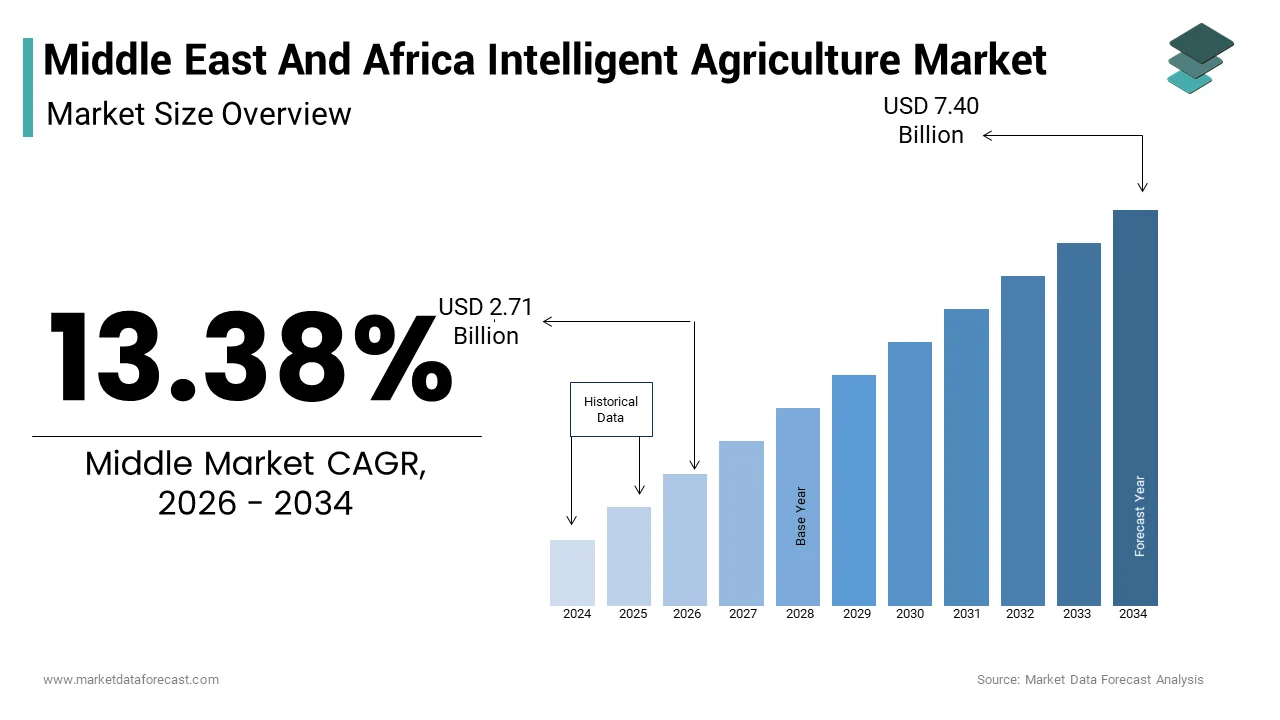
- Market Valuation: Valued at USD 2.39 billion (2025), estimated at USD 2.71 billion (2026), and projected to reach USD 7.40 billion by 2034, registering a strong CAGR of 13.38% (2026–2034).
- Primary Growth Drivers: Escalating adoption of modern digital farming technologies, rising need for livestock health tracking, growing global food demand, and proactive government support for agricultural modernization and water conservation.
Key Market Segment Metrics (2026–2034)
| Category | Leading Segments / Overview | Market Position & Growth Scope |
|---|---|---|
| By Application | Precision farming, livestock monitoring, fish farming, and smart greenhouses | Heavy deployment of yield and soil monitoring tools to optimize resource efficiency in arid and constrained environments |
| By Offering | Hardware, Software (Local/Web-Based & Cloud-Based), and Services (Integration, Managed, Connectivity, & Support) | End-to-end tech frameworks facilitating automation, water management, and real-time farm data analytics |
| By Country / Region | KSA, UAE, Israel, Rest of GCC, South Africa, Ethiopia, Kenya, Egypt, Sudan, and Rest of MEA | Driven by regional food security initiatives and technological investments in arid-zone agriculture |
Major Market Stakeholders & Ecosystem Structure
Market Structure: A developing regional landscape propelled by international agricultural research organizations, precision agriculture associations, and specialized technology providers shaping standards and deployment frameworks.
Key Entities & Organizations: GNSS Agency (GSA), Precision Ag Institute, International Society for Precision Agriculture (ISPA), SPAA Precision Agriculture, CropLife Media Group, Precision Agriculture Association, and the Agricultural Research Organization.
 Download Free Sample Report
Middle East and Africa Intelligent Agriculture Market Size
The Middle East and Africa intelligent agriculture market size was valued at USD 2.39 billion in 2025 and is anticipated to reach a valuation of USD 2.71 billion in 2026 and USD 7.40 billion by 2034, growing at a CAGR of 13.38% from 2026 to 2034.
The intelligent agriculture is the integration of advanced digital technologies, including Internet of Things sensors artificial intelligence and data analytics into agricultural practices to optimize resource usage and enhance crop productivity in arid and semi-arid environments. Governments across the Gulf Cooperation Council and select African nations are prioritizing digital transformation in agriculture to reduce import dependency and conserve natural resources. The deployment of drone technology satellite imagery and automated machinery enables real time monitoring of soil health and plant status. These innovations address the dual challenges of limited arable land and extreme climatic conditions. Stakeholders include technology providers agricultural enterprises and government bodies working collaboratively to build resilient food systems.
MARKET DRIVERS
Severe Water Scarcity Necessitates Precision Irrigation Solutions
The acute water shortages are making efficient water management a survival imperative rather than an optional enhancement. The sever water scarcity necessitates precision irrigation solutions is fuelling the growth of the Middle East and Africa intelligent agriculture market. The implementing smart irrigation systems using soil moisture sensors and automated controls can reduce water consumption, while maintaining or increasing crop yields in arid zones. This dramatic improvement in efficiency drives governments and large-scale farms to invest heavily in intelligent agriculture infrastructure. Countries like Saudi Arabia and the United Arab Emirates have mandated the use of modern irrigation techniques in new agricultural projects to preserve dwindling groundwater reserves. Smallholder farmers in Africa face similar pressures as rainfall becomes increasingly erratic requiring tools that maximize every drop of available water. The economic cost of water extraction and desalination that further incentivizes the use of precision technologies to minimize waste.
Government Initiatives for Food Security Drive Technology Adoption
The strategic national policies aimed at achieving food self-sufficiency is additionally fuelling the growth of the Middle East and Africa intelligent agriculture market. The African Union Agenda 2063 framework emphasizes the modernization of agriculture through digital innovation stating that increased productivity is key to lifting millions out of poverty and ensuring continental food security. These high-level political commitments translate into substantial public funding for pilot projects and subsidies for farmers adopting intelligent agriculture tools. Governments in Egypt and Morocco are launching national programs to equip farmers with digital platforms for weather forecasting and market access. State owned enterprises are partnering with technology firms to develop localized solutions that address specific regional challenges. The focus on reducing post harvest losses through smart storage and logistics further expands the scope of intelligent agriculture. Public private partnerships facilitate knowledge transfer and capacity building among local farmers.
MARKET RESTRAINTS
High Initial Investment Costs Restrict Smallholder Access
The prohibitive upfront costs for hardware software and installation is hindering the growth of the Middle East and Africa intelligent agriculture market. This economic barrier limits market penetration to large commercial estates and government backed projects leaving the most vulnerable producers behind. High interest rates on agricultural loans in many African countries further discourage borrowing for technology upgrades. The lack of flexible financing models tailored to seasonal cash flows exacerbates the affordability crisis. Farmers perceive intelligent agriculture as a luxury rather than a necessity due to the immediate financial burden.
Limited Digital Infrastructure and Connectivity Hinders Implementation
The inadequate internet connectivity and unreliable power supply in rural areas, where network coverage is sparse or non-existent is additionally hampering the growth of the Middle East and Africa intelligent agriculture market. The population in Sub Saharan Africa has access to mobile broadband internet, which is essential for real time data transmission from field sensors to cloud based analytics platforms. This infrastructure gap forces farmers to rely on offline manual methods or limits the functionality of smart devices to local storage without cloud integration. Data latency and connection drops compromise the accuracy of real time decision support systems. The high cost of deploying private networks in remote areas discourages technology providers from expanding their service offerings. Power fluctuations can damage sensitive electronic equipment leading to additional maintenance costs. The lack of digital literacy among rural populations further complicates the use of connected devices.
MARKET OPPORTUNITIES
Expansion of Vertical Farming and Controlled Environment Agriculture
The rise of vertical farming and controlled environment agriculture by enabling year round production in urban centers with minimal land and water usage is likely to promote new opportunities for the growth of the Middle East and Africa intelligent agriculture market. As per the United Nations Department of Economic and Social Affairs, urban populations in Africa will double by 2050, creating intense demand for locally grown fresh produce that can be met through high tech indoor farming facilities. This efficiency attracts significant private investment from real estate developers and retail chains seeking sustainable supply chains. Cities like Dubai and Cairo are seeing a surge in indoor farming startups that rely entirely on automated climate control and nutrient delivery systems. These facilities serve as showcases for intelligent agriculture technologies demonstrating their viability in extreme climates. The ability to grow crops independent of external weather conditions reduces risk and ensures consistent supply.
Integration of Mobile Based Advisory Services for Smallholders
The widespread penetration of mobile phones to deliver intelligent agriculture insights to smallholder farmers through low cost SMS and app based advisory services is another attribute to fuel the growth of the Middle East and Africa intelligent agriculture market. This model bypasses the need for expensive hardware by leveraging existing devices to deliver data driven recommendations. Tech companies are developing voice-based services in local languages to overcome literacy barriers. Governments and NGOs are partnering with telecom operators to subsidize data costs for agricultural apps. This approach democratizes access to intelligent agriculture benefits allowing millions of smallholders to participate in the digital economy. The scalability of mobile platforms enables rapid market expansion with minimal infrastructure investment.
MARKET CHALLENGES
Lack of Technical Expertise and Digital Literacy
The severe shortage of skilled personnel and low levels of digital literacy among farmers is likely to be a challenge for the expansion of the Middle East and Africa intelligent agriculture market. There is a gap in technical vocational training for modern agricultural technologies with fewer than 10% of agricultural extension workers trained in digital tools and precision farming methods. This skills deficit leads to underutilization of purchased technologies as farmers struggle to configure sensors or analyze data outputs correctly. Misinterpretation of data can result in poor decision making that negates the benefits of intelligent systems. The lack of local technical support means that minor glitches can render systems unusable for extended periods. Training programs are often too theoretical and not tailored to practical field conditions.
Data Privacy and Security Concerns
The growing concerns regarding data ownership privacy and cybersecurity, as farmers become wary of sharing sensitive operational data with third party providers is also to leverage the growth of the Middle East and Africa intelligent agriculture market. The lack of comprehensive legal frameworks in many countries to protect agricultural data from misuse or unauthorized access by corporations or foreign entities. The World Economic Forum states that cyber attacks on critical infrastructure including agricultural systems are increasing globally raising fears that intelligent farming networks could be vulnerable to sabotage or ransomware attacks that disrupt food production. Farmers fear that their yield data could be used by traders to manipulate prices or by insurers to deny claims. The absence of clear regulations on data rights creates uncertainty and distrust among potential users. Large agribusinesses may hesitate to integrate systems due to liability risks. The lack of localized data centers raises concerns about data sovereignty and cross border transfers.
REPORT COVERAGE
| REPORT METRIC | DETAILS |
| Market Size Available | 2025 to 2034 |
| Base Year | 2025 |
| Forecast Period | 2026 to 2034 |
| CAGR | 13.38% |
| Segments Covered | By Application, Offering, and By Country |
| Various Analyses Covered | Global, Regional & Country Level Analysis, Segment-Level Analysis, DROC, PESTLE Analysis, Porter’s Five Forces Analysis, Competitive Landscape, Analyst Overview on Investment Opportunities |
| Regions Covered | KSA, UAE, Israel, the rest of GCC countries, South Africa, Ethiopia, Kenya, Egypt, Sudan, the rest of MEA. |
| Market Leaders Profiled | GNSS Agency (GSA) (Czech Republic), Precision Ag Institute (U.S.), International Society for Precision Agriculture (ISPA) (U.S.), SPAA Precision Agriculture (Australia), CropLife (CropLife Media Group) (U.S.), Precision Agriculture Association (New Zealand), and Agricultural Research Organization (Israel). |
SEGMENTAL ANALYSIS
By Application Insights
The precision farming segment held a significant share of the Middle East and Africa intelligent agriculture market in 2025. As per the Food and Agriculture Organization of the United Nations, agriculture consumes approximately 85% of total freshwater withdrawals in the Near East and North Africa region yet faces increasing pressure from climate change, which is projected to reduce available water resources by 20% by 2040. The smart irrigation systems utilizing soil moisture sensors and automated valves can improve water use efficiency compared to traditional flood irrigation methods commonly used in the region. This substantial saving directly translates into cost reductions and sustainability compliance for large scale commercial farms. Governments in arid nations mandate the adoption of such technologies to preserve national water security. Farmers rely on real time data to optimize watering schedules preventing both under and over irrigation. The integration of weather forecasting with irrigation controllers allows for proactive adjustments based on predicted rainfall and evaporation rates. This technological capability is essential for maintaining crop yields in environments where water is the most limiting factor.
The smart greenhouse applications segment is attributed to register a fastest CAGR of 11.2% during the forecast period with the rapid urbanization and the need for local fresh produce production in harsh climates. According to the United Nations Department of Economic and Social Affairs, urban population in Africa will reach 1.2 billion by 2050, creating immense demand for food that can be met through high tech indoor farming facilities near city centers. Investors and governments are funding large scale vertical farms and smart greenhouses equipped with automated HVAC and nutrient delivery systems. These facilities operate independently of external weather conditions ensuring year round supply. The high initial cost is offset by premium pricing for locally grown pesticide free produce. Technology providers are developing modular greenhouse solutions that are easier to deploy and maintain. The trend towards sustainable urban living supports the expansion of this segment. Consumers prefer fresh locally sourced vegetables driving retail partnerships with indoor farms.
By Offering Insights
The hardware segment was the largest by accounting for 44.9% of the Middle East And Africa Intelligent Agriculture Market share in 2025 with the deployment of physical devices such as sensors, drones, and automated controllers is the foundational step in establishing any intelligent agriculture system. The number of connected agricultural devices in the region is growing rapidly as farmers invest in soil moisture sensors weather stations and livestock trackers to gather essential field data. The Food and Agriculture Organization of the United Nations states that without reliable hardware to capture real time environmental and biological metrics software and services cannot function effectively making hardware procurement the primary entry point for technology adoption. Large scale farms prioritize robust hardware that can withstand extreme temperatures and dust common in the region. The durability and accuracy of these devices determine the quality of data available for decision making. Governments subsidizing smart farming initiatives often focus grants on hardware purchases to lower barriers to entry. The tangible nature of hardware makes it easier for farmers to understand and value compared to abstract software solutions. Maintenance and replacement cycles also contribute to recurring revenue streams.
The software segment is swiftly emerging at a fastest CAGR of 9.2% from 2026 to 2034 with the increasing volume of data generated by hardware devices and the need for advanced analytics to derive actionable insights. The farmers using data driven decision support software can optimize input usage and increase profits by receiving personalized recommendations on planting timing fertilizer application and pest control. This value proposition drives rapid adoption of subscription-based software services. Platforms offering predictive analytics for weather and market prices are particularly popular. The scalability of software allows providers to serve millions of users with minimal marginal cost. Integration with mobile money facilitates easy payment for digital services. Farmers appreciate the convenience of accessing insights via smartphones. The continuous improvement of algorithms enhances accuracy and trust in the software.
COUNTRY LEVEL ANALYSIS
Kingdom of Saudi Arabia Market Analysis
The Kingdom of Saudi Arabia was the largest contributor of the Middle East and Africa intelligent agriculture market by holding 55.4% of the share in 2025 with the ambitious national visions and substantial government investment in food security technologies. As per the Saudi Ministry of Environment Water and Agriculture, the kingdom aims to increase the localization of strategic crops to 60% by 2030 through the adoption of smart farming techniques, including vertical farming and precision irrigation. Large scale projects in NEOM and other economic zones are showcasing cutting edge technologies. The focus on sustainability aligns with global trends attracting international technology partners. Local startups are emerging to provide customized solutions for date palm and vegetable production. Government subsidies encourage farmers to replace traditional methods with smart systems.
United Arab Emirates Market Analysis
The United Arab Emirates was positioned second by holding 19.2% of the Middle East and Africa intelligent agriculture market share in 2025 with the advanced research facilities and a strong focus on controlled environment agriculture. Dubai serves as a hub for agtech startups attracting venture capital and talent. The government provides incubators and grants for innovative solutions. High consumer demand for premium local produce supports the business case for high tech farming. Collaboration with international research institutions accelerates technology transfer.
Israel Market Analysis
Israel intelligent agriculture market growth is deemed to grow with the innovation in arid land farming and water management. The Start Up Nation Central report indicates that Israel is home to over 400 agtech companies, developing solutions in robotics sensors and data analytics, which are increasingly being adopted in African and Middle Eastern countries. Israeli firms partner with local entities in Ethiopia and Kenya to deploy drip irrigation and monitoring technologies. The expertise in dealing with water scarcity makes Israeli solutions highly relevant to the region. Government trade missions facilitate technology exchange.
South Africa Market Analysis
South Africa intelligent agriculture market growth is expected to grow with the strong commercial farming sector and advanced infrastructure. The government programs are supporting the digitization of smallholder farms to improve market access and productivity through mobile based advisory services. The presence of major global agtech companies facilitates technology availability. Local universities conduct research on climate smart agriculture. The market benefits from established supply chains and financial services. Farmers are knowledgeable and demand high quality solutions. Challenges include inequality in access between commercial and subsistence sectors. However, the overall trajectory is towards greater digital integration.
Ethiopia Market Analysis
Ethiopia intelligent agriculture market growth is driven by its large agricultural base and government reforms aimed at modernizing the sector. As per the Ethiopian Ministry of Agriculture, the Digital Ethiopia 2025 strategy includes specific components for transforming agriculture through the use of digital tools for extension services and linkage. The pilot projects using satellite data for crop insurance and yield prediction have shown promising results in improving resilience among smallholder farmers in the region. Mobile phone penetration is increasing enabling access to digital advisory platforms. The government is partnering with tech firms to scale these solutions. Focus on coffee and teff production drives demand for quality monitoring tools. Infrastructure limitations remain a challenge but improvements are ongoing. International donors support digital agriculture initiatives.
COMPETITIVE LANDSCAPE
The competitive landscape of the Middle East And Africa Intelligent Agriculture Market is characterized by a dynamic mix of global technology giants, regional agtech startups, and research institutions, vying to address unique climatic and infrastructural challenges. Multinational corporations leverage their extensive resources to offer comprehensive end to end solutions, including hardware, software, and consulting services, while local startups focus on niche problems, such as mobile based advisory services and affordable sensor networks. Competition is intense in the precision irrigation segment, due to critical water scarcity issues driving demand for efficient solutions. Companies differentiate themselves through the robustness of their hardware in harsh environments, and the accuracy of their predictive analytics algorithms. Strategic collaborations with governments and international development agencies are crucial, for securing large contracts and influencing policy. Price sensitivity among smallholder farmers forces providers to innovate in business models, such as pay per use or leasing options. Intellectual property protection varies across countries, affecting the speed of technology diffusion.
KEY MARKET PLAYERS
Some of the major players in the market are the Middle East and Africa
- GNSS Agency (GSA) (Czech Republic)
- Precision Ag Institute (U.S.)
- Netafim
- Badger Technologies
- CropX
- Pure Harvest Smart Farms
- Hello Tractor
- International Society for Precision Agriculture (ISPA) (U.S.)
- SPAA Precision Agriculture (Australia)
- CropLife (CropLife Media Group) (U.S.)
- Precision Agriculture Association (New Zealand)
- Agricultural Research Organization (Israel).
Top Players In The Market
- The International Center for Agricultural Research in the Dry Areas plays a pivotal role in advancing intelligent agriculture across the Middle East and Africa by developing climate resilient crop varieties and digital decision support tools. The organization actively collaborates with national governments to deploy satellite-based monitoring systems, that help farmers optimize water usage and predict pest outbreaks in arid regions. These initiatives enhance food security, by enabling precise resource management and reducing crop losses. The center also trains local extension workers on using smart farming technologies, ensuring sustainable adoption. Their focus on open-source data sharing fosters innovation among regional tech startups.
- Badger Technologies contributes significantly to the Middle East And Africa Intelligent Agriculture Market, by providing autonomous robotic solutions that address labor shortages and improve operational efficiency in large scale commercial farms. The company specializes in computer vision and artificial intelligence driven robots, that monitor crop health and detect weeds without chemical inputs. Recent actions include partnerships with major agribusinesses in South Africa and Egypt, to pilot autonomous scouting robots in vineyards and vegetable fields. These deployments demonstrate the ability of robots to collect high resolution data that informs precision irrigation and fertilization strategies. Badger Technologies focuses on delivering actionable insights that reduce input costs and increase yields. Their robust hardware is designed to withstand harsh desert conditions, ensuring reliability. The company continues to expand its service network in the region, offering maintenance and data analytics support.
- CropX is a leading innovator in the Middle East And Africa Intelligent Agriculture Market, offering an integrated platform that combines soil sensors, satellite imagery, and agronomic expertise to optimize irrigation and fertilization. The company serves thousands of farmers across Israel, Kenya, and Nigeria, by providing data driven recommendations that enhance water use efficiency and crop productivity. Recent actions include the expansion of its sensor network in Sub Saharan Africa, and the integration of machine learning algorithms that predict optimal planting windows based on hyperlocal weather forecasts. CropX collaborates with financial institutions to use farm data for credit scoring, enabling smallholders to access loans for technology adoption. Their user friendly mobile interface ensures accessibility for farmers, with varying levels of digital literacy.
Top Strategies Used By Key Market Participants
Key players in the Middle East and Africa Intelligent Agriculture Market primarily focus on forming strategic public private partnerships, to navigate regulatory landscapes and secure funding for large scale infrastructure projects. Companies invest heavily in localized research and development, to create solutions that are resilient to extreme heat, dust, and limited connectivity common in the region. Developing affordable and modular hardware options allows firms to cater to both large commercial estates, and resource constrained smallholder farmers. Integration with mobile money platforms facilitates seamless payments for subscription-based software services, enhancing accessibility for unbanked populations. Providing comprehensive training and technical support builds trust, and ensures proper utilization of complex technologies. Collaborating with telecommunications providers improves rural connectivity, enabling real time data transmission from remote fields. Customizing software interfaces for local languages and crops increases user adoption rates.
MARKET SEGMENTATION
This research report on the Middle East and Africa intelligent agriculture market is segmented and sub-segmented into the following categories.
By Application
- livestock monitoring applications
- Feeding Management
- Heat Stress Management
- Milk Harvesting
- Breeding Management
- Animal Comfort Management
- Behavior Monitoring & Management
- others
- precision farming applications
- Yield Monitoring
- Field Mapping
- Crop Scouting
- Weather Tracking & Forecasting
- Irrigation Management
- Inventory Management
- Farm Labor Management
- Financial Management
- others
- fish farming applications
- Fish Tracking & Fleet Navigation
- Feeding Management
- Water Quality Management
- others
- smart greenhouse applications
- HVAC Management
- Yield Monitoring
- Water & Fertilizer Management
- others
By Offering
- Hardware
- Hardware for Precision Farming
- Hardware for Livestock Monitoring
- Hardware for Fish Farming
- Hardware for Smart Greenhouse
- Hardware for Others Market
- Software
- Local/Web Based anWeb-Basedased
- Services
- System Integration and Consulting
- Managed Services
- Connectivity Services
- Assisted Professional Services
- Maintenance and Support
By Country
- KSA
- UAE
- Israel
- The rest GCC countries
- South Africa
- Ethiopia
- Kenya
- Egypt
- Sudan
- Rest of MEA