- Product Description Description
- Table of Contents TOC
- List of Table & Figure LOT
- Get Free Sample PDF Sample PDF
Market Size, 2025
$33.86 BnMarket Estimate, 2026
$38.07 BnMarket Forecast, 2034
$97.12 BnCAGR, 2026–2034
12.42%Executive Summary: Global Kiosk Market
- Market Scope: Comprehensive analysis of the global kiosk sector, detailing standalone interactive terminals, information access, ticketing, billing, self-checkout solutions, and regional profiles spanning 2026 to 2034.
- Market Valuation: Valued at USD 33.86 billion in 2025, reaching USD 38.07 billion in 2026, and projected to expand to USD 97.12 billion by 2034, growing at a robust CAGR of 12.42% from 2026 to 2034.
- Primary Growth Drivers: Growing demand for automation in retail and hospitality, rapid urbanization, rising smart city initiatives, and increasing integration of AI and IoT technologies.
Key Market Segment Metrics
| Category | Leading Segment (Base Position) | Fastest-Growing / High-Growth Segment |
|---|---|---|
| By Type | Retail Kiosks (dominated with a 40.7% share in 2026, driven by retail automation, quick checkouts, and product search needs) | Self-Service Kiosks (anticipated at a 12.5% CAGR, fueled by consumer preference for automation in healthcare and retail operations) |
| By Industry | Retail (led with a 35.1% share in 2026, supported by seamless shopping experiences, price checks, and inventory management) | Airports & Hotels (projected at the fastest 13.8% CAGR, propelled by surge in global passenger traffic and hospitality check-ins) |
| By Region | North America (market leader with a 35.4% share in 2026, backed by advanced infrastructure and high demand for automation) | Asia-Pacific (fastest-growing regional hub with a 12.8% CAGR, driven by rapid urbanization, smart cities, and rising disposable incomes) |
Major Market Players & Industry Landscape
Market Structure: Highly competitive environment characterized by global multi-industry leaders and specialized hardware/software providers integrating AI analytics, biometric authentication, and cloud-based management systems.
Key Companies: NCR Corporation, Diebold Nixdorf, Inc., Zebra Technologies, ZIVELO, Meridian Kiosks, KIOSK Information Systems, SITA, Advantech Co., Ltd., Embross, and Glory Global Solutions.
 Download Free Sample Report
Global Kiosk Market Size
The global kiosk market Size was valued at USD 33.86 billion in 2025, is expected to have 12.42 % CAGR from 2026 to 2034, and be worth USD 97.12 billion by 2034 from USD 38.07 billion in 2026.
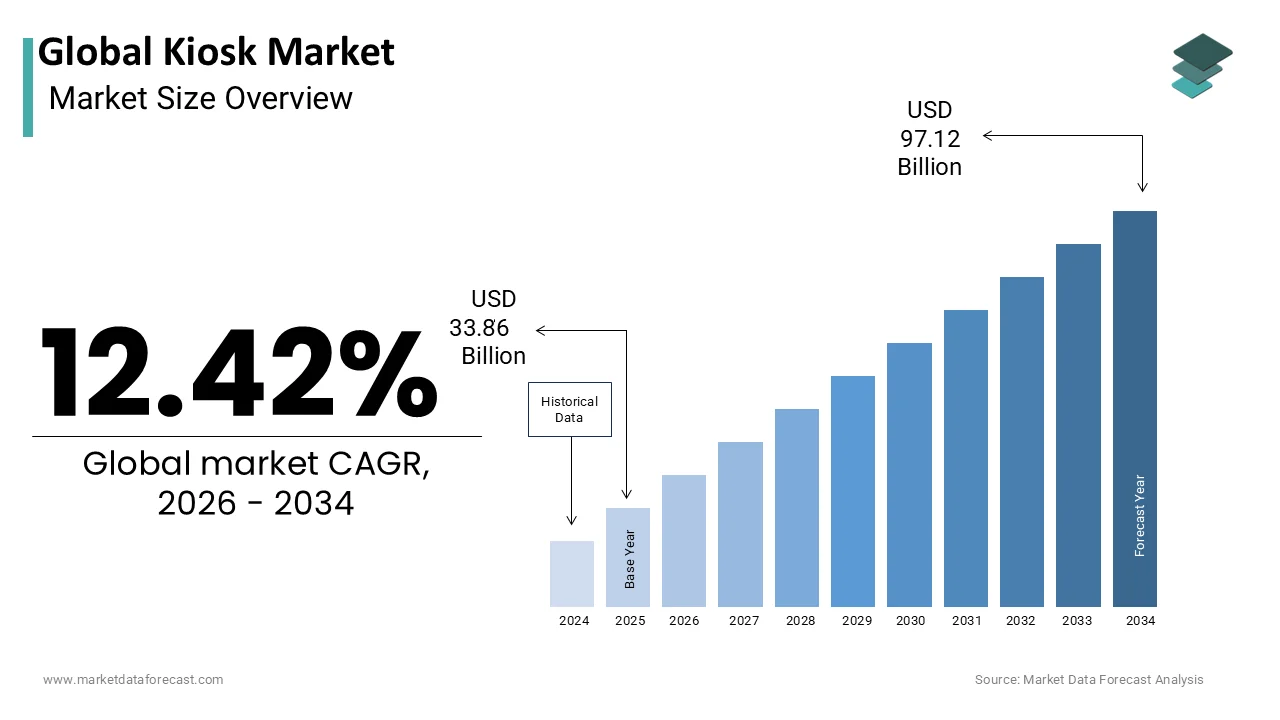
Kiosks are standalone, interactive terminals designed to provide users with functionalities such as information access, ticketing, billing, and self-checkout, leveraging advanced technologies like touchscreens, AI, and IoT to enhance user experiences. These systems have become integral to modern infrastructure, enabling businesses and institutions to streamline operations, reduce wait times, and improve customer satisfaction.
The adoption of kiosks is closely tied to broader societal trends, such as urbanization and digital transformation. The United Nations projects that 68% of the global population will live in urban areas by 2050, driving demand for efficient service delivery systems like kiosks. Additionally, the rise of smart cities has accelerated the deployment of automated solutions; for instance, the International Data Corporation (IDC) reports that global spending on smart city initiatives reached USD 135 billion in 2022. In sectors like healthcare, hospitals are increasingly adopting self-service kiosks for patient check-ins, reducing administrative work by up to 30%, according to a study by Deloitte.
Consumer behavior also plays a critical role in the growing relevance of kiosks. A survey by PwC found that 73% of consumers consider speed and convenience as key factors influencing their shopping decisions, making self-service kiosks an attractive option for businesses. Furthermore, airports worldwide are deploying kiosks to handle passenger processing, with the International Air Transport Association (IATA) estimating that over 80% of passengers now use self-service options for check-in and baggage drop. As automation and technological advancements continue to reshape industries, kiosks are becoming indispensable tools for enhancing efficiency and meeting evolving consumer expectations.
MARKET DRIVERS
Growing Demand for Automation in Retail and Hospitality
The increasing demand for automation in retail and hospitality is a major driver of the kiosk market. According to the National Retail Federation, 75% of retailers plan to invest in self-service technologies by 2025 to enhance customer experiences and reduce operational costs. Kiosks enable functions like self-checkout, price checks, and inventory searches, improving efficiency and convenience. A study shows that businesses using self-service kiosks report a 20% increase in sales due to faster transactions and reduced wait times. In the hospitality sector, hotels and restaurants are adopting kiosks for check-ins, room bookings, and food ordering, reducing labor costs by up to 15%. Urbanization and rising disposable incomes further fuel adoption, particularly in emerging markets.
Rising Urbanization and Smart City Initiatives
Urbanization and smart city initiatives are propelling the growth of the kiosk market. The United Nations projects that 68% of the global population will live in urban areas by 2050, driving demand for efficient service delivery systems. Smart city investments are accelerating this trend; the International Data Corporation (IDC) reports that global spending on smart city technologies reached USD 135 billion in 2022. Kiosks are integral to these initiatives, providing services like ticketing, information dissemination, and bill payments. For instance, airports worldwide are deploying self-service kiosks to handle growing passenger traffic, with the International Air Transport Association (IATA) estimating that over 80% of passengers now use self-service options. Governments and private entities are investing heavily in kiosks to improve public services, making them a cornerstone of urban infrastructure development.
MARKET RESTRAINTS
High Initial Costs and Budget Constraints
High initial cost of deployment, which limits adoption, especially among small businesses,s is one of the major restraints in the kiosk market. According to Deloitte, the average cost of installing a single interactive kiosk ranges from USD 5,000 to USD 15,000, depending on features and customization. This upfront investment can be prohibitive for small retailers or startups operating on tight budgets. Additionally, maintenance costs, including software updates and hardware repairs, add to the financial burden. In developing regions, economic instability further exacerbates this issue. The World Bank shows that nearly 600 million people in Sub-Saharan Africa lack access to reliable electricity, making kiosk adoption impractical in some areas. These financial barriers hinder widespread implementation, particularly in price-sensitive markets.
Technological Barriers and Integration Challenges
Technological barriers and integration challenges pose significant restraints to the kiosk market. Many businesses struggle to integrate kiosks with existing IT systems, leading to inefficiencies and higher costs. A report by Gartner notes that 40% of organizations face difficulties in aligning new technologies with legacy systems, delaying implementation timelines. Furthermore, cybersecurity concerns are growing as kiosks become more connected through IoT and cloud platforms. Cybersecurity Ventures estimates that global cybercrime costs will reach USD 10.5 trillion annually by 2025, raising fears about data breaches through poorly secured kiosks. These technological challenges require specialized expertise, which smaller businesses often lack. As a result, the complexity and risks associated with kiosk deployment slow market growth, particularly among less tech-savvy organizations.
MARKET OPPORTUNITIES
Expansion into Emerging Markets
Emerging markets present a significant opportunity for the kiosk market, driven by rapid urbanization and rising disposable incomes. The United Nations predicts that urban populations in Asia-Pacific and Africa will grow by 15% by 2030, creating demand for automated services. In India, the Ministry of Housing and Urban Affairs estimates that urban housing projects are increasing by 10% annually, indirectly boosting kiosk adoption in retail and hospitality sectors. Similarly, China’s Smart City Action Plan is investing heavily in automation technologies, with Statista reporting a 20% annual rise in kiosk installations. Rising consumer awareness about convenience and efficiency further fuels demand. With governments and private entities focusing on infrastructure development, emerging markets offer untapped potential for kiosk manufacturers seeking expansion opportunities.
Integration of AI and Advanced Technologies
The integration of AI and advanced technologies presents a transformative opportunity for the kiosk market. According to Market Data Forecast, AI-driven analytics can enhance kiosk functionalities, such as personalized recommendations and predictive maintenance, improving user experiences. For instance, airports are adopting AI-powered kiosks for facial recognition and automated boarding processes, reducing passenger wait times by up to 30%. Similarly, healthcare facilities are leveraging AI-enabled kiosks for patient diagnostics and appointment scheduling, streamlining operations. The International Data Corporation (IDC) forecasts that global spending on AI technologies will reach USD 110 billion by 2024, highlighting the growing emphasis on innovation.
MARKET CHALLENGES
Limited Consumer Awareness and Adoption Resistance
A significant challenge in the kiosk market is limited consumer awareness and resistance to adoption, particularly among older demographics. A survey conducted by PwC reveals that 45% of consumers aged 55 and above prefer traditional service methods over self-service kiosks, citing unfamiliarity or discomfort with technology. This resistance slows market penetration, especially in regions with aging populations. Additionally, cultural factors play a role; in some rural areas, consumers may distrust automated systems due to a lack of exposure. The United Nations reports that digital literacy rates remain low in many developing countries, further hindering adoption. Businesses must invest in education campaigns and user-friendly designs to overcome these barriers, but this requires additional resources and time, complicating market expansion efforts.
Maintenance and Technical Support Challenges
Maintenance and technical support challenges are significant hurdles for the kiosk market, impacting long-term usability and reliability. According to a study by Deloitte, 30% of kiosks deployed in public spaces experience downtime due to hardware malfunctions or software glitches, leading to user frustration and lost revenue. Regular maintenance, including screen repairs and system updates, adds to operational costs, particularly in remote or underserved areas. The World Bank emphasizes that nearly 600 million people in Sub-Saharan Africa lack access to reliable electricity, making it difficult to ensure consistent kiosk functionality. Furthermore, the shortage of skilled technicians exacerbates these issues, as highlighted by Eurostat, which reports that only 30% of young workers in Europe are entering skilled trades. These challenges strain businesses and limit the scalability of kiosk solutions.
REPORT COVERAGE
| REPORT METRIC | DETAILS |
| Market Size Available | 2025 to 2034 |
| Base Year | 2025 |
| Forecast Period | 2026 to 2034 |
| Segments Covered | By Type, Industry, and Region. |
| Various Analyses Covered | Global, Regional & Country Level Analysis, Segment-Level Analysis; DROC, PESTLE Analysis, Porter's Five Forces Analysis, Competitive Landscape, Analyst Overview of Investment Opportunities |
| Regions Covered | North America, Europe, APAC, Latin America, Middle East & Africa |
| Market Leader Profiled | ZIVELO (United States ),Meridian Kiosks (United State s),KIOSK Information Systems (United States) |
SEGMENTAL ANALYSIS
By Type Insights
The retail segment dominated the kiosk market with a 40.7% share in 2025, driven by the rise of self-service technologies. The U.S. Census Bureau reports that retail automation investments grew by 15% in 2022, boosting demand for kiosks. These kiosks enhance customer experience by enabling quick checkouts and product searches. According to Statista, over 60% of shoppers prefer self-service options, as they reduce wait times and improve convenience. Retail giants like Walmart and Amazon are investing heavily in automated kiosks, further solidifying this segment’s leadership. With urbanization and digital transformation driving retail innovation, retail kiosks remain critical for modern shopping experiences.
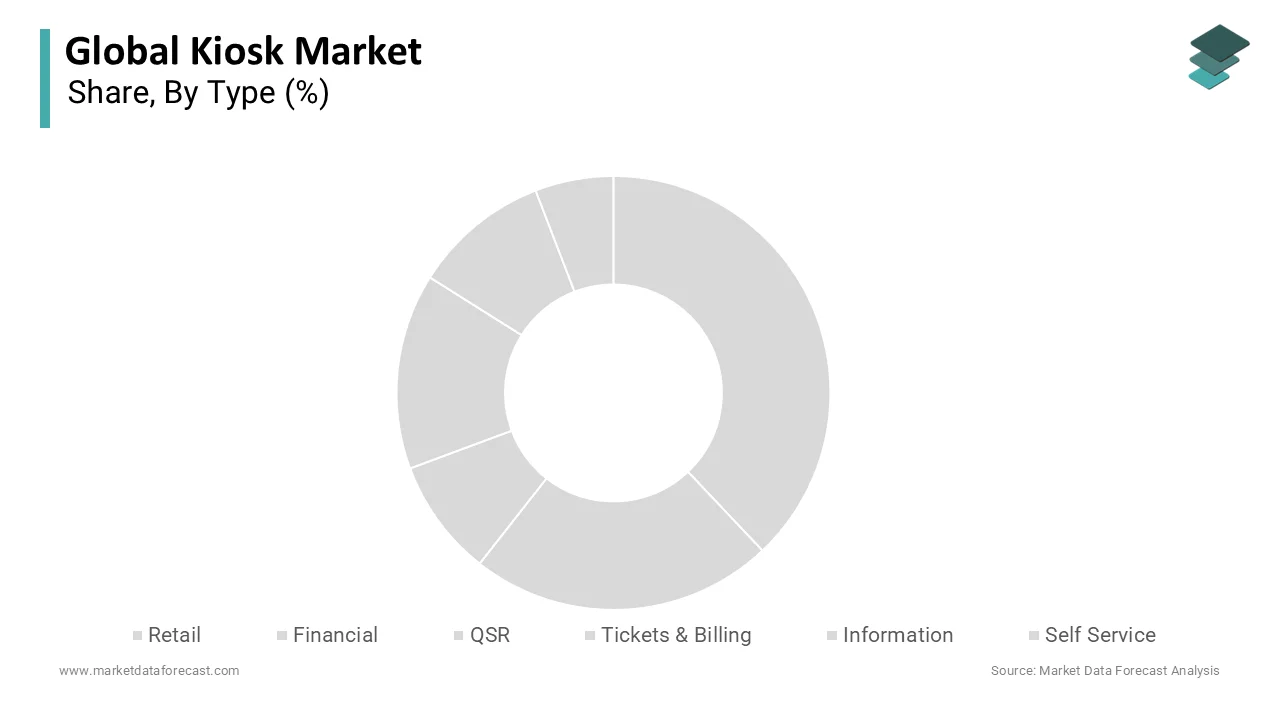
The Self-service kiosks segment is the fastest-growing segment, with a CAGR of 12.5% what is fueled by increasing consumer preference for automation. Industries like healthcare and retail are adopting these kiosks to streamline operations and reduce labor costs. For instance, hospitals use self-service kiosks for patient check-ins, reducing administrative work by 30%. Additionally, airports are deploying self-service kiosks for ticketing and baggage check-ins, improving efficiency. Rising urbanization and technological advancements, such as AI and touchscreens, further accelerate adoption, making this segment a key growth driver.
By Industry Insights
The retail industry segment led the kiosk market with a 35.1% share in 2025and is propelled by the growing demand for seamless shopping experiences. The National Retail Federation states that 75% of retailers plan to invest in self-service technologies by 2025, boosting kiosk adoption. Retail kiosks enable functions like price checks, inventory searches, and self-checkouts, enhancing customer satisfaction. According to a study, businesses using self-service kiosks report a 20% increase in sales due to improved efficiency. Urbanization and rising disposable incomes in emerging markets further fuel demand. With retail being a cornerstone of consumer activity, kiosks play a vital role in modernizing the shopping experience and driving operational efficiency.
The Airports and hotels segment is predicted to grow at the fastest CAGR of 13.8% owing to the increasing passenger traffic and tourism. The International Air Transport Association (IATA) reports that global air passenger numbers are expected to double by 2037, reaching 8.2 billion. This surge drives demand for self-service kiosks at airports for ticketing, boarding, and baggage handling. Similarly, hotels are adopting kiosks for check-ins, room bookings, and concierge services, reducing wait times by up to 40%. Rising urbanization and globalization further propel this segment, making it a key focus for kiosk manufacturers.
REGIONAL ANALYSIS
North America Kiosk Market Analysis
North America dominated the kiosk market by holding a 35.4% share in 2025, which was driven by advanced infrastructure and high consumer demand for automation. The U.S. Census Bureau reports that the retail and hospitality sectors invested over USD 10 billion in self-service technologies in 2022. Rising urbanization and digital transformation further propel adoption, with airports and retail stores deploying kiosks for efficiency. The region’s focus on AI and IoT integration ensures cutting-edge solutions. With government support for smart city initiatives, North America remains a leader in kiosk innovation, shaping global trends.
Asia-Pacific Kiosk Market Analysis
Asia-Pacific is the fastest-growing kiosk market, with a CAGR of 12.8% in2025, fueled by rapid urbanization and rising disposable incomes. The United Nations projects that urban populations in the region will grow by 15% by 2030, driving demand for automated services. China and India lead this growth, with India’s retail sector projected to grow at 10% annually. Government initiatives like China’s Smart City Action Plan further boost adoption. According to Market Data Forecast, Asia-Pacific accounts for over 40% of global kiosk installations. With increasing investments in retail and hospitality, this region is critical for manufacturers seeking expansion opportunities.
Europe Kiosk Market Analysis
Europe holds a significant position in the kiosk market due to its focus on sustainability and automation. The European Commission mandates energy-efficient technologies, driving the adoption of eco-friendly kiosks. Germany leads the region, contributing over 25% of Europe’s kiosk revenue. The hospitality and retail sectors are key adopters. Rising tourism, especially in cities like Paris and London, further fuels demand. With policies promoting green technologies and urbanization, Europe remains a pioneer in sustainable kiosk solutions, ensuring long-term market relevance.
Latin America
Latin America is an emerging kiosk market that is driven by economic growth and urbanization. The World Bank predicts that urban populations in the region will grow by 10% by 2030, increasing demand for retail and hospitality kiosks. Brazil and Mexico are key contributors. Rising middle-class incomes and government incentives for digital transformation further boost adoption. Despite challenges like infrastructure gaps, Latin America’s growing economy makes it a promising market for kiosk manufacturers.
Middle East & Africa Kiosk Market Analysis
The Middle East & Africa region is experiencing rising kiosk demand due to urbanization and tourism growth. The International Air Transport Association (IATA) states that passenger traffic in Gulf countries is expected to grow by 20% by 2030, driving airport kiosk installations. Saudi Arabia and the UAE lead the market, with investments in smart cities like NEOM boosting demand. In Africa, urbanization and retail expansion fuel growth, with Statista reporting a 15% annual rise in retail kiosk adoption. Rising disposable incomes and government initiatives to improve infrastructure further drive adoption. Despite challenges, this region’s growing urban centers ensure sustained kiosk demand.
COMPETITIVE LANDSCAPE
The kiosk market is very competitive. Many companies make self-service kiosks for different industries like retail, banking, healthcare, and transportation. Big companies like NCR Corporation, Diebold Nixdorf, and Zebra Technologies lead the market. They create new technology to improve kiosks and make them more useful for businesses and customers.
Many small and new companies also enter the market. They focus on special types of kiosks like ticketing machines or food ordering kiosks. These companies try to compete by offering lower prices or unique features. Some focus on making their kiosks easy to use,w hile others add advanced technology like touchless screens and artificial intelligence.
The market is growing because businesses want to reduce costs and serve customers faster. More stores and restaurants are using self-service kiosks to speed up orders and payments. Banks use kiosks to help customers with basic services without needing staff.
Companies compete by offering better designs, faster service, and strong security. Some form partnerships with other businesses to expand. Others buy smaller companies to grow faster. The demand for kiosks will continue to rise. Companies must keep improving their products to stay ahead in the market and attract more customers.
KEY MARKET PLAYERS
Some of the companies that are playing a dominating role in the Global Kiosk Market include
- ZIVELO (United States)
- Meridian Kiosks (United States)
- KIOSK Information Systems (United States)
- SITA (Switzerland)
- NCR Corporation (United States)
- Diebold Nixdorf, Inc. (United States)
- Advantech Co., Ltd. (Taiwan)
- Embross (Canada)
- Glory Global Solutions (International) Limited (United Kingdom)
- iQmetrix (Canada)
- REDYREF (United States)
- Peerless-AV (United States)
- CSA Service Solutions (United States)
- H32 Design and Development LLC (United States)
TOP LEADING PLAYERS IN THE MARKET
- NCR Corporation, a global leader in self-service kiosk solutions, has played a pivotal role in shaping the industry. The company has a strong presence in banking, retail, and hospitality, offering solutions such as ATMs, self-checkout systems, and customer service kiosks. NCR has consistently innovated by integrating cutting-edge technologies, including AI-driven automation, contactless payment solutions, and cloud-based kiosk management. Its ability to adapt to evolving consumer needs has helped maintain its dominance in the kiosk market. Additionally, NCR's global reach and extensive customer support network have made it a preferred partner for businesses looking to enhance customer engagement through self-service technologies.
- Diebold Nixdorf is a prominent player in the self-service kiosk market, with a strong focus on financial and retail technology solutions. The company specializes in ATMs, interactive teller machines (ITMs), and point-of-sale (POS) kiosks, catering to banks and retail stores worldwide. Its emphasis on security, user experience, and system reliability has contributed to its widespread adoption in high-demand environments. Diebold Nixdorf continues to drive innovation through the integration of biometric authentication, remote management capabilities, and AI-powered analytics in its kiosk solutions. With a commitment to sustainability and digital transformation, the company remains a key force in advancing the kiosk industry.
- Zebra Technologies has emerged as a significant player in the kiosk market, particularly through its expertise in enterprise-level data capture and automatic identification technologies. The company's expansion into kiosks was strengthened by its acquisition of Swecoin, a pioneer in kiosk printer technology. Zebra’s kiosk solutions are widely used in healthcare, logistics, and retail sectors, enabling businesses to streamline operations with advanced printing and self-service capabilities. The company is known for its high-performance thermal printing solutions, rugged kiosk designs, and IoT-enabled tracking features. By focusing on enhancing operational efficiency and data-driven automation, Zebra Technologies has made a substantial impact on the evolution of the kiosk market.
Top strategies used by the key market participants
- To stay ahead in the competitive kiosk market, companies focus on integrating advanced technologies such as AI, IoT, cloud computing, and biometric authentication into their self-service solutions. For example, NCR Corporation has developed AI-driven customer interaction kiosks and cloud-enabled self-checkout systems to enhance user experience and operational efficiency. Diebold Nixdorf integrates real-time data analytics and machine learning in its ATMs and retail kiosks, improving transaction security and automation. Zebra Technologies incorporates RFID tracking and automated printing capabilities, ensuring better workflow efficiency in logistics and healthcare.
- Acquiring innovative firms and forming strategic partnerships allow major kiosk companies to expand their technological capabilities and global reach. NCR Corporation has acquired several fintech and retail technology firms to strengthen its kiosk offerings, particularly in self-service banking and retail automation. Diebold Nixdorf has collaborated with global banking institutions to expand its ITM (Interactive Teller Machine) network, providing advanced self-service banking solutions. Zebra Technologies, through its acquisition of Swecoin, improved its kiosk printing technology, reinforcing its position in automated identification and data capture solutions.
- Diversification into different industries helps companies increase their market share and revenue. NCR Corporation has expanded beyond banking into retail, hospitality, and transportation with self-service kiosks for ordering, ticketing, and customer service. Diebold Nixdorf has enhanced its retail POS kiosk solutions, catering to major supermarkets and convenience stores worldwide. Zebra Technologies has targeted industries like healthcare and logistics, offering self-service kiosks for check-ins, patient registration, and asset tracking.
RECENT HAPPENINGS IN THE MARKET
- In February 2025, BrainBox AI launched its ARIA platform, an AI-driven solution for optimizing HVAC systems in commercial buildings. This innovation aims to enhance energy efficiency by predicting and adjusting system inefficiencies, ultimately reducing costs and carbon emissions.
- In January 2025, SPX Technologies, a leader in HVAC solutions, reported significant growth due to increasing demand from data centers and pharmaceutical facilities. The company is leveraging AI and energy-efficient technologies to enhance system performance.
- In December 2024, Carrier Global introduced a new AI-powered HVAC system designed to improve climate control efficiency. The system integrates IoT and predictive maintenance capabilities to reduce energy consumption and enhance user comfort.
- In November 2024, the U.S. Department of Energy announced new policies promoting the adoption of energy-efficient HVAC technologies. These initiatives support research and development of eco-friendly HVAC solutions to reduce carbon footprints nationwide.
MARKET SEGMENTATION
This research report on the Kiosk Market has been segmented and sub-segmented into the following categories.
By Type
- Retail
- Financial
- QSR
- Tickets & Billing
- Information
- Self Service
- Others (Photo, etc.)
By Industry
- Retail
- BFSI
- Hospitality
- Entertainment & Gaming
- Airports & Hotels
- IT/ Telecommunication
- Others (Luxury, etc.)
By Region
- North America
- Europe
- Asia Pacific
- Latin America
- Middle East and Africa