- Product Description Description
- Table of Contents TOC
- List of Table & Figure LOT
- Get Free Sample PDF Sample PDF
Market Size, 2025
$6.57 BnMarket Estimate, 2026
$7.03 BnMarket Forecast, 2034
$12.08 BnCAGR, 2026–2034
7%Executive Summary: Latin America Alfalfa Hay Market Analysis & Forecast (2026–2034)
- Market Scope: Comprehensive regional agricultural sector report analyzing product classifications (pellets, bales, cubes), animal feed application sectors, country-level adoption dynamics across Latin America (Argentina, Brazil, Mexico), and high-protein forage trends.
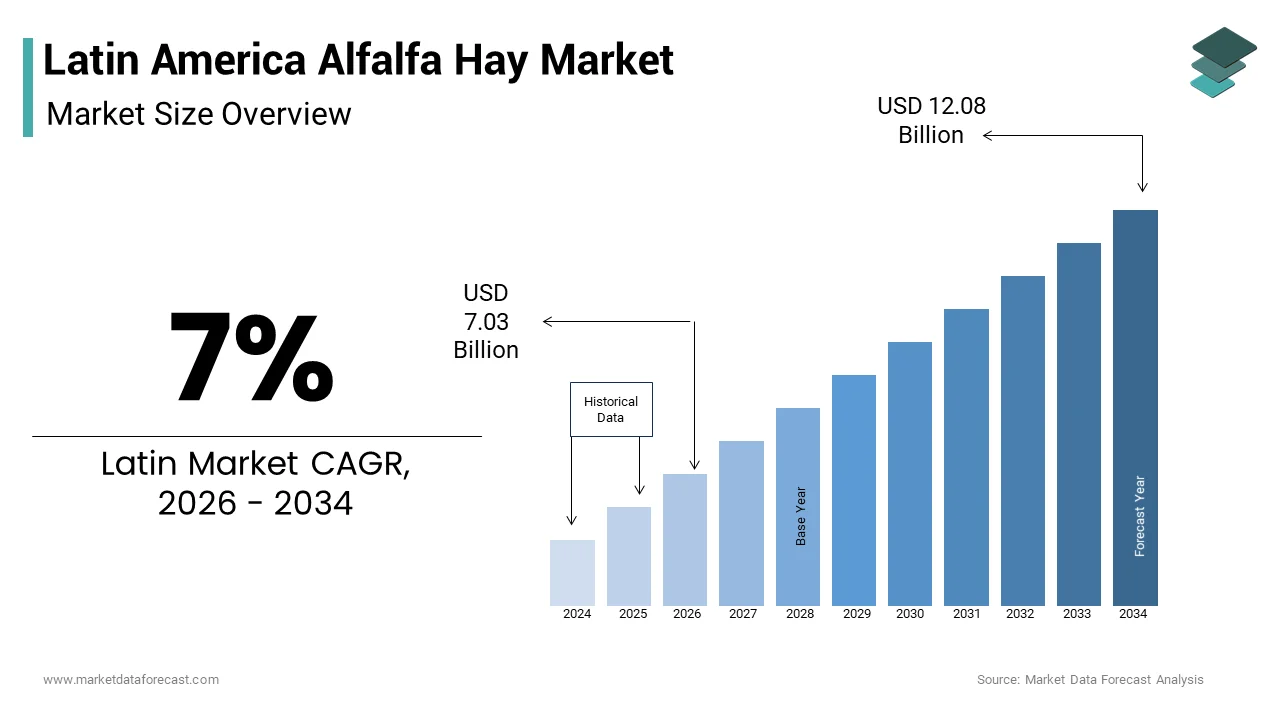
- Market Valuation: Valued at USD 6.57 billion (2025), estimated at USD 7.03 billion (2026), and projected to reach USD 12.08 billion by 2034, registering a compound annual growth rate (CAGR) of 7.00% from 2026 to 2034.
- Primary Growth Drivers: Rising demand for dairy and animal products, shrinking grazing land due to rapid urbanization, growth in high-yielding/bred cattle populations, and abundant arable land in developing agricultural hubs like Argentina.
Key Market Segment Metrics (2026–2034)
| Category | Leading Segment Focus | Key Growth Highlights |
|---|---|---|
| By Type | Bales & Pellets (essential for ruminant and equine nutrition) | High palatability, rich protein/fiber profile, and excellent mineral content compared to standard grass hays. |
| By Application | Meat / Dairy Animal Feed | Driven by commercial dairy investments and high-yielding cattle feed demands. |
| By Country | Argentina (leading production hub) | Lucrative growth supported by vast arable land alongside commercial operations in Brazil and Mexico. |
Major Market Players & Competitive Landscape
Market Structure: Competitive landscape characterized by major international exporters and regional agricultural suppliers catering to the expanding livestock, dairy, and equestrian feed sectors.
Key Companies: Alfalfa Monegros S.L., Coaba, Los Venteros S.C., Grupo Osés, Haykingdom Inc., Standlee Hay Company, Green Prairie International, Cubeit Hay Company, M&C Hay, Glenvar Hay, McCracken Hay Company, SL Follen Company, Anderson Hay & Grain Inc., Border Valley, Knight Ag Sourcing, Hay USA, Bailey Farms, Riverina Pty Ltd, and Gruppo Carli.
Latin America Alfalfa Hay Market Size
The Latin American alfalfa hay market size was valued at USD 6.57 billion in 2025 and is anticipated to reach USD 7.03 billion in 2026 to reach USD 12.08 billion by 2034, growing at a CAGR of 7% from 2026 to 2034.
Alfalfa hay is considered a vital part of the feed given to cattle, horses, dairy cows, goats, and sheep. It is an excellent source of good-quality protein and fiber. Alfalfa is a legume hay and is sometimes called Lucerne. They have higher protein and mineral content than regular hay and are also more palatable than grasshays. Alfalfa, in particular, is high in energy and is an excellent source of vitamins and minerals. Of all the perennial pasture forages, alfalfa has the highest feed values.
An increase in the demand for dairy and animal products, shrinking of the land for grazing animals, and growth in high-yielding cattle and bred cattle demand for feed are driving the alfalfa hay market. Growing investment in large-scale dairy operations to meet the demands of commercial dairy operators is further expected to aid the market growth. However, the decreasing land acreage due to drastically growing urbanization, competition regarding high-value crops, and water restrictions are some of the important factors hindering the growth of the alfalfa hay market. Growing demand for alfalfa in certain developing regions has led to price surges, which in turn have slowed down the market growth. This has caused the dairy producers to consider the replacement, thus lowering the rates for alfalfa hay again this year. An increase in the demand for animal and dairy products across the whole world is likely to increase the demand for alfalfa hay during the forecast period. The alfalfa hay is primarily used for animal rearing, and it delivers high feed value. High prices of alfalfa in certain areas are anticipated to hinder the growth of the market.
REPORT COVERAGE
| REPORT METRIC | DETAILS |
| Market Size Available | 2025 to 2034 |
| Base Year | 2025 |
| Forecast Period | 2026 to 2034 |
| CAGR | 11.29% |
| Segments Covered | By Type, Application, and By Country |
| Various Analyses Covered | Global, Regional & Country Level Analysis, Segment-Level Analysis, DROC, PESTLE Analysis, Porter’s Five Forces Analysis, Competitive Landscape, Analyst Overview on Investment Opportunities |
| Regions Covered | India, China, Japan, South Korea, Australia, New Zealand, Thailand, Malaysia, Vietnam, Philippines, Indonesia, Singapore, and the Rest of APAC |
| Market Leaders Profiled | Alfalfa Monegros, S.L., Coaba, Los Venteros S.C., Grupo Osés, Haykingdom Inc., STANDLEE HAY COMPANY, Green Prairie International, Cubeit Hay Company, M&C Hay, Glenvar Hay, McCracken HAY COMPANY, SL Follen Company, Anderson Hay & Grain Inc., Border Valley, Knight Ag Sourcing, Hay USA, Bailey Farms, Riverina Pty Ltd, and Gruppo Carli. |
COUNTRY ANALYSIS
Latin America is expected to witness lucrative growth due to the presence of a considerable amount of arable land to produce alfalfa in developing regions like Argentina.
KEY MARKET PLAYERS
Some of the key players dominating the market are
- Alfalfa Monegros
- S.L., Coaba
- Los Venteros S.C.
- Grupo Osés
- HaykingdInc. Inc.
- ANDLEE HAY COMPANY
- Green Prairie International
- Cubeit Hay Company
- M&C Hay
- Glenvar Hay
- McCracken HAY COMPANY
- SL Follen Company
- Anderson Hay & Grain Inc.
- Border Valley
- Knight Ag Sourcing
- Hay USA
- Bailey Farms
- Riverina Pty, Ltd
- Gruppo Carli.
MARKET SEGMENTATION
This research report on the Latin American alfalfa hay market size is segmented and sub-segmented into the following categories.
By Type
- Pellets
- Bales
- Cubes
By Application
- Meat/Dairy Animal Feed
- Poultry Feed
- Horse Feed
- Other
By Country
- Argentina
- Brazil
- Mexico