- Product Description Description
- Table of Contents TOC
- List of Table & Figure LOT
- Get Free Sample PDF Sample PDF
Market Size, 2025
$11.28 BnMarket Estimate, 2026
$11.72 BnMarket Forecast, 2034
$15.94 BnCAGR, 2026–2034
3.92%Executive Summary: Latin America Canned Food Market
- Market Scope: Comprehensive regional market analysis of the Latin American canned food sector covering product types, distribution channels, and country-level developments across processed and preserved food categories.
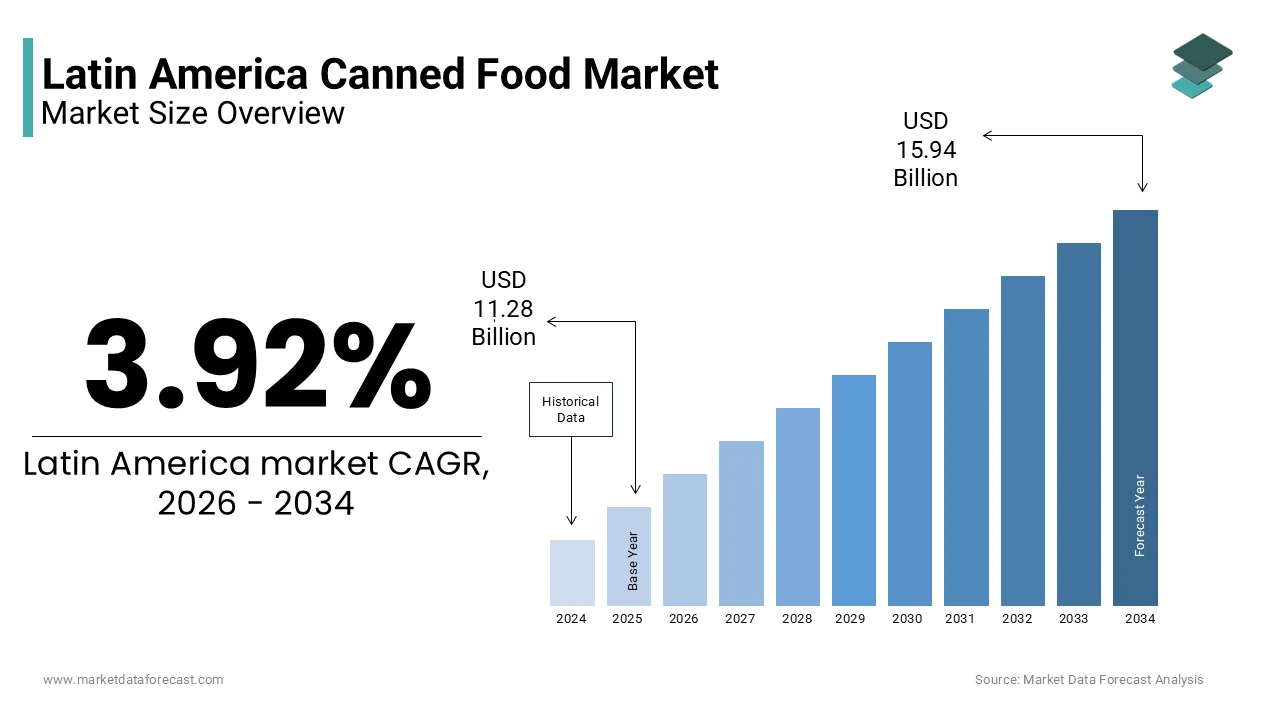
- Market Valuation: Valued at USD 11.28 billion in 2025, estimated at USD 11.72 billion in 2026, and projected to reach USD 15.94 billion by 2034, registering a steady CAGR of 3.92% from 2026 to 2034.
- Primary Growth Drivers: High product convenience, extended shelf life suitable for emergency storage, and changing eating habits influenced by western culture. Key market restraints include health concerns regarding extra sugar and salt content in processed canned foods.
Key Market Segment Metrics (2026–2034)
| Category | Leading Segment / Position | Fastest-Growing Segment |
|---|---|---|
| By Type | Canned Vegetables & Canned Fruits (widely demanded for household cooking and daily consumption) | Canned Ready-to-Eat Meals & Canned Seafood |
| By Distribution Channel | Supermarkets & Hypermarkets (dominate retail distribution through wide product availability and consumer footfall) | Internet Sales & Convenience Stores |
| By Country | Brazil & Mexico (commanding the largest regional shares due to large population bases and modern retail growth) | Argentina & Rest of Latin America |
Major Market Players & Market Structure
Market Structure: A dynamic regional landscape featuring multinational food processing corporations and prominent regional players focusing on packaging innovation, product line diversification, and robust supply chain networks.
Key Companies: Dole Food Company Inc., Del Monte Pacific Ltd., ConAgra Foods Inc., H.J. Heinz Company, Pinnacle Foods Inc., B&G Foods Holding Corporation, Bolton Group International, La Doria, Campbell Soup Company, Nestlé, Zanlakol, CECAB Group, Princes Limited, and Bonduelle.
 Download Free Sample Report
Latin America Canned Food Market Size
The Latin America canned food market size was valued at USD 11.28 billion in 2025 and is expected to reach USD 15.94 billion by 2034 from USD 11.72 billion in 2026. The market is projected to grow at a CAGR of 3.92%.
Canned food refers to food products that are preserved by sealing them in airtight metal cans or other containers and heating them to kill harmful bacteria. This market encompasses preserved vegetables, fruits, meats and seafood that offer extended shelf life and convenience. According to the Food and Agriculture Organisation of the United Nations (FAO), Latin America and the Caribbean account for 14 per cent of global food production. As per the Pan American Health Organisation, over 60% of adults in the Americas are overweight or obese. These facts highlight the dual pressure on manufacturers to provide accessible nutrition while managing health perceptions. The market thrives in countries like Brazil, Mexico, and Argentina, where industrial infrastructure supports large-scale preservation. Consumers increasingly rely on canned goods due to time constraints in metropolitan areas. The integration of modern packaging technologies further enhances product appeal. Regulatory bodies enforce strict quality standards to ensure safety. Supply chain efficiencies determine competitive positioning across borders. Economic volatility affects purchasing power, but essential food items remain resilient. The sector balances traditional consumption patterns with emerging health consciousness. Innovation in low-sodium and organic variants addresses evolving preferences. Distribution networks expand through both retail and e-commerce channels.
MARKET DRIVERS
Urbanisation and Busy Lifestyles Drive Convenience Demand
Urbanisation fundamentally reshapes dietary habits by increasing the need for quick meal solutions and accelerating the growth of the Latin American canned food market. According to the World Bank and UN Population Division, the urban population share in Latin America and the Caribbean averages approximately 82%. This high urban concentration reduces time available for home cooking and elevates reliance on processed foods. Canned foods offer immediate usability without extensive preparation, which aligns perfectly with the schedules of working professionals. As cities expand, the demand for shelf-stable items grows because they reduce frequent grocery trips. According to sources, the labour force participation rate among women in Latin America and the Caribbean stands at approximately 68%, following significant multi-decade growth from historical benchmarks of roughly 60% in the early 2010s. This demographic shift forces families to seek efficient food storage options. Canned vegetables and proteins become staple items in urban pantries due to their longevity and ease of use. Manufacturers respond by diversifying product lines to include single-serve portions and microwaveable formats. Retailers in major cities like São Paulo and Mexico City dedicate significant shelf space to these categories. The convenience factor outweighs fresh produce preferences for many consumers during weekdays. This trend sustains steady volume growth regardless of seasonal fluctuations. Companies invest in marketing campaigns that emphasise time-saving benefits. The structural change in living patterns ensures long-term demand stability for canned goods.
Economic Volatility Enhances Affordability Appeal
Economic instability in several nations in the region makes affordability a primary purchase driver for households and a key factor propelling the Latin American canned food market. According to the International Monetary Fund, end-of-year consumer price inflation in Argentina converged to approximately 140% in 2024 during the implementation of aggressive stabilisation frameworks. Canned foods generally offer lower price points compared to fresh equivalents when considering waste and spoilage factors. This economic advantage becomes crucial during periods of currency devaluation and income stagnation. Households prioritise budget-friendly options that provide nutritional value without high expenditure. As per the Economic Commission for Latin America and the Caribbean (ECLAC), the regional poverty average hovered around 28.4% to 29% when omitting localised, outsized structural progress from key regional economies. Canned goods allow families to stockpile essentials during sales or bulk purchases, which mitigates future price hikes. The long shelf life reduces financial loss from food spoilage, which is a significant concern for low-income groups. Supermarkets promote private label canned items to attract price-sensitive shoppers. Brands focus on value packs and promotional pricing to maintain sales volumes. The perception of canned food as an economical choice strengthens its market position during downturns. Consumers view these products as reliable staples that protect against economic shocks. This dynamic ensures consistent demand even when discretionary spending declines. Manufacturers optimise production costs to keep retail prices competitive.
MARKET RESTRAINTS
Health Consciousness Restricts Traditional Product Growth
Growing health awareness restricts the expansion of traditional varieties in the Latin American canned food market. These products are often high in sodium and preservatives. According to the Pan American Health Organisation, noncommunicable diseases are responsible for approximately 80% of all deaths in the Region of the Americas. Consumers increasingly scrutinise ingredient lists and avoid products with excessive additives. This shift negatively impacts sales of conventional canned soups, vegetables, and meats that rely on salt for preservation. Regulatory bodies in countries like Chile and Mexico mandate front-of-package warning labels for high sodium content, which deters health-conscious buyers. The World Health Organisation recommends limiting sodium intake to less than 2 grams per day, but many canned products exceed this threshold significantly. Retailers face pressure to remove unhealthy options from prominent displays. Manufacturers struggle to reformulate recipes without compromising taste and shelf stability. The negative perception of canned food as unhealthy persists despite technological advances. Younger demographics prefer fresh or minimally processed alternatives, which limits market penetration among key growth segments. Marketing efforts must overcome deep-seated biases against preserved foods. Sales growth slows in categories perceived as detrimental to cardiovascular health. Companies incur higher research and development costs to create cleaner label products. This restraint forces the industry to innovate rapidly or risk losing market share to fresh food retailers.
Environmental Concerns Limit Packaging Sustainability
Environmental concerns regarding metal packaging waste limit the sustainability profile of the Latin America canned food market. As per sources, aluminium beverage can recycling rates in leading Latin American markets regularly exceed 90%, whereas comprehensive regional metal can recycling data remains fragmented across municipal and informal sectors. Consumers and regulators increasingly demand eco-friendly packaging solutions which traditional tinplate cans fail to satisfy fully. The energy-intensive production process of metal containers raises carbon footprint concerns among environmentally aware buyers. Municipalities in major cities struggle with waste management infrastructure, which exacerbates the disposal problem. According to the Inter-American Development Bank, only 4.5% of solid waste in Latin America and the Caribbean is recycled. Brands face criticism for contributing to pollution despite the recyclability of metals. Alternative packaging materials like glass or biodegradable plastics gain preference among green consumers. The cost of implementing sustainable packaging technologies remains prohibitive for many mid-sized manufacturers. Regulatory pressures may soon impose extended producer responsibility laws, which increase operational costs. Consumer boycotts of non-sustainable brands pose reputational risks. The industry faces a complex challenge in balancing preservation needs with environmental stewardship. Failure to address these concerns may result in lost market access in progressive regions. Investment in circular economy initiatives becomes essential for long-term viability.
MARKET OPPORTUNITIES
Expansion of E-commerce Platforms Creates Distribution Opportunities
The rapid expansion of e-commerce platforms creates significant distribution opportunities for manufacturers in the Latin America canned food market. According to research, Latin America and the Caribbean's digital trade and infrastructure investments have seen double-digit annual growth rates. Online retailers offer broader product assortments than physical stores, which allows niche canned brands to reach wider audiences. Consumers appreciate the convenience of home delivery for heavy bulk items like canned goods. Digital platforms enable targeted marketing based on purchase history and dietary preferences. As per reports, internet use and smartphone accessibility have expanded dramatically across both urban and rural communities in Latin America. Manufacturers leverage data analytics to optimise inventory and reduce supply chain costs. Direct-to-consumer models eliminate intermediary margins and improve profitability. Subscription services for pantry staples gain traction among urban households. Social media integration facilitates brand engagement and product discovery. Cross border e commerce allows exporters to access new markets within the region. Logistics improvements reduce delivery times and enhance customer satisfaction. The digital shift enables smaller players to compete with established giants. Companies invest in user-friendly interfaces and secure payment gateways. This channel diversification reduces dependence on traditional retail outlets. The online segment offers higher growth potential compared to saturated brick-and-mortar markets.
Product Innovation in Organic and Low Sodium Variants Drives Premiumization
Product innovation in organic and low sodium variants drives premiumization and attracts health-conscious consumers, which in turn is anticipated to fuel the expansion of the Latin America canned food market. According to the Research Institute of Organic Agriculture (FiBL), organic farmland in Latin America experienced an expansion of 10.8%, adding 1 million hectares to reach a total of 10.3 million hectares. Manufacturers respond by launching premium canned lines that cater to specific dietary needs such as gluten-free or no added sugar. These specialised products command higher price margins and differentiate brands in crowded markets. According to the Pan American Health Organisation and the World Health Organisation, hypertension affects 35.4% of adults aged 30–79 in the region. Retailers allocate premium shelf space to these innovative offerings to capture value-oriented shoppers. Certification labels build trust and justify price premiums among discerning buyers. Companies invest in advanced preservation techniques like high-pressure processing to maintain nutrient integrity. Flavour profiles are enhanced using natural herbs instead of artificial enhancers. Packaging designs reflect premium positioning through minimalist and eco-friendly aesthetics. Export opportunities increase for high-quality organic canned goods to North America and Europe. Consumer education campaigns highlight the benefits of upgraded formulations. This trend transforms canned food from a commodity to a lifestyle choice. Innovation sustains relevance in a market increasingly focused on wellness. Brands that lead in clean label innovations gain competitive advantage.
MARKET CHALLENGES
Supply Chain Disruptions Challenge Raw Material Availability
Supply chain disruptions challenge raw material availability and increase production costs for manufacturers in the Latin America canned food market. According to studies, climate-related extreme events cause billions of dollars in agricultural and crop damage across Latin America, disrupting fruit and vegetable supplies. Droughts and floods damage crops, leading to seasonal shortages and price volatility for key inputs. Manufacturers face difficulties in securing quality raw materials at stable prices, which impacts profit margins. Transportation bottlenecks due to infrastructure deficiencies further delay deliveries from farms to processing plants. As per reports, logistics costs in Latin America and the Caribbean represent a significantly higher share of GDP and product value compared to OECD benchmarks, eroding export competitiveness. Reliance on imported packaging materials exposes companies to currency fluctuations and trade barriers. Inventory management becomes complex when supply predictability declines. Small and medium enterprises struggle more than large corporations to absorb these shocks. Production schedules face frequent adjustments, causing inefficiencies. Contract farming agreements help mitigate some risks but do not eliminate them entirely. Quality consistency suffers when suppliers switch sources during shortages. Manufacturers must invest in diversified sourcing strategies to ensure continuity. These operational challenges hinder capacity utilisation and market responsiveness. Resilience building becomes a strategic priority for long term stability.
Regulatory Compliance Burdens Increase Operational Costs
Regulatory compliance burdens increase operational costs and create entry barriers for new participants in the Latin American canned food market. As per research, national regulatory agencies enforce statutory food safety standards. Manufacturers must adhere to varying national regulations across different Latin American countries, which complicates regional expansion. Compliance with labelling requirements for allergens, sodium, and sugar content demands frequent packaging updates. According to the World Trade Organisation, non-tariff barriers and technical measures in the agri-food sector remain substantial, raising compliance and administrative overhead for cross-border shipments. Small producers lack resources to navigate complex regulatory landscapes effectively. Regular audits and certifications add to fixed costs without directly enhancing product value. Changes in legislation require rapid adaptation, which strains research and development budgets. Non-compliance risks severe penalties and product recalls, which damage brand reputation. Harmonisation of standards across Mercosur and other trade blocs remains incomplete, which creates fragmentation. Legal expertise becomes necessary to interpret evolving food codes. These regulatory hurdles slow down product launches and innovation cycles. Companies must allocate significant funds to compliance departments rather than growth initiatives. The burden disproportionately affects smaller players, limiting market diversity. Strategic planning must account for regulatory risks in each target market.
 REPORT COVERAGE
| REPORT METRIC | DETAILS |
| Market Size Available | 2025 to 2034 |
| Base Year | 2025 |
| Forecast Period | 2026 to 2034 |
| CAGR | 3.92% |
| Segments Covered | By Type, Distribution Channel, and Region |
| Various Analyses Covered | Global, Regional, & Country Level Analysis; Segment-Level Analysis; DROC; PESTLE Analysis; Porter’s Five Forces Analysis; Competitive Landscape; Analyst Overview of Investment Opporunities |
| Regions Covered | Latin America include Brazil, Argentina, Mexico, and the Rest of Latin America |
| Market Leaders Profiled | Dole Food Company Inc., DelMonte Pacific Ltd., ConAgra Foods Inc., H.J. Heinz Company, Pinnacle Foods Inc., B&G Food Holdings Corporation, Bolton Group International, La Doria, Campbell Soup, Nestle, Zanlakol, CECAB Group, Princes Limited and Bonduelle |
SEGMENTAL ANALYSIS
By Type Insights
The canned vegetables segment led the Latin America canned food market and captured a significant share in 2025. This prominence was attributed to its essential role in daily diets and widespread agricultural availability. The region’s strong agrarian base supports consistent supply chains for key crops like corn, beans, and tomatoes. This segment benefits from high consumer acceptance as a staple food item across various income levels. Manufacturers leverage local sourcing to maintain competitive pricing and ensure freshness retention through advanced canning techniques. The versatility of canned vegetables in traditional recipes further cements their market leadership. Retailers prioritise this category due to its high turnover rate and stable demand patterns. Health-conscious reforms in production have also helped mitigate negative perceptions regarding preservatives. The segment’s resilience during economic downturns makes it a reliable revenue generator for industry players. Strategic partnerships with local farmers enhance supply chain efficiency and reduce logistical costs. Product diversification into organic and low-sodium variants attracts premium buyers. The established distribution networks ensure wide availability even in remote areas. Consumer trust in well-known vegetable brands drives repeat purchases. Government initiatives promoting food security often include canned vegetables in subsidy programs. This institutional support bolsters market volume and stabilises prices for end consumers.
The abundant agricultural output in Latin America directly fuels the dominance of this segment. According to the Food and Agriculture Organisation of the United Nations (FAO), India is the world's largest producer of dry beans, while Brazil ranks among the top global producers, typically ranking third behind India and Myanmar. The massive production capacity ensures a steady flow of raw materials at competitive prices for processors. As per sources, smallholder and family farms contribute a critical share of domestic food crops and fresh vegetables throughout Latin America and the Caribbean, supporting localised food supply networks. This structure allows manufacturers to source locally and reduce transportation emissions and costs. The proximity of processing plants to farming communities minimises post-harvest losses, which are critical for maintaining quality. Efficient logistics enable quick transfer of produce from field to factory, preserving nutritional value. The availability of diverse crops such as peas, carrots, and corn supports varied product portfolios. Seasonal surpluses are effectively managed through canning, which prevents waste and stabilises farmers' incomes. This symbiotic relationship between agriculture and industry strengthens the market foundation. Regulatory support for agro-processing zones further enhances operational efficiencies. Tax incentives for value-added agricultural products encourage investment in canning infrastructure. The robust supply chain ensures consistent product availability throughout the year. Consumers benefit from affordable prices due to reduced input costs. This agricultural advantage provides a sustainable competitive edge for the region.
Increasing nutritional awareness among Latin American households significantly drives the consumption of canned vegetables. According to studies, micronutrient deficiencies and child malnutrition remain persistent challenges across Latin America and the Caribbean, driving consumer interest in fortified and nutritious food options. Canned vegetables retain most of their vitamins and minerals, making them a viable alternative to fresh produce when access is limited. The World Health Organization emphasizes the importance of vegetable intake for preventing noncommunicable diseases which aligns with public health campaigns in countries like Mexico and Chile. These campaigns educate consumers on the benefits of including preserved vegetables in daily meals. Urban families with limited time for cooking rely on canned options to meet dietary recommendations. Schools and hospitals increasingly incorporate canned vegetables into meal plans due to their safety and ease of preparation. The perception of canned goods as a practical solution for balanced nutrition gains traction among middle-class consumers. Marketing efforts highlight the convenience of having ready-to-use ingredients for soups and stews. Retail promotions often bundle canned vegetables with other healthy items to encourage bulk purchases. The affordability of these products makes them accessible to lower-income groups who struggle with fresh produce prices. This broad demographic appeal sustains high volume sales. Manufacturers respond by improving taste profiles to match fresh equivalents. The combination of health benefits and convenience solidifies the segment’s leading position.
The canned ready-to-eat meals segment is likely to experience the fastest CAGR of 6.8% during the forecast period. This rapid expansion is propelled by changing lifestyles and the increasing participation of women in the workforce. Urban professionals seek quick meal solutions that require minimal preparation time. The convenience of heating and eating appeals to younger demographics who prioritise efficiency. Manufacturers innovate with diverse flavours and international cuisines to attract adventurous eaters. Improved packaging technologies enhance portability and shelf appeal. The rise of single-person households increases demand for individual portion sizes. Retailers expand shelf space for ready-to-eat options to capture impulse buys. Marketing campaigns emphasise the time-saving benefits of these products. The segment benefits from higher profit margins compared to basic canned goods. Investment in research and development leads to better texture and taste retention. Digital marketing targets busy consumers through social media platforms. The growth trajectory indicates a shift towards premium convenience foods. This segment outpaces traditional categories due to its alignment with modern living patterns.
The evolving dynamics of the urban workforce are driving the rapid development of this segment. According to the International Labour Organisation (ILO), the overall labour force participation rate in Latin America and the Caribbean stands at approximately 62.5% to 63%, driven by post-pandemic employment recovery and service sector absorption. This shift results in longer working hours and less time for home cooking among urban residents. As per studies, peak-period commutes in major metropolitan areas like Bogotá and São Paulo frequently approach or exceed 90 minutes for lower-income transit users, constraining daily disposable time. Workers prefer meals that can be prepared quickly during short breaks or after long commutes. Canned ready-to-eat meals offer a practical solution that fits into tight schedules. Employers in corporate sectors often provide vending machines stocked with these items for employee convenience. The trend of dual-income households means both partners have limited time for meal preparation. This demographic reality creates a sustained need for efficient food options. Young professionals view ready-to-eat meals as a lifestyle choice rather than a compromise. The availability of diverse cuisines in canned formats satisfies varied taste preferences. Companies invest in branding that resonates with modern urban identities. The correlation between urbanisation rates and ready-to-eat food sales remains strong. This structural change in work-life balance ensures continued segment growth.
Innovation in flavour profiles plays a crucial role in attracting younger demographics to canned ready-to-eat meals. According to research, younger demographic cohorts and millennial consumers in Latin America exhibit heightened receptivity to novel culinary varieties and convenient packaged meal formats. Manufacturers respond by introducing products featuring Asian, Mexican, and Mediterranean flavours that appeal to adventurous palates. As per research, emerging generational cohorts demonstrate a higher willingness to explore flavour innovation and novelty over traditional brand stickiness in packaged food sectors. This openness allows new entrants to gain market share through unique offerings. Social media influencers promote these innovative products, creating viral trends among peer groups. Packaging designs reflect contemporary aesthetics that resonate with younger buyers. Limited edition flavours create urgency and encourage trial purchases. Collaborations with popular chefs enhance credibility and attract food enthusiasts. The use of natural spices and herbs improves perceived quality and healthiness. Younger consumers appreciate the convenience without sacrificing culinary excitement. Retailers place these products in prominent positions to maximise visibility. Online reviews and ratings influence purchasing decisions significantly in this demographic. The continuous introduction of new flavours keeps the segment dynamic and engaging. This strategy differentiates canned meals from traditional options perceived as boring. The focus on culinary innovation drives repeat purchases and brand advocacy.
By Distribution Channel Insights
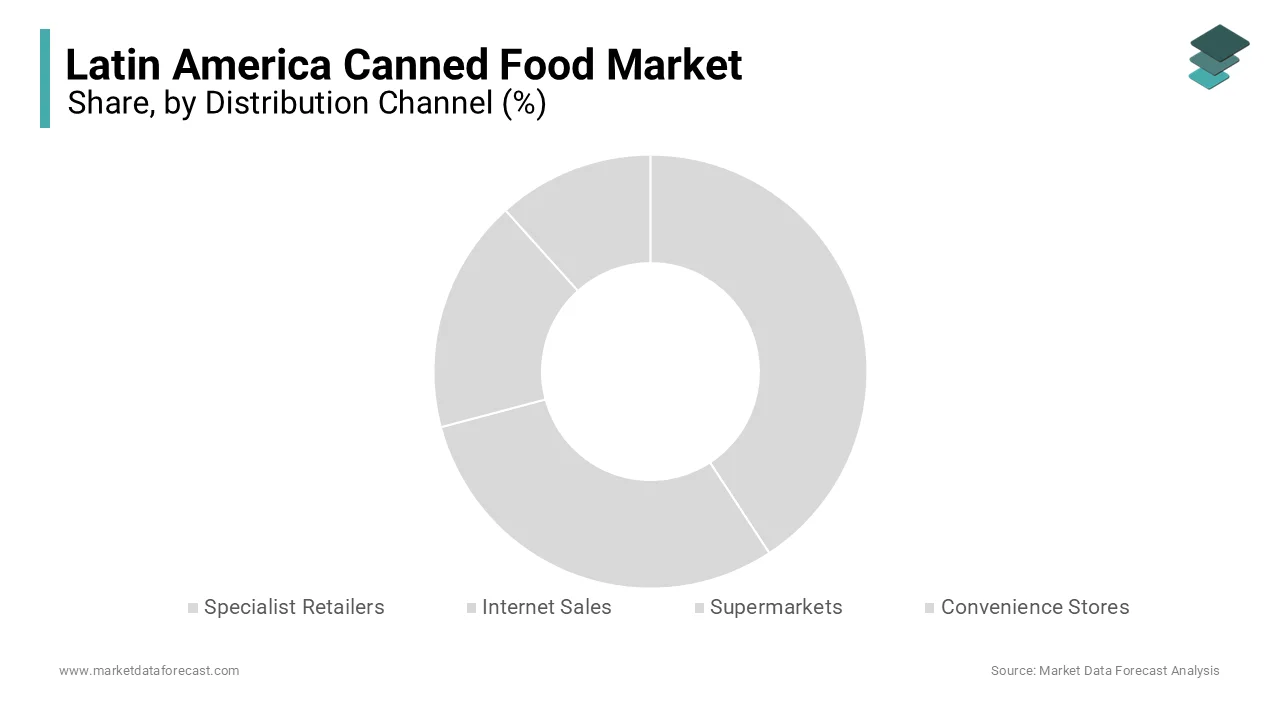
In 2025, the supermarkets segment held the largest share in the Latin America canned food market because of its extensive reach and comprehensive product assortment. These retail giants offer one-stop shopping experiences that appeal to families and bulk buyers. The presence of private label brands provides cost-effective alternatives that drive volume sales. Promotional activities such as discounts and bundle offers attract price-sensitive consumers. Supermarkets invest in cold chain infrastructure, which ensures product quality and safety. The strategic location of stores in urban and suburban areas enhances accessibility. Loyalty programs encourage repeat visits and increase customer retention. The ability to display large volumes of canned goods supports economies of scale. Relationships with major manufacturers ensure consistent stock availability. In-store promotions and sampling events drive immediate purchases. The trusted environment of supermarkets builds consumer confidence in product authenticity. Digital integration through online ordering and pickup services expands their reach. The dominance of this channel is reinforced by its ability to cater to diverse consumer segments. Regular shoppers rely on supermarkets for their weekly grocery needs, including canned staples. The visual appeal of well-organised aisles influences buying decisions. This channel remains the backbone of canned food distribution in the region.
The consolidation of retail chains significantly enhances market penetration for canned food products in supermarkets. According to reports, major supermarket conglomerates lead the grocery landscape in economies like Brazil and Mexico. This concentration allows for centralised procurement and efficient distribution networks. Large retailers negotiate better terms with suppliers, which lowers costs and increases margins. The expansion of hypermarkets in secondary cities brings canned goods to previously underserved populations. Standardised store layouts facilitate easy navigation and product discovery for consumers. Unified marketing campaigns across multiple locations boost brand visibility. The financial strength of consolidated chains enables investment in advanced inventory management systems. These systems reduce stockouts and ensure fresh product availability. Private label development becomes more feasible with larger-scale operations. Consumers benefit from competitive pricing due to operational efficiencies. The trust associated with major retail brands encourages trial of new canned products. Loyalty cards provide valuable data for targeted promotions and personalised offers. The physical presence of these chains reinforces brand recognition. Strategic partnerships with local producers support community engagement. This retail structure creates a stable platform for sustained market growth.
Consumer preference for one-stop shopping solutions strongly supports the dominance of supermarkets in the canned food market. According to the Inter-American Development Bank, household food spending historically represents a large structural block of overall household consumption in Latin America, ranging broadly from 20% to nearly 60% of total expenditure depending on country income tiers. Shoppers prefer to purchase canned goods alongside fresh produce, meats, and household items to save time and transportation costs. Supermarkets offer wide aisles and ample parking, which accommodate family shopping trips. The availability of diverse brands and package sizes caters to varying household needs. Bulk purchasing options appeal to larger families seeking value for money. In-store promotions and seasonal displays stimulate impulse buys of canned items. The convenience of comparing prices and reading labels in person builds consumer confidence. Many supermarkets provide additional services such as bakeries and pharmacies, which increase foot traffic. The social aspect of shopping in large stores remains important in Latin American culture. Weekly grocery routines often revolve around visits to preferred supermarket chains. The reliability of stock availability ensures that consumers can plan meals effectively. This habitual behaviour reinforces the leading position of supermarkets. Retailers optimise layouts to highlight canned food sections near high-traffic areas. The holistic shopping experience sustains long-term customer loyalty.
The internet sales segment is expected to exhibit a noteworthy CAGR of 12.5% from 2026 to 2034. This surge is fueled by increasing internet penetration and the adoption of digital payment methods. Consumers appreciate the convenience of home delivery, especially for heavy canned goods. E-commerce platforms offer wider product selections than physical stores. Subscription models for pantry staples gain popularity among busy households. Digital marketing enables targeted advertising based on consumer preferences. Mobile apps facilitate easy ordering and tracking of deliveries. The pandemic accelerated the shift towards online grocery shopping habits. Younger demographics prefer the efficiency of digital transactions. Cross-border e-commerce allows access to imported canned specialities. Logistics improvements reduce delivery times and enhance service quality. Data analytics help retailers optimise inventory and personalise recommendations. The growth of this channel reflects broader digital transformation trends. It offers higher margins for niche and premium canned products. Consumer trust in online security continues to improve. This channel disrupts traditional retail models with its agility.
The widespread adoption of digital payment methods facilitates seamless online transactions for canned food purchases. According to the Central Bank of Brazil, monthly transaction frequencies for Pix have scaled rapidly, comfortably exceeding 3 billion and expanding past 7 billion monthly entries to significantly streamline digital commerce workflows. This financial infrastructure reduces friction and encourages spontaneous purchases. According to the Inter-American Development Bank, electronic transactions and digital financial payment adoption tripled across regional markets between 2019 and 2023. Consumers feel more secure using familiar payment platforms for grocery orders. The availability of credit instalment options makes bulk purchases of canned goods more affordable. Mobile banking apps integrate with grocery platforms for quick payments. Reduced cash handling lowers security risks for both buyers and sellers. Transaction fees decrease as competition among payment providers intensifies. The ease of refund processing builds trust in online retailers. Digital receipts simplify expense tracking for household budgets. Integration with loyalty programs rewards frequent online shoppers. The transparency of digital records reduces disputes over orders. This financial ecosystem supports the rapid expansion of internet sales. Consumers appreciate the speed and convenience of cashless transactions. This technological advancement removes a major barrier to e-commerce growth.
Improvements in logistics infrastructure enable efficient delivery of canned food products to consumers. According to sources, last-mile distribution capabilities and global efficiency indexes have shown steady systemic modernisation in high-income regional economies like Chile and Uruguay. Specialised courier services handle heavy items like canned goods with care to prevent damage. Warehousing automation reduces order processing times and increases accuracy. The expansion of fulfilment centres in urban areas shortens delivery windows. Real-time tracking allows customers to monitor their orders closely. Cold chain logistics ensure temperature-sensitive canned items remain safe during transit. Partnerships with local delivery networks expand reach to suburban areas. Drone and autonomous vehicle trials promise future efficiency gains. Return policies become more flexible to address consumer concerns. The reliability of delivery services builds confidence in online grocery shopping. Cost-effective shipping options make small orders viable for retailers. Inventory management systems synchronise with delivery schedules to minimise waste. The professionalisation of logistics providers supports scaling up operations. Consumers benefit from faster and more reliable service. This operational excellence drives repeat purchases and positive word of mouth. The robust logistics network underpins the growth of internet sales.
REGIONAL ANALYSIS
Brazil Market Analysis
Brazil maintained dominance in the Latin America canned food market and accounted for a substantial share in 2025. This dominance was driven by its massive population and robust agricultural sector. The country serves as a major producer and consumer of canned beans, corn, and fruits. According to the Brazilian Association of Food Industries (ABIA), the food and beverage processing industry accounts for approximately 9.7 to 10.8 per cent of Brazil's total national GDP. Strong domestic demand drives local manufacturing capacities. Export opportunities to neighbouring countries enhance market vitality. Government policies support agro-industrial development through tax incentives. Urbanisation in cities like São Paulo and Rio de Janeiro fuels convenience food consumption. The middle-class expansion increases purchasing power for premium canned items. Retail modernisation improves product accessibility across regions. Cultural preferences for traditional dishes sustain demand for specific canned ingredients. Investment in technology improves production efficiency and quality. Environmental regulations push for sustainable packaging solutions. The competitive landscape features both multinational and local players. Consumer awareness of health issues influences product formulation. The market benefits from a well-established distribution network. Economic stability fluctuations impact short-term sales, but long-term trends remain positive. Brazil’s market size dictates regional trends and pricing strategies.
Argentina Market Analysis
Argentina is the fastest-growing country in the Latin American canned food market. This growth is supported by its strong meat and fruit processing industries. The country is renowned for high-quality canned peaches, tomatoes and beef products. According to the World Bank and the Undersecretariat of Agri-food Industry, food and agri-industrial products account for approximately 49 per cent to 53 per cent of Argentina's total merchandise goods exports. Economic volatility influences domestic consumption patterns, but export demand remains resilient. Inflationary pressures push consumers toward affordable canned alternatives. The tradition of asado and hearty stews supports steady demand for canned meats and vegetables. Government subsidies for agricultural inputs help maintain raw material supplies. Currency devaluation makes Argentine products competitive in international markets. Local brands dominate the domestic shelf space due to price advantages. Quality standards adhere to strict international norms, facilitating global trade. The market faces challenges from import restrictions on packaging materials. Innovation focuses on value-added products for niche markets. Distribution channels rely heavily on supermarkets and specialised retailers. Consumer loyalty to local brands remains strong despite economic uncertainties. The sector adapts quickly to changing regulatory environments. Investment in preservation technologies enhances product shelf life. Argentina’s reputation for quality supports premium positioning in export markets.
Chile Market Analysis
Chile has a notable presence in the Latin American canned food market due to high quality standards and export orientation. The country is a leading global supplier of canned salmon fruits and vegetables. According to ProChile and the National Customs Service, Chile's annual agri-food and food sector exports reached approximately 19 billion dollars, demonstrating sustained growth across international seafood, fresh fruit, and processed agricultural markets. Strict sanitary regulations ensure product safety and build international trust. The free trade agreements with multiple countries facilitate market access. Domestic consumption is influenced by high health consciousness and income levels. Consumers prefer organic and low-sodium canned options. Retailers offer extensive selections of imported and local brands. The mining sector’s workforce drives demand for convenient portable meals. Innovation in sustainable packaging aligns with environmental values. The market benefits from stable political and economic conditions. Investment in research and development leads to premium product launches. Distribution networks are highly efficient, reaching remote areas. Consumer education on nutrition influences purchasing decisions. The industry collaborates closely with agricultural producers for quality control. Chile serves as a gateway for international brands entering the region. The focus on sustainability differentiates its products in global markets. The market demonstrates resilience against external shocks.
COMPETITIVE LANDSCAPE
The competition in the Latin America Canned Food Market is characterized by a mix of multinational corporations and strong local players vying for consumer attention. Multinational brands leverage their global expertise and financial resources to introduce innovative products and advanced packaging technologies. Local companies compete effectively by offering culturally relevant flavors and lower price points that resonate with regional preferences. The market sees intense rivalry in pricing strategies as economic volatility influences consumer purchasing power. Brand loyalty remains a key differentiator with established players investing heavily in marketing and consumer engagement. New entrants face significant barriers due to high capital requirements for processing facilities and distribution networks. Competitive dynamics are shaped by regulatory compliance needs which vary across countries in the region. Companies differentiate themselves through sustainability initiatives and clean label formulations to attract health conscious buyers. The rise of private label brands from major supermarket chains adds pressure on branded manufacturers to maintain value propositions. Strategic alliances and joint ventures enable firms to share risks and expand market reach efficiently. This competitive landscape drives continuous improvement in product quality and operational efficiency across the sector.
KEY MARKET PLAYERS
Some of the notable companies in the Latin America canned food market are
- Dole Food Company Inc.
- DelMonte Pacific Ltd.
- ConAgra Foods Inc.
- H.J. Heinz Company
- Pinnacle Foods Inc.
- B&G Food Holdings Corporation
- Bolton Group International
- La Doria
- Campbell Soup
- Nestle
- Zanlakol
- CECAB Group
- Princes Limited
- Bonduelle
Top Players in the Market
- Nestlé maintains a robust presence in the Latin America Canned Food Market through its diverse portfolio of preserved vegetables and ready meals. The company leverages its extensive distribution network to reach both urban centers and rural areas effectively. Recent initiatives focus on reformulating products to reduce sodium content aligning with regional health regulations. Nestlé invests heavily in local sourcing partnerships to ensure supply chain resilience and support community farmers. The brand emphasizes sustainability by adopting recyclable packaging materials across its canned lines. Marketing campaigns highlight convenience and nutritional value to attract busy consumers. Innovation in flavor profiles caters to local culinary preferences enhancing consumer acceptance. Digital engagement strategies strengthen brand loyalty among younger demographics. The company continues to expand production capacities in key markets like Brazil and Mexico. These efforts solidify its position as a trusted household name in the region.
- Conagra Brands strengthens its footprint in the Latin America Canned Food Market by offering high quality preserved meats and vegetables. The company focuses on premium product lines that appeal to health conscious consumers seeking clean label options. Recent actions include launching organic canned fruit varieties to meet growing demand for natural ingredients. Conagra optimizes its logistics infrastructure to improve delivery efficiency and reduce costs. Strategic collaborations with local retailers enhance shelf visibility and promotional opportunities. The brand invests in consumer education programs highlighting the benefits of canned nutrition. Product innovation centers on convenient single serve formats for urban professionals. Sustainability initiatives target waste reduction in manufacturing processes. Conagra adapts its marketing messages to resonate with cultural values in different countries. These strategies drive consistent growth and brand recognition across the region.
- Del Monte plays a significant role in the Latin America Canned Food Market specializing in canned fruits and vegetables. The company prioritizes quality control from farm to can ensuring superior taste and texture. Recent developments include expanding its organic product range to cater to premium market segments. Del Monte enhances its supply chain transparency through digital tracking systems building consumer trust. The brand participates in regional agricultural development programs supporting sustainable farming practices. Marketing efforts emphasize the freshness and nutritional retention of its canned offerings. Partnerships with major supermarket chains secure prominent shelf placement and visibility. Del Monte introduces innovative packaging designs that improve convenience and recyclability. The company actively engages in community outreach to promote healthy eating habits. These actions reinforce its reputation for quality and reliability in the competitive landscape.
Top Strategies Used by Key Market Participants
Key players in the Latin America Canned Food Market employ several strategic initiatives to maintain competitiveness and drive growth. Product innovation remains a primary focus as companies develop low sodium and organic variants to address health concerns. Manufacturers invest in sustainable packaging solutions to meet environmental regulations and consumer expectations. Supply chain optimization is critical for reducing costs and ensuring raw material availability amidst climate challenges. Strategic partnerships with local farmers enhance sourcing efficiency and support community development. Digital transformation enables better consumer engagement through targeted marketing and e commerce platforms. Companies expand their distribution networks to reach underserved rural areas and increase market penetration. Brand positioning strategies emphasize convenience and nutritional value to attract busy urban consumers. Mergers and acquisitions allow firms to diversify product portfolios and enter new geographic segments. Regulatory compliance ensures adherence to strict food safety standards across different countries. These combined strategies help participants navigate market dynamics and sustain long term profitability in the region.
MARKET SEGMENTATION
This research report on the Latin America Canned Food market has been segmented and sub-segmented into the following categories.
By Type
- Canned Meat Products
- Canned Sea Food
- Canned Vegetables
- Canned Fruit
- Canned Ready To Eat Meals
- Canned Desserts
- Canned Pasta/Noodles
- Canned Soups
- Canned Cooking Sauces
By Distribution Channel
- Specialist Retailers
- Internet Sales
- Supermarkets
- Convenience Stores
By Country
- Argentina
- Brazil
- Mexico
- rest of Latin America