- Product Description Description
- Table of Contents TOC
- List of Table & Figure LOT
- Get Free Sample PDF Sample PDF
Market Size, 2025
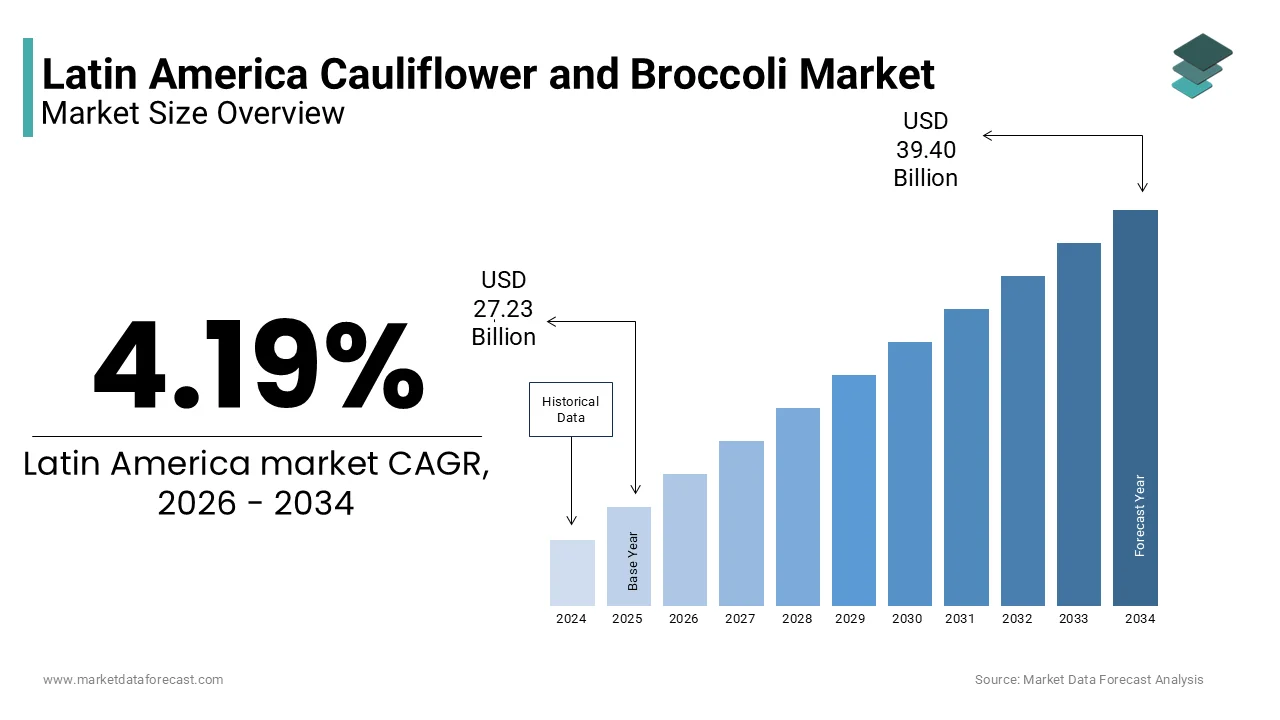
$27.23 BnMarket Estimate, 2026
$28.37 BnMarket Forecast, 2034
$39.40 BnCAGR, 2026–2034
4.19%Executive Summary: Latin America Cauliflower and Broccoli Market
- Market Scope: In-depth analysis of the Latin America cauliflower and broccoli market covering trade volumes, distribution channels, and major country-level markets.
- Market Valuation: Valued at USD 27.23 billion in 2025, estimated at USD 28.37 billion in 2026, and projected to reach USD 39.40 billion by 2034, growing at a compound annual growth rate (CAGR) of 4.19% from 2026 to 2034.
- Primary Growth Drivers: Rising health consciousness, strategic mergers, acquisitions, and vendor investments to ensure steady supply chains, alongside product and flavor innovations.
Key Market Segment Metrics (2026–2034)
| Category | Leading Segment Focus | Detailed Taxonomy & Sub-Segments |
|---|---|---|
| By Volume | Trade Flow Analysis | Imports & Exports by countries |
| By Distribution Channel | Modern Retail & E-commerce | Convenience stores, Supermarkets, Hypermarkets, & Online stores |
| By Country Focus | Brazil (Largest market) & Mexico | Brazil, Mexico, Argentina, Colombia, & remaining countries of South America |
Regional Insights & Market Dynamics
Brazil: Stands as the largest market in the region, followed closely by Mexico, Argentina, and Colombia, driven by expanding consumer bases and rising disposable incomes.
Market Dynamics: Increasing purchasing power and growing consumer focus on fresh, nutrient-dense green vegetables are fueling overall demand across Latin America.
Key Market Leaders Profiled: Groupe Vegco, Suttind Seeds, Premium Fresh, Jung Seed, Willowbrook Foods, and Charles Hard Seed Company.
 Download Free Sample Report
Latin America Cauliflower and Broccoli Market Size
The Latin America cauliflower and broccoli market size was valued at USD 27.23 billion in 2025 and is projected to reach USD 39.40 billion by 2034 from USD 28.37 billion in 2026, growing at a CAGR of 4.19%.
Cauliflower and broccoli are two closely related, nutrient-rich vegetables belonging to the same plant species (Brassica oleracea) and the cruciferous vegetable family (Brassicaceae). They are popular cool-season crops grown for their edible flowering heads or buds, but they differ significantly in appearance, flavour, and specific nutrient profiles due to centuries of selective breeding. These crops are increasingly valued for their high fibre content, vitamins and antioxidant properties, which align with growing regional health consciousness. As per the review, cauliflower and broccoli production in Latin America fluctuates across different regions based on localised climate impacts and farming infrastructure, with countries like Mexico maintaining a significant share of regional exports. This stability ensures a consistent supply chain for both domestic consumption and export markets. According to the Pan American Health Organisation (PAHO), noncommunicable diseases account for 65% of all deaths in the region. This public health imperative directly stimulates demand for affordable and accessible vegetables such as broccoli and cauliflower. Retailers are expanding cold chain infrastructure to maintain product freshness from farm to table. The integration of these vegetables into traditional cuisines and modern healthy eating trends supports market growth. Farmers are adopting improved seed varieties to enhance yield and disease resistance. Regulatory bodies are implementing stricter safety standards for pesticide residues, which influence production practices. Consequently, the market is evolving toward higher quality and safer produce offerings.
MARKET DRIVERS
Rising Prevalence of Lifestyle-Related Chronic Diseases
The rising prevalence of lifestyle-related chronic diseases is one of the major reasons behind the expansion of the Latin America cauliflower and broccoli market. Governments and health organisations are actively promoting diets rich in cruciferous vegetables to combat obesity, diabetes, and cardiovascular conditions. According to sources, escalating rates of noncommunicable diseases place immense long-term economic strains on Latin American public health systems, reinforcing the critical demand for nationwide preventative nutritional frameworks. This economic burden drives public health campaigns that emphasise the consumption of low calorie high nutrient foods like broccoli and cauliflower. As per the Brazilian Ministry of Health, national guidelines align with global standards by highlighting structural targets for fruits and vegetables, while the World Health Organisation explicitly recommends a minimum intake of 400 grams per day to mitigate chronic health risks. These guidelines influence consumer purchasing behaviour and encourage retailers to stock more fresh produce. Hospitals and wellness centres are incorporating these vegetables into therapeutic meal plans, further validating their health benefits. The high content of sulforaphane in broccoli is widely recognised for its anti-inflammatory properties, which appeal to health-conscious consumers. Educational initiatives in schools and communities raise awareness about the nutritional value of these crops. This sustained focus on disease prevention creates a stable and growing demand base. Consumers are increasingly willing to pay a premium for organic and pesticide-free options. The medical community’s endorsement reinforces the market position of these vegetables.
Expansion of Modern Retail and Cold Chain Infrastructure
The rapid expansion of modern retail formats and improved cold chain logistics further accelerate the growth of the Latin American cauliflower and broccoli market. This profoundly favours the availability and quality of these crops in the region. Supermarkets and hypermarkets are replacing traditional open-air markets as the primary source of fresh produce for urban consumers. According to studies, capital allocations targeting agricultural cold-chain distribution networks and transit corridors serve as vital mechanisms to systematically drive down post-harvest waste throughout Latin America. This improvement ensures that perishable vegetables like broccoli reach consumers in optimal condition, maintaining their nutritional value and visual appeal. As per research, the penetration of fresh produce categories into modern supermarket channels across major Latin American domestic markets has steadily advanced due to rising urban consumer preferences for organised distribution, visual shelf-life consistency, and sanitation. Retailers are implementing strict quality standards for suppliers, which encourages farmers to adopt better agricultural practices. The availability of pre-cut and packaged cauliflower and broccoli saves time for busy urban households. E-commerce platforms for grocery delivery are also gaining traction, offering wider access to fresh vegetables. Improved logistics enable producers to reach distant markets, including export destinations. This infrastructure development reduces waste and increases profitability for stakeholders. The consistency of supply supports long term contracts between retailers and growers.
MARKET RESTRAINTS
Vulnerability to Climate Change and Extreme Weather Events
Vulnerability to climate change and extreme weather events is a major obstruction to the stability of the Latin America cauliflower and broccoli market. These crops are sensitive to temperature fluctuations and water stress, which are becoming more frequent due to global warming. According to sources, climate-related disasters pose a severe economic challenge to Latin American and Caribbean agriculture, with severe and frequent weather anomalies driving widespread crop damage and varying fiscal deficits across regional economies. Such events disrupt planting schedules and reduce yields, leading to supply shortages and price volatility. As per research, shifting rainfall distribution and localised droughts across major agricultural regions in Brazil heavily disrupt fresh produce production cycles, often requiring emergency irrigation adjustments to mitigate severe output contractions. Farmers struggle to predict optimal planting windows, making crop management difficult. High temperatures can cause bolting in cauliflower, rendering the heads unusable for commercial sale. Water scarcity in arid regions limits irrigation capabilities, affecting crop quality. The lack of widespread adoption of climate-resilient seed varieties exacerbates these issues. Insurance coverage for smallholder farmers remains limited, leaving them exposed to financial risks. Supply chain disruptions during extreme weather events further compound the problem. Retailers face inconsistent supply, which affects consumer trust and loyalty. The unpredictability of production discourages long term investment in expansion.
High Post-Harvest Losses Due to Inefficient Handling
High post-harvest losses due to inefficient handling and a lack of proper packaging unfavourably impact the profitability and availability of these crops in the region, which slows down the growth of the Latin American cauliflower and broccoli market. These vegetables are highly perishable and require careful handling to maintain freshness and prevent spoilage. According to the Food and Agriculture Organisation of the United Nations (FAO), post-harvest losses for fresh vegetables in developing countries can reach up to 40% due to inadequate storage and transportation methods. This waste represents a significant economic loss for farmers and reduces the overall supply available to consumers. As per the study, poor post-harvest handling and suboptimal packaging during transit cause substantial structural bruising and accelerate physiological breakdown in delicate vegetable florets. Small-scale farmers often lack access to cooling facilities immediately after harvest, causing rapid quality degradation. The absence of standardised grading systems results in mixed quality batches that are difficult to sell at premium prices. Retailers reject damaged produce, leading to further waste at the distribution level. Consumer perception of quality is negatively affected by inconsistent product appearance. Investment in better packaging materials and training for handlers is limited due to cost constraints. The short shelf life of these vegetables requires rapid turnover, which is not always achievable. This inefficiency increases costs throughout the supply chain. It limits the ability of producers to access distant markets.
MARKET OPPORTUNITIES
Growth in Export Markets for Fresh and Processed Produce
The growth in export destinations for fresh and processed cauliflower and broccoli sets the stage for producers in the region to expand their revenue streams within the Latin American market. Countries like Mexico and Guatemala have established strong trade relationships with North America and Europe, where demand for off-season produce is high. According to the United States Department of Agriculture (USDA), Mexico functions as the dominant international supplier of fresh vegetables to the United States, servicing an expansive share of American domestic availability. This trend allows Latin American farmers to capitalise on counter-seasonal production cycles. As per the European Commission, regulations on maximum residue levels are being harmonised, facilitating easier access to European markets for compliant producers. Processing facilities for frozen and dehydrated broccoli and cauliflower are emerging to add value and extend shelf life. These processed products cater to the growing convenience food sector globally. Trade agreements such as the USMCA provide tariff-free access to key markets, enhancing competitiveness. Producers are investing in certification schemes like GlobalGAP to meet international quality standards. The reputation of Latin American produce for quality and flavour supports brand building. Diversifying into value-added products reduces dependence on volatile fresh markets. This opportunity encourages technological upgrades in farming and processing. It creates jobs and stimulates rural economies.
Adoption of Sustainable and Organic Farming Practices
The adoption of sustainable and organic farming practices offers a significant opportunity for differentiation and premium pricing in the Latin American cauliflower and broccoli market. Consumers in urban centres are increasingly seeking chemical-free produce due to health and environmental concerns. According to the study, the total acreage dedicated to organic crop production across Latin America ranks among the largest globally, responding directly to domestic policy support and international trade demand. Organic broccoli and cauliflower command higher prices in domestic and export markets, improving farmer incomes. As per sources, local accreditation pipelines for speciality fresh vegetable crops are steadily diversifying to formalise robust supply chains geared for both high-value domestic niches and export contracts. Sustainable practices such as drip irrigation and integrated pest management reduce environmental impact and resource usage. These methods appeal to eco-conscious retailers and consumers who prioritise sustainability. Government incentives for organic conversion lower the initial financial burden for farmers. Collaborative farming models allow smallholders to share certification costs and access larger markets. The story of sustainable production enhances brand value and customer loyalty. Retailers are dedicating shelf space to organic sections, attracting specific demographic segments. This trend aligns with global sustainability goals and corporate social responsibility initiatives. It positions Latin American produce as a responsible choice.
MARKET CHALLENGES
Fluctuation in Input Costs and Economic Instability
Fluctuations in input costs and broader economic instability remain a major challenge to the profitability and sustainability of the Latin America cauliflower and broccoli market. Farmers face rising prices for fertilisers, seeds, and fuel, which squeeze profit margins significantly. According to the World Bank, inflation rates in several Latin American countries have remained high, affecting the purchasing power of both producers and consumers. This economic pressure forces farmers to reduce input usage, potentially compromising yield and quality. As per the Inter-American Institute for Cooperation on Agriculture (IICA), fertiliser prices in Latin America soared by 137% in 2022 compared to 2021 due to global market fluctuations. Smallholder farmers are particularly vulnerable as they lack bargaining power and access to credit. Currency devaluations increase the cost of imported inputs while limiting export revenues. Consumers may switch to cheaper staple foods when vegetable prices rise, reducing demand. Price volatility makes it difficult for retailers to plan promotions and inventory. Long-term planning is hindered by unpredictable economic conditions. Investment in technology and infrastructure is delayed due to financial uncertainty. The sector struggles to attract young talent due to perceived risks. Stabilising input costs requires policy interventions and market mechanisms.
Pest and Disease Pressure in Tropical Climates
Pest and disease pressure in tropical and subtropical climates is a major impediment to the consistent production of these crops in the Latin American cauliflower and broccoli market. Warm and humid conditions favour the proliferation of pests such as aphids and diseases like black rot and downy mildew. According to sources, pest infestations and crop diseases present a persistent annual threat to vegetable cultivation in tropical regions, requiring integrated management practices to safeguard yields. Farmers must invest heavily in pesticides and fungicides to protect crops, increasing production costs. As per research, evolving chemical resistance among key crop pests challenges traditional crop protection methods, requiring adaptive pest-management strategies and alternative crop rotations. This reliance on chemicals raises concerns about residue levels and environmental contamination. Organic farmers face even greater challenges as they rely on biological controls, which may be less effective in severe outbreaks. Lack of technical knowledge among smallholders leads to improper application of treatments. Quarantine restrictions in export markets limit the use of certain chemicals, complicating compliance. Crop rotation is often difficult due to land constraints, limiting natural disease suppression. The need for constant monitoring increases labour requirements. These biological threats undermine yield stability and quality. They require continuous research and extension services to manage effectively.
 REPORT COVERAGE
| REPORT METRIC | DETAILS |
| Market Size Available | 2025 to 2034 |
| Base Year | 2025 |
| Forecast Period | 2026 to 2034 |
| CAGR | 4.19% |
| Segments Covered | By Volume, Distribution Channel, and Region |
| Various Analyses Covered | Global, Regional, & Country Level Analysis; Segment-Level Analysis; DROC; PESTLE Analysis; Porter’s Five Forces Analysis; Competitive Landscape; Analyst Overview of Investment Opportunities |
| Regions Covered | Latin America include Brazil, Argentina, Mexico, and the Rest of Latin America |
| Market Leaders Profiled | Groupe Vegco, Suttind Seeds, Premium Fresh, Jung Seed, Willowbrook Foods, Charles Hard Seed Company, Fresh Del Monte Produce Inc., Mission Produce Inc., and Calavo Growers Inc. |
SEGMENTAL ANALYSIS
By Volume Insights
The exports-by-countries segment maintained prominence in the Latin American cauliflower and broccoli market and accounted for a substantial share in 2025. This prominence of the segment was driven by the region’s strategic role as a primary supplier to North America and Europe during their off-seasons. Mexico and Guatemala serve as the epicentres of this export activity, leveraging favourable climates and trade agreements to maintain high shipment volumes. According to the United States Department of Agriculture (USDA), Mexico accounted for over 90% of fresh broccoli imports into the United States in 2024, demonstrating the sheer scale of cross-border trade. This dominance is driven by the counterseasonal production cycles that allow Latin American farmers to supply markets when domestic production in importing countries is low. As per the study, agricultural export value throughout Central America experiences continuous shifts driven by changing tariff agreements and structural improvements across corporate shipping nodes. The proximity to the US market reduces transportation costs and time, ensuring product freshness upon arrival. Trade agreements such as the USMCA facilitate tariff-free access, which enhances competitiveness. Large-scale commercial farms in these countries utilise advanced irrigation and harvesting technologies to meet strict quality standards required by international retailers. The consistent volume of exports stabilises income for producers and supports rural economies. Infrastructure investments in ports and cold chains further support this export-led growth. The reputation of Latin American produce for quality and reliability sustains long term contracts with global buyers. This segment drives significant foreign exchange earnings for exporting nations.
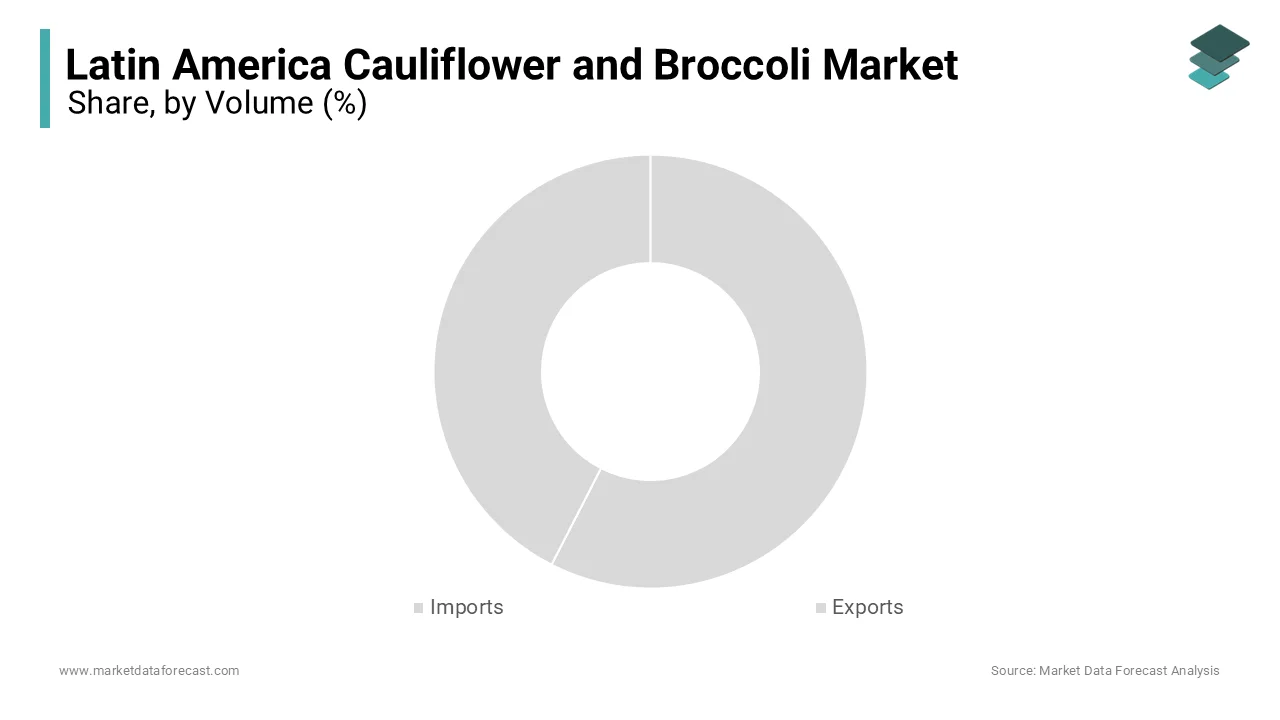
The imports segment is witnessing the quickest growth in the Latin American cauliflower and broccoli market due to rising urban consumption and gaps in local production during specific seasons. Countries like Chile, Argentina, and Brazil increasingly rely on imports to meet year-round demand, particularly for premium varieties and processed forms. According to sources, commercial exchanges of fresh agricultural products between neighbouring Latin American states expand steadily as structural logistics and cross-border transport corridors align. This growth is fueled by the expanding middle class in urban centres who seek diverse and high-quality produce options. As per research, domestic purchases of processed and frozen brassica vegetables supplement regional processing sectors to cover cold-chain inventory deficits across commercial hospitality networks. Local production often faces climatic challenges or pest pressures that create temporary shortages necessitating imports. Retailers are sourcing from neighbouring countries to ensure consistent shelf availability. The rise of modern retail formats requires standardised products that may not always be available locally. Processed imports offer convenience and longer shelf life, appealing to busy consumers. Trade liberalisation within Mercosur and other regional blocs reduces barriers, facilitating easier cross-border movement. Consumers are becoming more open to imported brands perceived as higher quality. This trend is supported by improved logistics and cold chain capabilities. The import segment offers resilience against local supply fluctuations.
By Distribution Channel Insights
The supermarkets segment led the Latin American cauliflower and broccoli market and captured a significant share in 2025. This leading position was attributed to its widespread presence and ability to offer consistent quality and variety. Urban consumers prefer supermarkets for their hygienic environment, reliable supply, and competitive pricing compared to traditional markets. According to sources, supermarkets' share of the retail market in fresh produce lags behind their overall food retail share, claiming only about 30 per cent of retail trade in fresh produce in major markets like Brazil. The channel allows retailers to implement strict quality control measures, ensuring that only fresh and visually appealing vegetables reach consumers. As per research, the physical infrastructure of large grocery chains continues to expand into secondary urban areas, altering the domestic purchasing patterns of regional households. Supermarkets offer pre-packaged and pre-cut options that cater to the convenience needs of working families. They also provide promotional discounts and loyalty programs that drive volume sales. The ability to source directly from large producers ensures stable prices and consistent supply. Cold chain infrastructure within supermarkets maintains product freshness, reducing waste. Consumers trust supermarkets for food safety and traceability information. The channel benefits from high foot traffic and one-stop shopping convenience. Marketing campaigns within stores educate consumers about health benefits. This dominance is reinforced by the professional management of inventory and display.
The online stores segment is the fastest-expanding in the Latin American cauliflower and broccoli market, owing to digital adoption and the demand for home delivery convenience. The pandemic accelerated the shift toward e-commerce for grocery shopping, a trend that has persisted post-lockdown. According to the study, e-commerce applications and digital grocery channels across Latin American urban centres have expanded rapidly as consumer segments prioritise digital convenience and fast fulfilment. This growth is supported by improved last-mile delivery networks and mobile payment solutions. As per sources, the baseline demand for home-delivered fresh foods remains highly concentrated among urban, technology-reliant demographics seeking specialised delivery solutions. Online platforms offer a wider variety, including organic and speciality varieties that may not be available in local physical stores. Subscription models for weekly vegetable boxes are gaining popularity, providing predictable revenue for sellers. Consumers appreciate the transparency of product origin and quality ratings available online. Digital marketing allows targeted promotions based on purchasing history. The convenience of avoiding traffic and queues appeals to busy professionals. Retailers are investing in app-based interfaces to enhance user experience. Cold chain logistics for delivery are improving, ensuring product quality upon arrival. This channel offers significant potential for expansion in underserved areas. It enables direct connection between producers and consumers.
REGIONAL ANALYSIS
Brazil grew steadily in the Latin American cauliflower and broccoli market in 2025. This growth of the Brazilian market was propelled by its vast agricultural land and large domestic consumer base. The country is a major producer of both vegetables, with significant output in the southern and central-western regions. According to the study, vegetable cultivation across Brazil integrates modern technical frameworks to support local domestic consumption, while structural crop adjustments are largely focused on primary commodities and grain production. This growth ensures adequate supply for both domestic consumption and export. As per sources, adaptive biotechnology research aimed at strengthening plant resilience against temperature volatility remains a key priority to help local producers insulate specialised cultivation cycles from climate stress. The rising middle class is increasing demand for healthy food options, boosting retail sales. Supermarkets and online platforms are expanding reach into smaller cities. Government programs support smallholder farmers, improving productivity and quality. Export opportunities to neighbouring countries are growing due to trade agreements. The market faces challenges related to logistics and post-harvest losses but remains robust. Investment in cold chain infrastructure is improving efficiency. Consumer awareness of nutritional benefits drives steady demand. Brazil serves as a key hub for regional trade.
Mexico was the top performer in the Latin American cauliflower and broccoli market in 2025. It is the leading exporter to North America. The country’s favourable climate allows for year-round production, making it a reliable supplier for the US market. According to the United States Department of Agriculture (USDA), Mexico accounted for over 90% of fresh broccoli imports into the United States in 2024, demonstrating the sheer scale of cross-border trade. This export orientation drives investment in large-scale commercial farming and advanced packing facilities. As per reviews, international shipments of high-value fresh produce generate vital economic revenues for commercial farming segments and rural supply chains across domestic Mexican states. Domestic consumption is also rising due to health awareness campaigns. Modern retail channels are expanding in urban areas, offering better quality produce. Farmers are adopting sustainable practices to meet international certification standards. Trade agreements facilitate smooth cross-border transactions. The market benefits from strong infrastructure connections to the US. Challenges include water scarcity and labour costs, but innovation is addressing these issues. Mexico remains a powerhouse in regional vegetable trade.
Argentina expanded moderately in the Latin American cauliflower and broccoli market due to strong domestic consumption and seasonal exports. The Pampas region provides ideal conditions for growing these crops, ensuring high-quality output. According to research, export channels for fresh regional produce rely heavily on localised pricing advantages and shifting currency valuations to negotiate trade agreements within South American economic blocs. The export activity supports local growers and stabilises prices. As per sources, localised research exploring crop disease mitigation helps farming operations enhance baseline yields while optimising the use of traditional chemical crop treatments. Domestic demand is driven by traditional cuisine and growing health consciousness. Supermarkets are the primary distribution channel offering fresh and packaged options. Economic instability poses challenges, but the sector remains resilient due to the essential nature of food. Organic farming is gaining traction among premium consumers. Infrastructure improvements are reducing post-harvest losses. Argentina leverages its reputation for quality agricultural products. The market is poised for gradual growth.
Chile also exhibited moderate growth in the Latin American cauliflower and broccoli market. It is known for its high-quality exports and counter-seasonal supply. The country serves as a key supplier to Northern Hemisphere markets during their winter months. According to sources, commercial shipments of high-quality fresh produce leverage strict phytosanitary compliance and international safety standards to capture specialised retail niches abroad. This focus on quality allows Chilean producers to command higher prices. As per reports, strategic certifications are deployed to systematically measure and advance economic and environmental sustainability across the agro-food sector. Domestic consumption is moderate but growing with increased health awareness. The market is characterised by efficient logistics and strong trade relationships. Certifications for global standards are widely adopted by exporters. Climate change poses risks, but adaptation strategies are being implemented. Chile serves as a model for efficient agricultural export management. The sector contributes significantly to rural employment. Innovation in packaging extends shelf life for long-distance transport.
COMPETITIVE LANDSCAPE
The competition in the Latin America cauliflower and broccoli market is characterized by a mix of large multinational distributors and numerous small to medium sized local producers. Large players leverage their extensive logistics networks and brand recognition to dominate export channels particularly to North America and Europe. They compete on the basis of consistent quality reliability and adherence to international safety standards. Local producers often focus on domestic markets or niche segments such as organic produce where they can command higher prices. Price competition is intense due to the commoditized nature of fresh vegetables but differentiation through quality and service mitigates this pressure. Regulatory compliance acts as a barrier to entry favoring established players with resources for certification and testing. The market sees frequent collaborations between growers and exporters to share risks and improve efficiency. Climate variability creates supply fluctuations which influence competitive dynamics and pricing power. Companies that invest in sustainable practices and technology gain a competitive edge. Consumer trends toward health and transparency drive innovation in packaging and labeling. The landscape is dynamic with continuous entry of new exporters from emerging production zones. This diversity ensures a vibrant market environment focused on efficiency and quality.
Key Market Players
Some of the key players in the Latin America cauliflower and broccoli market are
- Groupe Vegco
- Suttind Seeds
- Premium Fresh
- Jung Seed
- Willowbrook Foods
- Charles Hard Seed Company
- Fresh Del Monte Produce Inc.
- Mission Produce Inc.
- Calavo Growers Inc.
Top Players in the Market
- Fresh Del Monte Produce Inc operates as a major distributor and marketer of fresh produce with significant operations in Latin America. The company manages extensive supply chains for broccoli and cauliflower connecting regional growers to global markets particularly in North America. Fresh Del Monte recently invested in advanced packing facilities in Guatemala to improve efficiency and product quality. This expansion allows them to meet strict international standards for freshness and safety. The company focuses on sustainable farming practices including water conservation and integrated pest management. They collaborate closely with local farmers to ensure consistent supply and fair pricing. Fresh Del Monte leverages its logistics network to minimize post harvest losses during transportation. Their brand recognition helps secure premium contracts with large retail chains. By prioritizing quality control and traceability they maintain strong relationships with buyers. These efforts reinforce their position as a reliable partner in the fresh produce sector.
- Mission Produce Inc is primarily known for avocados but has expanded its portfolio to include other fresh vegetables like broccoli and cauliflower in key Latin American regions. The company utilizes its established distribution infrastructure to source and deliver high quality produce to international clients. Mission Produce recently strengthened its sourcing agreements with Mexican growers to ensure year round availability of cruciferous vegetables. This strategic move enhances their ability to offer diverse product bundles to retailers. The company emphasizes sustainability and social responsibility in its supply chain operations. They invest in technology to monitor crop health and optimize harvest timing. Mission Produce works with certification bodies to ensure compliance with global food safety standards. Their focus on operational excellence reduces costs and improves margins. By leveraging existing logistics capabilities they efficiently manage cross border trade. This diversification strengthens their resilience against market fluctuations in single commodity sectors.
- Calavo Growers Inc plays a significant role in the Latin America Cauliflower And Broccoli Market through its extensive network of independent growers and distributors. The company focuses on providing fresh high quality produce to foodservice and retail customers across the Americas. Calavo recently implemented new digital tools to enhance supply chain visibility and inventory management. This technological upgrade improves responsiveness to market demand and reduces waste. The company supports its grower partners with technical assistance and access to premium markets. They prioritize building long term relationships based on trust and mutual benefit. Calavo adheres to rigorous quality standards ensuring customer satisfaction and brand loyalty. Their flexible business model allows them to adapt quickly to changing consumer preferences. The company actively participates in industry initiatives promoting sustainable agriculture. By focusing on service and quality Calavo maintains a competitive edge in the fresh produce industry.
Top Strategies Used by Key Market Participants
Key players in the Latin America Cauliflower And Broccoli Market primarily focus on supply chain optimization and sustainability initiatives to maintain competitive advantage. Companies invest heavily in cold chain infrastructure to reduce post harvest losses and ensure product freshness during long distance transportation. This strategy addresses the perishable nature of these vegetables and meets retailer quality expectations. Strategic partnerships with local growers are essential to secure consistent supply and support rural communities. Firms also prioritize certification programs such as GlobalGAP to access premium international markets. Digital transformation is another critical strategy where companies use data analytics to predict demand and optimize harvesting schedules. Marketing efforts emphasize health benefits and sustainability credentials to appeal to conscious consumers. Diversification into processed products like frozen or pre cut vegetables adds value and extends shelf life. These multifaceted approaches ensure resilience against climate risks and market volatility while fostering long term growth in the dynamic regional landscape.
MARKET SEGMENTATION
This research report on the Latin America cauliflower and broccoli market has been segmented and sub-segmented into the following categories.
By Volume
- Imports
- Exports
By Distribution Channel
- convenience stores
- supermarkets
- hypermarkets
- online stores
By Country
- Brazil
- Mexico
- Argentina