- Product Description Description
- Table of Contents TOC
- List of Table & Figure LOT
- Get Free Sample PDF Sample PDF
Market Size, 2025
$9.08 BnMarket Estimate, 2026
$9.82 BnMarket Forecast, 2034
$18.30 BnCAGR, 2026–2034
8.1%Executive Summary: Latin America Corn Seeds Market
- Market Scope: Comprehensive Latin American corn seeds market analysis covering product types, end-product applications, country-level frameworks (Brazil, Argentina, Chile, Mexico, and others), and agricultural genetic advancements. Captures 25% of the global market.
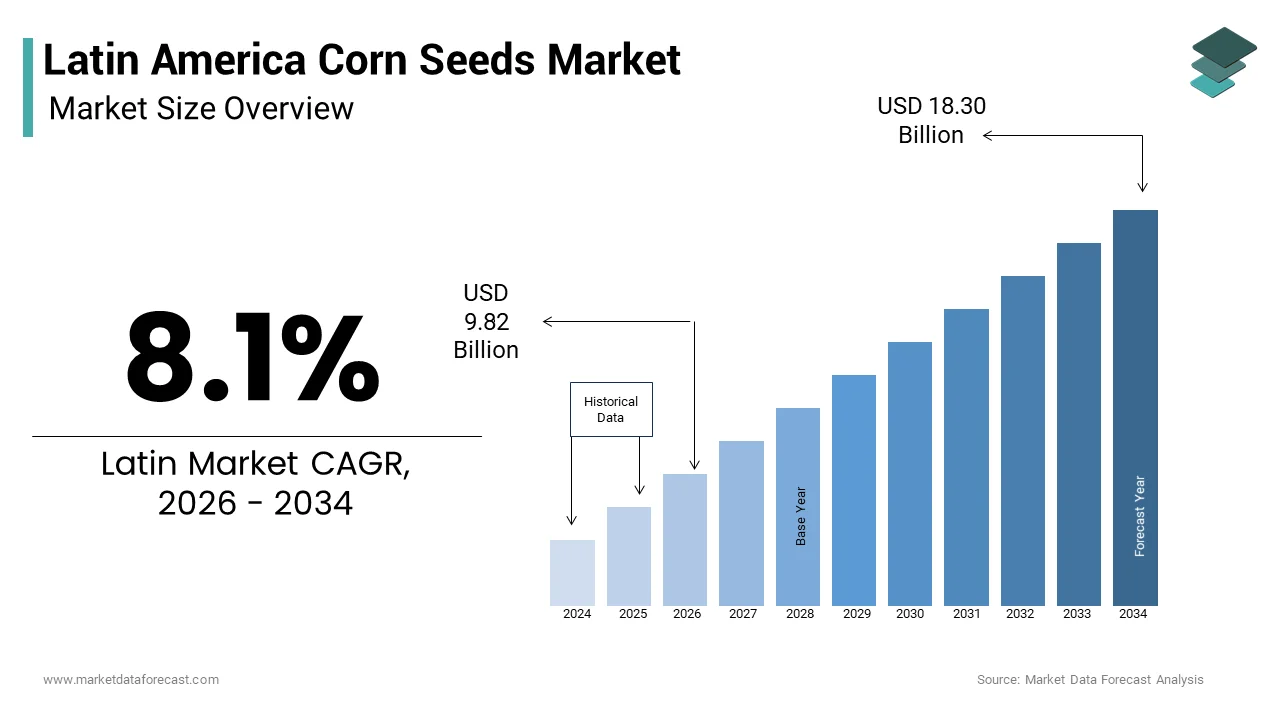
- Market Valuation: Valued at USD 9.08 billion in 2025, estimated at USD 9.82 billion in 2026, and projected to reach USD 18.30 billion by 2034, registering a CAGR of 8.1% (2025–2034).
- Primary Growth Drivers: Substantial improvements in crop yield and quality through genetic engineering advancements, along with strategic stockpiling and inventory planning by major agribusiness players based on demand-supply conditions. Key restraints include volatile commodity pricing and fluctuations in harvested acreage.
Key Market Segment Metrics (2025–2034)
| Category | Leading Segment (2025 Position) | Fastest-Growing Segment |
|---|---|---|
| By Type | Field corn (dominant type utilized widely for large-scale double-cropping systems like Brazil's safrinha and animal feed supply chains) | Specialty and disease-resistant hybrid seed categories |
| By End Products | Animal feed (largest end-product sector, servicing extensive poultry, pork, and cattle operations across South America) | Corn starch and industrial sweetener processing derivatives |
| By Country | Brazil and Argentina (major corn-producing powerhouses driving regional output and export leadership) | Expanding agricultural frontiers across South American growing belts |
Major Market Players & Market Structure
Market Structure: Highly concentrated and competitive landscape featuring multinational life-science leaders providing advanced transgenic traits, high-performance hybrids, and robust local adaptation networks.
Key Companies: Monsanto, Monsanto Company, DuPont Pioneer, Syngenta, and Bayer CropScience.
 Download Free Sample Report
Latin America Corn Seeds Market Size
The Latin American corn seeds market size will reach USD 9.08 billion in 2025 and is anticipated to reach a valuation of USD 9.82 billion in 2026 to USD 18.30 billion by 2034, growing at a CAGR of 8.1% from 2025 to 2034. It captures 25% of the global market.
Current Intro Definition of the Latin America Corn Seeds Market
The corn seeds are the hybrid and biotechnology enhanced maize germplasm specifically adapted to the diverse tropical and subtropical agroecological zones spanning from Mexico to Argentina. This sector is fundamentally distinct due to its reliance on advanced genetic traits for insect resistance and herbicide tolerance tailored to regional pest pressures such as fall armyworm and spittlebugs rather than temperate yield maximization alone. According to the United States Department of Agriculture Foreign Agricultural Service, Brazil harvested approximately 135 million metric tons of corn in the 2024/2025 crop year, amplifying its position as a global powerhouse that necessitates continuous seed innovation to sustain productivity across multiple growing seasons. As per the Food and Agriculture Organization of the United Nations, maize constitutes over 60% of total cereal production volume in Latin America, serving as the primary caloric foundation for both human consumption and the rapidly expanding livestock sector.
MARKET DRIVERS
Expansion of Double Cropping Systems in Tropical Savannas
The widespread adoption of double cropping systems, particularly the safrinha cycle in Brazil’s Cerrado region is a major factor bolstering the growth of the Latin America corn seeds market. According to the study, the safrinha crop accounted for approximately 78% of total national corn production in 2025, demonstrating that the secondary harvest has become the dominant agricultural event rather than a supplementary activity. This intensification forces farmers to purchase specialized hybrids capable of tolerating diminishing soil moisture and shorter daylight hours characteristic of late season planting windows between February and March. According to the Brazilian Agricultural Research Corporation, breeding programs now dedicate over 65% of research resources to developing varieties specifically optimized for these stress prone second crop conditions rather than traditional summer cultivation. Yield differentials between standard and safrinha adapted genetics can exceed 25 bags per hectare, creating a compelling economic incentive for growers to invest in higher priced proprietary seeds despite tighter profit margins in the second cycle.
Livestock Sector Growth Driving Feed Grain Requirements
The relentless expansion of poultry swine and dairy industries for high energy corn hybrids, as domestic feed mills seek consistent quality raw materials independent of international price volatility. The livestock sector growth is additionally accelerating the growth of the Latin America corn seeds market. As per the study, Latin American meat production is projected to increase by 14% between 2024 and 2033, driven largely by export-oriented growth in Brazil and Mexico that requires massive volumes of domestically produced feed grains. According to the Brazilian Association of Animal Protein, the country exported over 5 million tons of chicken meat in 2025, with each kilogram of production requiring approximately 1.7 kilograms of corn based feed ration. This direct linkage between protein exports and grain consumption insulates the seed market from fluctuations in human food demand, creating a stable baseline requirement for industrial scale corn cultivation. Additionally, the Mexican livestock industry imported over 17 million metric tons of yellow corn in 2024, highlighting a significant supply gap that domestic seed companies are targeting through improved tropical hybrids suited to rainfed environments, according to the study. The imperative to reduce import dependency, while supporting export growth ensures sustained investment in seed technologies that maximize caloric output per hectare under varying climatic constraints.
MARKET RESTRAINTS
Regulatory Divergence Hindering Biotechnology Trait Deployment
The significant disparities in biosafety regulatory frameworks create substantial friction for seed companies attempting to deploy uniform biotechnology platforms, thereby limiting farmer access to cutting edge traits available in other global countries. The regulatory divergence hindering biotechnology trait deployment is hindering the growth of the Latin America corn seeds market. According to CropLife Latin America, the average time lag for approving a new biotech corn trait in countries like Colombia or Ecuador exceeds 7 years compared to 3 years in Brazil and Argentina, resulting in a persistent technology gap that suppresses regional productivity potential. In Venezuela and parts of Central America, restrictive policies effectively ban modern biotechnology, forcing reliance on conventional hybrids that lack necessary protections against endemic pests like fall armyworm. This regulatory fragmentation prevents the formation of a cohesive regional market, discouraging private sector investment in localized breeding programs for smaller jurisdictions. Farmers in non-aligned countries consequently face yield penalties relative to neighbors with streamlined approval systems, perpetuating competitive disadvantages in both domestic and export markets.
Currency Volatility Eroding Farmer Purchasing Power
The chronic currency depreciation, such as Argentina and Brazil severely constrains farmer ability to afford premium priced corn seeds, which are often indexed to hard currencies due to royalty obligations and imported parent line costs. The currency volatility eroding farmer purchasing power is impeding the growth of the Latin America corn seeds market. According to the study, the official exchange rate depreciated by over 45% during 2024 alone, causing local currency prices for certified corn seed to rise disproportionately even when dollar denominated costs remained stable. In Brazil, the Real experienced similar pressure with seed companies implementing multiple price adjustments throughout the commercialization window to protect margins by creating uncertainty that delays purchasing decisions and disrupts planting logistics. This financial instability decouples seed pricing from agronomic value, making rational investment decisions difficult for producers already operating under thin margins and high interest rates.
MARKET OPPORTUNITIES
Development of Climate Resilient Germplasm for Marginal Areas
Advancements in drought tolerance and heat resilience breeding to expand viable corn cultivation into historically marginal areas of Northeast Brazil and Central America, where rainfall variability has previously limited reliable production. The development of climate resilient germplasm for marginal areas is solely creating new opportunities for the growth of the Latin America corn seeds market. According to the study, new generation drought tolerant hybrids released in 2025 demonstrated yield stability advantages of 18 to 22% over conventional checks under moderate water stress conditions in field trials across Mexico and Guatemala. The climate smart agriculture investments in Latin America could unlock an additional 12 million hectares of productive land by 2030, with corn serving as a primary beneficiary crop due to its central role in smallholder livelihoods. Ccording to the study, adoption of stress tolerant varieties in the semi-arid Caatinga biome increased by 34% in 2024, as government credit programs specifically incentivized resilient genetics. These innovations address the single largest source of yield variance in tropical corn production, converting high risk subsistence farming into commercially viable enterprises. Seed companies capturing this segment gain first mover advantage in vast underserved territories where competition remains limited and farmer loyalty is strong once performance is validated under local conditions.
Digital Integration Enhancing Seed Placement Precision
The emergence of digital agriculture platforms with seed sales improve placement accuracy and realize fuller genetic potential through site specific variety that is also to amplify the growth of the Latin America corn seeds market. According to McKinsey and Company, digital tool adoption among large scale Latin American corn growers reached 68% in 2025, enabling seed distributors to leverage field level analytics for precision marketing and technical support. Bayer Crop Science reported in 2025 that farms using their digital prescription services achieved average yield gains of 8 bags per hectare compared to neighboring fields relying on traditional blanket recommendations, validating the economic case for integrated seed plus data offerings. According to the tropical agriculture platform, digital advisory services reduced variety mismatch errors by 41% in pilot programs across Paraguay and Bolivia, directly translating to improved return on seed investment for participating producers. This integration transforms seed from a commodity transaction into a knowledge intensive service relationship, increasing switching costs and customer retention for providers who successfully embed themselves in farm management workflows. Companies mastering this convergence can differentiate offerings beyond genetic traits alone, capturing value from information asymmetry that traditionally plagued seed selection in heterogeneous tropical environments.
MARKET CHALLENGES
Rapid Evolution of Pest Resistance to Bt Traits
The accelerated evolution of resistance in fall armyworm populations to widely used Bacillus thuringiensis proteins, undermining the foundational value proposition of biotechnology dependent production systems. This is a major challenge for the growth of the Latin America corn seeds market. According to the Brazilian Agricultural Research Corporation, field collected fall armyworm populations in Mato Grosso and Bahia exhibited survival rates exceeding 60% on Cry1F expressing corn hybrids in 2025 monitoring surveys, confirming widespread resistance breakdown after less than a decade of intensive use. The International Centre for Insect Physiology and Ecology documented that resistance allele frequencies in Colombian populations doubled between 2023 and 2024, forcing emergency reliance on chemical insecticides that erode the environmental and economic benefits originally promised by transgenic seeds. Universidade Federal de Vicosa research indicates that managing this resistance crisis requires implementing complex refuge strategies that only 28% of surveyed farmers fully complied with in 2024, accelerating selection pressure toward resistant genotypes. Seed companies face mounting costs to stack multiple modes of action and develop next generation proteins while educating thousands of smallholders on stewardship practices. Failure to resolve this biological arms race risks triggering regulatory backlash and farmer disillusionment with biotechnology precisely when climate pressures demand more resilient solutions.
Informal Seed Sector Undermining Certified Quality Standards
The persistent prevalence of informal seed exchange networks and unlicensed multiplication operations is also to inhibit the growth of the Latin America corn seeds market. According to the study, approximately 35% of corn seed planted in Central America and Andean nations originates from uncertified sources lacking guaranteed germination purity or trait expression standards. As per the Food and Agriculture Organization of the United Nations, substandard seed contributes to yield gaps of 20 to 30% in smallholder systems across the region, perpetuating poverty traps and limiting technology transfer effectiveness. This informal sector also serves as vector for seed borne diseases like Fusarium ear rot and Stewart’s wilt, creating biosecurity externalities that affect compliant producers through cross contamination and trade restrictions. Formal seed companies struggle to compete on price against unregulated alternatives while bearing full compliance costs, distorting market signals and reducing incentives for continued breeding investment in public good traits needed for sustainable intensification.
REPORT COVERAGE
| REPORT METRIC | DETAILS |
| Market Size Available | 2025 to 2034 |
| Base Year | 2025 |
| Forecast Period | 2026 to 2034 |
| CAGR | 8.1% |
| Segments Covered | By Type, End Product, and Region. |
| Various Analyses Covered | Global, Regional, Country-Level Analysis, Segment-Level Analysis; DROC, PESTLE Analysis; Porter’s Five Forces Analysis; Competitive Landscape; Analyst Overview of Investment Opportunities |
| Regions Covered | Brazil, Chile, Argentina, and the rest of Latin |
| Market Leaders Profiled | Monsanto, Monsanto Company, DuPont Pioneer, Syngenta, and Bayer Crop Science. |
SEGMENTAL ANALYSIS
By Type Insights
The field corn segment held a significant share of the Latin America corn seeds market in 2025 due to its foundational role as the primary feedstock for the region’s massive livestock industry and biofuel production infrastructure. According to the study, field corn accounted for approximately 94% of total maize planted area in Latin America during the 2024/2025 agricultural cycle reflecting its status as an industrial commodity rather than a fresh vegetable crop. The dominance is structurally reinforced by integrated supply chains where poultry swine and ethanol processors contract directly with seed companies to ensure consistent quality traits that optimize conversion efficiency in downstream facilities. Furthermore, government stockpiling programs in Mexico and strategic reserves in Brazil prioritize field corn procurement for food security buffers ensuring public sector demand supplements private consumption. This emergence of industrial utility policy support and scale economies makes field corn the unassailable leader in regional seed commerce.
The sweet corn segment is expected to grow at a fastest CAGR of 9.4% throughout the forecast period with the rising urban middle class consumption and export-oriented processing industries in temperate zones. than total planted area this segment benefits from premium pricing structures and value added processing opportunities that attract investment disproportionate to volume share. According to the study, processed sweet corn exports from Argentina and Chile grew by 22% in 2024, as global demand for shelf stable vegetables increased amid supply chain disruptions in traditional sourcing regions. Breeding programs have responded by releasing shrunken gene varieties adapted to tropical lowlands enabling year-round production cycles previously impossible outside subtropical highlands. Food service sector recovery post pandemic further accelerates demand as restaurants incorporate sweet corn into diversified menus catering to health-conscious consumers seeking plant based options.
By End Products Insights
The animal feed segment was the largest by accounting for 34.6% of the Latin America corn seeds market share in 2025 due to the region’s position as a global protein export powerhouse and growing domestic meat consumption. This segment absorbs the vast majority of field corn production creating direct linkage between seed demand and livestock herd dynamics across poultry swine dairy and aquaculture sectors. Government policies in Mexico and Colombia explicitly subsidize feed grain imports when domestic supplies fall short underscoring the strategic priority placed on maintaining affordable protein costs for urban populations. Integrated poultry companies control significant portions of seed purchasing decisions through vertical coordination ensuring genetics align precisely with nutritional specifications for optimal feed conversion efficiency. This structural dependency on corn as biological fuel for protein synthesis insulates from human food demand volatility and anchors long term growth prospects to demographic and income trends driving meat consumption increases across developing economies.
The corn starch segment is expected to grow at a fastest CAGR of 8.7% during the forecast period with the diversification into biodegradable packaging pharmaceutical excipients and specialty food ingredients beyond traditional paper and textile uses. Pharmaceutical grade starch imports declined by 28% as local manufacturers achieved certification standards enabling import substitution in high margin medical applications. The waxy corn hybrids commanding 30 to 50% price premiums over conventional dent corn are seeing accelerated planting as processors secure dedicated supply through identity preserved contracting. This industrial diversification reduces dependence on commoditized feed areas and opens new revenue streams linked to green economy transitions and advanced manufacturing capabilities emerging across the region.
COUNTRY LEVEL ANALYSIS
Brazil Corn Seeds Market Analysis
Brazil was the top performer in the Latin America corn seeds market by accounting for 52.2% of share in 2025 with its status as world’s third largest producer and leading exporter of maize. The country’s unique double cropping system enables two full production cycles annually maximizing land productivity and seed turnover velocity unmatched elsewhere in hemisphere. According to the National Supply Company of Brazil, safrinha corn planted area reached 17.8 million hectares in 2025 representing 78% of national output and creating massive recurring demand for short cycle stress tolerant hybrids. Embrapa research indicates that genetic gain contributions to yield improvement averaged 1.8% annually over past decade demonstrating sustained breeding effectiveness in tropical adaptation. Mato Grosso state alone consumes more corn seed than entire Argentine market reflecting geographic concentration of intensive production systems. Export infrastructure expansion through northern arc ports reduced logistics costs enhancing farmer margins and supporting premium seed affordability. However currency volatility and pest resistance pressures create operational headwinds requiring continuous innovation in trait stacking and financial hedging mechanisms. Brazil’s technological sophistication and scale ensure continued leadership but also expose market to systemic risks from climate variability and global trade tensions affecting export dependent production model.
Mexico Corn Seeds Market Analysis
Mexico corn seeds market is likely to be driven by the irrigated production in northwest and traditional rainfed smallholder systems across central highlands. The country serves as center of origin for maize biodiversity creating unique regulatory environment balancing modern biotechnology adoption with native variety conservation mandates. Government decree phasing out white corn imports by 2024 stimulated domestic breeding efforts for high yielding native adapted hybrids though implementation delays created uncertainty. Water scarcity in northern basins increasingly constrains expansion making drought tolerance trait priority.
Argentina Corn Seeds Market Analysis
Argentina corn seeds market growth is propelled with the export oriented production model and early adoption of biotechnology that established regional precedent for transgenic crop commercialization. Rosario port complex handles over 35 million metric tons of corn exports annually making international competitiveness paramount driver of seed selection criteria focused on yield stability and grain quality standards demanded by Asian buyers. However, severe drought episodes in 2023 and 2024 exposed vulnerability to climate extremes accelerating demand for deeper rooted water efficient hybrids. Currency controls and export taxes periodically distort planting incentives causing acreage swings that complicate seed demand forecasting.
Chile Corn Seeds Market Analysis
Chile corn seeds market growth is likely to grow with the counter seasonal seed multiplication hub and premium processing corn producer leveraging Mediterranean climate advantages. Domestically, sweet corn and silage corn dominate over grain production due to limited arable land and competition from fruit orchards for water resources. Water allocation reforms and megadrought conditions impose hard constraints on expansion making efficiency traits more valuable than pure yield potential. Chile’s role as technology gateway and specialized producer compensates for small domestic scale providing outsized influence on regional germplasm development pipelines.
COMPETITIVE LANDSCAPE
Competition in the Latin American corn seeds market features intense rivalry among multinational giants, alongside strong regional players and emerging local breeders, creating a multi-tiered competitive landscape. Global leaders leverage proprietary trait stacks and digital ecosystems, defending premium positioning through integrated value propositions extending beyond genetics alone. Regional champions compete on local adaptation speed, regulatory navigation, and farmer relationships, particularly in secondary markets where multinationals maintain lighter footprints. Generic seed producers capture volume in price-sensitive segments, especially among smallholders and rainfed systems where biotechnology premiums remain prohibitive. Competitive intensity varies geographically, with Brazil exhibiting the highest consolidation due to scale requirements, while Central America remains fragmented with numerous local suppliers. Resistance evolution compresses product life cycles, forcing continuous innovation just to maintain baseline efficacy standards. Public sector breeding programs provide foundational germplasm that private companies enhance, creating an interdependent innovation ecosystem. Currency volatility creates opportunities for locally capitalized firms with lower hard currency exposure, versus import-dependent multinationals. This dynamic environment rewards companies balancing technological sophistication with operational flexibility, and a deep contextual understanding of diverse production systems spanning tropical savannas to temperate pampas.
KEY PLAYERS MARKET
These are the market players that are dominating tEuropeanope corn seeds market.
- Monsanto
- Monsanto Company
- DuPont Pioneer
- Corteva Agriscience
- Syngenta
- Bayer CropScience.
Top Players In The Market
- Bayer Crop Science maintains extensive involvement in the Latin American corn seeds market through integrated germplasm and trait platforms tailored to tropical production systems across Brazil and Argentina. The company recently launched next-generation insect resistance traits, specifically addressing fall armyworm pressure in safrinha corn cycles. Bayer strengthened its position by expanding breeding stations in Mato Grosso and Córdoba, accelerating local adaptation of elite genetics. Strategic partnerships with digital agriculture platforms enable precision variety recommendations, enhancing farmer outcomes. Their stewardship programs promote refuge compliance, preserving biotechnology efficacy long term. Recent regulatory approvals for drought-tolerant hybrids broaden addressable environments in Northeast Brazil. Continuous investment in seed treatment technologies protects early-season establishment against soil pests. This comprehensive approach integrates genetics, chemistry, and data services, reinforcing leadership through value creation beyond seed sales alone.
- Corteva Agriscience contributes significantly to the Latin American corn seeds market, leveraging a diverse genetic base from the Pioneer brand heritage adapted to regional agroecologies from Mexico to the Southern Cone. The company recently introduced waxy corn hybrids, targeting growing starch processing demand in Brazil and Argentina. Corteva strengthened its position by upgrading seed production facilities in Paraguay, ensuring supply reliability for double-crop systems. Collaborative research with Embrapa accelerates the development of climate-resilient varieties for marginal environments. Their Enlist weed control system integration simplifies herbicide management, reducing application complexity for farmers. Expansion of retail network coverage improves last-mile access in underserved Central American markets. Digital tools like Granular connect seed placement decisions with field analytics, optimizing genetic expression potential. This combination of broad portfolio depth and localized execution sustains competitive relevance across heterogeneous production contexts.
- Syngenta Seeds plays a vital role in the Latin American corn seeds market through high-performance hybrids, combining yield stability with multiple mode-of-action insect protection suited to intensive cropping systems. The company recently received approval for Vip3A protein stacking, enhancing the lepidopteran control spectrum in Brazilian safrinha environments. Syngenta strengthened its position by acquiring Valagro biologicals, complementing chemical seed treatments with sustainable plant health solutions. Investment in Chilean winter nurseries accelerates global breeding cycles, benefiting regional product pipelines. Their Ag Assistant digital platform provides real-time agronomic support, improving technology adoption efficiency among medium-scale producers. Expansion of identity-preserved contracting for specialty corn varieties captures premium processing segments. Manufacturing footprint diversification across Argentina and Brazil mitigates currency and logistics risks. This integrated biological and digital strategy addresses evolving sustainability expectations, while maintaining productivity leadership in core commodity segments.
Top Strategies Used By Key Market Participants
Key players in the Latin American corn seeds market prioritize localized breeding programs, adapting global germplasm to specific tropical photoperiods, pest pressures, and soil conditions rather than importing temperate varieties directly. Companies invest heavily in trait stewardship education, promoting refuge compliance and resistance management to preserve biotechnology value amid accelerating pest adaptation. Strategic acquisitions of biological and digital agriculture firms enable portfolio diversification, addressing sustainability demands without cannibalizing core hybrid revenue streams. Vertical integration through seed production facility expansions ensures supply security during currency volatility and logistical disruptions affecting import-dependent competitors. Partnerships with public research institutions, like Embrapa and INTA, leverage local expertise while sharing development costs for regionally specific challenges. Identity-preserved contracting for specialty corn varieties captures premium margins in processing and export niches, beyond commoditized feed grain markets. Digital platform integration transforms seed sales into knowledge-intensive service relationships, increasing customer retention and enabling data-driven product placement optimization across heterogeneous farm environments.
MARKET SEGMENTATION
This research report on the Latin American corn seeds market is segmented and sub-segmented into the following categories.
By Type
- Baby Corn
- Field Corn
- Sweet Corn
- Pop Corn
By End Products
- Animal Feed
- Corn Flour or meal
- Corn Starch
- Corn Syrup
By Country
- Brazil
- Chile
- Argentina
- Others