- Product Description Description
- Table of Contents TOC
- List of Table & Figure LOT
- Get Free Sample PDF Sample PDF
Market Size, 2025
$342 MnMarket Estimate, 2026
$364 MnMarket Forecast, 2034
$598 MnCAGR, 2026–2034
6.40%Latin America Functional Food Ingredients Market Size, Growth, Trends & Forecast (2026–2034)
The Latin America functional food ingredients market size was valued at USD 342.18 million in 2025, reached USD 364.08 million in 2026, and is projected to expand up to USD 598.04 million by 2034, registering a compound annual growth rate (CAGR) of 6.40% during the forecast period from 2026 to 2034. Driven by increasing demand for fortified foods, rising lifestyle-related health problems, chronic disease prevention, and heightened awareness of immunity-enhancing diets, the market continues robust regional growth.
Key Executive Metrics (At-a-Glance)
- 2025 Base Valuation: USD 342.18 Million
- 2026 Current Valuation: USD 364.08 Million
- 2034 Forecast Valuation: USD 598.04 Million
- Compound Annual Growth Rate (CAGR): 6.40% (2026–2034)
- Leading Country Market: Brazil (Leading the regional market due to high consumption of functional foods and a well-developed food industry infrastructure)
- Fastest-Growing Country Market: Argentina (Expected to grow the fastest owing to an improving economy, large population base willing to spend on health products, and expanding consumer markets)
- Leading Type Segment: Vitamins and Minerals (Hold a major share as vital substances essential for body development and healthy diets)
- Fastest-Growing Type Segment: Prebiotics and Probiotics (Projected to grow the fastest driven by rising consumer awareness regarding beneficial microorganisms)
- Leading Application Segment: Food Applications (Hold a major market share in product formulations)
- Fastest-Growing Application Segment: Beverage Applications (Expected to grow at a rapid pace)
Core Market Drivers
- Health & Wellness Shift: Rising prevalence of chronic diseases prompting consumers to pivot toward healthier, disease-preventive food products.
- Immunity Awareness: Growing education around the immunity-enhancing benefits of proper diets, fortified foods, and functional nutrition.
Primary Market Restraints & Challenges
- Regulatory & Cost Hurdles: Strict government legislations, limited accessibility and availability of specialized ingredients, and their relatively expensive nature.
Latin America Functional Food Ingredients Market Segmentation Highlights
| Segment Category | Leading / Dominant Segment | Fastest-Growing / Prominent Segment |
|---|---|---|
| By Type | Vitamins & Minerals (Major share in body development) | Prebiotics & Probiotics (Driven by microbial awareness) |
| By Application | Food Applications (Major market share) | Beverage Applications (Rapid pace of growth) |
| By Country | Brazil (Regional market leader) | Argentina (Fastest-growing consumer market) |
Major Industry Players Profiled
Key operators leading the Latin America functional food ingredients market include Archer Daniels Midland Company, Cargill, Incorporated, Koninklijke DSM N.V., BASF SE, Arla Foods, Tate and Lyle PLC, Ingredion Incorporated, Kerry Group PLC, E. I. Du Pont De Nemours and Company, and Associated British Foods.
Latin America Functional Food Ingredients Market Size
The Latin America functional food ingredients market size was valued at USD 342.18 million in 2025, and is projected to reach USD 598.04 million by 2034 from USD 364.08 million in 2026, growing at a CAGR of 6.40%.
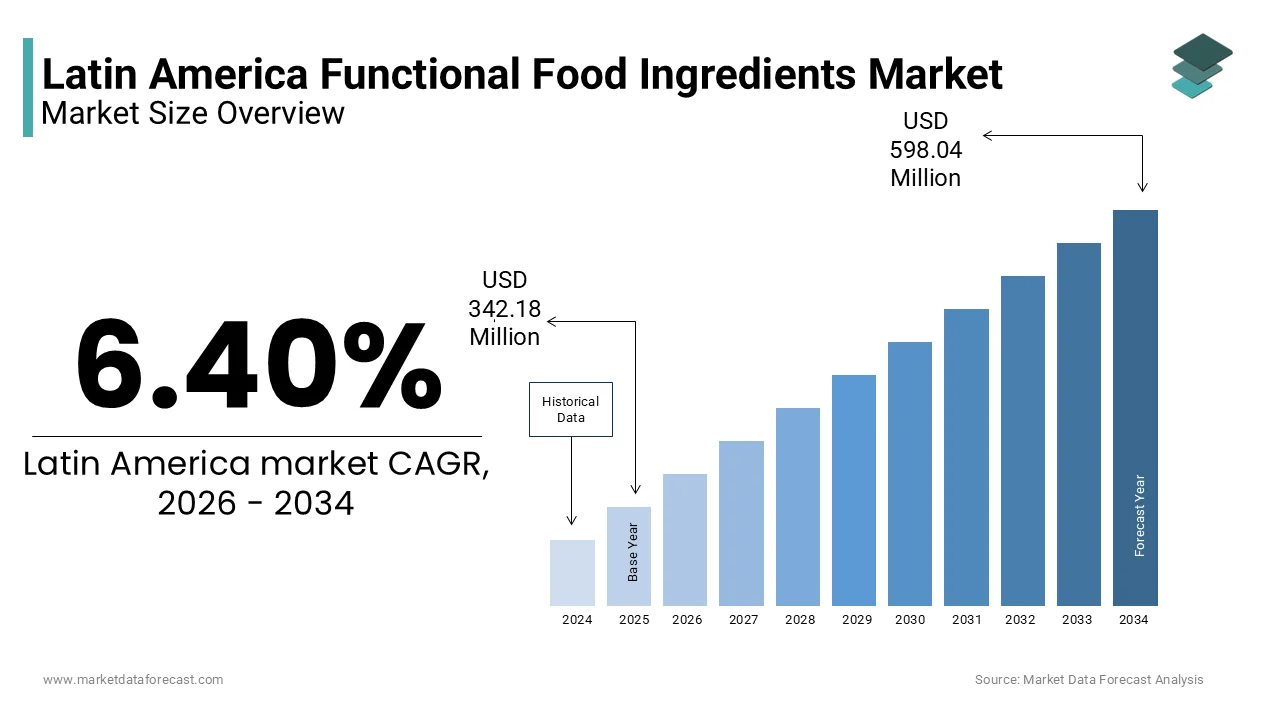
Functional Food Ingredients are the ingredients that can add additional benefits to the food product often related to health promotion or disease prevention. Functional foods are designed to have physiological benefits and/or reduce the risk of chronic disease beyond basic nutritional functions and may be similar in appearance to conventional food and consumed as part of a regular diet. The features of these ingredients include preservation, texturization, emulsification, coloring, processing aids, and nutritional enhancement.
Factors fuelling the growth of the market are increasing demand for fortified/fortified food, rising dietary problems coupled with modern lifestyles, the prevalence of chronic diseases driving consumers to shift to healthier food products, and growing awareness regarding the immunity-enhancing properties of proper diet and food habits. However, the market growth is hindered by factors like strict government legislation, limited accessibility and availability of ingredients, and their expensive nature.
REPORT COVERAGE
| REPORT METRIC | DETAILS |
| Market Size Available | 2025 to 2034 |
| Base Year | 2025 |
| Forecast Period | 2026 to 2034 |
| CAGR | 6.40% |
| Segments Covered | By Type, Application, Health Benefit, and Region |
| Various Analyses Covered | Global, Regional, & Country Level Analysis; Segment-Level Analysis; DROC, PESTLE Analysis; Porter’s Five Forces Analysis; Competitive Landscape; Analyst Overview of Investment Opportunities |
| Regions Covered | Mexico, Brazil, Argentina, Chile and Rest of Latin America |
| Market Leaders Profiled | Archer Daniels Midland Company, Cargill, Incorporated, Koninklijke DSM N.V., BASF SE, Arla Foods, Tate and Lyle PLC, Ingredion Incorporated, Kerry Group PLC, E. I. Du Pont De Nemours and Company and Associated British Foods |
REGIONAL ANALYSIS
Based on Geographical analysis the market is separated into regions of Brazil, Argentina, Mexico, and the Rest of Latin America. Brazil is leading the market regionally, due to high consumption and demand of fortified/functional as well as due to the presence of a well-developed food industry. Argentina is expected to grow the fastest owing to its increasing economy with a large population base ready to spend on functional food and rapidly growing consumer markets. Vitamin and mineral ingredients hold the major share in the type segment as these substances are vital for a healthy diet and play an important role in all life cycles for body development. Prebiotics and probiotics are expected to grow the fastest due to increasing awareness regarding beneficiary micro-organisms. Food applications hold a major share in the applications segment while beverage applications are expected to grow at a rapid pace.
KEY MARKET PLAYERS
Key Layers In Latin America Functional Food Ingredients Market are Archer Daniels Midland Company, Cargill, Incorporated, Koninklijke DSM N.V., BASF SE, Arla Foods, Tate and Lyle PLC, Ingredion Incorporated, Kerry Group PLC, E. I. Du Pont De Nemours and Company and Associated British Foods.
MARKET SEGMENTATION
The Latin America functional food ingredients market is segmented and sub-segmented into the following categories
By Type
- Protein
- Vitamin
- Mineral
- Prebiotic
- Probiotic
- Hydrocolloid
- Essential Oil
- Fatty Acid
- Carotenoid
By Application
- Food
- Beverage
By Health Benefit
- Gut
- Bone
- Health
- Immunity
- Nutrition
By Country
- Brazil
- Argentina
- Chile