- Product Description Description
- Table of Contents TOC
- List of Table & Figure LOT
- Get Free Sample PDF Sample PDF
Market Size, 2025
$0.47 BnMarket Estimate, 2026
$0.48 BnMarket Forecast, 2034
$0.60 BnCAGR, 2026–2034
2.8%Latin America Overactive Bladder Treatment Market Size, Trends, and Forecast (2026-2034)
- Market Scope: Comprehensive regional industry analysis covering treatment modalities (mirabegron, anticholinergics, botox, intravesical instillation, and neurostimulation), disease indications (neurogenic and idiopathic overactive bladder), and country-level adoption across Brazil, Mexico, Argentina, Chile, and the rest of Latin America.
- Market Valuation: Valued at USD 0.47 billion in 2025, estimated at USD 0.48 billion in 2026, and projected to reach USD 0.60 billion by 2034, registering a steady compound annual growth rate (CAGR) of 2.8% from 2026 to 2034.
- Primary Growth Drivers: Rapidly expanding geriatric population, rising prevalence of neurological disorders associated with bladder dysfunction, increasing availability of novel therapies, and active pharmaceutical marketing coupled with favorable demographic shifts.
Key Market Segment Metrics (2026-2034)
| Category | Leading Segment (Base Position) | Fastest-Growing / Promising Segment |
|---|---|---|
| By Treatment & Disease | Anticholinergics & Mirabegron (dominant pharmacological frontline options) & Idiopathic Overactive Bladder (higher patient population base) | Neurostimulation & Botox (expanding via advanced clinical procedures for refractory cases) & Neurogenic Overactive Bladder |
| By Country | Brazil (dominant regional market share driven by improving healthcare facilities and a large senior demographic) | Mexico & Argentina (growing rapidly through rising healthcare expenditures and broader therapeutic awareness) |
Major Market Players & Industry Structure
Market Structure: Competitive pharmaceutical landscape featuring major global corporations focusing on pharmacological innovations, advanced neuromodulation devices, and expanding regional commercial footprints.
Key Industry Companies: Pfizer, Allergan Plc, Astellas Pharma Inc, Johnson & Johnson, Teva Pharmaceutical Industries, Mylan N.V., Sanofi, and Endo International.
Latin America Overactive Bladder Treatment Market Size
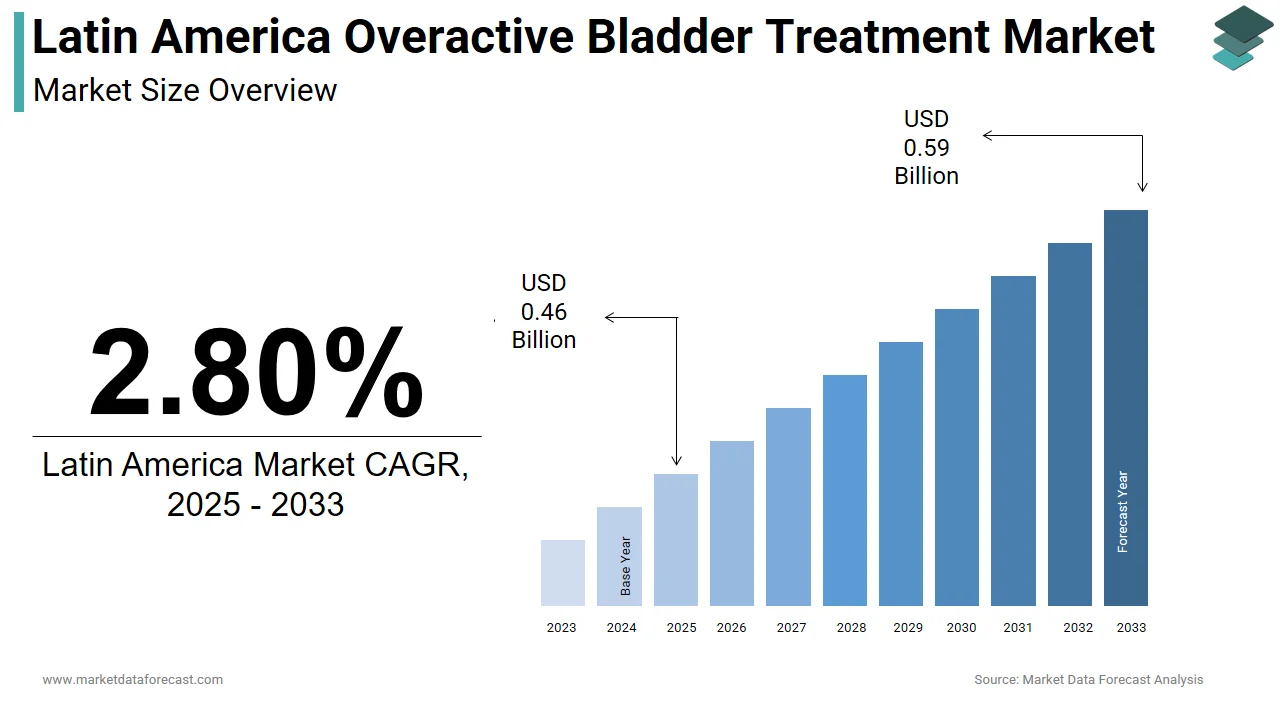
The Latin America overactive bladder treatment market was valued at USD 0.47 billion in 2025. The market is estimated at USD 0.48 billion in 2026 and is projected to reach USD 0.60 billion by 2034, growing at a CAGR of 2.8% from 2026 to 2034.
MARKET DRIVERS
Growing Geriatric Population and Neurological Disorders Fuel Overactive Bladder Treatment Demand
The term "overactive bladder" refers to a condition in which a person feels compelled to urinate frequently; this can lead to a lack of bladder control over time, known as urge incontinence. Unfortunately, people usually ignore this problem for years before it becomes a significant discomfort.
The exact cause of this ailment is uncertain. Bladder training, pelvic floor exercises, and behavioral techniques are commonly used in the early stages of treatment for this illness. If other treatments fail, medicines and neurostimulations are recommended.
There are also procedures for persons with neurological problems that involve medical devices such as the Urgent PC Neuromodulation System, injectables, and surgical techniques.
The demand for overactive bladder treatment has increased as the number of patients with neurological illnesses has increased, particularly among the elderly. In addition, the market is growing due to the availability of novel therapies and the rise of pharmaceutical businesses. The market's expansion is fueled by novel intravenous medicines, active marketing by pharmaceutical companies, and favorable demographics.
Incontinence affects twice so many more older women as it does males. As a result, an increase in the geriatric population, combined with diseases caused by overactive bladder, fuels the expansion of the overactive bladder treatment market.
MARKET RESTRAINTS
Side Effects of Medications and Low Awareness Limit Overactive Bladder Treatment Adoption
Adverse pharmacological side effects are suffocating the overactive bladder treatment industry. The medications that are being administered have negative side effects on the bodies of the patients. Dry skin, constipation, dry mouth, dry or itchy skin, impaired vision, dyspepsia, urinary tract infection, urinary dysfunction, and sleepiness are all typical adverse effects of these drugs. On the other hand, particular medicines may cause memory loss, hallucinations, sleeplessness, and other adverse effects. As a result, leading companies in the overactive bladder therapy market are competing. However, the market growth is being limited by a lack of information regarding the ailment, available therapies, and the adverse effects of drug use.
REPORT COVERAGE
| REPORT METRIC | DETAILS |
| Market Size Available | 2025 to 2034 |
| Base Year | 2025 |
| Forecast Period | 2026 to 2034 |
| Segments Covered | By Treatment, Disease, and Country. |
| Various Analyses Covered | Global, Regional and Country-Level Analysis, Segment-Level Analysis, Drivers, Restraints, Opportunities, Challenges; PESTLE Analysis; Porter’s Five Forces Analysis, Competitive Landscape, Analyst Overview of Investment Opportunities |
| Countries Covered | Brazil, Mexico, Argentina, Chile, Rest of Latin America |
| Market Leaders Profiled | Pfizer, Allergan Plc, Hisamitsu Pharmaceutical, Johnson & Johnson, Astellas Pharma Inc, Teva Pharmaceutical Industries, Mylan N.V, Sanofi, Aurobindo Pharma Ltd, and Endo International. |
COUNTRY LEVEL ANALYSIS
Geographically, the Latin American market is expected to account for a moderate share in the overactive bladder treatment market during the forecast period. The regional market growth can be linked to the increased prevalence of bladder over activity, rising healthcare expenditures, and growing awareness of overactive bladder throughout the projection period.
In addition, the development of novel intravenous medicines, active marketing by pharmaceutical companies, and favorable demographics are the main drivers of the Latin American market growth. However, the market is predicted to expand in countries like Mexico, Brazil, Argentina, Chile, and the rest of Latin America, increasing their need for overactive bladder treatment.
The Brazil overactive bladder treatment market is projected to register a dominant share in the overactive bladder treatment market in the coming years. Various prominent companies in the overactive bladder therapies market are also contributing to the overactive bladder market growth. In addition, improving healthcare facilities, favorable reimbursement policies, and a growing senior population is propelling the market growth.
Furthermore, advanced treatment methods are introduced by the healthcare professional and institutions, positively influencing the market growth. For instance, the most popular treatments are Mirabegron, Anticholinergics, Botox, Intravesical Instillation, and Neurostimulation. As a result, this market is expected to grow.
KEY MARKET PLAYERS
Prominent companies leading in the Latin America Overactive Bladder Treatment Market profiled in the report are Pfizer, Allergan Plc, Hisamitsu Pharmaceutical, Johnson & Johnson, Astellas Pharma Inc, Teva Pharmaceutical Industries, Mylan N.V, Sanofi, Aurobindo Pharma Ltd, and Endo International.
MARKET SEGMENTATION
This Latin America overactive bladder treatment market research report is segmented and sub-segmented into the following categories.
By Treatment
- Mirabegron
- Anticholinergics
- Botox
- Intravesical Instillation
- Neurostimulation
By Disease
- Neurogenic Overactive Bladder
- Idiopathic Overactive Bladder
By Country
- Brazil
- Mexico
- Argentina
- Chile
- Rest of Latin America