- Product Description Description
- Table of Contents TOC
- List of Table & Figure LOT
- Get Free Sample PDF Sample PDF
Market Size, 2025
$70.38 BnMarket Estimate, 2026
$75.24 BnMarket Forecast, 2034
$128.31 BnCAGR, 2026–2034
6.90%Latin America Snack Products Market Report Summary
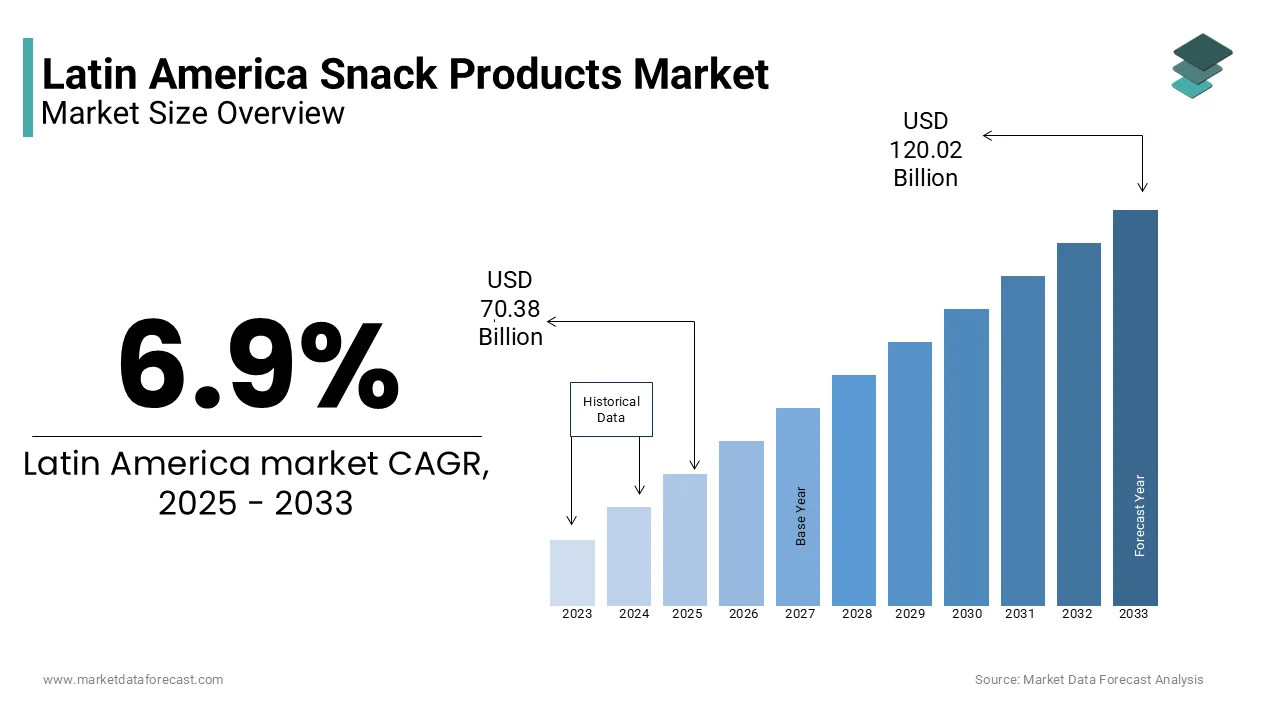
The Latin America snack products market was valued at USD 70.38 billion in 2025, is estimated to reach USD 75.24 billion in 2026, and is projected to reach USD 128.31 billion by 2034, growing at a CAGR of 6.90% during the forecast period. Market growth is driven by increasing demand for convenient and ready to eat food products, rising urbanization, and changing consumer lifestyles. The growing popularity of on the go snacking, along with product innovation in flavors and healthier alternatives, is further supporting market expansion. In addition, expanding retail infrastructure and rising disposable incomes are contributing to sustained growth across Latin America.
Key Market Trends
- Rising demand for convenient and ready to eat snack products is driving market growth.
- Increasing consumer preference for on the go snacking is boosting demand.
- Growing innovation in flavors and healthier snack options is supporting market expansion.
- Expansion of supermarkets and organized retail channels is improving product availability.
- Rising influence of western consumption patterns is enhancing market growth.
Segmental Insights
- Based on type, the salted snacks segment was the largest and held 35.4% of the Latin America snack products market share in 2025. This dominance is attributed to high consumer preference for savory snacks and wide product availability.
- Based on distribution channel, the supermarkets segment accounted for 45.3% of the Latin America snack products market share in 2025. The segment’s growth is driven by strong retail presence, product variety, and consumer convenience.
Regional Insights
- The Latin America snack products market is experiencing strong growth across key countries, supported by rising consumption and retail expansion.
- Brazil was the largest contributor, accounting for 30.3% of the Latin America snack products market share in 2025, driven by large consumer base, increasing snack consumption, and expanding retail sector.
Competitive Landscape
The Latin America snack products market is highly competitive, with key players focusing on product innovation, branding, and expansion of distribution networks to strengthen their market position. Companies are investing in new product launches, healthier formulations, and marketing strategies. Prominent players in the Latin America snack products market include Kellogg Company, Nestle Inc, ConAgra Foods Inc, Calbee Inc, Frito Lay, Cadbury Schweppes PLC, Ferrero Group, The Hershey Company, Meridian Foods, Wolfgang, PepsiCo, SK Food International, and Bare Snacks.
Latin America Snack Products Market Size
The Latin America snack products market size was valued at USD 70.38 billion in 2025, and the market size is expected to reach USD 128.31 billion by 2034 from USD 75.24 billion in 2026. The market is growing at a CAGR of 6.90% during the period.
The snack products are ready to eat food items, including savory chips extruded snacks nuts and sweet confectionery that cater to the evolving consumption habits of consumers, across Brazil, Mexico, Argentina, and Colombia. The definition extends beyond traditional packaged goods to include emerging categories, such as baked alternatives and protein enriched options that reflect a shifting consumer consciousness towards health and wellness. Furthermore, urbanization rates have surpassed 80% in many key countries by facilitating greater access to modern retail channels and impulse purchase venues. The interplay between traditional culinary preferences and modern lifestyle constraints defines the current landscape. Consumers increasingly seek products that offer both sensory satisfaction and nutritional value prompting manufacturers to innovate within established categories.
MARKET DRIVERS
Rapid Urbanization and Changing Lifestyles Drive Convenience Food Demand
The acceleration of urbanization and consumer preference for the convenience food are majorly escalating the growth of the Latin America snack products market. As per the research, over 80% of the population in Latin America and the Caribbean resides in urban areas a figure that continues to rise steadily each year. This demographic shift correlates directly with busier lifestyles and reduced time available for meal preparation leading to an increased reliance on convenient food options. Urban consumers often face longer commute times and demanding work schedules which necessitate quick and portable food solutions. Snacks fulfill this need by offering immediate consumption without the requirement for extensive preparation or cleanup. The density of retail outlets in urban zones ensures that snack products are readily available at various points of sale encouraging impulse purchases. Furthermore, the concentration of younger demographics in cities fosters a culture of social snacking where shared experiences revolve around food consumption. This trend is particularly evident among working professionals and students who prioritize efficiency and convenience. The urban environment also facilitates faster adoption of new product launches and trends allowing manufacturers to iterate quickly based on consumer feedback. Consequently, the structural transformation of society towards urban living creates a sustained and growing base of consumers who view snacks as an integral component of their daily dietary intake rather than occasional treats.
Growing Youth Population Fuels Demand For Affordable And Trendy Snacks
The significant proportion of young individuals is substantially fuelling the growth of Latin Americca snack products market. According to the Economic Commission for Latin America and the Caribbean, approximately 25% of the regional population falls within the age bracket of 15 to 29 years. This youthful cohort exhibits distinct consumption preferences that favor affordability variety and novelty in food choices. Young consumers are more likely to experiment with new flavors and brands driven by social media influence and peer interactions. They perceive snacking as a form of self expression and social bonding which drives frequent purchases of small pack sizes that fit within limited disposable incomes. The prevalence of digital connectivity among this group means that marketing campaigns targeting taste innovation and lifestyle alignment resonate strongly. As per Statista internet penetration in Latin America has reached over 70% enabling brands to engage directly with young audiences through targeted digital advertising. This connectivity amplifies the impact of viral trends and influencer endorsements which can rapidly elevate the status of specific snack products. Additionally, the youth demographic is heavily represented in educational institutions and entry level employment sectors where access to full meal facilities may be limited or time constrained. Snacks provide a practical solution for energy replenishment throughout the day. The preference for bold and intense flavors among younger consumers also pushes manufacturers to develop innovative product lines that differentiate themselves from traditional offerings.
MARKET RESTRAINTS
Stringent Health Regulations and Labeling Requirements Restrict Product Formulation
The implementation of rigorous health regulations and mandatory labeling laws, across several Latin American countries is restricting the growth of Latin America snack products market. Countries, such as Chile, Mexico, Peru, and Uruguay have pioneered front of package warning label systems that require clear identification of products high in calories sugars sodium or saturated fats. As per the Pan American Health Organization, these labeling initiatives are designed to combat rising rates of obesity and non-communicable diseases, which affect millions of residents in the region. The visual impact of black octagonal warning labels on packaging has been shown to influence consumer purchasing decisions negatively for products that fail to meet nutritional thresholds. Manufacturers must reformulate existing products to avoid these warnings which often involves costly research and development efforts and changes in supply chain sourcing. The process of reducing sugar or sodium content while maintaining taste and texture is technically challenging and can alter consumer acceptance. Furthermore, these regulations restrict advertising directed at children limiting the ability of brands to build loyalty among younger demographics through traditional media channels. According to the World Health Organization, the prevalence of overweight and obesity in Latin America has risen sharply with more than 58% of adults classified as overweight or obese. This public health crisis has galvanized governments to take decisive action resulting in a regulatory environment that prioritizes health over commercial interests. Companies face increased compliance costs and potential penalties for non-adherence which can erode profit margins. The fragmented nature of regulations across different countries also complicates regional strategy requiring localized approaches for each market.
Economic Volatility And Inflationary Pressures Limit Consumer Spending Power
The persistent economic instability and high inflation rates in key countries by eroding consumer purchasing power and forcing shifts towards lower priced alternatives is hindering the growth of Latin America snack products market. Countries, such as Argentina and Venezuela have experienced double digit inflation rates for extended periods, which significantly reduces the real income of households. As per the International Monetary Fund, inflation in Argentina exceeded 100% in recent years creating a challenging environment for discretionary spending. This economic pressure leads to trading down behavior where shoppers switch from premium international brands to local private label equivalents or bulk generic options that offer better value per unit. The volatility of currency exchange rates further exacerbates the situation for manufacturers who rely on imported ingredients or packaging materials. Fluctuating costs make it difficult to maintain stable pricing strategies and protect profit margins. According to the Economic Commission for Latin America and the Caribbean, economic growth in the region has been uneven with several countries facing recessionary pressures that dampen consumer confidence. Small and medium sized enterprises within the snack sector are particularly vulnerable to these macroeconomic shocks as they lack the financial resilience of larger multinational corporations. The uncertainty surrounding future economic conditions also discourages long term investment in capacity expansion or new product development.
MARKET OPPORTUNITIES
Expansion Of Health Conscious and Functional Snack Categories Offers Growth Potential
The rising awareness of health and wellness for manufacturers to develop and promote functional and nutritious snack options that align with modern dietary preferences is solely to create new opportunities for the growth of Latin America snack products market. As per the research, the wellness economy in Latin America is growing at a rate faster than the global average driven by increasing interest in preventive health measures and natural ingredients. Consumers are actively seeking snacks that offer additional benefits such as high protein content fiber enrichment or the inclusion of superfoods like quinoa chia seeds and acai. This shift allows brands to differentiate themselves in a crowded market by positioning products as part of a balanced lifestyle rather than indulgent treats. The demand for clean label products free from artificial preservatives colors and flavors is also gaining momentum particularly among urban middle class households. This trend opens avenues for innovation in ingredient sourcing and product formulation enabling companies to tap into niche segments that were previously underserved. The integration of local agricultural produce into snack formulations not only appeals to national pride, but also supports sustainability narratives that resonate with environmentally conscious buyers. Furthermore, the expansion of e-commerce platforms facilitates the distribution of specialized health focused snacks to remote areas where physical retail availability may be limited. Digital channels allow for detailed communication of health benefits and ingredient transparency, which builds trust and loyalty among informed consumers.
Penetration Of Modern Retail And E Commerce Channels Enhances Market Accessibility
The rapid expansion of modern retail infrastructure and the burgeoning e-commerce sector for snack manufacturers to enhance product visibility is also to impact positively on the growth of latin America snack products market. As per the study, the penetration of organized retail in the region has increased substantially with supermarkets and hypermarkets becoming the dominant channels for grocery shopping in urban areas. This shift from traditional independent stores to modern trade allows for better shelf placement promotional displays and consistent product availability which drives sales volume. The consolidation of retail chains also enables manufacturers to negotiate broader distribution agreements that cover multiple countries efficiently. Simultaneously, the growth of online grocery shopping has accelerated due to improved logistics networks and increased smartphone usage. According to the research, e-commerce sales in Latin America are projected to grow at a double digit compound annual growth rate in the coming years. This digital transformation allows snack brands to bypass geographical barriers and reach consumers in semi urban and rural areas who previously had limited access to diverse product ranges. Online platforms also provide valuable data insights into consumer preferences and purchasing behaviors enabling targeted marketing and personalized recommendations. The convenience of home delivery appeals to busy urban professionals and families who prioritize time saving solutions. These channels offer interactive engagement opportunities that can drive brand awareness and trial.
MARKET CHALLENGES
Supply Chain Disruptions and Raw Material Price Fluctuations Pose Operational Challenges
The vulnerability of supply chains to external shocks and the volatility of raw material prices constitute by affecting production consistency and cost management is a key challenge for the growth of Latin America snack products market. The region relies heavily on agricultural commodities, such as corn, potatoes, and oilseeds, which are subject to weather variations and climate change impacts. As per the Food and Agriculture Organization of the United Nations, extreme weather events including droughts and floods have become more frequent in Latin America disrupting crop yields and causing supply shortages. These disruptions lead to sudden spikes in input costs which manufacturers struggle to pass on to price sensitive consumers without losing market share. Additionally logistical inefficiencies such as port congestion and transportation bottlenecks further complicate the movement of goods both domestically and internationally. The dependence on imported packaging materials and specialized ingredients exposes companies to currency fluctuations and global trade tensions. Manufacturers must maintain higher inventory levels to buffer against these uncertainties which ties up capital and increases storage costs. The lack of integrated regional logistics networks means that cross border trade within Latin America remains cumbersome and expensive. Furthermore, geopolitical instability in certain areas can lead to sudden policy changes or trade restrictions that disrupt supply flows. Companies face the constant challenge of balancing cost efficiency with supply security requiring sophisticated risk management strategies.
Intense Competition From Informal Sector And Local Artisanal Producers Limits Market Share
The presence of a large informal sector and numerous local artisanal producers by fragmenting the market and exerting downward pressure on prices is another attribute to degrade the growth of Latin America snack products market. In many countries, a substantial portion of snack consumption occurs through street vendors small family owned businesses and unregulated local producers who offer fresh and traditional products at lower prices. These informal operators often evade taxes and regulatory compliance costs allowing them to undercut formal market players on price. The appeal of freshly prepared and culturally authentic snacks also resonates strongly with consumers who value tradition and taste over branded convenience. Local artisans frequently utilize indigenous ingredients and traditional recipes that large manufacturers find difficult to replicate at scale without compromising authenticity. This competition limits the ability of formal companies to penetrate lower income segments and rural areas where informal trade dominates. The lack of brand loyalty in certain segments makes it easy for consumers to switch between formal and informal options based on price and availability. Established brands face the challenge of differentiating themselves through quality safety and innovation while competing against low-cost alternatives. The regulatory gap between formal and informal sectors creates an uneven playing field, where compliant companies bear higher operational costs.
REPORT COVERAGE
| REPORT METRIC | DETAILS |
| Market Size Available | 2025 to 2034 |
| Base Year | 2025 |
| Forecast Period | 2026 to 2034 |
| CAGR | 6.90% |
| Segments Covered | By Type, Distribution Channel, and Region |
| Various Analyses Covered | Global, Regional, & Country Level Analysis; Segment-Level Analysis; DROC, PESTLE Analysis; Porter’s Five Forces Analysis; Competitive Landscape; Analyst Overview of Investment Opportunities |
| Regions Covered | Brazil, Mexico, Argentina, Chile & Rest of Latin America |
| Market Leaders Profiled | Kellogg’s Company, Nestle Inc, ConAgra Foods Inc, Calbee, Inc., Frito Lay’s, Cadbury Schweppes PLC, Ferrero Group, Hershey Foods, Meridian Foods, Wolfgang, PepsiCo, SK Food International, Bare Snacks. |
SEGMENTAL ANALYSIS
By Type Insights
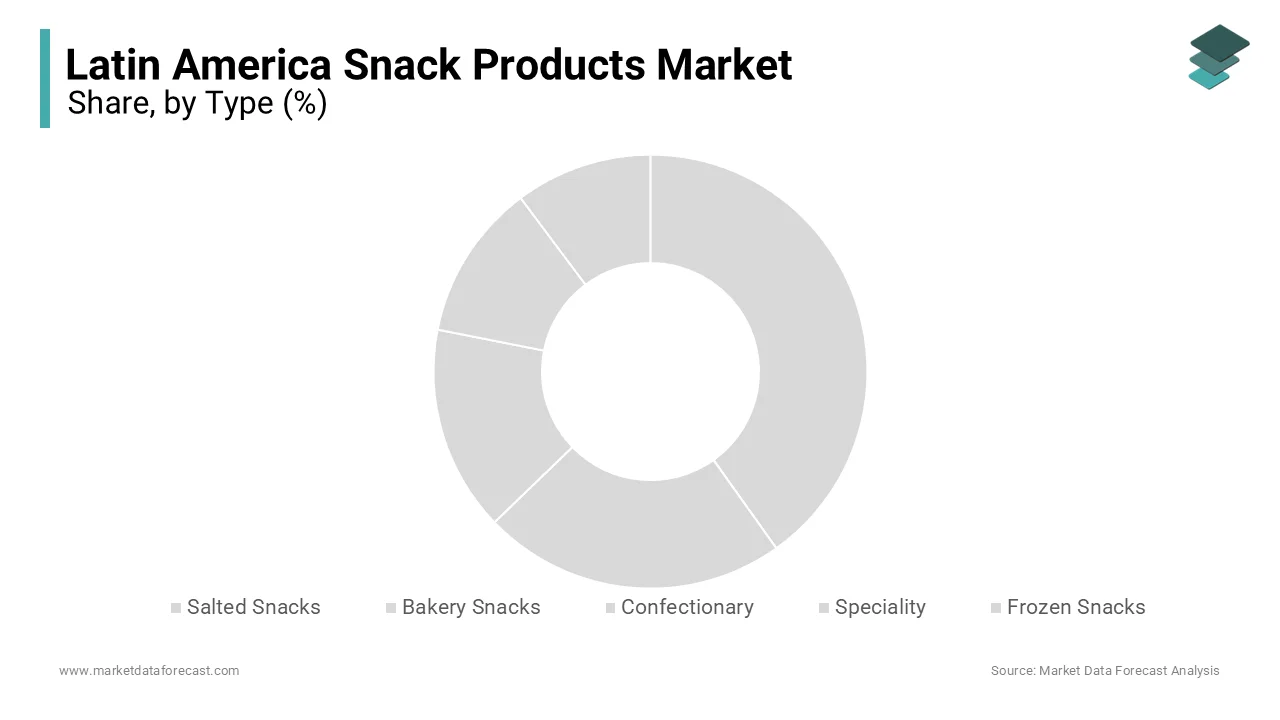
The salted snacks segment was accounted in holding 35.4% of the Latin America Snack Products Market share in 2025 with the deep rooted cultural preference for savory flavors, such as corn based chips potato crisps and extruded snacks, which are staples in daily consumption patterns. As per Euromonitor International, salted snacks have consistently outperformed other categories due to their affordability and wide availability in both modern and traditional retail channels. The production of these snacks relies heavily on locally sourced raw materials like corn and potatoes, which are abundant in countries like Mexico and Brazil, thereby keeping production costs low and ensuring competitive pricing for consumers. According to the Food and Agriculture Organization of the United Nations, Latin America is a major global producer of corn providing a stable and cost effective supply chain for manufacturers. This local sourcing advantage allows companies to maintain profit margins even in inflationary environments. Furthermore, the versatility of salted snacks enables manufacturers to introduce diverse flavor profiles ranging from traditional lime and chili to innovative regional varieties that resonate with local palates.
The speciality snacks segment is likely to witness a fastest CAGR of 6.5% from 2026 to 2034. This accelerated growth is primarily driven by rising health consciousness among consumers, who are increasingly seeking nutrient dense alternatives to traditional processed snacks. As per the Global Wellness Institute, the Latin America is expanding rapidly with consumers prioritizing products that offer functional benefits, such as high protein content gluten free formulations and organic ingredients. The shift towards healthier lifestyles is particularly evident among urban middle class populations in Brazil and Mexico, who are willing to pay a premium for snacks that align with their dietary goals. The trend has prompted manufacturers to innovate with ingredients like quinoa chia seeds amaranth and nuts which are native to the region and perceived as superfoods. The availability of these indigenous ingredients provides a unique selling proposition for local brands aiming to differentiate themselves in a crowded market. Furthermore, the influence of social media and fitness influencers has amplified awareness about the benefits of clean eating and mindful snacking. Digital platforms serve as powerful tools for educating consumers about the nutritional value of speciality snacks thereby driving trial and repeat purchases.
By Distribution Channel Insights
The supermarkets segment held 45.3% of the Latin America Snack Products Market share in 2025 owing to the ongoing consolidation of modern retail infrastructure, which has transformed shopping habits and increased the accessibility of packaged goods. As per the Inter American Development Bank the penetration of organized retail in Latin America has grown steadily with large supermarket chains expanding their footprint in both urban and peri urban areas. These retailers offer a wide assortment of snack products under one roof providing consumers with convenience and variety that traditional stores cannot match. The ability of supermarkets to negotiate bulk purchases allows them to offer competitive pricing and frequent promotions which attract price sensitive shoppers. According to survey, promotional activities in supermarkets drive a significant portion of snack sales as consumers respond positively to discounts and bundle offers. The structured environment of supermarkets also facilitates effective merchandising strategies, such as end cap displays and eye level shelving which enhance product visibility and impulse purchases. Furthermore, the presence of private label brands in supermarkets provides affordable alternatives that compete directly with national brands thereby increasing overall category volume. The trust associated with established supermarket chains regarding product quality and safety also influences consumer preference especially in the post pandemic era.
The internet sales are emerging as the fastest growing distribution channel in the Latin America Snack Products Market with a projected compound annual growth rate of 8.2% from 2024 to 2029. This rapid expansion is fueled by increasing digital penetration and the widespread adoption of e commerce platforms across the region. As per Statista internet usage in Latin America has surpassed 70% with millions of new users coming online each year. This connectivity has transformed consumer behavior enabling shoppers to browse and purchase snacks from the comfort of their homes. The convenience of home delivery appeals to busy urban professionals and families who value time saving solutions. The emergence of quick commerce platforms that promise delivery within minutes has further boosted online snack sales, particularly in major cities like Sao Paulo and Mexico City. These platforms cater to immediate cravings and impulse purchases replicating the convenience of physical stores in a digital format. The ability to compare prices and read reviews online also empowers consumers to make informed decisions fostering trust in online transactions.
REGIONAL ANALYSIS
Brazil Snack Products Market Analysis
Brazil snack products market was the out performer in the Latin America region by holding 30.3% of the share in 2025 with a high volume of consumption driven by a large population and a vibrant culture of social snacking. The presence of major multinational manufacturers alongside strong local players creates a competitive landscape that drives innovation and affordability. The young demographic profile of Brazil with a significant median age contributes to the high demand for convenient and trendy snack options. Furthermore, the expansion of modern retail chains in secondary cities has improved access to packaged snacks beyond major metropolitan areas. The government's focus on agricultural productivity ensures a reliable supply of raw materials such as cassava and corn which are essential for snack production. This domestic abundance supports cost effective manufacturing and export potential.
Mexico Snack Products Market Analysis
Mexico snack products market growth is likely to be driven by the deep cultural affinity for spicy and savory flavors, which dictates product development and consumer preferences. As per the National Institute of Statistics and Geography, Mexico has a high per capita consumption of chips and tortilla based snacks, which are integral to daily meals and snacks. The proximity to the United States facilitates the adoption of global trends while maintaining distinct local identities in flavor profiles. The growing middle class in urban centers like Mexico City and Guadalajara is increasingly demanding premium and health oriented snack options. The government's implementation of front of package labeling laws has influenced formulation strategies prompting manufacturers to reduce sodium and sugar content. The tourism sector also contributes significantly to snack sales particularly in coastal regions where visitors seek authentic culinary experiences.
Argentina Snack Products Market Analysis
Argentina snack products market growth is likely to have a prominent growth opportunities in coming years with the economic volatility and high inflation rates, which impact consumer purchasing power and brand loyalty. Despite these challenges, the demand for snacks remains resilient as consumers view them as affordable indulgences during times of economic stress. According to the Argentine Chamber of Supermarkets, sales of private label snacks have surged as shoppers seek value for money. The cultural tradition of mate drinking often accompanied by biscuits and savory snacks sustains steady demand throughout the day. Local manufacturers have adapted by focusing on cost efficient production and localized sourcing to mitigate import dependencies. The prevalence of bakeries and confectionery shops in urban areas provides alternative channels for snack consumption complementing retail sales. The younger population in Buenos Aires and other major cities is increasingly open to international flavors and healthy alternatives driving niche growth segments. Government policies aimed at stabilizing the economy and supporting local industry play a crucial role in shaping market conditions.
Chile Snack Products Market Analysis
Chile snack products market growth is likely to driven by the high health consciousness and strict regulatory frameworks that influence product formulation and marketing. As per the Ministry of Health, Chile was a pioneer in implementing front of package warning labels, which has significantly impacted the snack industry. Manufacturers have responded by reformulating products to meet nutritional standards and avoiding black octagonal labels. The high literacy rate and access to information empower consumers to make informed dietary choices favoring natural and minimally processed options. The strong retail infrastructure with high penetration of supermarkets and convenience stores ensures wide availability of diverse snack products. Chilean consumers are also early adopters of international trends such as gluten free and vegan snacks driving innovation in these categories. The stable economic environment compared to other regional peers supports consistent consumer spending on premium products. The export orientation of the Chilean food industry also influences domestic standards encouraging high quality production practices. The emphasis on sustainability and ethical sourcing resonates with environmentally aware shoppers further shaping market dynamics.
COMPETITIVE LANDSCAPE
The competition in the Latin America Snack Products Market is characterized by a high degree of fragmentation and intense rivalry between multinational corporations and local artisans. Global giants leverage economies of scale extensive distribution networks and strong brand equity to maintain dominance in urban centers. However local players compete effectively by offering authentic flavors lower prices and deeper cultural resonance with consumers. The market sees frequent product launches as companies strive to innovate and capture shifting consumer preferences towards healthier and premium options. Price sensitivity remains a significant factor influencing competitive dynamics particularly in economically volatile regions where value for money dictates purchasing decisions. Regulatory pressures regarding health labeling and ingredient transparency force all participants to adapt quickly increasing operational costs and complexity. The rise of e-commerce has lowered entry barriers allowing niche brands to reach wider audiences without substantial physical infrastructure investments.
Key Market Players
Some of the key players in Latin America snack products market are
- Kellogg Company
- Nestle Inc.
- ConAgra Foods Inc.
- Calbee Inc.
- Frito-Lay
- Cadbury Schweppes PLC
- Ferrero Group
- The Hershey Company
- Meridian Foods
- Wolfgang
- PepsiCo
- SK Food International
- Bare Snacks
Top Players in the Market
- PepsiCo maintains a robust presence in the Latin America Snack Products Market through its extensive portfolio of savory snacks and beverages. The company leverages strong brand recognition with products like Sabritas in Mexico and Chipsy in various regions to drive consumer loyalty. PepsiCo focuses on sustainable agriculture initiatives sourcing corn and potatoes locally to support farmers and ensure supply chain stability. Recent actions include expanding production facilities in Brazil to enhance manufacturing capacity and reduce logistical costs. The corporation actively reformulates products to meet evolving health regulations while introducing innovative flavors that resonate with local tastes.
- Grupo Bimbo operates as a dominant force in the bakery snack segment across Latin America with a vast distribution network reaching remote areas. The company emphasizes affordability and accessibility ensuring its products are available in both modern retail and traditional independent stores. Grupo Bimbo invests heavily in operational efficiency utilizing advanced logistics to minimize waste and maximize freshness. Recent strategic moves include acquiring local brands to diversify its product offerings and cater to specific regional preferences. The firm prioritizes nutritional improvement by reducing sugar and sodium content in its formulations aligning with health trends. Grupo Bimbo also engages in community programs supporting education and food security which strengthens brand loyalty. Their adoption of digital tools for inventory management and sales tracking enhances responsiveness to market demands.
- Kellogg Company contributes significantly to the Latin America Snack Products Market through its diverse range of cereals crackers and fruit snacks. The company focuses on providing nutritious options that appeal to health conscious consumers particularly families and children. Kellogg leverages global expertise to introduce innovative products while adapting flavors to local palates in countries like Brazil and Mexico. Recent actions include investing in plant based snack lines to capitalize on the growing demand for alternative proteins. The corporation enhances its supply chain resilience by partnering with local suppliers and implementing sustainable farming practices. Kellogg actively promotes digital engagement through social media campaigns and interactive content to build brand affinity. Their commitment to transparency in labeling and ingredient sourcing builds trust with informed shoppers.
Top Strategies Used by the Key Market Participants
Key players in the Latin America Snack Products Market primarily employ product innovation and localization strategies to capture consumer interest. Companies frequently introduce new flavors inspired by regional culinary traditions to differentiate their offerings and appeal to local tastes. Health oriented reformulation is another strategy, as manufacturers reduce sugar sodium and fat content to comply with strict regulatory standards and meet rising wellness demands. Expansion of distribution networks into rural and semi urban areas ensures broader market penetration and accessibility for diverse consumer segments. Strategic acquisitions of local brands allow multinational corporations to integrate established customer bases and leverage existing supply chains efficiently. Digital transformation initiatives including e commerce integration and data driven marketing enhance customer engagement and personalize shopping experiences. Sustainability efforts such as eco friendly packaging and responsible sourcing are increasingly utilized to build brand reputation and align with environmental consciousness among consumers. These combined approaches enable companies to navigate competitive pressures and sustain growth in the evolving market landscape.
MARKET SEGMENTATION
This Research Report on Latin America snack products market is segmented and sub segmented into following categories
By Type
- Salted Snacks
- Bakery Snacks
- Confectionary
- Speciality
- Frozen Snacks
By Distribution Channel
- Specialist Retailers
- Internet Sales
- Super Markets
- Convenience Stores
By Country
- Brazil
- Argentina
- Mexico
- Rest of Latin America