- Product Description Description
- Table of Contents TOC
- List of Table & Figure LOT
- Get Free Sample PDF Sample PDF
Market Size, 2025
$1.59 BnMarket Estimate, 2026
$1.92 BnMarket Forecast, 2034
$8.84 BnCAGR, 2026–2034
21%Latin America Vertical Farming Market Size, Growth, Trends & Forecast (2026–2034)
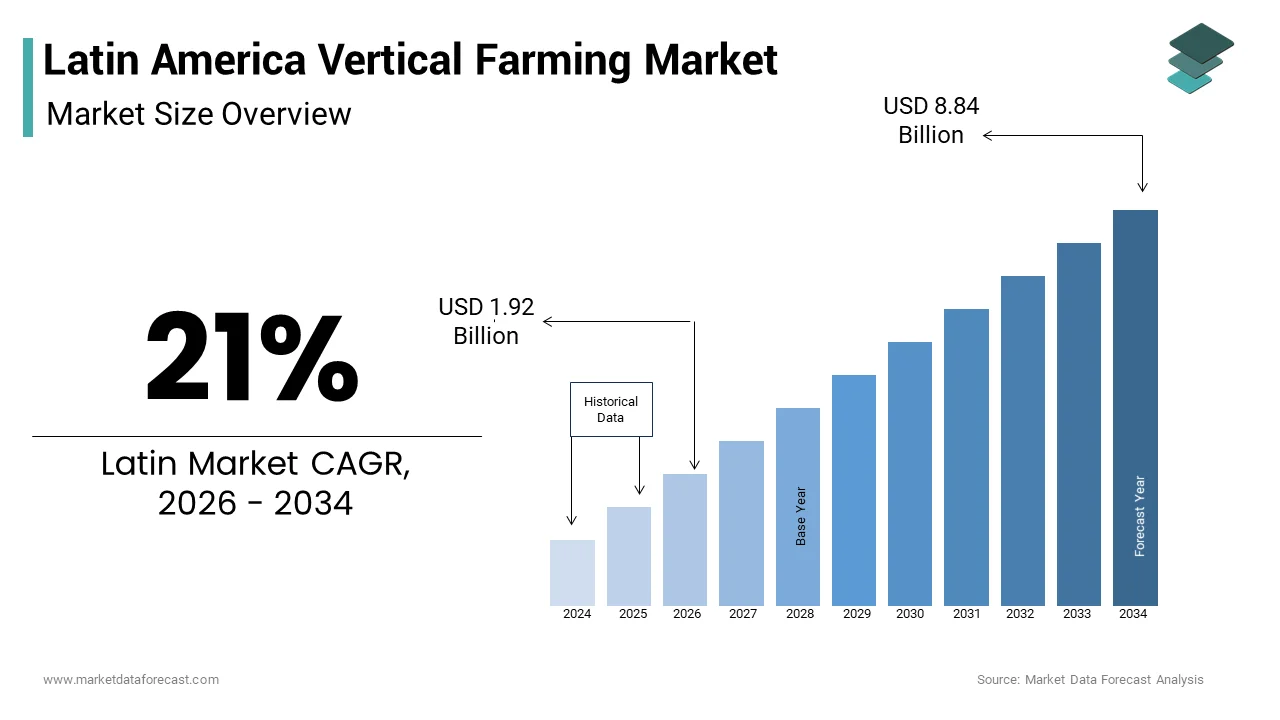
The Latin America vertical farming market size was valued at USD 1.59 billion in 2025, is anticipated to reach USD 1.92 billion in 2026, and is projected to expand up to USD 8.84 billion by 2034, registering a compound annual growth rate (CAGR) of 21% during the forecast period from 2026 to 2034. Growth is driven by rapid urban concentration (approx. 81% urban population), severe water scarcity issues in metropolitan centers like Mexico City and São Paulo, and the need to mitigate high post-harvest agricultural losses.
Key Executive Metrics (At-a-Glance)
- 2025 Base Valuation: USD 1.59 Billion
- 2026 Current Valuation: USD 1.92 Billion
- 2034 Forecast Valuation: USD 8.84 Billion
- Compound Annual Growth Rate (CAGR): 21% (2026–2034)
- Dominant Growth Mechanism Segment: Hydroponics
- Fastest-Growing Growth Mechanism Segment: Aeroponics (14.5% CAGR)
- Dominant Structure Segment: Building-Based Vertical Farms
- Fastest-Growing Structure Segment: Shipping Container Farms (16.2% CAGR)
- Dominant Offering Segment: Hardware
- Fastest-Growing Offering Segment: Software (16.6% CAGR)
- Dominant Country Market: Brazil
Core Market Drivers
- Rapid Urbanization: Dense city populations demanding fresh, locally grown produce that minimizes lengthy supply chain transit times and nutrient degradation.
- Water Scarcity & Climate Volatility: Prolonged droughts and erratic weather patterns making closed-loop, resource-efficient indoor agriculture (using up to 95% less water) a strategic necessity.
Primary Market Restraints & Challenges
- High Capital & Operational Costs: Expensive initial infrastructure setup and continuous energy consumption for LED lighting and climate control.
- Technical & Regulatory Barriers: Critical shortage of skilled agtech professionals, fragmented regulatory frameworks, and supply chain vulnerabilities for imported technology.
Latin America Vertical Farming Market Segmentation Breakdown
| Segment Category | Largest (Dominant) Sub-Segment | Fastest-Growing Sub-Segment |
|---|---|---|
| By Growth Mechanism | Hydroponics | Aeroponics (14.5% CAGR) |
| By Structure | Building-Based Vertical Farms | Shipping Container Farms (16.2% CAGR) |
| By Offering | Hardware | Software (16.6% CAGR) |
| By Country | Brazil | Mexico / Argentina |
Major Industry Players Profiled
Key corporations steering the Latin American vertical farming market include Illumitex Inc. (U.S.), Aerofarms (U.S.), Koninklijke Philips N.V. (The Netherlands), and Sky Greens (Singapore), among others.
Latin America Vertical Farming Market Size
The Latin America vertical farming market size will reach USD 1.59 billion in 2025 and is anticipated to reach USD 1.92 billion in 2026 to USD 8.84 billion by 2034, growing at a CAGR of 21% from 2026 to 2034.
Vertical farming represents an emerging agricultural paradigm that utilizes controlled environment agriculture techniques to cultivate crops in vertically stacked layers, often within urban settings. This innovative approach integrates hydroponics, aeroponics, and aquaponics systems with advanced lighting and climate control technologies to maximize yield per square foot while minimizing resource consumption. The region is witnessing a gradual shift toward this method due to rapid urbanization and the increasing need for food security in densely populated areas. As per the United Nations Department of Economic and Social Affairs, approximately 81% of the population in Latin America and the Caribbean lives in urban areas, which is one of the highest urbanization rates globally. This demographic concentration creates significant logistical challenges for traditional supply chains, leading to higher post-harvest losses and reduced freshness of produce. According to the Food and Agriculture Organization of the United Nations, post-harvest losses in the region can reach up to 30% for fruits and vegetables due to inadequate storage and transportation infrastructure. Vertical farming offers a localized solution that reduces transit times and ensures consistent quality. Furthermore, the region faces growing water scarcity issues, with the World Resources Institute indicating that several major cities, including Mexico City and São Paulo, experience high water stress levels. Vertical farming systems use up to 95% less water than conventional field farming, making them a sustainable alternative for arid and semi-arid zones. These environmental and demographic pressures are driving interest among investors and policymakers to support indoor agriculture initiatives across the continent.
MARKET DRIVERS
Rapid Urbanization and Demand for Fresh Local Produce
The unprecedented rate of urbanization in Latin America is a key factor propelling the expansion of the Latin American vertical farming market, as cities struggle to provide fresh and nutritious food to their growing populations. As per the World Bank, the urban population in the region is expected to continue expanding, with megacities like Bogotá, Lima, and Buenos Aires facing immense pressure on their food distribution networks. Traditional agriculture, located in rural areas, often suffers from long supply chains that result in significant nutrient degradation and spoilage before products reach urban consumers. Vertical farms, located within or near city centers, eliminate these logistical bottlenecks by delivering harvests directly to retailers and restaurants within hours of picking. According to the Inter-American Development Bank, inefficient logistics contribute to high food prices in urban centers, making locally grown produce an attractive alternative despite potentially higher production costs. Consumers in these metropolitan areas are increasingly health-conscious and willing to pay a premium for pesticide-free and nutrient-dense leafy greens and herbs. The proximity of vertical farms allows for year-round production, regardless of external weather conditions, ensuring a stable supply of fresh produce. This reliability is crucial for hotels, supermarkets, and high-end restaurants that require consistent quality. The ability to grow food in unused urban spaces, such as warehouses and rooftops, also aligns with smart city initiatives aimed at optimizing land use. This convergence of demographic trends and consumer preferences drives the strategic expansion of vertical farming operations in major Latin American hubs.
Severe Water Scarcity and Climate Volatility
Unpredictable climate patterns and increasing water scarcity across Latin America necessitate the adoption of resource-efficient agricultural methods, which is further boosting the vertical farming market expansion in Latin America. Many countries in the region are experiencing prolonged droughts and erratic rainfall due to climate change, which threatens traditional crop yields and food security. According to the Economic Commission for Latin America and the Caribbean, climate-related disasters have caused billions of dollars in agricultural losses in recent years, highlighting the vulnerability of open-field farming. Vertical farming systems utilize closed-loop irrigation technologies that recycle water and nutrients, reducing consumption by up to 95% compared to conventional methods. This efficiency is critical in regions facing acute water stress, such as northern Mexico and parts of Chile, where aquifers are being depleted at unsustainable rates. According to the World Resources Institute, several major Latin American cities are classified as having extremely high baseline water stress, prompting urgent measures to conserve this vital resource. Vertical farms do not rely on rainfall or large-scale irrigation infrastructure, making them resilient to droughts and extreme weather events. The controlled environment also eliminates the need for pesticides and herbicides, which can contaminate local water sources. Governments and environmental organizations are increasingly recognizing the role of indoor agriculture in sustainable water management strategies. By decoupling food production from natural weather cycles, vertical farming offers a reliable solution for maintaining agricultural output in the face of climatic uncertainty. This resilience drives investment from both public and private sectors seeking to secure long-term food supplies.
MARKET RESTRAINTS
High Initial Capital Investment and Operational Costs
The substantial financial barrier posed by high initial capital expenditure and ongoing operational costs significantly restrains the widespread adoption of vertical farming in Latin America, which is a significant restraint to the Latin American vertical farming market growth. Establishing a commercial-scale vertical farm requires significant investment in specialized infrastructure, including LED lighting systems, HVAC units, sensors, and automated growing racks. As per the International Finance Corporation, the cost of setting up a high-tech indoor farm can be 10 to 20 times higher per square meter than traditional greenhouse operations. This high entry threshold limits participation to well-funded corporations or foreign investors, excluding small and medium-sized local enterprises. Additionally, the recurring cost of electricity required to power artificial lighting and climate control systems constitutes a major portion of operational expenses. In many Latin American countries, energy prices are relatively high and subject to volatility, which impacts profit margins. According to the Inter-American Development Bank, energy inefficiencies and a lack of subsidies for renewable energy integration further exacerbate these costs. Unlike traditional farming, which relies on free sunlight, vertical farms must generate their own light, leading to continuous energy demand. The return on investment period is often longer than anticipated due to these persistent overheads. Financial institutions in the region are frequently hesitant to lend to such novel agricultural models due to perceived risks and a lack of historical performance data. This funding gap stifles innovation and slows the scaling of projects. Without accessible financing options and cost-reduction technologies, vertical farming remains a niche sector rather than a mainstream agricultural solution.
Limited Technical Expertise and Skilled Workforce
A critical shortage of skilled professionals with expertise in agronomy, engineering, and data analytics hinders the efficient operation and expansion of vertical farming facilities in Latin America. Successful vertical farming requires a multidisciplinary approach, combining plant science with mechanical engineering, software management, and supply chain logistics. As per the Organisation for Economic Co-operation and Development, there is a significant skills gap in the region’s labor market, particularly in advanced technological sectors, including agritech. Educational institutions have been slow to update curricula to include specialized training in controlled environment agriculture, resulting in a limited pool of qualified candidates. According to the International Labour Organization, the mismatch between available skills and industry needs leads to higher recruitment costs and operational inefficiencies for vertical farming companies. Operators often struggle to troubleshoot complex technical issues, such as nutrient imbalance, sensor malfunctions, or software glitches, which can lead to crop loss. The reliance on imported technology also necessitates specialized maintenance knowledge that is scarce locally. Training existing agricultural workers to adapt to high-tech environments requires time and resources that many startups lack. This human capital deficit forces companies to hire expensive expatriate experts or invest heavily in internal training programs. The lack of a robust ecosystem of technicians and agronomists slows down the replication of successful models. Until the educational and vocational landscape adapts to meet these specific needs, the growth of the vertical farming sector will remain constrained by operational challenges and workforce limitations.
MARKET OPPORTUNITIES
Integration with Renewable Energy Sources
The abundant potential for renewable energy generation in Latin America presents a significant opportunity to mitigate the high operational costs associated with vertical farming. Countries like Chile, Brazil, and Mexico have vast solar and wind resources that can be harnessed to power energy-intensive indoor farming operations. As per the International Renewable Energy Agency, Latin America has some of the lowest costs for solar photovoltaic energy globally, making it an economically viable option for reducing electricity bills. Integrating solar panels with vertical farm infrastructure can create hybrid systems that lower dependency on the grid and stabilize energy costs. According to the Inter-American Development Bank, investments in clean energy technologies are increasing, driven by government incentives and corporate sustainability goals. Vertical farming companies that adopt renewable energy solutions can market their produce as carbon-neutral or low-carbon, appealing to environmentally conscious consumers and retailers. Power purchase agreements with local renewable energy providers can further secure long-term, low-cost energy supplies. Additionally, advancements in battery storage technology allow farms to store excess energy for use during peak hours or cloudy days, enhancing reliability. This synergy between agritech and cleantech aligns with regional climate commitments and attracts impact investors focused on sustainable development. By leveraging local renewable resources, vertical farms can transform their biggest cost center into a competitive advantage. This strategic integration not only improves profitability but also enhances the environmental credentials of the sector, fostering greater acceptance and support from policymakers and communities.
Expansion into High-Value Specialty Crops
The cultivation of high-value specialty crops, such as medicinal herbs, microgreens, and exotic fruits, offers a lucrative opportunity for the Latin American vertical farming market. Unlike staple crops, which have thin margins, specialty items command premium prices in upscale markets, hotels, and export channels. According to the Food and Agriculture Organization of the United Nations, the demand for organic and functional foods is rising among the growing middle class in the region. Vertical farms can precisely control growing conditions to enhance the nutritional content and flavor profiles of these crops, making them highly desirable. For instance, saffron, vanilla, and certain medicinal plants require specific conditions that are difficult to maintain in open fields but ideal for controlled environments. According to market observations, the hospitality industry in tourist destinations like Cancun, Cartagena, and Rio de Janeiro seeks consistent supplies of high-quality garnishes and ingredients. Vertical farms can establish direct contracts with these businesses, ensuring steady revenue streams. Furthermore, the ability to grow off-season or rare varieties allows producers to capture niche markets with less competition. Export opportunities to North America and Europe for out-of-season specialty produce also exist, given the geographic proximity. By focusing on high-margin products, vertical farming companies can offset high operational costs and demonstrate economic viability. This strategic pivot from volume to value enables the sector to thrive even in a price-sensitive market.
MARKET CHALLENGES
Unstable Regulatory Frameworks and Policy Uncertainty
The lack of clear and consistent regulatory frameworks governing indoor agriculture and food safety poses a significant challenge to the growth of the vertical farming market in Latin America. Most existing agricultural policies are designed for traditional field farming and do not address the unique aspects of controlled environment agriculture, such as nutrient solutions, artificial lighting, and indoor pest management. As per the World Bank, regulatory ambiguity creates uncertainty for investors, who hesitate to commit capital without clear guidelines on compliance and standards. Different countries, and even municipalities within the same country, may have varying requirements for zoning, building codes, and water usage, which complicates expansion plans. According to the Inter-American Dialogue, inconsistent enforcement of regulations leads to operational disruptions and increased legal costs for companies navigating the bureaucratic landscape. The classification of vertical farms as industrial facilities rather than agricultural entities in some jurisdictions can result in higher tax burdens and restricted access to agricultural subsidies. Furthermore, the absence of standardized certification processes for indoor-grown produce makes it difficult for farmers to differentiate their products in the market. Policymakers often lack a technical understanding of vertical farming technologies, leading to outdated or inappropriate regulations. This regulatory lag stifles innovation and discourages local entrepreneurs from entering the sector. Harmonizing policies and creating specific legal categories for vertical farming are essential steps to foster a supportive environment. Until these structural issues are addressed, the sector will face unnecessary hurdles that impede its potential.
Supply Chain Vulnerabilities for Imported Technology
The heavy reliance on imported technology and equipment for vertical farming systems exposes the Latin American market to supply chain vulnerabilities and currency fluctuations. Key components, such as LED grow lights, sensors, controllers, and hydroponic systems, are predominantly manufactured in North America, Europe, and Asia. As per the Economic Commission for Latin America and the Caribbean, dependence on imports makes the sector susceptible to global trade disruptions, tariffs, and shipping delays. Currency devaluation in countries like Argentina and Brazil significantly increases the cost of acquiring foreign technology, reducing the affordability of setup and maintenance. According to the Inter-American Development Bank, logistics inefficiencies and port congestion in the region further exacerbate delivery times and costs. When equipment fails, the lack of local spare parts and technical support can lead to prolonged downtime and crop loss. Manufacturers often do not have a strong local presence, meaning that warranty claims and repairs take weeks or months to resolve. This dependency undermines the resilience of vertical farming operations and increases operational risks. Efforts to localize manufacturing are hindered by limited industrial capacity and high production costs for high-tech components. Developing a local supply chain ecosystem is a long-term process that requires significant investment and policy support. Until then, vertical farming companies must navigate a fragile supply network that threatens their operational continuity and financial stability.
REPORT COVERAGE
| REPORT METRIC | DETAILS |
| Market Size Available | 2025 to 2033 |
| Base Year | 2025 |
| Forecast Period | 2026 to 2034 |
| CAGR | 21% |
| Segments Covered | By Growth Mechanism, Structure, Offering |
| Various Analyses Covered | Global, Regional & Country Level Analysis, Segment-Level Analysis, DROC, PESTLE Analysis, Porter’s Five Forces Analysis, Competitive Landscape, Analyst Overview on Investment Opportunities |
| Regions Covered | Brazil, Mexico, Argentina, and the rest of Latin America |
| Market Leaders Profiled | Illumitex Inc. (U.S.), Aerofarms (U.S.), Koninklijke Philips N.V. (The Netherlands), and Sky Greens (Singapore), among others. |
SEGMENTAL ANALYSIS
By Growth Mechanism
The hydroponics segment dominated the market by holding the major share of the Latin American market in 2025 due to its technological maturity, cost-effectiveness, and proven scalability for commercial crop production. This soilless cultivation method involves growing plants in nutrient-rich water solutions, which allows for precise control over mineral uptake and faster growth cycles compared to traditional agriculture. According to the Food and Agriculture Organization of the United Nations, hydroponic systems can produce yields up to 30% higher than conventional field farming while using significantly less land. In Latin America, where arable land is increasingly pressured by urbanization, hydroponics offers a viable solution for high-density food production. The initial setup costs for hydroponic systems are lower than those for aeroponics, making them more accessible to small and medium-sized enterprises in the region. According to the Inter-American Development Bank, the simplicity of maintenance and operation reduces the need for highly specialized technical labor, which is often scarce in rural and semi-urban areas. Major crops, such as lettuce, tomatoes, and herbs, thrive in hydroponic environments, providing consistent quality that meets the demands of supermarkets and restaurants. The widespread availability of local materials for constructing basic hydroponic setups further supports its dominance. Additionally, extensive research and development efforts by agricultural universities in countries like Brazil and Mexico have optimized hydroponic protocols for regional climates. This combination of economic viability, operational ease, and agronomic success ensures that hydroponics remains the preferred choice for the majority of vertical farming initiatives across the continent.
On the other side, the aeroponics segment is estimated to showcase a promising CAGR in the Latin American market during the forecast period owing to its superior resource efficiency and ability to maximize oxygen exposure to plant roots. This advanced technique involves suspending plant roots in the air and misting them with a nutrient solution, which results in faster growth rates and higher yields per square foot. The segment is projected to grow at a compound annual growth rate of 14.5% over the next five years, as technology costs decrease and awareness of its benefits increases. According to the National Aeronautics and Space Administration, which pioneered aeroponic technology for space applications, this method uses up to 98% less water than traditional farming and 40% less than hydroponics. This extreme efficiency is particularly attractive in regions facing severe water scarcity, such as northern Mexico and parts of Chile. According to the World Resources Institute, water stress levels in these areas are critically high, prompting farmers to adopt the most efficient irrigation technologies available. Aeroponics also eliminates the risk of soil-borne diseases and reduces the need for pesticides, appealing to health-conscious consumers. Recent advancements in nozzle technology and automation have made aeroponic systems more reliable and easier to manage. Startups in urban centers like São Paulo and Bogotá are increasingly adopting aeroponics for high-value crops, such as strawberries and medicinal herbs. The potential for vertical stacking without heavy substrate weight allows for taller and denser installations, maximizing urban space utilization. These advantages drive rapid adoption among tech-savvy investors and innovative agricultural entrepreneurs.
By Structure Insights
The building-based vertical farms segment had the largest share of the Latin American market in 2025 due to their capacity for large-scale production and integration into existing urban infrastructure. These facilities utilize repurposed warehouses, industrial buildings, or purpose-built structures to house multiple layers of growing systems, allowing for significant output volumes. According to the United Nations Human Settlements Programme, the rapid expansion of urban areas in Latin America has left many industrial zones underutilized, providing ample space for conversion into agricultural hubs. Building-based farms benefit from established utilities, such as electricity, water, and internet connectivity, which reduces initial infrastructure costs. According to the Economic Commission for Latin America and the Caribbean, retrofitting existing structures is often more cost-effective than new construction, especially in major cities where land prices are prohibitive. These facilities can accommodate heavy equipment and large-scale HVAC systems necessary for maintaining optimal growing conditions year-round. They also offer better insulation and climate control compared to smaller units, ensuring consistent crop quality. Large retail chains and food service providers prefer sourcing from building-based farms due to their ability to supply bulk orders consistently. The visibility of these large facilities also serves as a powerful marketing tool, enhancing brand recognition and consumer trust. Furthermore, building-based farms can integrate renewable energy sources, such as rooftop solar panels, more effectively due to their larger surface area. This scalability and operational stability solidify their position as the dominant structure type in the regional market.
On the other side, the shipping container farms segment is estimated to register a promising CAGR in the Latin American market during the forecast period owing to their modularity, mobility, and rapid deployment capabilities. These compact units are equipped with fully automated growing systems and can be installed in diverse locations, including parking lots, rooftops, and remote areas. The segment is expanding at a compound annual growth rate of 16.2% as entrepreneurs and communities seek flexible agricultural solutions. According to the International Organization for Standardization, shipping containers are globally standardized, making them easy to transport and install without extensive site preparation. This plug-and-play nature appeals to startups and educational institutions that want to test vertical farming concepts with lower capital risk. According to the Inter-American Development Bank, container farms are particularly suitable for disaster relief scenarios and remote communities where traditional supply chains are disrupted. They require minimal construction work and can be operational within weeks of delivery. The enclosed environment provides excellent protection against pests and extreme weather events, which are common in tropical regions. Technological advancements have improved the energy efficiency of container units, making them more economically viable. Social enterprises are increasingly using container farms to provide fresh produce in food deserts within large cities. The ability to scale operations by adding more units allows for gradual expansion based on demand. This flexibility and speed to market drive the rapid adoption of shipping container farms across the region.
By Offering Insights
The hardware segment dominated the market by capturing the major share of the Latin American market in 2025 because it constitutes the foundational physical infrastructure required for any controlled environment agriculture operation. This segment includes LED lighting systems, HVAC units, irrigation pumps, sensors, and growing racks, which represent the highest initial capital expenditure. According to the International Energy Agency, lighting and climate control systems account for approximately 60% to 70% of the total setup cost of a vertical farm. The demand for durable and efficient hardware is driven by the need to maintain precise environmental conditions for optimal plant growth. According to the Brazilian Agricultural Research Corporation, the reliability of hardware components directly impacts crop yield and quality, making investment in high-quality equipment essential. Local distributors and international manufacturers compete to supply these critical components, creating a robust market ecosystem. The replacement and upgrade cycle for hardware also contributes to sustained revenue streams. As technology advances, farmers replace older LEDs with more energy-efficient models or upgrade sensors for better data accuracy. The physical nature of hardware makes it a tangible asset that investors prioritize during funding rounds. Furthermore, government subsidies for agricultural machinery often extend to vertical farming equipment, encouraging purchases. The dominance of hardware is reinforced by the fact that software and services depend entirely on the underlying physical infrastructure to function. Without robust hardware, the precision and efficiency promises of vertical farming cannot be realized.
On the other side, the software segment is the fastest growing offering segment in the Latin America vertical farming market and is expected to register a CAGR of 16.6% during the forecast period due to the increasing integration of artificial intelligence and data analytics in agricultural operations. This segment includes farm management platforms, monitoring applications, and predictive analytics tools that optimize resource usage and crop performance. As per Statista, the adoption of Internet of Things devices in agriculture is rising rapidly, enabling real-time data collection on temperature, humidity, and nutrient levels. Software solutions process this data to provide actionable insights, such as adjusting light spectra or irrigation schedules automatically. According to the Inter-American Development Bank, digital literacy among farmers is improving, facilitating the uptake of complex software tools. Cloud-based platforms allow remote monitoring and management, reducing the need for a constant physical presence. This is particularly beneficial for operators managing multiple sites. Software also enables traceability and certification compliance, which is increasingly important for export markets. Subscription-based models make advanced software accessible to smaller farms that cannot afford large upfront investments. The ability to predict yields and detect diseases early enhances profitability and reduces waste. As connectivity improves across the region, the reliance on sophisticated software to manage complex vertical farming systems will continue to accelerate.
COUNTRY LEVEL INSIGHTS
Brazil Vertical Farming Market Analysis
Brazil held the largest share of the Latin American market in 2025 and is expected to expand its position as the market frontrunner over the next few years as major urban centers accelerate their adoption of indoor agricultural facilities. The country’s vast agricultural heritage, combined with rapid urbanization in cities like São Paulo and Rio de Janeiro, creates a strong demand for innovative food production methods. High levels of pesticide use in conventional farming have led health-conscious consumers to seek safer alternatives, driving interest in controlled environment agriculture. According to the Brazilian Institute of Geography and Statistics, over 85% of the population lives in urban areas, concentrating demand for fresh, local produce. Government initiatives promoting sustainable agriculture and water conservation support the adoption of vertical farming technologies. The presence of numerous agtech startups and venture capital funding fosters innovation and experimentation. Large retail chains are partnering with vertical farms to secure consistent supplies of leafy greens and herbs. The tropical climate poses challenges for cooling but also offers opportunities for year-round production of certain crops. Infrastructure improvements in logistics and energy distribution further facilitate market growth. Educational programs in universities are producing skilled professionals capable of managing high-tech farms. These factors combine to make Brazil the primary engine of growth for the vertical farming sector in the region.
Mexico Vertical Farming Market Analysis
Mexico is anticipated to see high technology adoption rates in its northern and metropolitan territories over the coming years, primarily to counter severe agricultural water constraints. As per insights from the Mexican Ministry of Agriculture, Mexico represents a significant and rapidly evolving market in the Latin America vertical farming sector, driven by water scarcity and proximity to the United States export market. Northern states facing severe droughts are increasingly turning to vertical farming as a sustainable alternative to water-intensive field crops. According to the National Water Commission of Mexico, aquifer depletion rates are alarming, prompting strict regulations on water usage that favor efficient technologies. The maquiladora industry and growing middle class in cities like Monterrey and Guadalajara create demand for premium fresh produce. Trade agreements with the United States facilitate the export of high-value specialty crops grown in vertical farms. Local entrepreneurs are leveraging technology transfers from North American partners to establish state-of-the-art facilities. Government grants for innovation in agriculture support pilot projects and research initiatives. The tourism sector in coastal areas also drives demand for consistent, high-quality ingredients. Challenges include high energy costs and security concerns, but the strategic importance of food security keeps investment flowing. Mexico’s unique position as a bridge between North and South America enhances its role as a testing ground for new vertical farming models.
Argentina Vertical Farming Market Analysis
Argentina is projected to build a highly self-reliant and specialized indoor farming niche over the next few years by adapting low-cost, locally manufactured systems to navigate ongoing fiscal fluctuations. As per estimates from the Argentine Chamber of Agribusiness, Argentina serves as an emerging market in the Latin America vertical farming landscape, characterized by economic volatility but strong agricultural expertise. Economic instability and currency devaluation make importing technology expensive, yet they also drive local innovation and the adaptation of low-cost solutions. According to the National Institute of Agricultural Technology, Argentina has a strong tradition of agricultural research, which is now being applied to indoor farming techniques. Urban centers like Buenos Aires are seeing a rise in community-supported agriculture projects using vertical methods to bypass inflationary food prices. The demand for organic and pesticide-free produce is growing among affluent consumers who can afford premium prices. Export opportunities for off-season berries and herbs to Europe and North America incentivize investment in controlled environment agriculture.
COMPETITIVE LANDSCAPE
The competitive landscape of the Latin America vertical farming market is characterized by a mix of international technology providers and emerging local startups vying for dominance in a nascent but rapidly evolving sector. Global players leverage their advanced technological expertise and established brand recognition to secure partnerships with major retail chains and institutional investors. Local competitors focus on cost effective solutions and deep understanding of regional consumer preferences and regulatory environments. Competition drives innovation in energy efficiency crop variety and automation technologies to reduce operational costs and improve profitability. The market is fragmented with no single dominant player allowing for diverse business models ranging from hardware sales to farm as a service offerings. Strategic alliances with agricultural research institutions and government bodies help companies navigate regulatory hurdles and gain credibility. Price sensitivity among consumers and high initial investment costs create barriers to entry but also encourage collaborative ventures. As awareness of food security and sustainability grows the competitive intensity increases prompting companies to differentiate through superior product quality and reliable supply chains. This dynamic environment fosters continuous improvement and adaptation to local market needs.
KEY MARKET PLAYERS
Key players involved in the development of the vertical farming market are
- Illumitex Inc. (U.S.)
- Aerofarms (U.S.)
- Infarm
- Agricool
- Koninklijke Philips N.V. (The Netherlands)
- Sky Greens (Singapore)
Top Players In The Market
- AeroFarms is a global leader in indoor vertical farming that has expanded its footprint in Latin America through strategic partnerships and technology licensing agreements. The company utilizes its proprietary aeroponic system to grow leafy greens without soil sunlight or pesticides ensuring high nutritional value and safety. Recent actions include collaborating with local distributors in Brazil and Mexico to adapt its growing protocols to regional climate conditions and consumer preferences. AeroFarms focuses on knowledge transfer by training local agronomists in advanced data analytics and crop management techniques. This approach strengthens its market position by establishing a reputation for technological excellence and operational efficiency. By enabling local partners to operate state of the art facilities AeroFarms expands its brand presence without heavy capital expenditure. Their commitment to sustainability and food safety resonates with health conscious consumers and premium retail chains across the region.
- Infarm operates a decentralized vertical farming network that places modular growing units directly within retail stores and distribution centers in major Latin American cities. The company’s innovative model reduces transportation emissions and ensures maximum freshness for consumers by harvesting produce on site. Recent strategic initiatives involve partnering with leading supermarket chains in Chile and Argentina to install smart farming modules in high traffic locations. Infarm leverages cloud based software to monitor and optimize growth conditions remotely ensuring consistent quality across all units. This direct to consumer approach enhances brand visibility and allows for real time feedback integration. By decentralizing production Infarm reduces logistical complexities and spoilage rates which are common challenges in the region. Their focus on urban integration and retail collaboration positions them as a key player in transforming last mile food delivery and enhancing urban food security through localized production systems.
- Agricool specializes in converting shipping containers into automated vertical farms known as Cooltainers which are ideal for the diverse geographical landscapes of Latin America. The company focuses on growing strawberries and herbs using LED lighting and hydroponic systems controlled by artificial intelligence. Recent actions include launching pilot projects in Colombia and Peru to demonstrate the viability of container farming in remote and urban areas. Agricool emphasizes circular economy principles by upcycling used containers and using renewable energy sources to power its units. This sustainable approach appeals to environmentally conscious investors and consumers in the region. The modularity of their solution allows for rapid deployment and scalability making it attractive for startups and community projects. By providing turnkey solutions including hardware software and agronomic support Agricool lowers entry barriers for new farmers. Their emphasis on local production and reduced water usage aligns with regional sustainability goals and regulatory trends.
Top Strategies Used By Key Market Participants
Key players in the Latin America vertical farming market predominantly employ localization strategies to adapt technologies to regional climatic and economic conditions. Companies focus on forming strategic partnerships with local retailers and distributors to ensure market access and brand visibility. Investing in renewable energy integration helps mitigate high electricity costs which are a major operational constraint in the region. Developing modular and scalable solutions such as container farms allows for flexible deployment in diverse urban and rural settings. Providing comprehensive training and technical support addresses the skilled labor shortage and ensures operational success for clients. Emphasizing sustainability and water efficiency aligns with government incentives and consumer preferences for eco friendly products. Leveraging digital platforms for remote monitoring and data analytics enhances crop yields and resource management. These strategies enable companies to overcome infrastructure challenges and build resilient business models tailored to the unique dynamics of the Latin American agricultural landscape.
MARKET SEGMENTATION
This research report on the Latin America vertical farming market is segmented and sub-segmented into the following categories.
By Growth Mechanism Type
- Hydroponics
- Aeroponics
- Aquaponics
By Structure Used
- Buildings and Shipping Containers
By Type of Offering
- Hardware
- Software
- Service
By Country
- Brazil
- Argentina
- Chile
- Mexico
- Rest of Latin America