- Product Description Description
- Table of Contents TOC
- List of Table & Figure LOT
- Get Free Sample PDF Sample PDF
Market Size, 2025
$452.71 MnMarket Estimate, 2026
$497.66 MnMarket Forecast, 2034
$1061.37 MnCAGR, 2026–2034
9.93%Executive Summary: Latin America Glufosinate Market
- Market Scope: Comprehensive Latin America glufosinate market analysis covering crop types, formulation forms, application categories, regional leadership frameworks, and weed management trends.
- Market Valuation: Valued at USD 452.71 million (2025), estimated at USD 497.66 million (2026), and projected to reach USD 1,061.37 million by 2034, registering a robust CAGR of 9.93% (2026–2034).
- Primary Growth Drivers: Prevalence of glyphosate-resistant weeds, widespread adoption of genetically modified crops tolerant to glufosinate-ammonium, micro-encapsulated formulations, and precision drone-spraying technologies. Key challenges include regulatory restrictions, environmental concerns, and cross-resistant weed species.
Key Market Segment Metrics (2026–2034)
| Category | Leading Segment (2025 Position) | Fastest-Growing Segment |
|---|---|---|
| By Crop Type & Form | Genetically modified crops (largest segment) & Liquid formulations (dominate form segment) | Conventional crops (5.8% CAGR) & Dry forms (expanding at a 6.2% CAGR due to storage stability) |
| By Application | Agriculture (accounts for the majority of applications) | Non-agricultural uses (growing at a 4.5% CAGR) |
| By Region / Country | Brazil (leads regionally with a 45.2% market share in 2025, followed by Argentina at 25.6%) | Latin American agricultural hubs expanding via no-till farming systems and soybean cultivation |
Major Market Players & Market Structure
Market Structure: Highly competitive regional agricultural chemical ecosystem featuring major life sciences corporations and specialized agrochemical manufacturers driving co-formulations, local production capabilities, and advanced adjuvant technologies.
Key Companies: Bayer AG, BASF SE, UPL Limited, Syngenta AG, E. I. du Pont de Nemours and Company, Jiangsu Huangma Agrochemicals Co Ltd., Nufarm Ltd, Jiangsu Seven Continent Green Chemical Co Ltd., Zhejiang Yongnong Chem. Ind. Co. Ltd., and Hebei Veyong Bio-Chemical Co Ltd.
Latin America Glufosinate Market Size
The Latin American glufosinate market size will reach USD 452.71 million in 2025 and is anticipated to reach USD 497.66 million in 2026 to reach USD 1061.37 million by 2034, growing at a CAGR of 9.93% from 2026 to 2034.

Current Market Overview And Definition
Glufosinate (often formulated as glufosinate-ammonium) is a broad-spectrum, non-selective contact herbicide. It is primarily used in agriculture to eliminate a wide variety of annual and perennial weeds, as well as grasses, without altering the soil structure. It acts by inhibiting the enzyme glutamine synthetase leading to the accumulation of ammonia and subsequent plant cell death making it effective against a wide range of annual and perennial weeds. This chemical is particularly vital in countries with extensive soybean corn and cotton cultivation where resistance to glyphosate has become a pervasive issue. According to data from the Food and Agriculture Organization (FAO), Latin America accounts for over 50 percent of global soybean production, positioning the region as the world's leading producer and creating an enormous baseline demand for robust weed management and herbicidal solutions. As per the Systematic Survey of Agricultural Production from the Brazilian Institute of Geography and Statistics (IBGE), Brazil's cultivated soybean area has surged past previous baselines to reach an estimated 48.3 million hectares, emphasizing the massive, unprecedented scale of agricultural operations requiring highly efficient weed control. The market is characterized by a shift towards integrated weed management strategies where glufosinate is used in rotation or tank mixes to preserve efficacy. Furthermore the adoption of genetically modified crops tolerant to glufosinate has expanded its utility allowing for post emergence applications without crop damage. This agronomic flexibility combined with the urgent need to combat resistant weed species positions glufosinate as a cornerstone of modern crop protection protocols in the diverse climatic and regulatory landscapes of Latin America.
MARKET DRIVERS
Escalating Prevalence Of Glyphosate Resistant Weeds
The escalating prevalence of glyphosate-resistant weeds fuels the growth of the Latin America glufosinate market. This is because farmers are seeking alternative modes of action to maintain crop yields. Decades of intensive glyphosate use in major cropping systems have led to the evolution of hard to control weed species such as Palmer amaranth and horseweed which significantly threaten productivity. According to data from the International Survey of Herbicide Resistant Weeds, Latin America records dozens of unique glyphosate-resistant weed biotypes, with agricultural powerhouses Brazil and Argentina exhibiting the highest concentration of resistance events globally. Assessments from the Weed Science Society of America (WSSA) show that unmanaged, herbicide-resistant weeds can drive crop yield losses well past 50 percent, making herbicide rotation and portfolio diversification economically non-negotiable for growers. Glufosinate offers a distinct mechanism of action that remains effective against many of these resistant populations providing a crucial tool for resistance management. The Mato Grosso Agricultural Research Institute (IMAmt) demonstrate that rotating glufosinate-ammonium into traditional glyphosate regimes provides a complete, critical knockdown of hard-to-control broadleaf weeds, effectively breaking cycles of exclusive selection pressure. Furthermore the introduction of new crop traits tolerant to glufosinate allows for flexible application timing enhancing its appeal. This biological imperative drives consistent demand as farmers prioritize sustainable and effective weed management solutions to safeguard their economic viability in an increasingly challenging agronomic environment.
Expansion Of Genetically Modified Crop Adoption
The rapid expansion of genetically modified crop adoption in the region significantly boosts the expansion of the Latin America glufosinate market. This enables safe and effective post emergence application in major commodity crops. Biotechnology companies have developed soybean corn and cotton varieties with tolerance to glufosinate allowing farmers to apply the herbicide during critical growth stages without causing crop injury. According to the International Service for the Acquisition of Agri biotech Applications over 90 percent of soybeans planted in Argentina and Brazil are genetically modified with a significant portion featuring tolerance to multiple herbicides including glufosinate. This high adoption rate creates a structural demand for the herbicide as it becomes an integral part of the standard operating procedure for large scale commercial farming. The Paraguayan Ministry of Agriculture and Livestock (MAG) highlights steady single-digit year-over-year expansion in biotech soybean land area, mirroring the broader regional push toward adopting multi-herbicide tolerant traits. Furthermore the ability to control late emerging weeds that escape pre emergence treatments enhances overall field cleanliness and harvest efficiency. As per sources. the stacking of multiple tolerance traits in new hybrids continues to drive the relevance of glufosinate in modern agricultural systems. This technological synergy between seed genetics and crop protection chemicals ensures sustained market growth and deepens the integration of glufosinate into regional farming practices.
MARKET RESTRAINTS
Stringent Regulatory Restrictions And Environmental Concerns
Stringent regulatory restrictions and growing environmental concerns limit the growth of the Latin America glufosinate market. These are major restraints to its unrestricted use in the region as governments respond to public pressure regarding chemical safety. Several countries have implemented tighter controls on pesticide registration and usage limits due to potential risks to human health and non target organisms. According to the Pan American Health Organization there is increasing scrutiny on the long term effects of herbicide exposure on rural communities leading to calls for stricter monitoring and reduced application rates. In countries like Colombia and Ecuador regulatory agencies have periodically reviewed the status of glufosinate resulting in temporary bans or restricted use zones near water bodies and residential areas. Data from environmental NGOs indicates that runoff containing herbicide residues can impact aquatic ecosystems prompting authorities to enforce buffer zones that limit the treatable area. Furthermore the European Union’s decision to restrict certain pesticides influences Latin American export markets as producers adhere to international residue standards to maintain access. As per research the cost of meeting these evolving regulatory requirements increases operational burdens and limits market flexibility. These regulatory headwinds create uncertainty for manufacturers and farmers alike potentially slowing the adoption rate and forcing a search for alternative non chemical weed control methods.
High Volatility In Raw Material Prices And Supply Chain Disruptions
High volatility in raw material prices and supply chain disruptions hinder the stability of the Latin America glufosinate market. This affects affordability and availability for end users. The production of glufosinate relies on key intermediates such as methylphosphinic acid and ammonia whose prices are subject to global energy markets and geopolitical tensions. According to the World Bank global fertilizer and chemical prices experienced fluctuations of up to 40 percent in recent years due to supply chain bottlenecks and energy cost spikes. This volatility directly impacts the manufacturing cost of glufosinate leading to unpredictable pricing for farmers who operate on thin margins. Data from local agricultural cooperatives in Argentina shows that sudden price increases can reduce herbicide application rates or lead to substitution with cheaper less effective alternatives compromising weed control. Furthermore logistical challenges in landlocked regions or ports with congestion delays can disrupt the timely delivery of products during critical planting windows. As per import statistics from Chile and Peru reliance on imported active ingredients makes the market vulnerable to currency exchange rate fluctuations and trade policy changes. These economic and logistical instabilities hinder consistent market growth and force stakeholders to manage inventory risks carefully limiting the potential for expansive market development.
MARKET OPPORTUNITIES
Development Of Next Generation Formulations And Mixtures
The development of next generation formulations and mixtures presents a substantial opportunity for the Latin America glufosinate market. This helps to enhance efficacy, ease of use, and environmental profile. Manufacturers are investing in research to create advanced formulations such as micro encapsulated or oil dispersion versions that improve rain fastness and leaf penetration reducing the required dosage. In structural commercial shifts, agrochemical developers have introduced innovative premixed co-formulations, such as UPL's Lifeline-Sync combining glufosinate-ammonium with S-metolachlor, to target multiple weed pathways simultaneously and mitigate resistance in Latin American row crops. The National Institute for Agricultural Research (INIA) of Uruguay indicates that optimizing application parameters and surfactant chemistry preserves high efficacy against broadleaf weeds while adhering to strict environmental runoff baselines. Furthermore the integration of adjuvants that enhance spreading and retention on waxy leaf surfaces improves performance under diverse climatic conditions common in the region. As per patent filings by major agrochemical companies there is a surge in innovation focused on reducing drift and volatility addressing key regulatory and safety concerns. These technological advancements allow manufacturers to differentiate their products and offer value added solutions that appeal to modern farmers seeking efficiency and sustainability. Companies can leverage these innovations to capture premium market segments. This approach also extends the lifecycle of Glufosinate in an increasingly competitive landscape.
Integration With Precision Agriculture Technologies
The integration of glufosinate application with precision agriculture technologies offers significant opportunities to optimize usage and minimize waste in farming operations in the region, which is anticipated to drive the expansion of the Latin America glufosinate market. Advanced technologies such as drone spraying variable rate application and satellite guided machinery enable targeted herbicide delivery based on real time weed mapping. Regional surveys released by the Inter-American Institute for Cooperation on Agriculture (IICA) confirm that Brazil and Argentina lead South America in Digital Agriculture (DA) adoption, driven heavily by GPS-guided machinery and remote sensing mapping platforms. Smart farming pilots shows that site specific application of glufosinate can reduce total chemical usage by up to 30 percent while maintaining effective weed control. This efficiency appeals to cost conscious farmers and aligns with sustainability goals promoted by global food buyers. Furthermore digital platforms that provide decision support for optimal application timing based on weather and weed growth stages enhance the effectiveness of glufosinate treatments. As per a study, the convergence of chemical and digital solutions creates new business models where service providers offer integrated weed management packages. This technological synergy not only improves profitability for farmers but also strengthens the market position of glufosinate as a modern and data driven crop protection solution.
MARKET CHALLENGES
Emergence Of Cross Resistant Weed Species
The emergence of cross resistant weed species is a major challenge to the Latin America glufosinate market. This affects the long term viability of glufosinate in the region as weeds evolve mechanisms to survive multiple herbicide modes of action. Some weed populations have developed resistance to both glyphosate and glufosinate complicating weed management strategies and limiting available chemical options. According to research published by the Weed Science Society of America cases of multiple resistant Palmer amaranth and Italian ryegrass are increasing in intensity in southern Brazil and northern Argentina. Data from university extension services indicates that fields with history of continuous glufosinate use show higher frequencies of resistant biotypes reducing the efficacy of standard application rates. This biological adaptation forces farmers to resort to more expensive and complex control measures such as tillage or manual weeding which increase production costs and labor requirements. As per agronomic surveys the lack of new herbicide modes of action in the pipeline exacerbates the problem leaving growers with few effective chemical alternatives. Managing this resistance requires rigorous stewardship and rotation practices which are not always adopted due to economic pressures. This ongoing evolutionary arms race threatens the reliability of glufosinate as a cornerstone herbicide and necessitates constant vigilance and adaptation from the agricultural community.
Lack Of Technical Knowledge And Improper Application Practices
A lack of technical knowledge and improper application practices among smallholder and medium scale farmers are serious constraints to the optimal performance of glufosinate, which in turn slows down the expansion of the Latin American market. Effective use of this herbicide requires precise timing correct dosage and appropriate environmental conditions to ensure maximum uptake and minimal off target movement. According to the Rural Extension Services in many Latin American countries a significant portion of farmers lack access to formal training on integrated weed management principles. Data from field assessments reveals that incorrect nozzle selection poor calibration of sprayers and application during high wind or rain events are common errors that lead to control failures. Furthermore the tendency to under dose to save costs or over dose due to fear of failure contributes to resistance development and environmental contamination. Research shows that the vast majority of performance-related product complaints stem from improper application timing, particularly attempting to treat fully matured, tall weeds beyond the recommended growth stage. This knowledge gap undermines the value proposition of the product and leads to dissatisfaction among users. Addressing this challenge requires substantial investment in education and extension services which are often underfunded. The full potential of glufosinate cannot be realized without improved technical capacity. This limitation hinders both market growth and sustainable agricultural practices.
REPORT COVERAGE
| REPORT METRIC | DETAILS |
| Market Size Available | 2025 to 2034 |
| Base Year | 2025 |
| Forecast Period | 2026 to 2034 |
| CAGR | 9.93% |
| Segments Covered | By Crop, Form, Application, Country |
| Various Analyses Covered | Global, Regional and Country Level Analysis; Segment-Level Analysis; DROC; PESTLE Analysis; Porter’s Five Forces Analysis; Competitive Landscape; Analyst Overview of Investment Opportunities |
| Regions Covered | Brazil, Mexico, Argentina, Chile, Rest of Latin America |
| Market Leaders Profiled | Bayer AG, E. I. du Pont de Nemours and Company, UPL, Syngenta AG, Jiangsu Huangma Agrochemicals Co Ltd., Nufarm Ltd, Jiangsu Seven continent Green Chemical Co Ltd., Zhejiang Yongnong Chem. Ind. Co. Ltd. , Hebei Veyong Bio-Chemical Co Ltd. |
SEGMENTAL ANALYSIS
By Crop Insights
The genetically modified crops segment dominated the Latin America glufosinate market and accounted for a substantial share in 2025. Moreover, the dominance of this segment is driven by the agronomic convenience and efficacy of managing complex weed spectra without damaging the cash crop. Such market share is also due to the widespread adoption of herbicide tolerant soybean corn and cotton varieties that allow for safe post emergence application. According to the International Service for the Acquisition of Agri biotech Applications over 90 percent of soybeans planted in Brazil and Argentina are genetically modified with a significant proportion featuring tolerance to glufosinate ammonium. This high penetration rate creates a structural and recurring demand for the herbicide as it becomes an integral component of standard weed management protocols. The Brazilian Ministry of Agriculture and Livestock (MAPA) highlights a steady expansion in stacked-trait seed approvals, reflecting a strong grower preference for wider, highly flexible post-emergence weed application windows. Furthermore the ability to control late emerging weeds that escape pre emergence treatments enhances overall field cleanliness and harvest efficiency. As per sources, the stacking of multiple tolerance traits including resistance to glyphosate and glufosinate continues to drive the relevance of this herbicide. The economic benefits of reduced tillage and improved yield stability further solidify the position of genetically modified crops as the primary driver of glufosinate consumption in the region ensuring sustained market leadership.
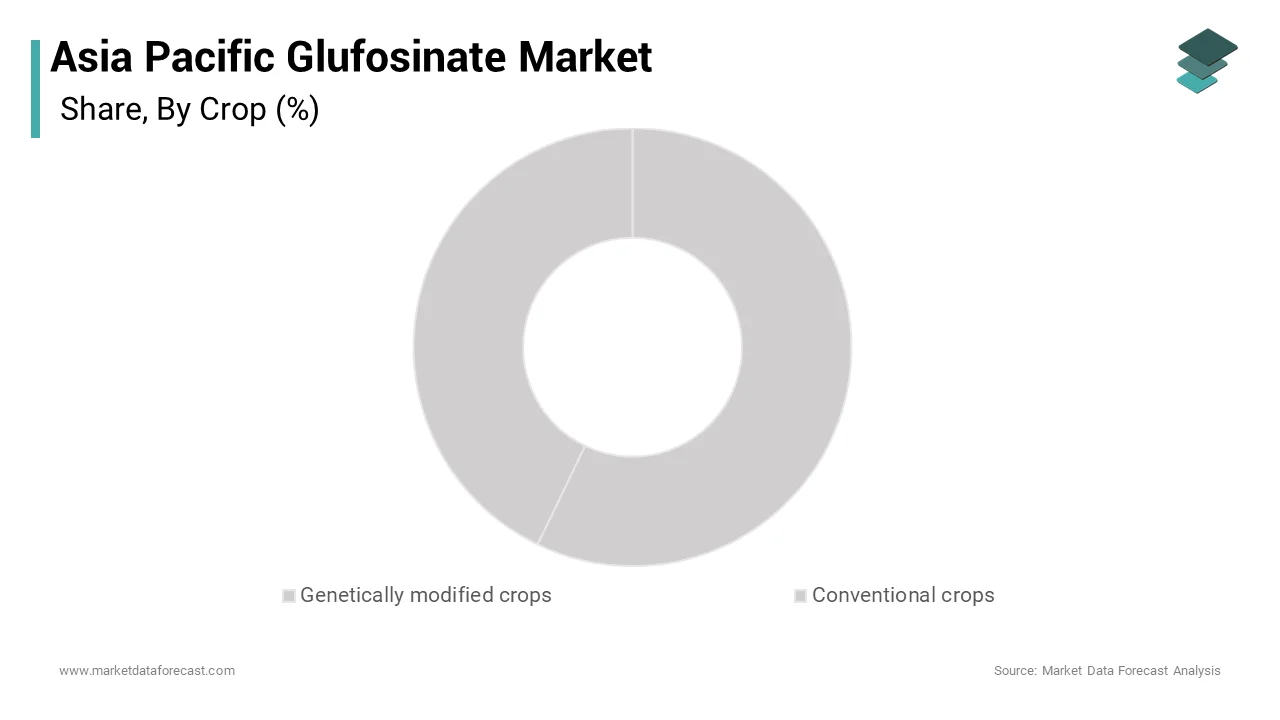
On the contrary, the conventional crops segment is predicted to witness the highest CAGR of 5.8% between 2026 and 2034. This accelerated growth is fueled by the increasing need for effective non selective weed control in organic and non GMO farming systems where glyphosate use is restricted or prohibited. According to regional organic agriculture frameworks, rising demand for certified organic produce has prompted a shift toward non-chemical weed controls, whereas glufosinate remains strictly confined to conventional and genetically modified systems as a synthetic chemical tool. The National Institute for Agricultural Research (INIA) of Uruguay emphasize the use of diversified chemical rotations during the pre-planting fallow period to clear resistant weed populations before establishing conventional winter cereal crops. Furthermore regulatory pressures in certain export markets encourage the use of diverse herbicide modes of action to prevent resistance buildup in conventional systems. As per studies glufosinate is increasingly used as a burndown agent before planting conventional crops providing effective early season weed control. The expansion of sustainable agriculture initiatives and consumer preference for non GMO products drive this segment's rapid expansion offering new avenues for glufosinate application beyond the dominant GMO sector.
By Form Insights
The liquid formulations segment led the Latin America glufosinate market and captured a significant share in 2025. Its ease of application, compatibility with existing spraying equipment, and rapid absorption characteristics have contributed to its leading position. This market share is further propelled by the operational efficiency it offers to large-scale commercial farmers who prioritize speed and uniform coverage across vast areas. Agrochemical registration databases confirm that Soluble Concentrates (SL) represent the predominant commercial form of glufosinate-ammonium, favored by growers for its rapid solubility and ease of tank-mixing with compatible crop protection products. Data from equipment manufacturers indicates that over 80 percent of agricultural sprayers in Brazil and Argentina are designed for liquid applications making this form the most accessible and practical choice for end users. Furthermore liquid formulations ensure consistent dosing and reduce the risk of clogging nozzles which is a common issue with dry forms in humid tropical conditions. As per research the availability of ready to use liquid products simplifies logistics and storage for retailers and farmers alike. The established supply chain and familiarity with liquid handling protocols among agricultural workers further reinforce the leading position of this segment ensuring its continued prevalence in the regional market.
But the dry forms segment is estimated to register the fastest CAGR of 6.2% over the forecast period due to advantages in storage stability transportation efficiency and reduced packaging waste. This growth is particularly notable in remote areas and among smallholder farmers who face challenges with liquid storage and spill risks. According to logistical studies conducted by agricultural cooperatives dry formulations occupy less volume and weight compared to liquid equivalents reducing freight costs by up to 30 percent for long distance distribution. Data from environmental agencies highlights that dry forms generate less plastic waste from containers appealing to sustainability conscious stakeholders and regulators. Furthermore advancements in formulation technology have improved the solubility and dispersion properties of dry glufosinate products making them easier to mix and apply without compromising efficacy. As per market analysis from Andean countries like Peru and Bolivia the adoption of dry forms is rising due to their longer shelf life in varying climatic conditions. The convenience of handling and reduced risk of leakage during transport make dry forms an attractive option for expanding market reach into underserved regions driving their accelerated growth rate.
By Application Insights
In 2025, the agriculture segment held the majority share of the Latin America glufosinate market because of the critical role of weed management in major commodity crop production. The supremacy of this segment is also fuelled by the extensive cultivation of soybeans corn cotton and sugarcane which require effective herbicidal solutions to maximize yields and minimize competition for nutrients. According to the Food and Agriculture Organization of the United Nations Latin America is a global powerhouse in agricultural exports with millions of hectares dedicated to these key crops necessitating robust crop protection measures. Data from national agricultural statistics in Brazil and Argentina shows that herbicide expenditure accounts for a significant portion of input costs reflecting the intensity of weed pressure in tropical and subtropical climates. Glufosinate is widely used for pre plant burndown and post emergence control in genetically modified fields providing farmers with a reliable tool to maintain clean fields. As per surveys the integration of glufosinate into integrated weed management programs is standard practice for commercial growers seeking to combat glyphosate resistant weeds. The sheer scale of agricultural operations and the economic imperative to protect crop yields ensure that agriculture remains the primary driver of glufosinate demand in the region.
However, the non agriculture applications segment is anticipated to witness the fastest CAGR of 4.5% from 2026 to 2034 owing to increasing use in industrial vegetation management rights of way and urban landscape maintenance. This expansion is further supported by the need for effective broad spectrum weed control in areas where aesthetic and safety standards are paramount such as roadsides railways and utility corridors. National infrastructure registries show growing public investment in urban landscaping and transit corridor maintenance, though municipal weed control heavily restricts synthetic chemical applications in favor of mechanical clearing methods to protect urban populations. Furthermore the rise in tourism and hospitality sectors in coastal regions drives the maintenance of golf courses parks and resorts where weed free environments are essential for customer satisfaction. As per regulatory guidelines glufosinate is approved for many non crop uses providing a versatile solution for land managers. The expansion of urban infrastructure and industrial zones creates new opportunities for glufosinate application outside traditional farming driving the steady growth of this niche but expanding segment.
COUNTRY LEVEL ANALYSIS
Brazil Glufosinate Market Analysis
Brazil outperformed other countries in the Latin America glufosinate market and occupied a 45.2% share in 2025. This prominence of the Brazilian market was driven by its status as a global agricultural superpower and extensive adoption of genetically modified crops. The market status in Brazil is showing intense agricultural activity in states like Mato Grosso and Paraná where soybean and corn production drives high herbicide consumption. According to the Brazilian Institute of Geography and Statistics the country harvested over 40 million hectares of soybeans in recent seasons creating massive demand for effective weed control solutions. The prevalence of glyphosate resistant weeds such as Palmer amaranth has compelled farmers to integrate glufosinate into their management strategies ensuring its continued relevance. Data from the National Union of Plant Protection Industries indicates that glufosinate sales have grown steadily as farmers seek to preserve crop yields and manage resistance. Furthermore the approval of new glufosinate tolerant crop traits by the National Technical Commission on Biosafety has expanded application possibilities. The robust distribution network and strong presence of multinational agrochemical companies facilitate easy access to products. This combination of scale technological adoption and agronomic necessity solidifies Brazil’s position as the dominant force in the regional glufosinate market.
Argentina Glufosinate Market Analysis
Argentina was the next prominent country in the Latin America glufosinate market and held a 25.6% share in 2025 because of its heavy reliance on no till farming systems and the high adoption of biotechnology. The market in Argentina is known for the widespread use of genetically modified soybeans and corn, which are predominantly treated with glufosinate for effective weed control. According to the Argentine Chamber of Agrochemicals and Fertilizers the country applies millions of liters of herbicides annually with glufosinate playing a key role in managing resistant weed species in the Pampas region. The Argentine Secretariat of Agriculture, Livestock, and Fisheries confirm that transgenic crop acreage remains stable at near-total adoption levels, locking in a predictable baseline demand for glufosinate-compatible weed control programs. Furthermore economic factors such as currency fluctuations influence purchasing patterns but the critical need for yield protection ensures steady consumption. The presence of local formulation plants and import channels ensures product availability despite logistical challenges. As per sources, farmers are increasingly adopting tank mixes containing glufosinate to enhance efficacy against tough weeds. This strategic importance of glufosinate in maintaining the productivity of Argentina’s key export crops maintains its strong market position.
Mexico Glufosinate Market Analysis
Mexico holds a noteworthy position in the Latin American market due to the production of vegetables fruits and grains where glufosinate is used for burndown and orchard management. The country’s market has diverse agricultural practices ranging from large scale commercial farming to smallholder operations. According to the Ministry of Agriculture and Rural Development the adoption of genetically modified crops is limited compared to South America but glufosinate is widely used in conventional systems for weed control. Data from agricultural associations indicates growing interest in integrated weed management strategies that include glufosinate to reduce reliance on single mode of action herbicides. Furthermore the expansion of industrial zones and infrastructure projects drives non agricultural applications for vegetation control. As per regulatory updates from COFEPRIS the registration process for agrochemicals is stringent but ongoing approvals support market entry for new formulations. The proximity to the United States facilitates trade and technology transfer influencing local practices. This mix of traditional and modern farming methods creates a unique demand profile for glufosinate in Mexico.
COMPETITIVE LANDSCAPE
The competition in the Latin America Glufosinate Market is characterized by the presence of established multinational corporations alongside aggressive regional players who strive to capture market share through pricing strategies and localized solutions. Major global companies leverage their extensive research and development capabilities to introduce innovative formulations and integrated weed management systems that offer superior performance. Meanwhile local manufacturers focus on producing cost effective generic alternatives that appeal to price sensitive farmers in emerging economies. This dynamic creates a fragmented landscape where brand loyalty and product efficacy are key differentiators. Strategic alliances with seed companies and digital agriculture providers are increasingly common as firms seek to offer holistic solutions. Regulatory compliance and environmental sustainability also play crucial roles in shaping competitive dynamics. As resistance to herbicides grows companies must continuously innovate to maintain effectiveness. This intense rivalry drives improvements in product quality and service delivery benefiting farmers who seek reliable and affordable weed control options in the diverse agricultural settings of Latin America.
KEY MARKET PLAYERS
Some of the major companies dominating the Glufosinate market include The
- Dow Chemical Company
- Bayer AG
- BASF SE
- E. I. du Pont de Nemours and Company
- UPL
- Syngenta AG
- Jiangsu Huangma Agrochemicals Co Ltd.
- Nufarm Ltd,
- Jiangsu SevenContinent Green Chemical Co Ltd.
- Zhejiang Yongnong Chem. Ind. Co. Ltd
- Hebei Veyong Bio-Chemical Co, Ltd.
Top In The Market
- Bayer AG maintains a robust presence in the Latin America glufosinate market through its Liberty brand which is widely recognized for its efficacy in controlling resistant weeds. The company actively supports farmers with integrated weed management programs that combine glufosinate tolerant seeds with precise application techniques. Recent initiatives include the launch of digital farming platforms in Brazil and Argentina to optimize herbicide usage and improve crop yields. Bayer has also expanded its local production capabilities to ensure consistent supply and reduce dependency on imports. These efforts demonstrate a strong commitment to sustainability and farmer profitability while reinforcing its leadership position by providing comprehensive solutions that address the evolving challenges of modern agriculture in the region.
- BASF SE contributes significantly to the Latin America glufosinate market by offering high quality active ingredients and formulated products under brands such as Clearfield. The company focuses on innovation and collaboration with local distributors to enhance market reach and technical support for growers. Recently BASF has strengthened its position by introducing new adjuvant technologies that improve the performance of glufosinate in diverse climatic conditions. The company also engages in extensive training programs for agricultural professionals to promote responsible use and resistance management. These strategic actions ensure that BASF remains a trusted partner for farmers seeking reliable and effective weed control solutions while adapting to regulatory changes and environmental standards across Latin American countries.
- UPL Limited plays a pivotal role in the Latin America glufosinate market by providing cost effective and accessible crop protection solutions to a wide range of farmers. The company leverages its strong distribution network to deliver glufosinate products to remote and underserved areas ensuring broad market penetration. Recent actions include strategic acquisitions of local formulation plants in Brazil and Argentina to enhance manufacturing efficiency and product availability. UPL has also launched innovative generic formulations that offer competitive pricing without compromising quality. These moves strengthen its market position by addressing the needs of price sensitive customers while maintaining high standards of performance. By focusing on accessibility and value UPL continues to expand its footprint and influence in the dynamic Latin American agrochemical landscape.
Major Strategies Used By Key Players
Key players in the Latin America Glufosinate Market primarily focus on product innovation and strategic partnerships to maintain their competitive edge. Companies invest heavily in research and development to create advanced formulations that enhance efficacy and reduce environmental impact. Collaborations with local distributors and agricultural cooperatives facilitate broader market access and improve customer support services. Additionally manufacturers emphasize education and training programs to promote responsible use and resistance management among farmers. Expanding local production capacities helps mitigate supply chain risks and reduces costs. These strategies enable companies to address the specific needs of Latin American agriculture while ensuring sustainable growth and long term customer loyalty in a highly competitive environment.
MARKET SEGMENTATION
This research report on the Latin American glufosinate market size is segmented and sub-segmented into the following categories.
By Crop
- Genetically modified crops
- Conventional crops with genetically modified crops leading the Glufosinate market
By Form
- Dry
- Liquid form
By Application
- Agricultural
- grains & cereals
- fruits & vegetables
- oilseeds & pulses and others
- Non-agricultural
By Country
- Brazil
- Argentina
- Mexico