Latin America Automotive Market Size, Share, Trends, And Growth Forecast Report, Segmented By Type, Fuel, Sales Channel, Vehicle Size and Country (Brazil, Mexico, Argentina, Chile and Rest of Latin America), Industry Analysis From 2026 to 2034
Market Size, 2025
$174.73 BnMarket Estimate, 2026
$180.95 BnMarket Forecast, 2034
$239.38 BnCAGR, 2026–2034
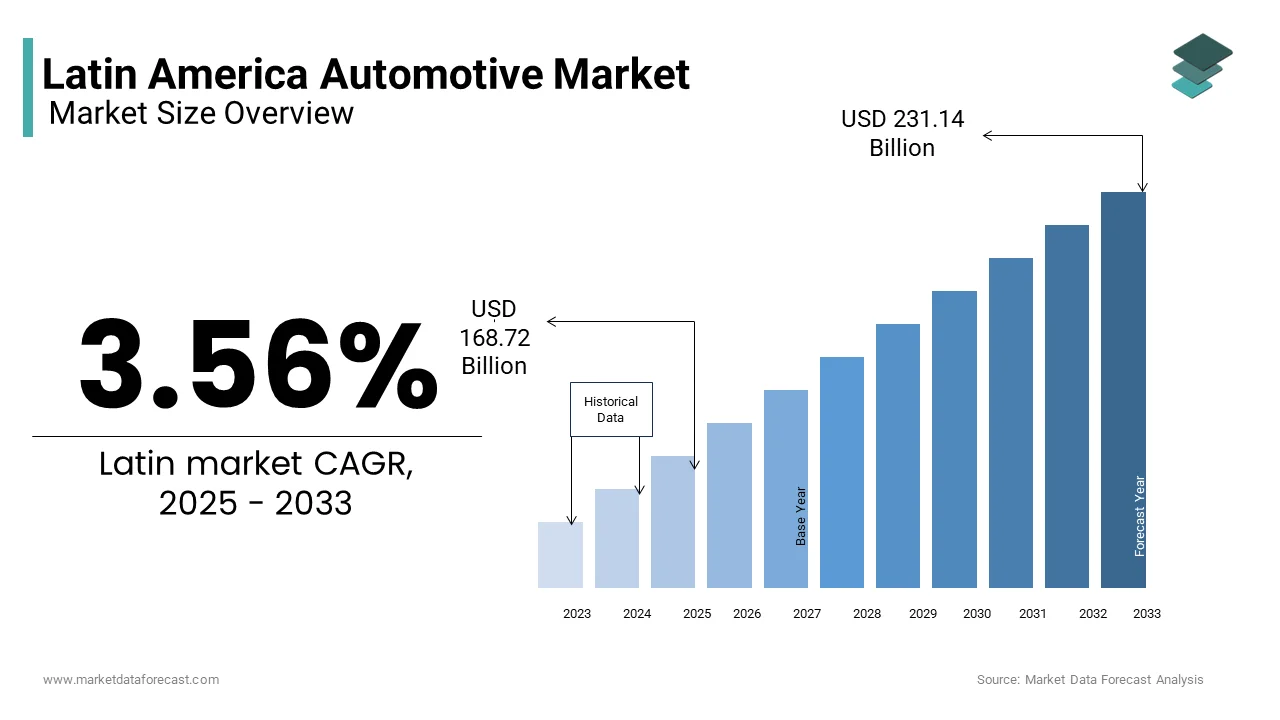
3.56%Latin America Automotive Market Size
The Latin American automotive market was valued at USD 174.73 billion in 2025 and is anticipated to reach USD 180.95 billion in 2026 and USD 239.38 billion by 2034, growing at a CAGR of 3.56% during the forecast period from 2026 to 2034.
The automotive industry is a diverse and evolving landscape of vehicle manufacturing, sales, and aftermarket services across countries such as Brazil, Mexico, Argentina, Colombia, and Chile. As per the International Organization of Motor Vehicle Manufacturers (OICA), Latin America produced more than 4 million vehicles in 2023, with Mexico alone responsible for over half of that volume. Moreover, the sector is transforming with the gradual adoption of electric and hybrid vehicles, supported by government incentives and rising environmental awareness.
MARKET DRIVERS
Urbanization and Rising Middle-Class Population
The rapid pace of urbanization and the expanding middle-class population in Brazil, Mexico, and Colombia are majorly propelling the growth of the Latin American automotive market. As per the United Nations Economic Commission for Latin America and the Caribbean (ECLAC), over 75% of Latin Americans reside in urban areas, and this figure is expected to grow steadily through the decade. In Brazil, where car ownership remains below global averages, the rise in disposable incomes has spurred new vehicle purchases among first-time buyers. Additionally, financial inclusion initiatives and improved credit availability have made vehicle financing more accessible.
Export-Oriented Manufacturing and Foreign Investment
The strong emphasis on export-oriented manufacturing in Mexico, which has emerged as one of the top global automotive production centers, is additionally expected to fuel the growth of the Latin American automotive market. According to the International Organization of Motor Vehicle Manufacturers (OICA), Mexico ranked sixth worldwide in vehicle production in 2023, with over 3.3 million units manufactured, of which more than 80% were exported to the United States and Canada under trade agreements like USMCA.
MARKET RESTRAINTS
Economic Instability and Currency Fluctuations
The economic instability in countries such as Argentina, Venezuela, and parts of Central America, where inflationary pressures and currency fluctuations hinder consumer spending and business investment, is slowly degrading the growth of the Latin American automotive market. According to the International Monetary Fund (IMF), Argentina experienced an annual inflation rate of over 94% in 2023, which is severely impacting purchasing power and discouraging new vehicle acquisitions. Currency devaluation is another critical challenge, especially in economies reliant on imported components. Similarly, in Brazil, despite a relatively stable macroeconomic environment compared to other regional peers, exchange rate volatility continues to impact cost structures.
Regulatory Challenges and Trade Barriers
Regulatory complexities and trade barriers pose significant challenges to the Latin American automotive market, limiting cross-border integration and hindering large-scale production efficiency. According to the World Bank’s Doing Business Report 2023, customs procedures in countries like Peru and Ecuador remain cumbersome, often requiring extensive documentation and prolonged clearance times for imported automotive components. This inefficiency increases operational costs for manufacturers and delays product launches.
In addition, some governments impose high tariffs to protect domestic industries, inadvertently raising vehicle prices and limiting affordability. These restrictions discourage multinational automakers from expanding their presence in certain markets, thereby stifling broader regional integration and growth. Furthermore, inconsistent emissions and safety regulations across countries complicate compliance efforts for manufacturers aiming to standardize their product offerings.
MARKET OPPORTUNITIES
Electrification and Green Mobility Initiatives
A significant opportunity emerging in the Latin American automotive market is the growing push toward electrification and green mobility. Several countries in the region are implementing policies and incentives to promote electric vehicles (EVs), aligning with global sustainability goals and carbon reduction commitments. According to the International Energy Agency (IEA), EV sales in Latin America grew by over 60% in 2023, with Mexico, Brazil, and Chile leading the adoption curve.
Chile has taken proactive steps to reduce vehicular emissions by setting ambitious targets under its National Decarbonization Plan. Additionally, Santiago has introduced low-emission zones, encouraging fleet operators and private consumers to transition away from internal combustion engine vehicles. Mexico has also been actively integrating electric mobility into its automotive strategy. The Mexican Center for Innovation in Transportation (CENIT) reported that in 2023, several global automakers announced plans to convert existing production lines to accommodate EV manufacturing, with Volkswagen and BMW expanding their electrified vehicle portfolios in the country.
Expansion of Shared Mobility and Digital Integration
The rapid evolution of shared mobility services and digital integration presents a compelling opportunity for the Latin American automotive market. Ride-hailing platforms, car-sharing services, and mobility-as-a-service (MaaS) models are gaining traction, particularly in densely populated urban centers like São Paulo, Bogotá, and Mexico City. This trend is being further accelerated by advancements in telematics, connected car technologies, and mobile-based vehicle management systems. Automakers are leveraging these digital capabilities to offer enhanced user experiences and integrate their products into broader smart mobility ecosystems. Moreover, governments and private stakeholders are investing in integrated transport networks to improve urban mobility efficiency.
MARKET CHALLENGES
Supply Chain Disruptions and Component Shortages
The ongoing disruption in global supply chains and shortages of critical automotive components, particularly semiconductors and raw materials, are challenges for the market players. The semiconductor crisis, which began during the pandemic, continues to affect production schedules across the region, delaying vehicle deliveries and increasing manufacturing costs. Brazil has also faced similar constraints, with local assembly lines relying heavily on imported electronic components. The Brazilian Association of Automotive Vehicle Manufacturers (ANFAVEA) reported that in 2023, automotive firms had to revise production forecasts downward due to extended lead times for microchips and electrical systems.
Infrastructure Gaps and Aftermarket Limitations
A persistent challenge for the Latin American automotive market is the lack of comprehensive infrastructure and underdeveloped aftermarket services, which limit vehicle accessibility and long-term ownership convenience. While major cities in Brazil, Mexico, and Chile have relatively advanced road networks and service centers, rural and semi-urban regions suffer from inadequate transportation infrastructure and limited access to maintenance and repair facilities. According to the World Bank’s Logistics Performance Index 2023, only three Latin American countries,,s Chile, Mexico, and Panama, ranked within the top 50 globally for infrastructure quality, with the disparities that exist across the region. Poor road conditions and insufficient highway connectivity increase vehicle wear and tear by discouraging potential buyers who anticipate high maintenance costs. Moreover, the automotive aftermarket, including spare parts distribution and dealership service networks, remains fragmented in many countries.
REPORT COVERAGE
| REPORT METRIC | DETAILS |
| Market Size Available | 2025 to 2034 |
| Base Year | 2025 |
| Forecast Period | 2026 to 2034 |
| CAGR | 3.56% |
| Segments Covered | By Type, Fuel, Sales Channel, Vehicle Size, and Region. |
| Various Analyses Covered | Global, Regional, Country-Level Analysis, Segment-Level Analysis, DROC, PESTLE Analysis, Porter’s Five Forces Analysis, Competitive Landscape, Analyst Overview of Investment Opportunities |
| Regions Covered | Brazil, Mexico, Argentina, Chile, Etc. |
| Market Leaders Profiled | BMW, Subaru, Porsche, Hyundai, FCA, Toyota, Tesla, Renault, Honda, Volkswagen, SAIC Motor, Nissan, Ford, and Daimler. |
SEGMENT ANALYSIS
By Type Insights
The passenger cars segment accounted for 48.2% of the Latin American automotive market share in 2025. The growth of the segment is attributed to the growing middle-class population, which has significantly boosted demand for affordable and fuel-efficient vehicles. According to the World Bank, over 160 million individuals in Latin America now belong to the middle-income group, enhancing their purchasing capacity for private transportation. Passenger car registrations increased by nearly 15% in 2023 in Brazil, as per data from the Brazilian Association of Automotive Vehicle Manufacturers (ANFAVEA), reflecting stronger consumer confidence and improved access to financing options. Additionally, automakers have been tailoring compact and mid-size models specifically for Latin American consumers by focusing on cost-effectiveness and fuel efficiency.
The Electric vehicles (EVs) segment is likely to grow with an expected CAGR of 28.5% in the coming years. The implementation of national electrification strategies in Chile and Colombia is expected to drive the growth of the segment. As per the Chilean Ministry of Energy, the country registered an increase of over 90% in EV sales in 2023 compared to the previous year. Moreover, automakers are increasingly introducing EV models tailored for Latin American markets. Volkswagen, BYD, and Nissan have all launched localized electric offerings in recent years, aligning with shifting consumer preferences.
By Fuel Insights
The Internal combustion engine (ICE) vehicles segment held the dominant share of the Latin American automotive market in 2025. The continued reliance on ICE vehicles is reinforced by economic realities and consumer preference for cost-effective transportation solutions, especially in countries like Brazil, Argentina, and Peru. According to the Economic Commission for Latin America and the Caribbean (ECLAC), only 5% of vehicles sold in 2023 featured electric or hybrid powertrains, with the entrenched position of gasoline and diesel-powered automobiles. Another contributing factor is the availability of locally produced fuel for ethanol-based flex-fuel vehicles in Brazil. The Brazilian Ministry of Mines and Energy reported that in 2023, flex-fuel cars accounted for more than 70% of new passenger vehicle sales by offering consumers a cost-effective alternative to pure gasoline engines.
The hybrid vehicles segment is anticipated to register a CAGR of 22.4% in the coming years. A key catalyst for hybrid adoption is the expansion of incentive programs in countries such as Mexico and Chile, where buyers receive reduced taxes, toll exemptions, and preferential registration fees. In addition, the lack of extensive EV charging infrastructure in many parts of Latin America makes hybrids a more viable option for consumers seeking fuel efficiency without range anxiety. As per the International Council on Clean Transportation (ICCT), Brazil saw a 30% increase in hybrid registrations in 2023, with São Paulo and Rio de Janeiro leading adoption.
By Sales Channel Insights
The dealerships segment led the largest share of the Latin American automotive market in 2025. According to the Mexican Association of Automotive Distributors (AMDA), over 80% of new car buyers in Mexico visited at least two dealerships before finalizing a purchase in 2023. Additionally, financing and after-sales services offered at dealerships contribute to their continued dominance.
The online retail segment isexpectedy to witness a CAGR of 19.6% from 2025 to 2033 with the adoption of omnichannel retail strategies by major automakers, allowing customers to browse, configure, finance, and even complete purchases online. Moreover, younger, tech-savvy consumers are increasingly preferring digital-first buying experiences, reducing dependency on traditional dealership visits.
By Vehicle Size Insights
The compact vehicles segment was the largest, occupying 41.2% of the Latin American automotive market share in 2024 due to the high proportion of first-time buyers and budget-conscious consumers in Brazil, Mexico, and Colombia. According to the World Bank, nearly 60% of Latin Americans reside in cities where compact cars offer advantages in terms of maneuverability and parking convenience. Additionally, fluctuating fuel prices make compact models more appealing due to their lower consumption rates. Automakers have responded by expanding their compact vehicle portfolios.
The luxury vehicles segment is expected to register a CAGR of 14.2% during the forecast period, with the expanding upper-middle and high-income demographic, particularly in Brazil, Mexico, and Chile. According to Deloitte, the number of high-net-worth individuals (HNWIs) in Latin America surpassed 1.2 million in 2023, which is creating a strong consumer base for luxury brands such as BMW, Mercedes-Benz, and Audi. Furthermore, automakers are intensifying their marketing efforts and establishing exclusive dealer networks to cater to this segment. In addition, leasing and premium financing options are becoming more accessible by allowing aspirational buyers to enter the luxury market.
COUNTRY ANALYSIS
Brazil Automotive Market Analysis
Brazil was the top performer in the Latin American automotive market, holding a market 35.4% of 35.4% in 2024. A key strength lies in Brazil’s status as a major production hub, with companies like Fiat Chrysler Automobiles (now Stellantis), Volkswagen, Ford, and Toyota operating significant assembly plants. Additionally, the popularity of locally adapted flex-fuel vehicles continues to drive sales, particularly among price-sensitive consumers. As per the Ministry of Mines and Energy in 2023, flex-fuel cars accounted for over 70% of new passenger vehicle registrations by leveraging Brazil’s abundant ethanol supply.
Mexico Automotive Market Analysis
Mexico was ranked second in the Latin American automotive market with 30.2% of the share in 202,4, with its strategic location, trade agreements, and deep integration into North American supply chains.
Mexico is one of the world’s top ten vehicle producers, with over 3.3 million units manufactured in 20,23, of which more than 80% were exported to the United States and Canada under the USMCA trade framework. Major global automakers such as General Motors, Nissan, and Volkswagen have invested heavily in local manufacturing facilities, drawn by competitive labor costs and proximity to major markets.
Argentina's automotive market is expected to grow with the highest CAGR in the coming years. The domestic market benefits from a strong tradition of automobile manufacturing, with companies like Renault, Fiat Chrysler Automobiles, and Toyota maintaining local production lines. Government initiatives aimed at stabilizing the economy and supporting strategic industries have played a role in revitalizing the sector. The Central Bank of Argentina noted that inflation remained above 90% in 202,3, posing affordability concerns for consumers. However, vehicle financing programs introduced by banks and manufacturers helped sustain demand in the commercial and light truck segments.
Chile Automotive Market Analysis
The Chilean automotive market is growing prominently with its aggressive push toward electrification, supported by national policies aimed at reducing carbon emissions. The Chilean Ministry of Energy reported that in 2023, EV sales grew by over 90% compared to the previous year, driven by tax exemptions, import duty waivers, and the development of a nationwide charging infrastructure.
COMPETITIVE LANDSCAPE
The Latin American automotive market is characterized by a mix of global automakers and regional players competing on product diversity, pricing, and technological innovation. While established multinational brands dominate the landscape, there is increasing pressure from emerging mobility solutions and shifting consumer preferences toward affordability and sustainability. The competition is particularly intense in countries like Brazil and Mexico, where manufacturers must navigate fluctuating economic conditions, trade dynamics, and evolving government policies.
Local adaptation plays a crucial role in maintaining competitiveness, with automakers focusing on cost-effective, fuel-efficient models suited to regional infrastructure and driving conditions. At the same time, dealerships and digital sales channels are both being leveraged to reach broader audiences. The market also sees growing participation from Chinese automakers, who are entering the region with competitively priced electric models, further intensifying competition. The Latin American automotive sector remains a highly contested space where agility and localization determine success with new entrants, evolving regulations, and rapid technological advancements.
KEY MARKET PLAYERS
Are the market players that are dominating the Latin American automotive market?
- BMW
- Subaru
- Porsche
- Hyundai
- FCA
- Toyota
- Tesla
- Renault
- Honda
- Volkswagen
- SAIC Motor
- Nissan
- Ford
- Daimler
Top Players In The Market
- Stellantis was formed from the merger of Fiat Chrysler Automobiles and PSA Group, and holds a strong presence in Latin America, particularly in Brazil and Argentina. The company has been a long-standing player in the region by offering a diverse lineup that includes popular compact and commercial vehicles tailored to local preferences. Stellantis has consistently invested in regional manufacturing facilities and supply chain optimization.
- Volkswagen is one of the most influential automotive brands in Latin America, with deep-rooted operations in Brazil and Mexico. Volkswagen has maintained a strong consumer base by adapting models to regional demand and is known for its broad product portfolio and robust dealership network. The company is also expanding its electric vehicle offerings in response to evolving environmental policies across the region.
- General Motors has historically played a major role in the Latin American automotive landscape, especially in Brazil and Mexico. Although it scaled back some operations in recent years, GM continues to influence the market through strategic partnerships and localized production strategies. Its focus on durable, fuel-efficient models aligns well with consumer needs in key markets across the region.
Top Strategies Used By Key Market Participants
- Key players in the Latin American automotive market are leveraging several strategic approaches to strengthen their foothold and remain competitive. One of the primary strategies is localized production and customization, where automakers tailor vehicle designs, features, and pricing to match regional preferences and economic conditions. This approach enhances customer satisfaction and ensures better market penetration.
- Another critical strategy is strategic alliances and joint ventures, allowing companies to share resources, reduce costs, and accelerate product development. These collaborations often involve partnerships with local suppliers, governments, or financial institutions to facilitate easier access to financing and distribution networks.
- Technology integration and electrification initiatives are becoming increasingly important. Automakers are investing in hybrid and electric vehicle technologies, as well as digital retail platforms, to meet evolving consumer expectations and regulatory requirements. These efforts help firms differentiate themselves in a dynamic and rapidly transforming market environment.
RECENT MARKET NEWS
- In March 2023, Volkswagen announced an investment plan to modernize its plant in PueblaMexicoo, focusing on preparing the facility for future electric vehicle production, which is signaling a shift toward sustainable mobility in the region.
- In August 2023, Stellantis launched a new locally produced compact SUV in Brazil that was designed specifically for Latin American consumers, aiming to capture a larger share of the growing SUV segment and boost domestic sales.
- In January 2024, Toyota expanded its hybrid vehicle lineup in Chile by introducing new models equipped with advanced energy-saving technologies, aligning with the country’s push for cleaner transportation alternatives.
- In May 2024, BYD opened its first full-scale electric vehicle assembly plant in São Paulo, Brazil, positioning itself as a key player in the region’s EV transition and enhancing local production capabilities.
- In September 2024, Ford partnered with a leading Mexican fintech firm to introduce flexible leasing and financing options, which are making vehicle ownership more accessible and improving customer engagement in key urban markets.
MARKET SEGMENTATION
This research report on the Latin American automotive market is segmented and sub-segmented into the following categories.
By Type
- Passenger Cars
- Commercial Vehicles
- Electric Vehicles
- Two Wheelers
By Fuel Type
- Internal Combustion Engine
- Electric
- Hybrid
- Hydrogen
By Sales Channel
- Direct Sales
- Dealerships
- Online Retail
By Vehicle Size
- Compact
- Mid-Size
- Full-Size
By Country
- Mexico
- Brazil
- Argentina
- Chile
- Rest of Latin America
Frequently Asked Questions
What is the Latin America automotive market?
The Latin America automotive market includes vehicle production, imports, sales, aftermarket services, and mobility solutions across major regional economies.
What drives growth in the Latin America automotive market?
Urbanization, rising middle-class income, growing demand for affordable cars, and expansion of regional manufacturing hubs.
Which countries lead the Latin America automotive market?
Brazil and Mexico dominate due to strong manufacturing capacity, export networks, and high domestic vehicle demand.
What trends are shaping the Latin America automotive market?
Growth in compact cars, rising EV interest, expansion of ride-sharing fleets, and increasing investments in digital and connected vehicle features.
What challenges affect the Latin America automotive market?
Economic volatility, high financing costs, limited charging infrastructure for EVs, and dependence on imported vehicle components.
How is electrification influencing the Latin America automotive market?
Interest in EVs is rising, with governments promoting cleaner transport, but adoption remains slow due to cost barriers and infrastructure gaps.
Who are the key consumers in the Latin America automotive market?
Urban families, entry-level buyers, commercial fleet operators, and ride-hailing companies are major contributors to vehicle demand.
What role does manufacturing play in the Latin America automotive market?
Brazil and Mexico act as production hubs, supplying vehicles to domestic buyers and exporting to the U.S., Europe, and regional markets.
How is digital transformation impacting the Latin America automotive market?
Online car sales, mobile-based servicing, and connected-car platforms are gaining traction as consumers seek more convenient buying experiences.
What is the future outlook for the Latin America automotive market?
Growth is expected as economies stabilize, mobility services expand, and automakers strengthen local production and EV strategies.
Related Reports
Access the study in MULTIPLE FORMATS
Purchase options starting from
$ 1600
Didn’t find what you’re looking for?
TALK TO OUR ANALYST TEAM
Need something within your budget?
NO WORRIES! WE GOT YOU COVERED!
Call us on: +1 888 702 9696 (U.S Toll Free)
Write to us: sales@marketdataforecast.com