- Product Description Description
- Table of Contents TOC
- List of Table & Figure LOT
- Get Free Sample PDF Sample PDF
Market Size, 2025
$28.62 BnMarket Estimate, 2026
$31.20 BnMarket Forecast, 2034
$62.31 BnCAGR, 2026–2034
9.03%Executive Summary: Latin America Biologics Market
- Market Scope: Comprehensive Latin American biologics market evaluation covering source types, product categories, manufacturing methods, disease indications, and country-level adoption dynamics.
- Market Valuation: Valued at USD 28.62 billion (2025), estimated at USD 31.20 billion (2026), and projected to reach USD 62.31 billion by 2034, registering a solid CAGR of 9.03% (2026–2034).
- Primary Growth Drivers: Rising prevalence of chronic and lifestyle-related diseases (such as cancer and diabetes), expanding capital investments by major biopharmaceutical players, supportive government initiatives, and rising adoption of innovative target therapies and biosimilars.
Key Market Segment Metrics (2026–2034)
| Category | Leading Segment (2025 Position) | Fastest-Growing Segment (2026–2034) |
|---|---|---|
| By Source | Mammalian Expression Systems (dominate biologics production due to high fidelity in complex protein folding and post-translational modifications) | Microbial & Alternative Systems (expanding through advanced genetic engineering and cost-effective scaling) |
| By Product | Monoclonal Antibodies & Vaccines (account for the lion's share of regional clinical demand and commercial revenues) | Recombinant Proteins & Molecular Therapies (growing rapidly alongside targeted oncology and rare disease treatments) |
| By Manufacturing Type | In-House Manufacturing (leads regional output as major firms maintain strict quality control and intellectual property security) | Outsourced Manufacturing / CDMO Partnerships (accelerating as companies seek flexible production capacity and cost optimization) |
| By Disease Category | Oncology (captures the largest market share driven by escalating cancer incidence and high adoption of targeted biologics) | Immunological & Cardiovascular Disorders (expanding dynamically due to rising chronic lifestyle conditions and targeted biologic therapies) |
| By Country | Brazil (leads the Latin American market backed by a large population base, high healthcare expenditure, and robust local biopharma production) | Mexico, Argentina, and Chile (experiencing strong growth via expanding healthcare infrastructure and biosimilar adoption frameworks) |
Major Market Players & Market Structure
Market Structure: Highly fragmented yet competitive regional landscape where multinational pharmaceutical giants compete alongside consolidated local corporate networks and expanding biotechnology enterprises.
Key Companies: Gilead Sciences, AbbVie, Merck & Co., Novo Nordisk, Biogen, Pfizer, CSL, Shire, Johnson & Johnson, Allergan Plc, Samsung Biologics, Medly, and Astellas Pharma Inc.
 Download Free Sample Report
Latin America Biologics Market Size
The Latin America biologics market was valued at USD 28.62 billion in 2025. This market is expected to grow at a CAGR of 9.03% from 2026 to 2034, rising from USD 31.20 billion in 2026 to USD 62.31 billion by 2034.
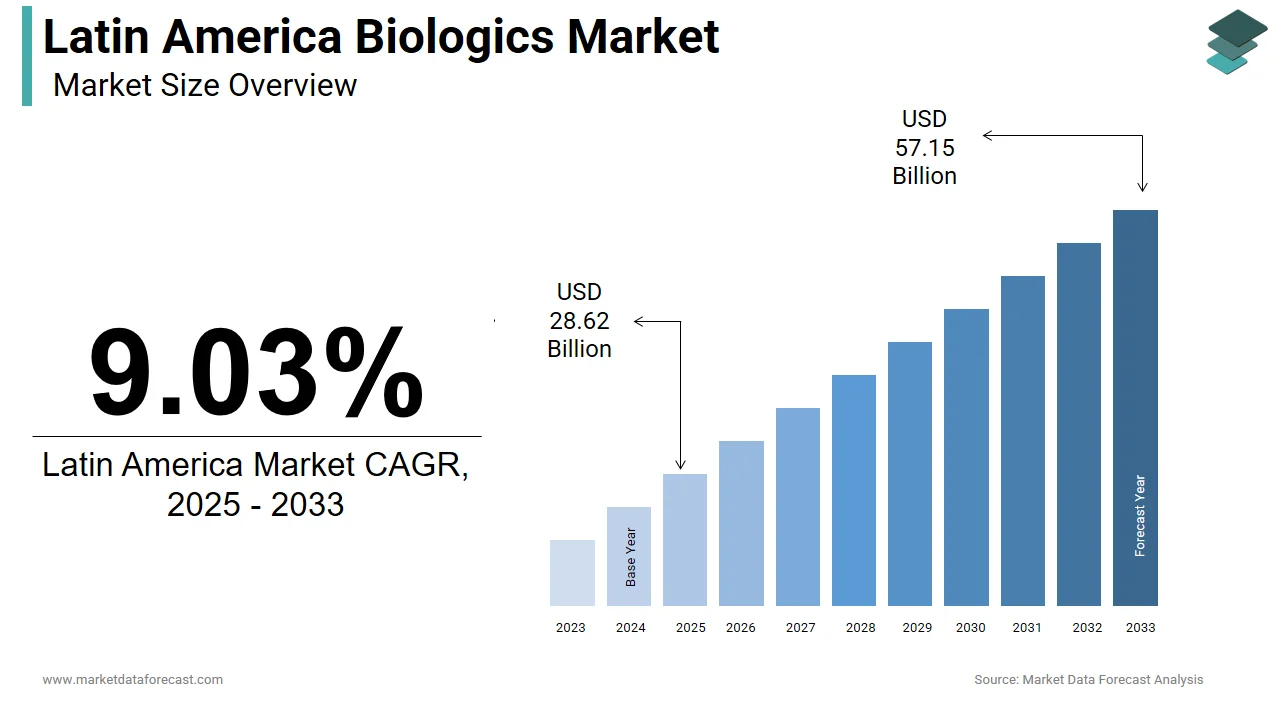
Biologics are advanced therapeutic proteins, monoclonal antibodies, and vaccines produced through living organisms and utilized extensively for treating complex oncology, immunological, and metabolic conditions across regional clinical networks. Furthermore, chronic illnesses require sophisticated targeted interventions, pushing institutional buyers to prioritize complex macromolecular drugs.
MARKET DRIVERS
Rising Prevalence of Complex Chronic Pathology
The accelerating epidemiological transition toward long term metabolic disorders and oncological diseases is impacting positively on the growth of the Latin America biologics market. According to the study, the rising incidence of complex pathologies directly accelerates regional demand for sophisticated macromolecular therapies and specialized clinical interventions. This heavy disease burden forces institutional care providers to look past traditional small molecule drugs and adopt targeted biological agents capable of modifying disease progression at the cellular level. Furthermore, according to Pan American Health Organization demographic studies, noncommunicable conditions are responsible for 5.5 million deaths annually throughout the Americas, reinforcing the clinical urgency for advanced therapeutic molecules. This profound mortality and morbidity pressure guarantees that hospitals and specialized treatment centers maintain continuous procurement pathways for modern biological treatments.
Expansion of Biotechnology Research and Foreign Direct Investment
Growing corporate investments dedicated to advanced biotechnology manufacturing infrastructure and clinical trials are transforming local supply chain dynamics, which is also promoting the growth of the Latin American biologics market. According to the research, increased capital deployment by major pharmaceutical enterprises significantly drives regional market expansion and technological capability. This influx of funding allows domestic laboratories to upgrade their technical capabilities, fostering collaborative drug development initiatives tailored to regional genetic profiles. Furthermore, pharmaceutical manufacturing trends are external financial support, and contract outsourcing arrangements enable local facilities to produce complex injectable treatments more efficiently.
MARKET RESTRAINTS
Prohibitive Treatment Costs and Budgetary Constraints
The high financial barriers associated with procuring innovative biological drugs create severe limitations for resource-constrained public healthcare infrastructure throughout developing economies. The prohibitive treatment costs and budgetary constraints is restricting the growth of the Latin American biologics market. The substantial capital required for advanced biological research and commercialization heavily restricts broad accessibility outside elite private clinics. Because state-funded health systems operate under strict financial limits, purchasing expensive monoclonal antibodies or gene therapies forces administrators to ration care carefully. Additionally, according to World Bank health financing reviews, public expenditure allocations across multiple regional nations frequently lag behind the surging cost of imported biotechnology. This financial imbalance forces many institutional providers to restrict patient access, delaying the widespread adoption of next-generation therapeutic molecules.
Complex Regulatory Frameworks and Approval Bottlenecks
Navigating intricate bureaucratic approval guidelines established by national health authorities introduces considerable friction for international manufacturers is also limiting the growth of the Latin American biologics market. The strict regulatory policies and intricate quality control mandates for living organism derivatives heavily complicate product registration timelines. These rigorous safety validations, while necessary to prevent immunogenic adverse events, which is significantly extend commercialization windows and increase administrative overhead for suppliers. Furthermore, according to global regulatory harmonization reviews by life science authorities, a lack of alignment between domestic agencies and international standards creates prolonged administrative delays.
MARKET OPPORTUNITIES
Proliferation of Cost-Effective Biosimilar Alternatives
The imminent patent expiration of several blockbuster biologic drugs opens massive commercial avenues for local manufacturers specializing in affordable follow-on protein therapeutics that is expected to bolster new opportunities for the growth of the Latin American biologics market. This massive valuation jump reflects an aggressive strategic pivot by regional healthcare systems aiming to substitute expensive originator drugs with economical equivalents. Furthermore, according to Coherent Market Insights sector reports, cost-containment pressures encourage national governments to fast-track regulatory pathways for high-quality biosimilars. This favorable economic shift allows regional hospitals to treat significantly larger patient cohorts without exceeding fixed annual pharmacy budgets.
Strategic Regional Contract Manufacturing Partnerships
The global relocation of biopharmaceutical production capacity toward emerging countries for local contract manufacturing organizations to capture high-value outsourcing agreements is also to promote new opportunities for the growth of the Latin American biologics market. This operational shift enables multinational innovators to leverage local technical expertise and lower labor overhead without compromising strict international quality standards. Furthermore, as per regional economic development data, state-backed incentives for domestic life science hubs help attract cutting-edge bioreactor technology to local facilities. Consequently, domestic manufacturing providers can secure long term supply contracts with global pharmaceutical giants, transforming the region into an active biological export hub.
MARKET CHALLENGES
Severe Cold Chain Infrastructure Deficiencies
The inadequate logistical networks and unreliable temperature-controlled storage facilities across rural territories present formidable operational barriers for sensitive macromolecular distribution. The severe cold chain infrastructure deficiencies also limit the growth of the Latin American biologics market. According to global pharmaceutical supply chain assessments, biological products require strict continuous refrigeration between 2 and 8 degrees Celsius, failing which their complex molecular structures degrade rapidly. Because regional transportation corridors often suffer from structural delays and erratic power supplies, maintaining this unbroken cold chain becomes an expensive engineering challenge. Furthermore, according to World Health Organization logistical audits in developing nations, transit spoilage accounts for notable inventory losses before treatments ever reach regional clinics. This infrastructural vulnerability limits advanced biological distribution primarily to well-equipped metropolitan centers, leaving outlying populations underserved.
Shortage of Specialized Scientific Talent
A persistent deficit of highly trained bioprocess engineers and specialized clinical researchers creates operational disruptions for domestic biotechnology development and advanced manufacturing execution. The shortage of specialized scientific talent is another factor contributing to the decline in the growth of the Latin American biologics market. According to Latin American life science workforce studies, complex mammalian cell culture cultivation and sophisticated analytical testing require advanced technical competencies that traditional educational curricula often fail to provide. This talent gap forces local biotechnology firms to rely heavily on expensive foreign consultants, increasing operational expenditures significantly. Furthermore, according to regional academic evaluations, brain drain phenomena frequently draw top-tier biotechnologists toward North American or European research institutions. Consequently, local companies struggle to scale up sophisticated laboratory pipelines, slowing the pace of home-grown biopharmaceutical innovation across the region.
REPORT COVERAGE
| REPORT METRIC | DETAILS |
| Market Size Available | 2025 to 2034 |
| Base Year | 2025 |
| Forecast Period | 2026 to 2034 |
| Segments Covered | By Source, Product, Biologics Manufacturing, Disease Category, and Country. |
| Various Analyses Covered | Global, Regional and Country-Level Analysis, Segment-Level Analysis, Drivers, Restraints, Opportunities, Challenges; PESTLE Analysis; Porter’s Five Forces Analysis, Competitive Landscape, Analyst Overview of Investment Opportunities |
| Countries Covered | Brazil, Mexico, Argentina, Chile, Rest of Latin America |
| Market Leaders Profiled | Gilead Science, AbbVie, Merck & Co, Novo Nordisk, Biogen, Pfizer, CSL, Shire, Johnson & Johnson, Allergan Plc., Samsung Biologics, Medly, and Astellas Pharma Inc |
SEGMENTAL ANALYSIS
By Source Insights
The microbial source segment was the largest by holding 33.2% of the Latin America biologics market share in 2025, with the bacterial and yeast expression systems offering established, cost-effective manufacturing routes for producing recombinant proteins, insulin variants, and foundational vaccines. This manufacturing dominance relies on the ability of microbial systems to achieve rapid cell growth and high expression yields at a fraction of the operational cost required for complex animal cell cultures. This deep-rooted technical familiarity ensures that regional public health institutions can procure essential recombinant therapeutics affordably without facing prohibitive processing overheads.
The mammalian expression segment is likely to grow at an anticipated CAGR of 6.9% during the forecast period, with the skyrocketing regional clinical requirement for complex monoclonal antibodies and therapeutic proteins that demand sophisticated post-translational modifications. This rapid expansion occurs because mammalian hosts provide the precise cellular machinery required to fold intricate macromolecular structures safely, preventing adverse immunogenic reactions in human patients. Additionally, biopharmaceutical production reviews demonstrate that regional mammalian contract manufacturing capabilities are scaling upward to support advanced drug pipelines, directly accelerating local adoption as multinational innovators shift complex biologics processing toward specialized emerging facilities.
By Product Insights
The monoclonal antibodies segment held a dominant share of the Latin America biologics market in 2025, with these precision-engineered molecules offering unmatched efficacy in targeting specific disease cell surface markers across oncology and autoimmune indications. This product dominance is fueled by the continuous introduction of novel oncological treatments designed to neutralize tumor cell proliferation with minimal damage to healthy surrounding tissues. Furthermore, Pan American Health Organization cancer registry statistics highlight that the rising regional tumor burden creates a constant institutional demand for high-purity monoclonal antibody treatments, compelling both public and private hospital formularies to prioritize these advanced macromolecular products above conventional pharmaceutical alternatives.
The vaccine products segment is anticipated to witness the fastest CAGR of 6.9% from 2026 to 2034 with the aggressive public immunization campaigns and regional disease prevention mandates. World Health Organization immunization tracking data shows that regional inoculation programs distribute millions of doses annually to combat emerging infectious threats and endemic viral pathogens across tropical territories. This swift growth velocity is heavily supported by state-backed biotechnology initiatives aimed at establishing domestic vaccine manufacturing plants to guarantee supply chain independence during global health emergencies. Moreover, regional epidemiological updates emphasize that cooperative public-health agreements between local ministries and international health organizations continuously inject vital capital into vaccine development pipelines by ensuring sustained commercial momentum across primary care networks.
By Disease Category Insights
The oncology segment was the largest, holding 34.2% of the Latin America biologics market share in 2025 with the relentless proliferation of targeted cancer therapies. This dominant position is driven by the clinical necessity of deploying monoclonal antibodies and specialized immunomodulators to manage treatment-resistant tumors effectively. Furthermore, Pan American Health Organization cancer metrics record over 749,000 annual regional mortality events due to malignant diseases, creating an urgent, unyielding institutional demand for advanced oncological biologics within major tertiary hospital centers.
The immunological disorders segment is swiftly emerging at the fastest CAGR of 6.9% during the forecast period, with the rising diagnostic rates of chronic inflammatory conditions and autoimmune diseases across urban populations. Global health epidemiological studies indicate that the prevalence of autoimmune pathologies in Latin America has risen significantly, triggering a corresponding surge in prescriptions for biological disease-modifying anti-rheumatic drugs. This accelerated growth rate is heavily driven by expanding patient access to specialty clinics and the introduction of affordable biosimilar alternatives that make complex immunological treatments financially viable for middle-class demographics. Additionally, clinical immunology research reviews show that enhanced physician awareness regarding early biologic intervention for rheumatoid arthritis and Crohn disease is rapidly broadening the active patient cohort.
COUNTRY LEVEL ANALYSIS
Brazil Biologics Market Analysis
Brazil was the top performer in the Latin America biologics market by holding a 38.1% share in 2025, with the primary commercial engine and regulatory trendsetter for advanced biotechnology adoption across South America. This active government initiatives through the Unified Health System, which actively integrates high-cost biological drugs and domestic biosimilars into public distribution lists. Furthermore, national health demographic reviews project that Brazil's expanding middle class and dedicated public health funding will continue to attract major multinational pharmaceutical investments, amplifying its status as the most lucrative destination for innovative biologic therapies in the region.
Mexico Biologics Market Analysis
Mexico biologics market was ranked second, holding a 23.1% share in 2025, with a sophisticated private healthcare infrastructure, high population density, and strong supply chain integration with North American pharmaceutical markets. This strong national performance is driven by the heavy concentration of specialized urban hospitals treating complex metabolic and oncological disorders that require advanced biological medications. Additionally, trade and economic development studies indicate that Mexico serves as a strategic export hub by leveraging localized manufacturing facilities to streamline the distribution of complex biologics.
Argentina Biologics Market Analysis
Argentina's biologics market is likely to grow at the fastest CAGR during the forecast period with the regional biopharmaceutical framework, supported by a highly educated scientific community and an active biotechnology research sector capable of producing complex active pharmaceutical ingredients. This specialized market status is underpinned by progressive national legislation supporting local biosimilar development and active public-private partnerships in biotechnology laboratories. Furthermore, specialized endocrinologists and oncologists practicing in Buenos Aires and other major urban centers maintain high acceptance rates for innovative macromolecular treatments, ensuring steady institutional procurement despite periodic macroeconomic turbulence.
Chile Biologics Market Analysis
Chile's biologics market growth is steadily growing with the transparent regulatory oversight and robust per capita healthcare spending. Chile's emphasis on healthcare modernization has enabled rapid adoption of cutting-edge monoclonal antibodies and targeted immunotherapy treatments within both public institutional networks and private clinics. This strong market performance is driven by proactive health policies aimed at reducing treatment backlogs for catastrophic illnesses through the systematic incorporation of high-cost biologics into national reimbursement frameworks. Additionally, health sector development studies demonstrate that Chile's stable economic environment and reliable cold chain logistics infrastructure make it an ideal test bed for introducing novel, temperature-sensitive biopharmaceuticals to the broader regional market.
Rest of Latin America
The Rest of Latin America segment, encompassing diverse developing economies across Central America, the Caribbean, and smaller South American territories, exhibits emerging market potential as local health authorities gradually expand specialized care access. This expanding commercial footprint is supported by multilateral health initiatives and growing telecommunication networks that facilitate remote specialist consultations and improve supply chain tracking. Furthermore, public health modernization programs in secondary nations are slowly bridging historical treatment disparities, fostering a steady, long-term increase in basic biological product adoption outside major metropolitan capitals.
COMPETITIVE LANDSCAPE
The competitive environment of the regional biopharmaceutical industry is characterized by intense rivalry among multinational pharmaceutical corporations that leverage extensive product pipelines and advanced technological capabilities to capture high-value hospital contracts. These established market leaders constantly compete by emphasizing clinical efficacy, robust safety profiles, and comprehensive post-marketing surveillance support to secure preferred status within institutional formularies. Regional competition is further intensified by the rapid market entry of domestic biosimilar manufacturers offering cost-effective alternatives to expensive originator biologics, forcing multinational firms to adjust their pricing and localization strategies. Macroeconomic volatility and fluctuating local currencies across major economies demand flexible financial planning and localized manufacturing investments to maintain competitive stability.
KEY MARKET PLAYERS
The leading companies operating in the Latin America biologics market include:
- Gilead Sciences
- AbbVie
- Merck & Co.
- Novo Nordisk
- Biogen
- Pfizer Inc.
- CSL
- Shire
- Johnson & Johnson
- Allergan Plc.
- Novartis AG
- Hoffmann-La Roche Ltd.
- Samsung Biologics
- Medly
- Astellas Pharma Inc.
TOP PLAYERS IN THE MARKET
- F Hoffmann-La Roche Ltd contributes extensively to the regional biopharmaceutical sector by delivering an expansive portfolio of targeted monoclonal antibodies and oncology treatments designed for complex patient care needs. Their ongoing market involvement centers on establishing robust clinical collaborations with major medical research centers across South America to expand patient access to cutting-edge immunotherapies.
- Pfizer Inc maintains a powerful regional presence by supplying a diverse array of advanced biological vaccines, inflammation treatments, and complex biosimilar formulations to numerous healthcare institutions. The corporation engages deeply with local health authorities to support large-scale immunization programs and clinical trials tailored to regional epidemiological demands. To strengthen its commercial footing, the firm prioritizes strategic portfolio diversification and targeted educational outreach campaigns directed at specialized medical practitioners seeking reliable biologic treatment alternatives for chronic and infectious pathologies.
- Novartis AG plays a transformative role through the commercialization of innovative biopharmaceuticals, advanced cellular therapies, and immunology treatments targeting severe chronic conditions throughout developing countries. Their active involvement focuses on expanding local clinical research capacity and optimizing cold chain distribution pathways to ensure product stability across diverse geographic territories. To secure a stronger regional footprint, the enterprise leverages targeted digital health partnerships and enhances its specialized supply chain agreements to facilitate seamless delivery across both public and private hospital sectors.
TOP STRATEGIES USED BY KEY MARKET PARTICIPANTS
Key industry participants operating within the regional biopharmaceutical landscape deploy aggressive partnership strategies by collaborating with local contract manufacturing organizations to streamline regional production and reduce import dependencies. Manufacturers heavily prioritize the rapid development and commercialization of affordable biosimilar alternatives to capture high-volume public procurement contracts across resource-constrained healthcare systems. Leading global suppliers also invest extensively in advanced cold chain logistical networks and digital temperature tracking systems to protect sensitive macromolecular stability during long-distance transit. Furthermore, key players continuously establish strategic alliances with local research institutes to conduct region-specific clinical trials, ensuring their biological formulations align closely with local genetic profiles and disease burdens. Corporations also utilize targeted educational programs for healthcare professionals to build deep clinical trust and accelerate the adoption of complex targeted immunotherapies.
MARKET SEGMENTATION
This Latin America biologics market research report is segmented and sub-segmented into the following categories.
By Source
- Microbial
- Mammalian
- Others
By Product
- Monoclonal Antibodies
- Vaccines
- Recombinant Proteins
- Antisense, RNAi, & Molecular Therapy
- Others
By Biologics Manufacturing
- Outsourced
- In-house
By Disease Category
- Oncology
- Infectious Diseases
- Immunological Disorders
- Cardiovascular Disorders
- Hematological Disorders
- Others
By Country
- Brazil
- Mexico
- Argentina
- Chile
- Rest of Latin America