- Product Description Description
- Table of Contents TOC
- List of Table & Figure LOT
- Get Free Sample PDF Sample PDF
Market Size, 2025
$367.50 BnMarket Estimate, 2026
$397.27 BnMarket Forecast, 2034
$740.78 BnCAGR, 2026–2034
8.10%Executive Summary: Biologics Market
- Market Scope: Comprehensive global biologics market analysis covering source segments, product categories, manufacturing models, disease applications, and regional leadership frameworks.
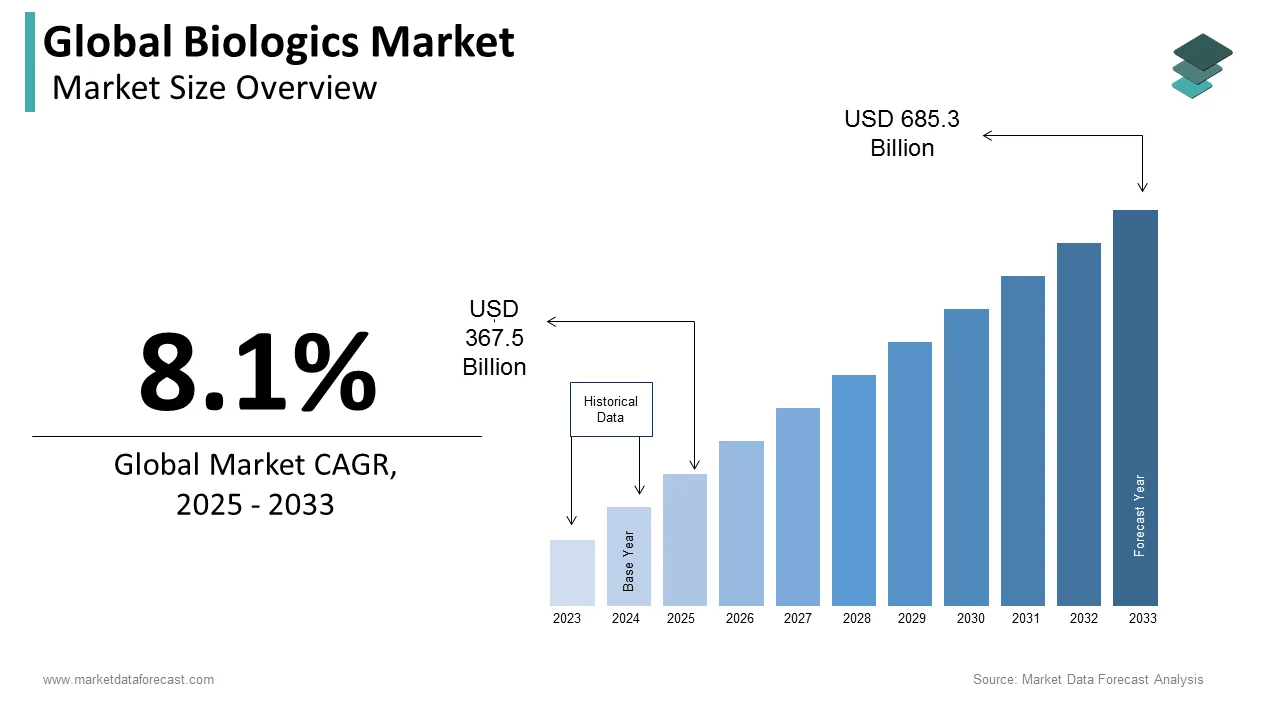
- Market Valuation: Valued at USD 367.50 billion (2025), estimated at USD 397.27 billion (2026), and projected to reach USD 740.78 billion by 2034, registering a robust CAGR of 8.10% (2026–2034).
- Primary Growth Drivers: Increasing incidence of chronic diseases, rising acceptance of innovative therapies, growing demand for biological drugs, patent expirations, expanding healthcare expenditure, and increasing applications of gene-based and cellular biologics.
Key Market Segment Metrics (2026–2034)
| Category | Leading Segment (2025 Position) | Fastest-Growing Segment |
|---|---|---|
| By Source & Product | Microbial Source (largest share in 2025); Monoclonal Antibodies (dominated product market) | Microbial Source Segment & Vaccines (anticipated to record the fastest CAGR) |
| By Manufacturing Model & Disease | In-House Manufacturing (dominant model); Oncology (accounted for the largest disease category share) | Outsourced Biomanufacturing & CDMO Partnerships |
| By Therapy Type | Recombinant Proteins & Established Monoclonal Antibody Formulations | RNA-Based Therapies & Cell/Gene-Based Biologics |
| By Region / Country | North America (led globally in 2025, accounting for 80% of world biotech research), followed by Europe | Asia-Pacific (ranked third, projected to register the highest regional CAGR through 2034) |
Major Market Players & Market Structure
Market Structure: Highly competitive global biopharmaceutical landscape featuring major multinational drug manufacturers competing intensely on bioprocessing capabilities, commercial manufacturing capacity, monoclonal antibodies, vaccines, recombinant proteins, RNA-based therapies, and innovative targeted biologics.
Key Companies: Johnson & Johnson, F. Hoffmann-La Roche, Bristol-Myers Squibb, GlaxoSmithKline, AbbVie, Amgen, Sanofi, Eli Lilly and Company, Merck & Co., and Pfizer.
Global Biologics Market Size
The size of the global biologics market was estimated at USD 367.5 billion in 2025. The global market is anticipated to grow at a CAGR of 8.1% from 2026 to 2034 and be worth USD 740.78 billion by 2034 from USD 397.27 billion in 2026.
MARKET DRIVERS
Y-O-Y growth in the incidence of chronic diseases and an increasing number of initiatives from the governments of several countries to develop innovative techniques are driving the growth of the global biologics market. iologics have broad applications in targeted therapies and help treat various medical conditions when treatments are unavailable. The increasing acceptability of innovative therapies and rising demand for biological drugs with an increasing number of patent expiries are promoting the demand for biologics worldwide. In addition, gene-based and cellular biologics are major elements in biomedical research. In addition, growing healthcare expenditure and the rising prevalence of promoting promising treatment procedures are contributing to the biologics market expansion.
The rising scale of pharmaceutical companies worldwide is a plus to the growth rate of the biologics market. Oral products have increased efficacy for various diseases such as Crohn's and rheumatoid arthritis, prompting patients to adopt novel treatment procedures. This is enhancing the growth rate of the biologics market eventually. Furthermore, the rising geriatric population and increasing emphasis on lowering the cost of treatment procedures are also urging the biologics market. Also, people's preference for pills rather than injections is increasing the market's growth rate. Technological advancements are also expanding the growth rate of the market. For instance, Eli Lilly and Pfizer adopted Amazon's Elastic Compute Cloud (EC2) platform to conduct simulation models more effectively in early drug discovery.
Furthermore, launching innovative therapies with the latest technologies is anticipated to create growth opportunities for the market. Reduction in the demand for small-molecule drug R&D activities is expected to promote the biologics market growth shortly.
MARKET RESTRAINTS
Lack of awareness regarding the utilization of biologics in the research centers and the complex regulatory structure by the government in approving new products are some of the major factors hindering the market's growth rate. In addition, long-term use of biologics leads to specific problems such as changes in blood pressure, gastrointestinal complications, and breathing problems, slowly hampering the market's demand. Furthermore, supervising treatment procedures with biologics requires advanced technologies. This is to restrain the biologics market growth during the forecast period. Furthermore, the absence of skilled people in laboratories to analyze the outcome limits the biologics market's growth rate. The high cost of installing and maintaining laboratory devices impedes market growth. Furthermore, the manufacturing process of biologic drugs is a little complex and remains a significant challenge for the market to grow. Less turnover for clinical trials is declining the growth rate of the biologics market.
REPORT COVERAGE
| REPORT METRIC | DETAILS |
| Market Size Available | 2025 to 2034 |
| Base Year | 2025 |
| Forecast Period | 2026 to 2034 |
| Segments Covered | By Source, Product, Biologics Manufacturing Type, Disease Category and Region. |
| Various Analyses Covered | Global, Regional, and Country-Level Analysis, Segment-Level Analysis, Drivers, Restraints, Opportunities, Challenges; PESTLE Analysis; Porter’s Five Forces Analysis, Competitive Landscape, Analyst Overview of Investment Opportunities |
| Regions Covered | North America, Europe, Asia Pacific, Latin America, Middle East & Africa |
| Market Leaders Profiled | Johnson & Johnson (J&J), F Hoffmann-La Roche, Bristol-Myers Squibb, GlaxoSmithKline, AbbVie, Amgen, Sanofi, Eli Lilly and Company, Merck & Co., and Pfizer Inc. |
SEGMENTAL ANALYSIS
By Source Insights
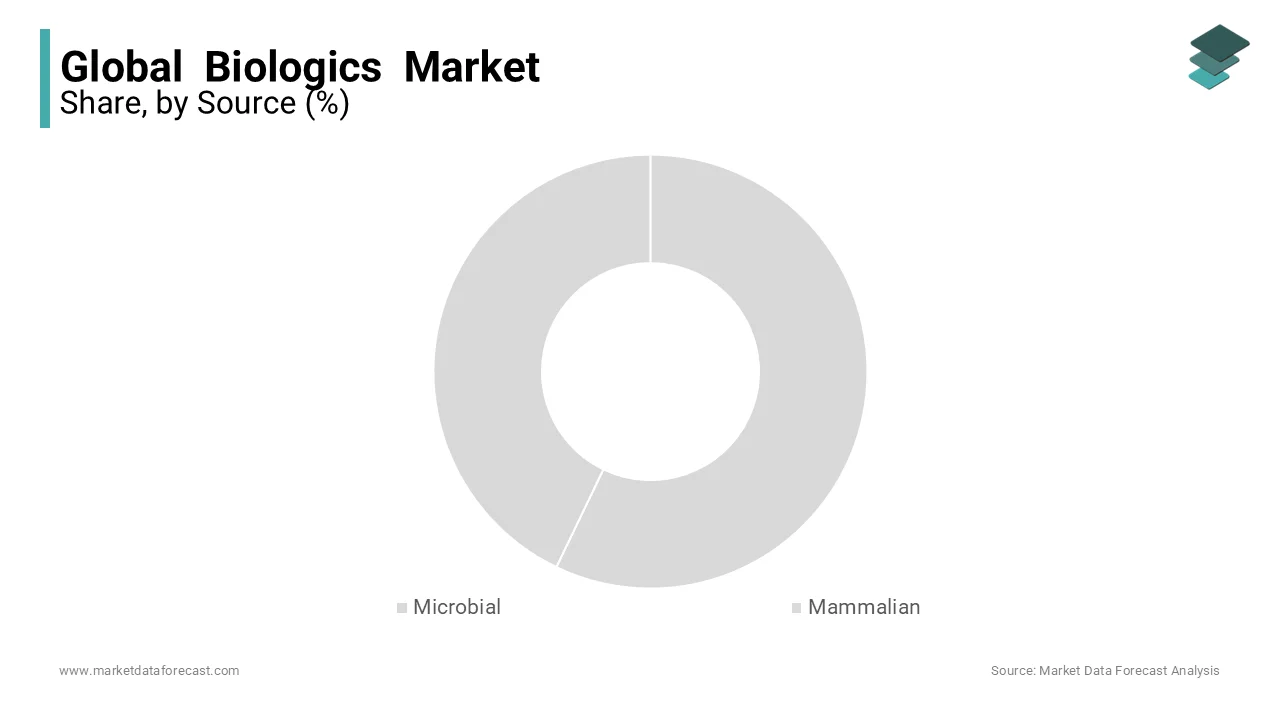
The microbial segment accounted for the largest share of the worldwide biologics market in 2025 and is expected to grow at the highest CAGR during the forecast period. This is because scientists have found various beneficial applications that can be derived from microbial source biologics.
On the other hand, the mammalian segment had a considerable share of the worldwide market in 2025 and is expected to grow at a reasonable CAGR during the forecast period. This is because scientists are doing more research in this field, and soon this source will have the same market share as microbial.
By Product Insights
The monoclonal antibodies segment dominated the biologics market in terms of share in 2025 and is expected to grow at a healthy CAGR during the forecast period, owing to their higher usage in different therapeutic areas. Monoclonal antibodies allow the targeting of unhealthy cells without harming healthy cells. These drugs benefit cancer management and treat autoimmune diseases, including rheumatoid arthritis.
The vaccines segment is anticipated to witness the fastest CAGR in the coming years, owing to its usage as a preventative tool in infectious diseases. Currently, when the world is suffering from a deadly virus, there is an immediate need for effective virus, and biologics will be a key to the development of vaccines.
By Biologics Manufacturing Insights
The in-house segment had a significant global market share in 2025. Manufacturing is a significant part of the significant steps of biologics production process and comprises a substantial share of the biologics market. It has two segments, 'Outsourced' and 'In-house' Companies, that are opting to manufacture biologics in their plants; thus, in-house dominates the market. Companies are engaged in investing in their bioprocessing capabilities. The companies are investing more in their plants to increase their commercial manufacturing capacity. The rising population has forced countries to be self-sustained, as in the case of the world pandemic, and there might be problems in supply dependent on others.
By Disease Category Insights
The oncology segment accounted for the largest share of the worldwide market in 2025 and is estimated to grow at a healthy CAGR in the coming years, owing to the rising incidence of cancer coupled with the cure for it. In addition, different R&D projects are present. These projects include gene therapies and antisense therapies for cancer eradication. Oncology also had the second-highest growth rate among all other sub-segments. The advantages of cancer therapy are significant.
The infectious disease segment held a substantial share of the global market in 2025. The increase in the negative impact of viral diseases has led to more investments in treating infectious diseases. As a result, it will soon take over the oncology sub-segment.
Immunological, cardiovascular, and hematological disorders have third, fourth, and fifth places, respectively.
REGIONAL ANALYSIS
North America Biologics Market Analysis
North America accounted for the largest share of the worldwide market in 2025. The region's domination is anticipated to continue during the forecast period owing to significant established participants in this region. In addition, the North American region has the world's 80% research in healthcare biotechnology. As a result, higher demand for products for treating diseases has increased this region's revenue share.

Europe Biologics Market Analysis
Europe held the second-largest share worldwide in 2025 and is expected to grow reasonably. The improvement in healthcare quality and the rise in disease cases have fuelled the growth in this region.
Asia Pacific Biologics Market Analysis
Asia Pacific captured the third-largest share of the worldwide market in 2025 and is expected to have the highest growth CAGR in the global market owing to the growing population and high expected population growth, which has led to more investments.
KEY MARKET PLAYERS
Some of the companies that are playing a dominating role in the global biologics market include
- Johnson & Johnson (J&J)
- F. Hoffmann-La Roche
- Bristol-Myers Squibb
- GlaxoSmithKline
- AbbVie
- Amgen
- Sanofi
- Eli Lilly and Company
- Merck & Co.
- Pfizer Inc.
GLOBAL BIOLOGICS MARKET NEWS
- In August 2019, the National Centre for Research and Development funded Euro 6.7 billion to Wroclaw-based Pure Biologics, a biotech startup, for its PureBike project. The project focused on developing an immuno-oncological drug that is useful to treat triple-negative breast cancer (TNBC).
- In September 2019, BioCare Medical LLC, a leading provider of immunohistochemistry (IHC) instrumentation and reagents, announced the launch of p16INK4a, a new mouse monoclonal antibody. It is cost-effective and shows accurate results in the evaluation of cervical biopsies.
MARKET SEGMENTATION
This research report on the global biologics market has been segmented and sub-segmented based on source, product, biologics manufacturing type, disease category, and region.
By Source
- Microbial
- Mammalian
- Others
By Product
- Monoclonal Antibodies
- Vaccines
- Recombinant Proteins
- Antisense, RNAi, & Molecular Therapy
- Others
By Biologics Manufacturing
- Outsourced
- In-house
By Disease Category
- Oncology
- Infectious Diseases
- Immunological Disorders
- Cardiovascular Disorders
- Hematological Disorders
- Others
By Region
- North America
- Europe
- Asia Pacific
- Latin America
- The Middle East and Africa