Latin America Biomass Market Size, Share, Trends, COVID-19 Impact & Growth Analysis Report – Segmented By Feed Stock (Agriculture, Waste Wood and Woody Residue, Solid Municipal Waste, Other Feedstocks),Application & Country (Mexico, Brazil, Argentina, Chile and Rest of Latin America) - Industry Analysis From 2026 to 2034
Latin America Biomass Market Size
The Latin American biomass market size was valued at USD 4571.18 million in 2025 and is anticipated to reach USD 4901.19 million in 2026 from USD 8554.29 million by 2034, growing at a CAGR of 7.21% during the forecast period from 2026 to 2034.
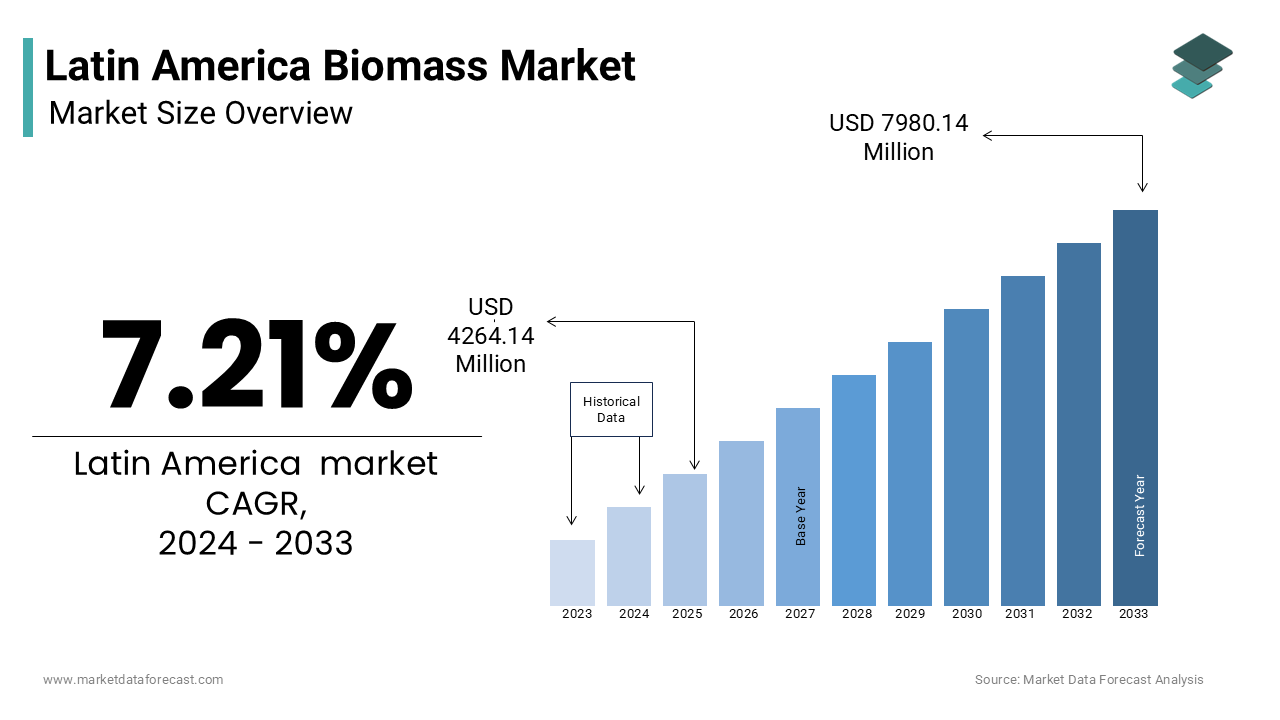
Biomass comprises organic materials such as agricultural residues, forestry waste, and municipal solid waste, which are increasingly being utilized for power generation, heat production, and biofuel development. Countries like Brazil, Argentina, Colombia, and Mexico are at the forefront of this shift, leveraging their abundant natural resources and expanding policy frameworks that support renewable energy adoption. Additionally, the region's vast sugarcane plantations, especially in Brazil, have made it a global leader in bioethanol production.
MARKET DRIVERS
Abundant Agricultural and Forestry Residues
The vast availability of agricultural and forestry residues, which serve as key feedstocks for energy production is prominently propelling the growth of the Latin America biomass market. The region’s agrarian economies generate significant quantities of organic waste from crops such as sugarcane, soybean, corn, and palm oil, offering a sustainable and low-cost resource for biomass conversion. According to the Food and Agriculture Organization (FAO), Latin America produces over 700 million metric tons of agricultural residues annually, much of which remains underutilized. In addition to agriculture, the forestry industry in countries like Chile and Argentina generates substantial wood processing waste, which is increasingly being repurposed for thermal and electrical applications.
Government Support and Renewable Energy Policies
Government backing through favorable policies and regulatory frameworks is another critical factor propelling the Latin America biomass market. Several national governments have introduced mandates, subsidies, and tax incentives aimed at promoting renewable energy sources, including biomass, as part of broader climate action strategies. Brazil leads the way with its RenovaBio program, launched in 2020, which aims to increase the share of biofuels in the national transport matrix by setting annual carbon reduction goals and issuing tradable credits to producers. Similarly, Argentina has introduced Law 27.669, mandating that at least 20% of electricity generated by 2030 must come from non-conventional renewables, including biomass.
MARKET RESTRAINTS
Limited Access to Financing and Investment
The limited availability of financing and investment for small-scale and independent biomass projects is slowly hindering the growth of the Latin America biomass market. Many biomass ventures struggle to secure capital due to perceived risks associated with technology viability, fluctuating feedstock prices, and regulatory uncertainty. Moreover, in countries with volatile macroeconomic conditions, such as Argentina and Ecuador, currency fluctuations and inflation further deter long-term investment in biomass energy.
Inadequate Feedstock Supply Chain Infrastructure
Also, the lack of a well-developed feedstock supply chain infrastructure is impeding the growth of the Latin America biomass market. According to the Food and Agriculture Organization (FAO), approximately 30% of agricultural residues remain uncollected or improperly managed, which is limiting their utilization in energy applications. In rural regions, where much of the biomass potential lies, poor road connectivity and outdated storage facilities result in high transportation costs and material degradation. Furthermore, there is a lack of standardized protocols for biomass procurement by making it difficult for energy producers to ensure a consistent and reliable supply.
MARKET OPPORTUNITIES
Expansion of Biogas and Waste-to-Energy Projects
The growing interest in biogas and waste-to-energy initiatives in urban and industrial settings shall create huge growth opportunities for the Latin America biomass market in the next coming years. As the increasing municipal solid waste generation and rising concerns over landfill emissions, several cities are exploring anaerobic digestion and gasification technologies to convert organic waste into usable energy. Cities like Bogotá, São Paulo, and Santiago have already initiated pilot programs to harness landfill gas and wastewater treatment plant biogas for electricity and heating applications. The Pan American Health Organization (PAHO) noted in 2023 that if fully implemented, these initiatives could reduce methane emissions by up to 30 million metric tons of CO₂ equivalent annually by aligning with regional climate commitments. Moreover, industrial sectors such as food processing, dairy, and brewing are adopting on-site biogas systems to meet energy demands while reducing disposal costs.
Integration of Biomass with Existing Agro-Industrial Operations
The integration of biomass energy systems with existing agro-industrial operations is enabling more efficient resource utilization and reducing dependency on fossil fuels which is to promote new opportunities for the Latin America biomass market. Many large-scale agricultural enterprises, particularly in the sugarcane, palm oil, and soybean sectors, generate surplus organic waste that can be converted into energy through cogeneration or direct combustion. Brazil has been a pioneer in this regard, where sugarcane mills use bagasse to produce steam and electricity, meeting internal energy needs and feeding excess power into the national grid. Similarly, in Argentina and Colombia, palm oil and rice husk producers are exploring biomass-based boilers and gasifiers to replace diesel generators. The Latin American Biomass Association (LABIO) noted in 2023 that such hybrid energy models are gaining traction due to declining equipment costs and improved financing options.
MARKET CHALLENGES
Competition with Other Renewable Energy Sources
The increasing competition from other renewable energy sources like wind and solar, which are receiving greater policy and investment attention is certainly to pose new opportunities for the Latin America biomass market. Governments and investors tend to favor these technologies due to their scalability, lower operational complexity, and faster deployment timelines. According to the International Renewable Energy Agency (IRENA), in 2023, wind and solar together accounted for over 60% of new renewable capacity additions in Latin America when compared to just 15% for biomass. Additionally, financial institutions and multilateral lenders are directing a larger share of green financing towards intermittent renewables, citing higher efficiency rates and clearer return-on-investment metrics.
Environmental and Land Use Concerns
Environmental and land use concerns pose a significant challenge to the Latin America biomass market, particularly regarding deforestation, biodiversity loss, and the ethical implications of using agricultural land for energy production. As demand for biomass feedstock increases, there is growing scrutiny over whether large-scale cultivation of energy crops could compete with food production or lead to unsustainable land conversion. According to the United Nations Environment Programme (UNEP), approximately 2.6 million hectares of forest were lost annually in Latin America between 2010 and 2020 with some attributed to biomass-related activities. Moreover, the European Union’s updated Renewable Energy Directive (RED III) now imposes tighter sustainability thresholds for imported biomass and biofuels, potentially affecting Latin American exports.
SEGMENTAL ANALYSIS
By Feedstock Insights
The agricultural waste segment was the largest and held 45.3% of the Latin America biomass market share in 2024 with the region’s strong agricultural base, which produces vast quantities of organic residues from crops such as sugarcane, corn, soybean, and rice. Brazil contributes significantly through its extensive sugarcane industry, generating millions of tons of bagasse annually. Additionally, government incentives aimed at promoting circular economy practices are encouraging agro-industrial firms to convert waste into energy. The Brazilian Ministry of Mines and Energy noted that in 2023, over 60% of bioelectricity generated in the country came from sugarcane biomass, which is demonstrating the economic and environmental viability of agricultural waste-based energy systems.
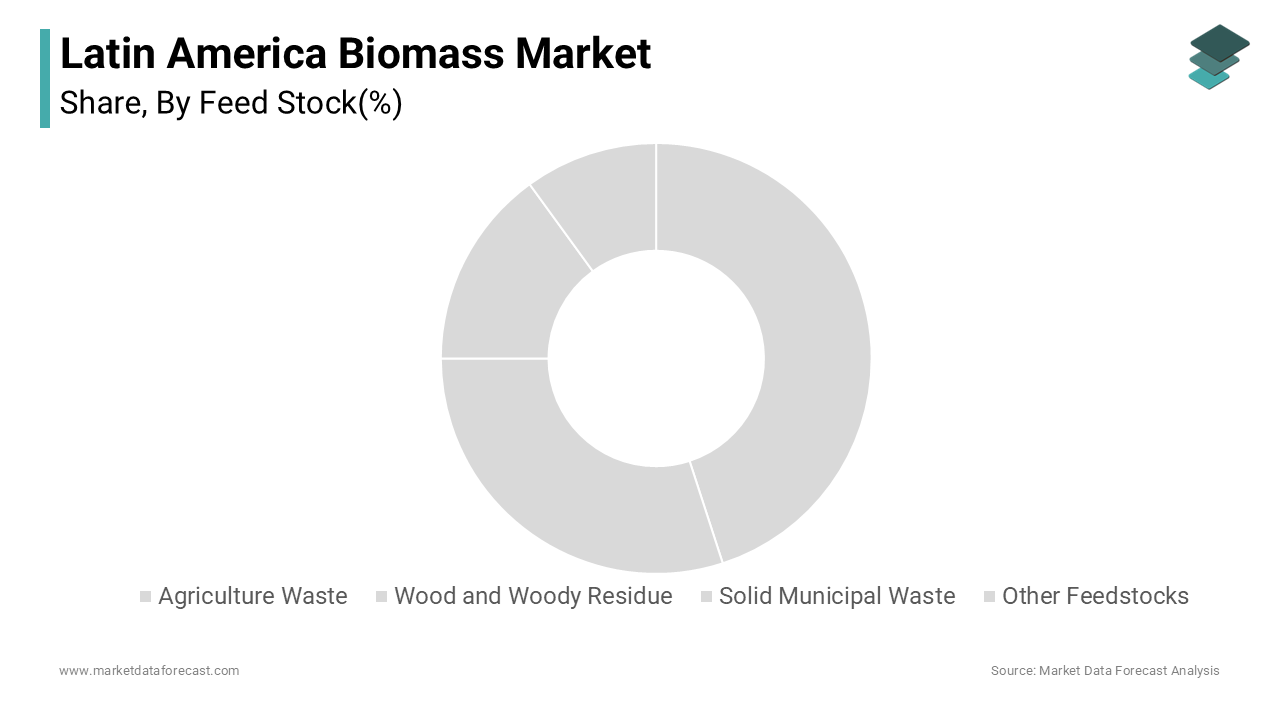
The solid municipal waste (SMW) segment is likely to grow with an expected CAGR of 8.9% in the next coming years. According to the World Bank’s What a Waste 2.0 report, Latin America generates over 220 million metric tons of municipal solid waste annually, with only about 20% being processed in controlled environments. The growing emphasis on waste valorization converting organic components into biogas or electricity is driving investment in anaerobic digestion and gasification technologies. Moreover, cities like Bogotá, São Paulo, and Santiago have launched initiatives to harness landfill gas and develop modern waste treatment facilities. According to the Pan American Health Organization (PAHO) in 2023, these initiatives could reduce methane emissions by up to 30 million metric tons CO₂ equivalent annually, which is aligning with regional climate goals.
By Application Insights
The power generation segment was accounted in holding 58.2% of the Latin America biomass market share in 2024 with the expansion of cogeneration plants in the agro-industrial sector in Brazil. The Brazilian Sugarcane Industry Association (UNICA) stated that in 2023, over 80 sugar mills were exporting surplus electricity derived from sugarcane bagasse, which is significantly contributing to grid stability and rural electrification. Additionally, government-backed renewable energy programs such as Brazil’s RenovaBio have incentivized biomass-based electricity production by reinforcing its role in the energy mix. Another contributing factor is the growing deployment of biogas and waste-to-energy plants, particularly in urban centers. According to the Latin American Biogas Association (LABIO), more than 200 new biogas plants were commissioned across the region in 2023, many of which supplied electricity to local grids.
The heating application segment is lucratively growing with an anticipated CAGR of 7.6% during the forecast period. The growth of the segment is attributed to be driven by the cost-effectiveness of biomass-based heating compared to fossil fuels in rural and semi-urban areas. Furthermore, governments across the region are promoting biomass for district heating systems, particularly in colder regions of Argentina and Chile. In addition, improved access to financing and technical support has enabled small and medium enterprises (SMEs) to transition to biomass heating.
REGIONAL ANALYSIS
Brazil was the top performer in the Latin America biomass market by capturing 42.3% of share in 2024 due to its massive sugarcane industry, which supplies millions of tons of bagasse annually for cogeneration in sugar and ethanol mills. Additionally, Brazil leads in bioethanol production, with the Ministry of Mines and Energy noting that domestic ethanol output exceeded 35 billion liters in 2023, largely fueled by the RenovaBio program designed to reduce carbon emissions from transportation.
Mexico was next with 18.3% of the Latin America biomass market share in 2024 with the increasing use of biomass in the agro-industrial sector, particularly in food processing and textile manufacturing, where companies are adopting biomass boilers to reduce energy costs. Additionally, Mexico is expanding its biogas and waste-to-energy initiatives in urban centers like Mexico City and Guadalajara. Government incentives such as the Clean Energy Certificates (CELs) system have further encouraged investment in biomass-based power generation.
Argentina biomass market growth is driven by its strong agro-industrial base and growing interest in renewable energy to drive biomass utilization across multiple sectors. Additionally, Argentina benefits from abundant crop residues from soybean and wheat production, which serve as viable feedstocks for biomass energy. Moreover, the passage of Law 27.669 in 2022, mandating that at least 20% of electricity come from non-conventional renewables by 2030, has spurred investment in biomass-based power generation.The
Chile biomass market is likely to grow with a stable regulatory environment and a growing emphasis on diversifying its energy matrix beyond intermittent renewables. Additionally, Chile is increasingly investing in district heating systems powered by biomass, especially in southern regions where winters are harsh. Moreover, the country’s participation in international sustainability agreements, including the European Union’s Renewable Energy Directive (RED III), has led to greater scrutiny of biomass sourcing and certification processes.
COMPETITIVE LANDSCAPE
The competition in the Latin America biomass market is intensifying as both global and regional players seek to capitalize on the region’s abundant organic resources and growing emphasis on renewable energy. While traditional energy providers are integrating biomass into their portfolios, specialized firms focused exclusively on bioenergy are emerging as strong contenders. Key players are increasingly differentiating themselves through technological advancements, localized feedstock utilization, and tailored financing models that support small and medium-sized enterprises. Collaboration between industry stakeholders, research institutions, and policymakers is becoming essential to drive standardization and scalability.
KEY MARKET PLAYERS
Key players operating in the Latin America biomass market include
- Enel Green Power
- Veolia
- Green Energy Brazil
- Grupo Neoelectra
- Abengoa Bioenergy
- Raízen
- Cosan Biomassa
- BP Bunge Bioenergia
Top Players in the Latin America Biomass Market
One of the leading players in the Latin America biomass market is Raízen, a Brazilian energy company formed through the merger of Shell’s biofuels division and Cosan. Raízen plays a pivotal role in the sugarcane-based ethanol and biomass power generation sector, operating one of the largest fleets of sugar mills equipped with cogeneration systems. Its extensive supply chain and integration with agricultural production have made it a key contributor to Brazil’s renewable energy landscape.
Another major player is Enel Green Power, an Italian multinational active across several Latin American countries including Chile, Mexico, and Argentina. The company has been expanding its portfolio of biomass-fueled power plants, leveraging both agricultural and forestry residues. Enel's focus on clean energy diversification and sustainability aligns with regional decarbonization goals, reinforcing its influence in the biomass space.
Grupo GEA is also a significant participant in Argentina and Colombia. Grupo GEA supports industrial clients in transitioning from fossil fuels to biomass-based thermal and electrical systems as a leader in biogas technology and waste-to-energy solutions. Its technical expertise and project execution capabilities make it a strategic actor in advancing biomass adoption across the region.
Top Strategies Used by Key Market Participants
A primary strategy employed by key players in the Latin America biomass market is vertical integration, wherein companies control multiple stages of the biomass value chain from feedstock sourcing to energy generation and distribution. This approach enhances cost efficiency, ensures feedstock availability, and reduces dependency on external suppliers.
Another widely adopted strategy is technology innovation and localization, where firms invest in adapting biomass conversion technologies to local conditions. Companies are customizing gasifiers, anaerobic digesters, and cogeneration units to better suit regional feedstocks such as sugarcane bagasse, palm fiber, and municipal solid waste.
Forming strategic partnerships with agro-industrial operators has become crucial for biomass companies aiming to scale operations. Biomass firms gain direct access to organic waste streams by enabling continuous and sustainable energy production while supporting circular economy principles.
RECENT MARKET DEVELOPMENTS
- In March 2024, Raízen announced a new investment plan to expand its biomass cogeneration capacity across its sugar and ethanol mills in Brazil, which is aiming to increase internal energy self-sufficiency and contribute surplus electricity to the national grid.
- In July 2023, Enel Green Power inaugurated a new biomass-fueled power plant in northern Argentina by utilizing agricultural waste from nearby farming cooperatives to generate clean electricity and support rural electrification efforts.
- In November 2023, Grupo GEA signed a partnership agreement with a Colombian dairy cooperative to install a biogas system that converts livestock manure into renewable thermal energy by reducing operational costs and greenhouse gas emissions.
- In January 2024, BioEnergy International launched a pilot project in Chile to test the feasibility of using forest residues for district heating in cold-weather municipalities, which is marking a step toward scalable decentralized biomass solutions.
- In May 2023, Soluciones Energéticas Sustentables (SES) entered into a joint venture with a Mexican municipal authority to develop a landfill gas capture facility in Guadalajara by converting solid waste into usable energy for urban infrastructure needs.
MARKET SEGMENTATION
This research report on the Latin America biomass market is segmented and sub-segmented into the following categories.
By Feedstock
- Agriculture Waste
- Wood and Woody Residue
- Solid Municipal Waste
- Other Feedstocks
By Application
- Power Generation
- Heating
- Other Applications
By Country
- Mexico
- Brazil
- Argentina
- Chile
- Rest of Latin America
Frequently Asked Questions
What factors are driving the growth of the Latin America Biomass Market?
Key drivers of the Latin America Biomass Market include rising energy demand, government incentives for renewable energy, abundant agricultural waste, and growing environmental awareness.
What are the main applications of biomass in the Latin America Biomass Market?
The main applications in the Latin America Biomass Market include electricity generation, industrial heating, residential heating, and the production of biofuels like biodiesel and ethanol.
What are the challenges facing the Latin America Biomass Market?
Challenges in the Latin America Biomass Market include inconsistent biomass supply, lack of infrastructure, regulatory hurdles, and competition from other renewables like solar and wind.
What is the future outlook for the Latin America Biomass Market?
The Latin America Biomass Market is expected to grow steadily over the next decade due to policy support, sustainability goals, and increased investments in renewable energy.
Related Reports
Access the study in MULTIPLE FORMATS
Purchase options starting from
$ 1600
Didn’t find what you’re looking for?
TALK TO OUR ANALYST TEAM
Need something within your budget?
NO WORRIES! WE GOT YOU COVERED!
Call us on: +1 888 702 9696 (U.S Toll Free)
Write to us: sales@marketdataforecast.com